



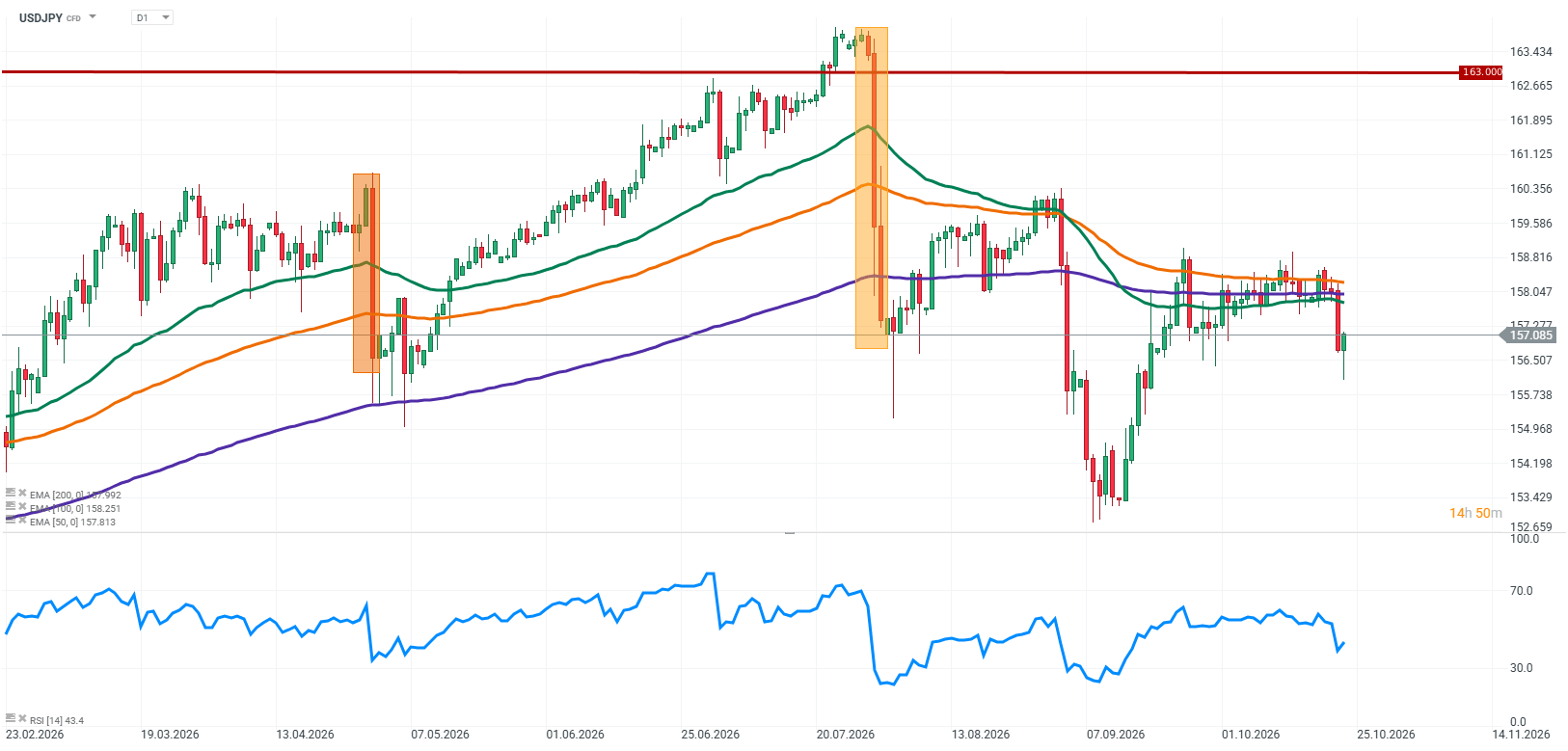
USDJPY remains below the 160 level, which has become one of the most important reference points for the market in recent months. The yen is receiving increasing support from expectations surrounding Bank of Japan (BoJ) policy, while the latest inflation data suggest that price pressures in Japan are picking up again. However, this does not necessarily mean that a sustained strengthening of the yen is now within reach.
September’s inflation figures from Japan sent an important signal to the market. Core inflation rose to 2.1% year-on-year, up from 1.7% in August, moving back above the Bank of Japan’s 2% target. Even more notable was underlying inflation excluding food and energy, which accelerated to 2.4% from 1.9%, exceeding expectations. This second measure strengthens the case for further monetary policy normalisation in Japan.
As a result, the market is increasingly focused on the possibility of another BoJ rate hike, most likely in December. At the same time, the other side of the equation cannot be ignored: the United States. Inflation remains a global concern, and persistent price pressures could limit the Fed’s room for manoeuvre. For USDJPY, this means that the next move will depend not only on how quickly Japan raises interest rates, but also on whether the US central bank needs to maintain a restrictive stance for longer than the market currently expects.
Source: XTB Research
Key factors currently shaping USDJPY
Inflation in Japan moves back above the BoJ’s target
The latest inflation data from Japan strengthen the case for continued monetary policy normalisation. Headline CPI rose to 2.1% year-on-year in September, compared with 1.9% in the previous month. The same reading was recorded for core inflation, which excludes fresh food.
However, the most important signal comes from the measure excluding both food and energy. This indicator rose to 2.4% from 1.9%, exceeding the forecast of 2.3%. This matters because it provides a clearer picture of whether price pressures are persisting beyond the most volatile components of the inflation basket.
Another important development is the acceleration in goods and services prices. Goods inflation rose to 2.8%, while services inflation reached 1.5% year-on-year. This does not necessarily mean that price pressures are equally strong across the entire economy, but it suggests that the problem is not limited to a single component of the inflation basket.
For the Bank of Japan, this represents an important shift. For years, one of the biggest challenges facing the Japanese economy was persistently low inflation. The central bank must now pay closer attention to the risk of price pressures becoming entrenched, particularly as a weak yen raises import costs and higher energy prices could add further inflationary pressure.
Markets are increasingly pricing in another rate hike
Expectations surrounding the BoJ’s next moves remain one of the most important drivers for the yen. Following September’s rate hike to 1.25%, markets are increasingly pointing to December as the most likely timing for the next move. A further increase to 1.50% has become a meaningful scenario for investors, although the final decision will depend on incoming data and the central bank’s communication.
The BoJ’s next meeting, scheduled for October 29–30, could be particularly important because of the updated economic projections and signals regarding the future path of interest rates. Leaving rates unchanged would not necessarily be negative for the yen if the central bank simultaneously indicates that a December hike remains a realistic possibility.
On the other hand, inflation alone does not guarantee rapid monetary tightening. The BoJ must also consider the state of the economy, labour market conditions and the resilience of domestic demand. If policymakers conclude that rising prices are driven primarily by higher energy costs and import prices, they may remain more cautious.
For the currency market, the key question is therefore not simply whether the BoJ will raise rates, but also what path for future decisions it signals. The stronger the conviction that further hikes are coming, the greater the potential for sustained support for the yen.
The 160 level remains a key reference point
USDJPY remains below 160, and the market must continue to account for the risk of intervention by Japanese authorities. In recent weeks, the pair has traded in a range of approximately 157–159, suggesting that investors remain cautious about pushing the yen into another sustained period of weakness.
The 160 level is significant both psychologically and fundamentally. Further yen depreciation raises import costs, potentially adding to inflationary pressure in Japan. At the same time, sharp currency moves could increase the likelihood of a response from the authorities.
However, this does not mean that 160 represents an insurmountable barrier. Intervention can trigger a rapid appreciation of the yen, but without a change in underlying market conditions, its effects may prove short-lived.
The current situation is particularly interesting because the yen may be receiving support from two directions: rising expectations of further BoJ rate hikes and the risk of intervention. A more sustained decline in USDJPY, however, would require confirmation that the expected interest rate paths of Japan and the United States are genuinely beginning to converge.
Inflation is not just Japan’s problem. The Fed remains under pressure too
When analysing USDJPY, it is easy to focus exclusively on Japanese inflation and expectations surrounding the BoJ. However, the dollar remains the other side of the equation, and developments in the United States could be just as important for the pair’s next move.
Inflationary pressure is not limited to Japan. Higher energy prices and the risk of elevated costs persisting mean that central banks around the world must remain cautious. For the Fed, this creates the risk that persistent inflation will limit its ability to ease monetary policy.
However, it would be premature to assume that higher inflation will automatically lead to further US rate hikes. The Federal Reserve must balance the risk of rising prices against labour market conditions and the outlook for economic growth. Markets will therefore focus not only on inflation readings themselves, but also on whether price pressures are persistent enough to justify a more restrictive policy stance.
Recent moves in the US bond market illustrate just how complicated this relationship has become. The yield on 10-year US Treasuries fell by approximately 13.5 basis points on October 22, moving closer to the 5% level. The decline was linked, among other factors, to growing concerns about the economic outlook and demand for safe-haven assets. At the same time, markets scaled back expectations for further Fed rate hikes in the near term.
This is an important signal for USDJPY. If US Treasury yields continue to fall while the BoJ prepares markets for further rate increases, the yen could gain room to appreciate. However, if US inflation surprises to the upside again and the Fed signals that monetary policy will remain restrictive for longer, the dollar could regain the upper hand.
The policy gap between the BoJ and the Fed remains crucial
The relationship between monetary policy in Japan and the United States remains the most important fundamental driver of USDJPY.
On the Japanese side, core inflation is above target, expectations for another rate hike are increasing, and further monetary policy normalisation remains a possibility. The US picture is more complicated. Inflation could limit the scope for rate cuts, while a deterioration in the economic outlook could simultaneously lead markets to lower their expectations for future interest rates.
A favourable scenario for the yen would involve the BoJ continuing to raise rates while the Fed keeps rates unchanged or gradually begins easing policy. In this case, the interest rate differential between the two countries would narrow over time, reducing the appeal of strategies that involve borrowing in a lower-yielding currency such as the yen to invest in higher-yielding assets elsewhere.
A much less favourable scenario would emerge if US inflation remained persistent, the Fed maintained a restrictive stance and the BoJ limited itself to occasional rate increases. Under those circumstances, an improvement in the yen’s outlook might not be enough to establish a sustained downtrend in USDJPY.
It is also worth remembering that markets price in the future, not just current central bank decisions. If a December BoJ rate hike is already largely priced in, an increase of 25 basis points alone may not trigger a significant reaction. What could matter more is whether the central bank signals further hikes in 2027.
USDJPY awaits its next catalyst
Japan’s latest inflation figures strengthen the case for further monetary tightening and provide a basis for continued support for the yen. Particularly important is the increase in underlying inflation excluding food and energy to 2.4%, pointing to stronger price pressures than the headline CPI figure alone might suggest.
At the same time, USDJPY remains below 160, and the market must account for both the possibility of intervention and changing expectations surrounding BoJ policy. This is not yet sufficient evidence, however, to conclude that the broader trend has definitively reversed.
Over the coming days, particular attention will focus on the Bank of Japan’s communication at its October 29–30 meeting, movements in US Treasury yields and further signals regarding inflation and the health of the US economy.
If the BoJ more clearly opens the door to a December rate hike while US yields remain under pressure, USDJPY could extend its decline. If US data instead strengthen expectations that the Fed will keep interest rates elevated, the dollar could regain ground.
The key question is therefore no longer simply whether Japanese inflation is high enough to justify another rate hike. Markets are increasingly considering that possibility. What matters now is whether the BoJ’s changing stance will be strong enough to erode the dollar’s advantage, and whether Fed policy will become another factor sustaining pressure on the yen.


BREAKING: France slows down, Germany holds on. Euro falls below 1.12



Macro Calendar: Preliminary PMI Readings and Earnings Ahead



Morning Wrap: AI profitability concerns spark market Sell-Off



Daily Summary: Valuations Under Pressure, Capital Moves Away From Technology
The material on this page does not constitute as financial advice and does not take into account your level of understanding, investment objectives, financial situation or any other particular needs.
All the information provided, including opinions, market research, mathematical results and technical analyses published on the website or transmitted to you by other means is provided for information purposes only and should in no event be interpreted as an offer of, or solicitation for, a transaction in any financial instrument, nor should the information provided be construed as advice of legal or fiscal nature.
Any investment decisions you make shall be based exclusively on your level of understanding, investment objectives, financial situation or any other particular needs. Any decision to act on information published on the website or transmitted to you by other means is entirely at your own risk. You are solely responsible for such decisions.
If you are in doubt or are not sure that you understand a particular product, instrument, service, or transaction, you should seek professional or legal advice before trading.
Investing in OTC Derivatives carries a high degree of risk, as they are leveraged based products and often small movements in the market could lead to much larger movements in the value of your investment and this could work against you or for you. Please ensure that you fully understand the risks involved, taking into account your investments objectives and level of experience, before trading, and if necessary, seek independent advice.