



The main driver of volatility. The day was dominated by a sharp drop in oil prices, which fell by more than 7 percent on the back of hopes for a diplomatic resolution to the conflict between the U.S. and Iran. Falling oil prices removed some of the geopolitical risk premium from the market and improved sentiment across the broader market, encouraging investors to return to cyclical sectors. In the background, however, lingering nervousness surrounding the AI sector persisted following a weak October. Investors were also bracing for an exceptionally busy week, featuring a special election, labor market data, and earnings reports from more tech companies.
Geopolitics. Key developments included signs of a thaw in U.S.-Iranian relations, as Secretary of State Marco Rubio emphasized that President Trump had not decided to launch an attack and would prefer to resolve the conflict peacefully. The Iranian side signaled its readiness for dialogue, and President Pezeshkian indicated that the government had received the necessary authorization from the Supreme Leader to conduct talks. The market had previously priced in the risk of military escalation following the elections, so the mere headlines about negotiations caused commodity prices to plummet. On Tuesday, U.S. midterm elections will take place, in which the Democrats are favored to take control of the House of Representatives, while the outcome of the Senate race remains uncertain.
Macroeconomic data. The October ISM Manufacturing Index for the U.S. rose to 55.5 points from 54.5, clearly beating expectations of 54.5 and signaling an acceleration in manufacturing activity. According to the report, production and inventories rose, while the prices subindex weakened to 75.2 points, signaling a slight easing of cost pressures. In Europe, the eurozone manufacturing PMI fell slightly to 52.7 points but remained above the expansion threshold. Market attention is now focused on Friday’s U.S. jobs report and this week’s decisions by major central banks.
Indices. On Wall Street, the Dow Jones stood out with a gain of about 0.9 percent, while the S&P 500 and Nasdaq each rose about 0.3 percent, held back by weakness in the technology sector. Capital flowed into cyclical stocks, with the consumer discretionary sector gaining about 3 percent and the financials, industrials, and materials sectors also performing strongly. In Europe, the broad STOXX 600 rose slightly, supported by lower commodity prices and a rebound following Friday’s sell-off. In the CFD markets, European and Asian indices posted the strongest gains, with Spain’s SPA35 up 2.08 percent and Japan’s JP225 up 1.24 percent, while the U.S. US100 and Poland’s W20 remained slightly in the red.
Stocks. The tech sector came under pressure following the announcement of Marvell’s acquisition of Lumentum in a deal worth $115 billion, after which Marvell fell about 10 percent and Lumentum as much as 15 percent. Oracle also saw a sharp decline, falling about 6 percent following news of plans to raise $10 billion through a stock offering and another $10 billion through bonds to finance investments in AI. Attention was drawn to Anthropic’s updated prospectus, which showed approximately $17 billion in revenue for the third quarter, but also massive infrastructure commitments. After the market closed, Apple released its earnings, amid growing nervousness surrounding the company, as evidenced by increased demand for put options.
Currencies. The foreign exchange market remained relatively calm, with the dollar under slight pressure as the index fell to around 101.6 points. The euro recouped some of its losses and rose to around 1.119, despite lingering concerns about French public finances and social tensions in France. The Japanese yen remained weak against the dollar, trading around 158. On the zloty market, the Polish currency strengthened, with the USDPLN pair falling by 0.29 percent, while the EURPLN pair rose slightly.
Commodities. The day was marked by a sharp drop in oil prices, which fell by more than 7 percent following reports of a possible agreement between the U.S. and Iran and the unwinding of part of the geopolitical premium. In the CFD markets, Brent crude fell 7.76 percent and U.S. WTI fell 6.53 percent, while European natural gas plunged even further, by nearly 9 percent. Precious metals moved in the opposite direction, benefiting from a weaker dollar and demand for safe-haven assets, with silver gaining 3.12 percent and gold rising 2.07 percent to around $3,953 per ounce. This pattern shows a clear rotation away from energy commodities and toward metals.
Cryptocurrencies. Weakness persisted in the digital asset market, reflecting a cautious approach to risk in the technology sector. Bitcoin fell about 1.2 percent, slipping to around $76,700. The sell-off was part of broader pressure—which has been ongoing for several weeks—on sentiment-sensitive assets amid concerns about artificial intelligence and high valuations.
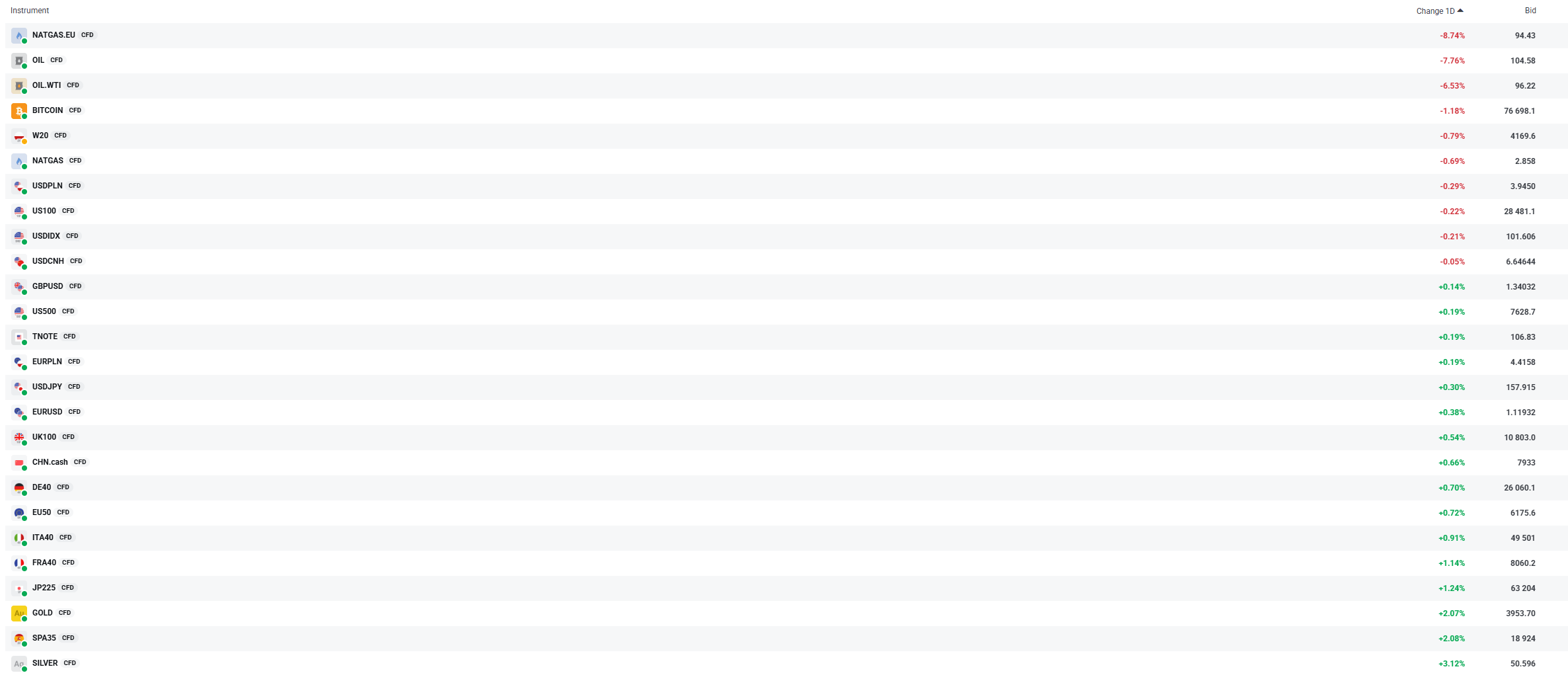
Volatility currently observed in selected, most popular instruments. Source: XTB


Gold loses almost 1% 📉

Chart of the Day: Nasdaq 100 Slips Into Correction 📉 AI Rally Loses Steam - What’s Next for US100? (03.11.2026)


Economic Calendar: US Midterms, JOLTS and Factory Orders Take Center Stage (03.11.2026)


Morning wrap: Stock Indices Fall Again 🚩 Oil Tries To Rebound Following US Strike on Iran’s Qeshm Island (03.11.2026)
The material on this page does not constitute as financial advice and does not take into account your level of understanding, investment objectives, financial situation or any other particular needs.
All the information provided, including opinions, market research, mathematical results and technical analyses published on the website or transmitted to you by other means is provided for information purposes only and should in no event be interpreted as an offer of, or solicitation for, a transaction in any financial instrument, nor should the information provided be construed as advice of legal or fiscal nature.
Any investment decisions you make shall be based exclusively on your level of understanding, investment objectives, financial situation or any other particular needs. Any decision to act on information published on the website or transmitted to you by other means is entirely at your own risk. You are solely responsible for such decisions.
If you are in doubt or are not sure that you understand a particular product, instrument, service, or transaction, you should seek professional or legal advice before trading.
Investing in OTC Derivatives carries a high degree of risk, as they are leveraged based products and often small movements in the market could lead to much larger movements in the value of your investment and this could work against you or for you. Please ensure that you fully understand the risks involved, taking into account your investments objectives and level of experience, before trading, and if necessary, seek independent advice.