


The Dollar Index (USDIDX) has halted its recent slide and resumed the uptrend following comments from Israel's Defense Minister. Israel Katz stated that the country is prepared to resume strikes on Iran and is currently "waiting for a green light from the United States."
In addition to the safe-haven demand sparked by fears of a Middle East escalation, the greenback received a significant boost from the latest PMI data. The reports indicate a record rebound in US business activity, reinforcing the "higher-for-longer" narrative for interest rates.
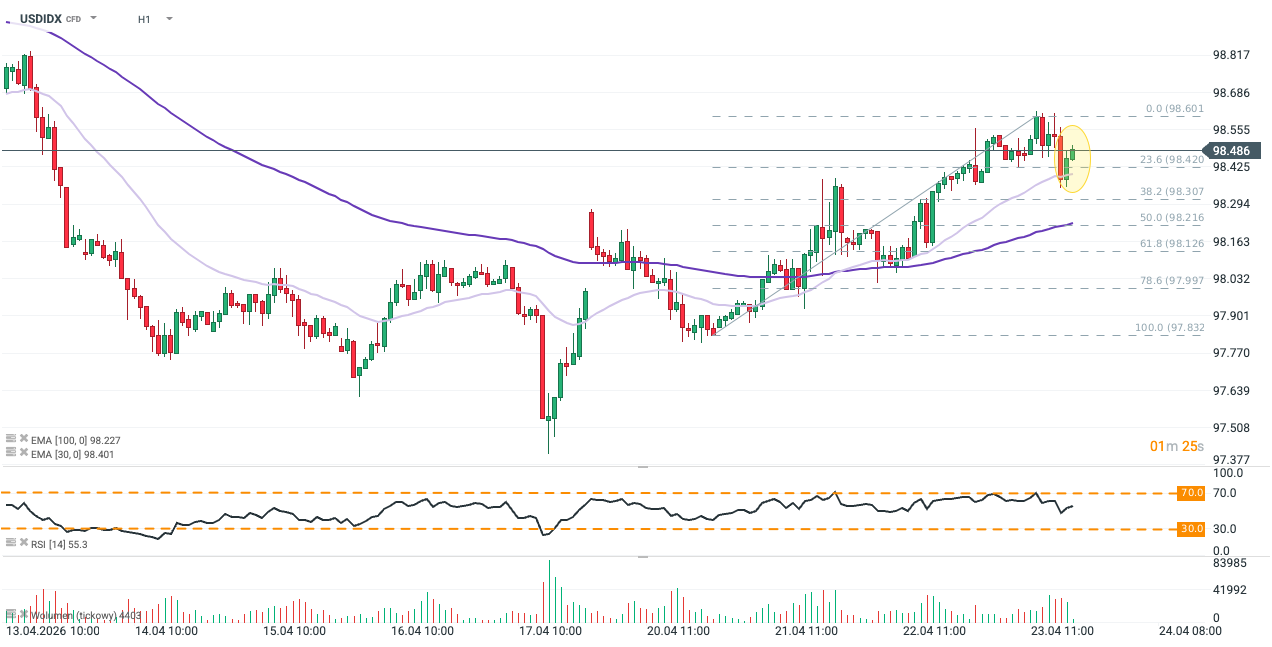
USDIDX successfully bounced off the EMA30 on the H1 (one-hour) interval. Source: xStation5
Inflationary Shadows in the PMI Data
The PMI indices exceeded expectations in both the services and manufacturing sectors. However, the internal details offer a "hawkish" sting: strong contributions from price sub-indices—covering both input costs and final product prices—have raised alarms about inflationary pressure bleeding into the wider economy. This data suggests a more hawkish stance from the Federal Reserve, potentially slashing the odds of significant interest rate cuts in 2026.
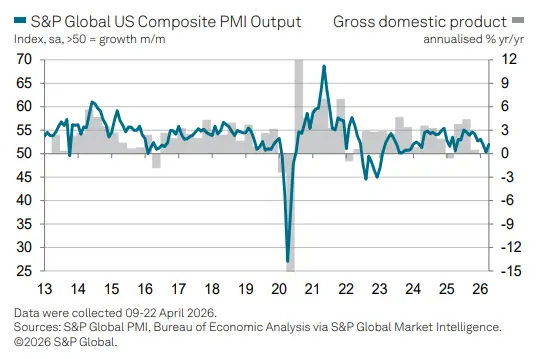
S&P Global Insight: The US private sector is firmly back in expansion territory. Source: S&P Global
Currency Reactions: Emerging Markets vs. G10
The dollar’s strength is being felt most acutely across Emerging Markets (EM), for example:
-
Hungarian Forint (USDHUF): +0.5%
-
Indian Rupee (USDINR): +0.2%
-
South African Rand (USDZAR): +0.2%
Within the G10 space, the "risk-off" sentiment is most visible in the New Zealand Dollar (NZDUSD: -0.4%), which wiped out its early-session gains, snapping a recovery streak that had lasted since the beginning of the week.
Interestingly, the Australian Dollar (AUD) is showing resilience similar to the almost flat-trading Pound, Yen and Euro (AUDUSD, EURUSD, GBPUSD: -0.05%). This is largely due to a sharp rebound in Australia’s own PMI figures, which have heightened the risk of further rate hikes by the RBA.
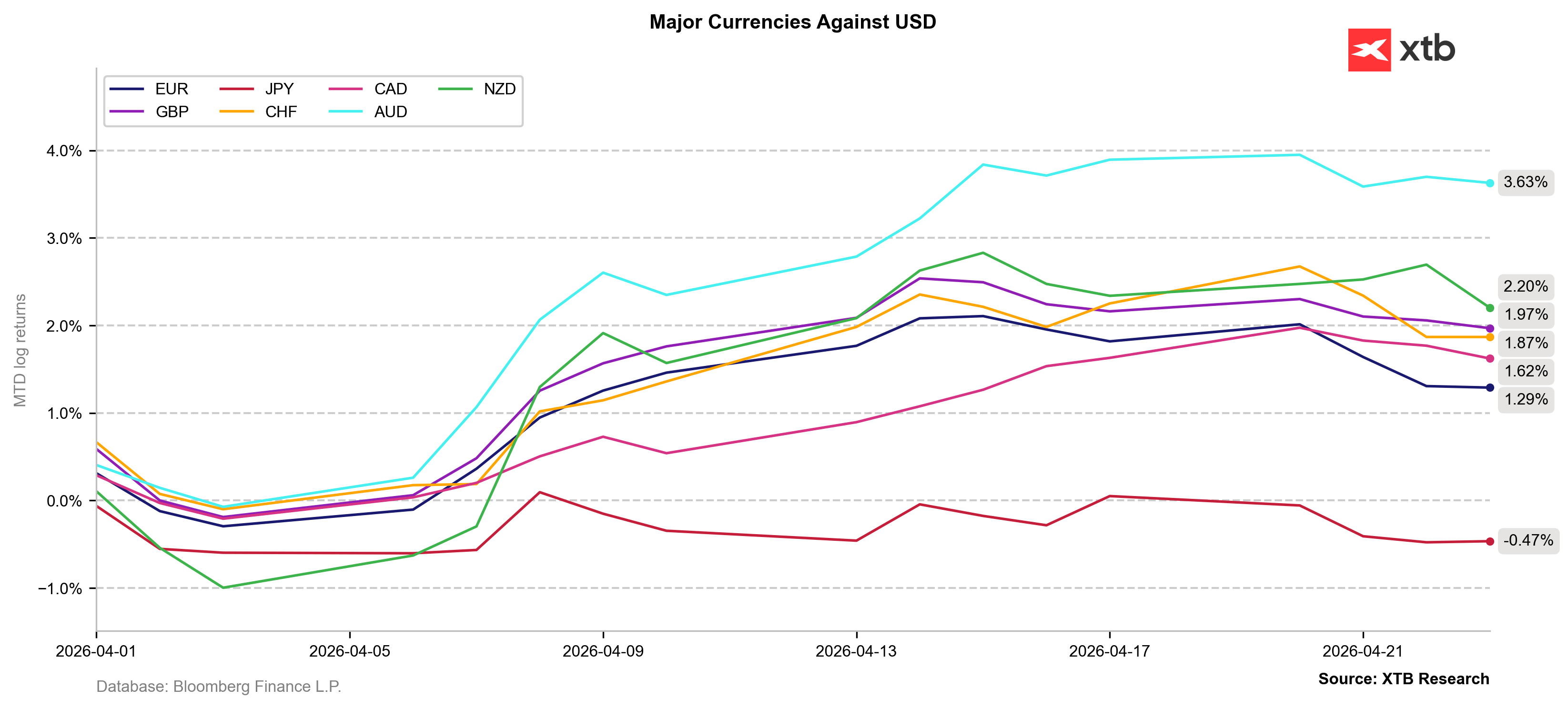
Market Context: Despite today’s pullback, the NZD has still had a relatively stronger month against the USD compared to its G10 peers. Source: XTB Research
The Norwegian Krone (NOK) Paradox
The Norwegian Krone is losing disproportionate ground today. Theoretically, the recent spike in Brent crude oil prices should support the NOK, but the bounce in USDNOK from a 4-year low suggests this weakness is purely driven by the broader "risk-off" environment rather than energy fundamentals.
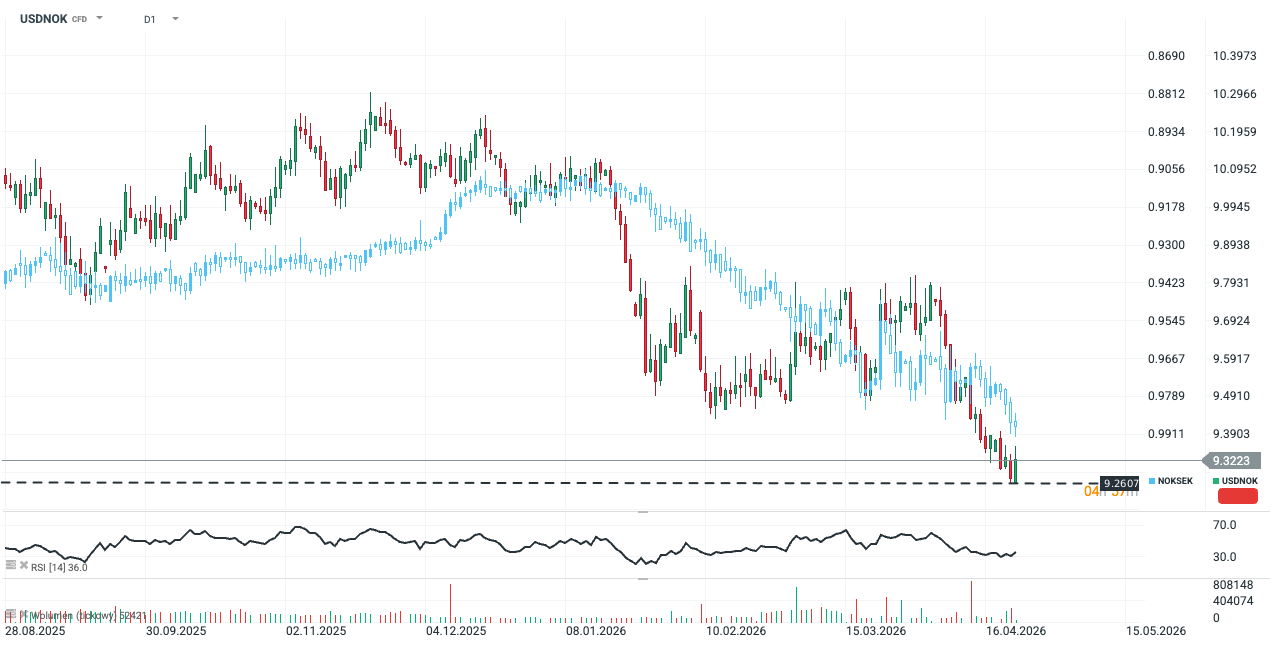
Visualizing Risk-Off: The flight to safety is particularly clear when comparing the surge in USDNOK against the gains in NOKSEK, consistent with gains in the OIL futures. Source: xStation5



Daily summary: Wall Street climbs higher as oil falls 📈 SpaceX surges 28%


Oil slides 2.5% to $88 as Middle East tensions ease 📉 Is the uptrend over?



Wall Street Rebounds as Oil Prices Fall 📈 Adobe Shares Drop 8% After Earnings


BREAKING: USDIDX decline despite strong University of Michigan data
The material on this page does not constitute as financial advice and does not take into account your level of understanding, investment objectives, financial situation or any other particular needs.
All the information provided, including opinions, market research, mathematical results and technical analyses published on the website or transmitted to you by other means is provided for information purposes only and should in no event be interpreted as an offer of, or solicitation for, a transaction in any financial instrument, nor should the information provided be construed as advice of legal or fiscal nature.
Any investment decisions you make shall be based exclusively on your level of understanding, investment objectives, financial situation or any other particular needs. Any decision to act on information published on the website or transmitted to you by other means is entirely at your own risk. You are solely responsible for such decisions.
If you are in doubt or are not sure that you understand a particular product, instrument, service, or transaction, you should seek professional or legal advice before trading.
Investing in OTC Derivatives carries a high degree of risk, as they are leveraged based products and often small movements in the market could lead to much larger movements in the value of your investment and this could work against you or for you. Please ensure that you fully understand the risks involved, taking into account your investments objectives and level of experience, before trading, and if necessary, seek independent advice.
