


- Microsoft revenue rose 19 percent year-on-year to 92.28 billion USD.
- Azure cloud revenue grew 48 percent year-on-year to reach 33.17 billion USD.
- Capital expenditures doubled to 39.37 billion USD, reducing free cash flow.

- Microsoft revenue rose 19 percent year-on-year to 92.28 billion USD.
- Azure cloud revenue grew 48 percent year-on-year to reach 33.17 billion USD.
- Capital expenditures doubled to 39.37 billion USD, reducing free cash flow.
Microsoft delivered a solid quarter, materially ahead of expectations. The positive surprises were concentrated in the Cloud segment, which is currently at the center of shareholders’ and the market’s attention. In after hours trading, the company’s shares are up about 3 to 4 percent.
- Revenue rose 19 percent year on year to USD 92.28 billion, versus expectations of around USD 91 billion.
- Operating profit increased 21 percent year on year to USD 4.92 billion.
- On an adjusted EPS basis, profit rose 18 percent to USD 4.89, versus an expected approximately USD 4.72.
- At the same time, the operating margin improved from about 48.9 percent to 49.8 percent.
- Azure performed best, accelerating growth to 48 percent year on year and reaching USD 33.17 billion.
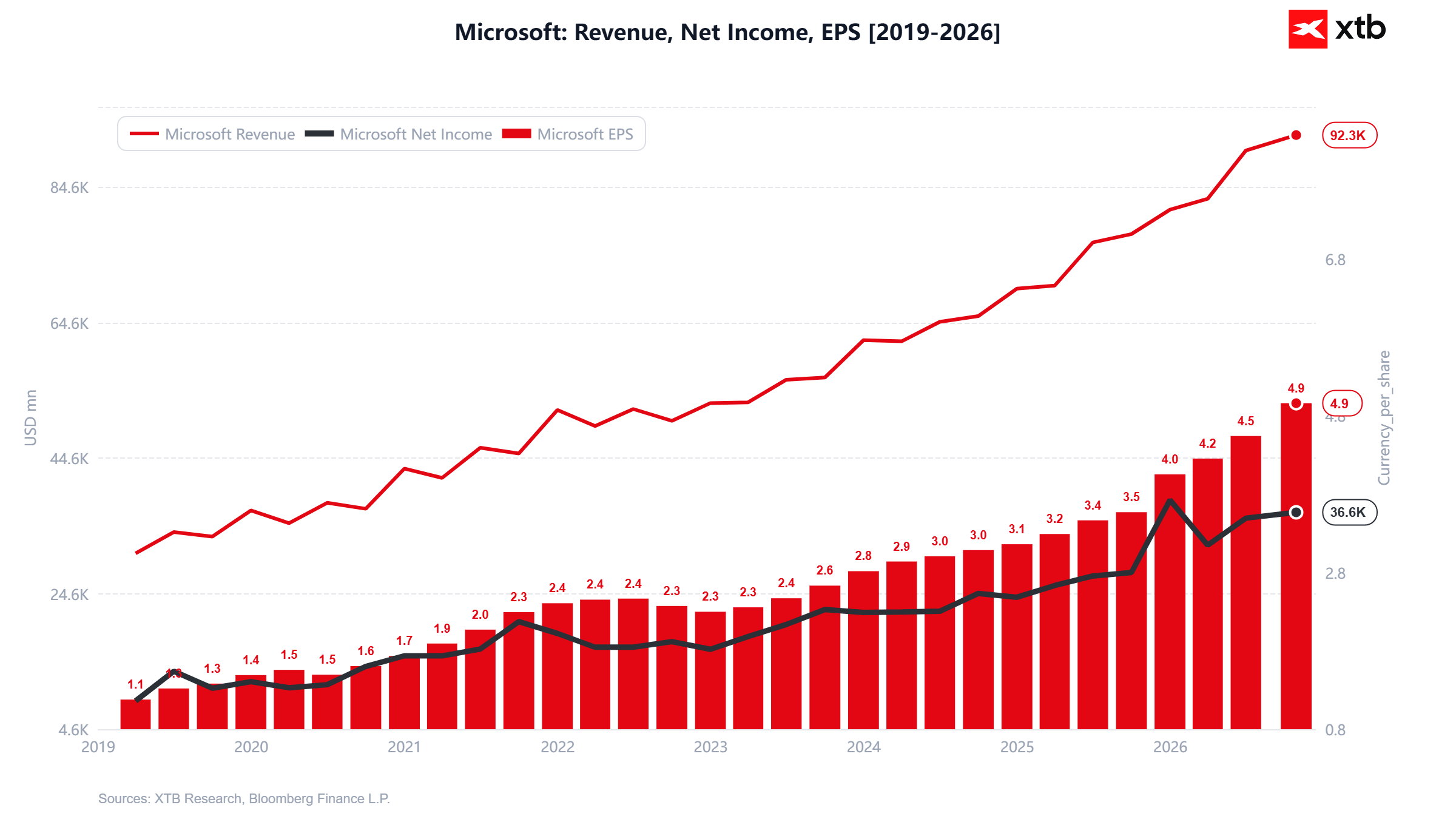
Azure is the strongest argument for the market’s positive reaction. Management had previously guided for growth of around 45 percent at constant currency.
- On the negative side are capital expenditures and cash spending. CAPEX increased 103 percent year on year to USD 39.37 billion.
- This is reflected in a decline in FCF to USD 18.63 billion. That represents a drop in FCF coverage of net income to 51 percent, compared with 92 percent a year ago.
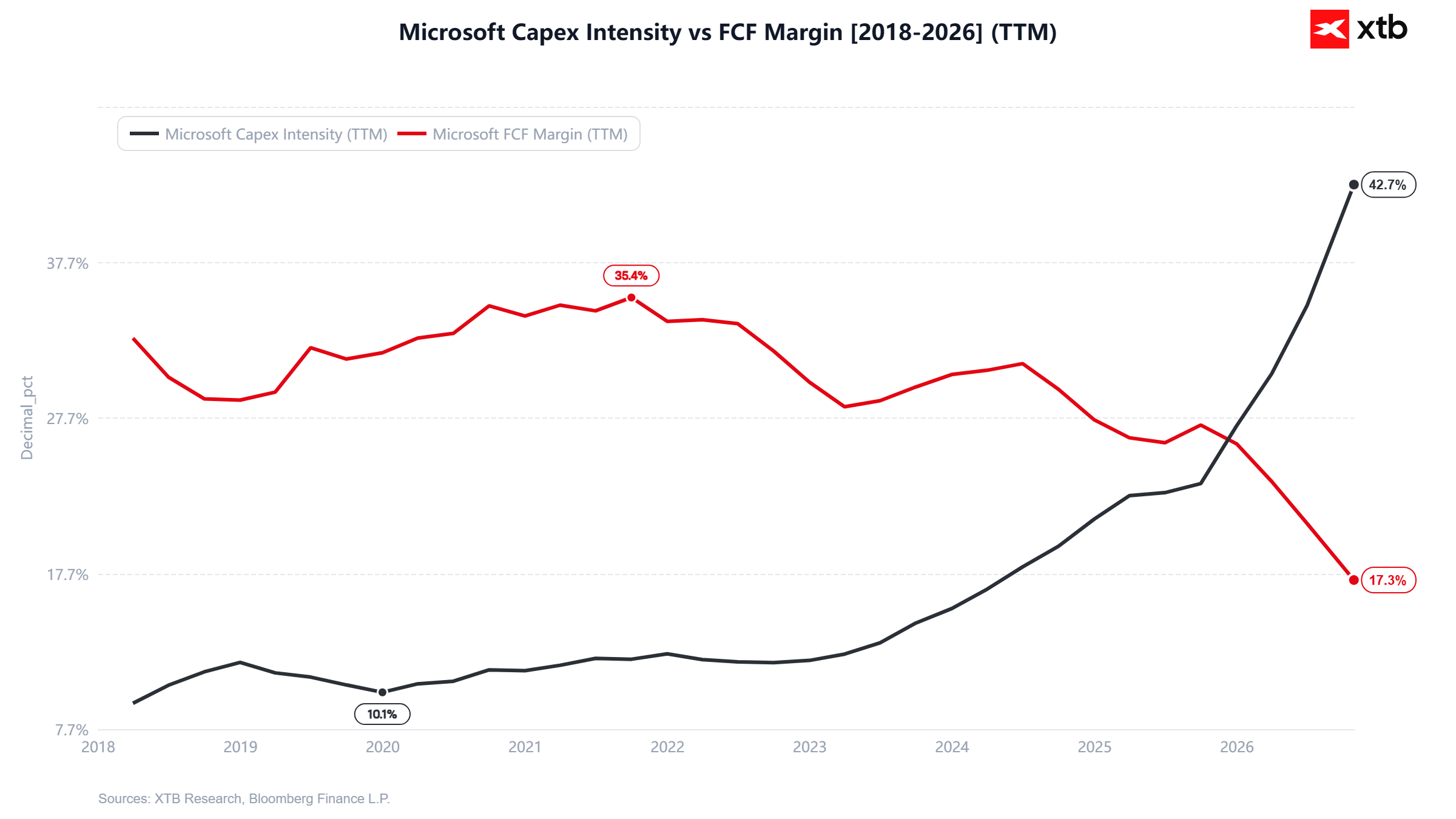
Crucially in the context of investment, Microsoft changed its accounting policy and announced an extension of the estimated useful life of data centers and buildings from 15 to 25 years.
This means that part of future agreements shifts from finance leases to operating leases, reducing reported CAPEX without a corresponding reduction in investment. The company cited this as the reason for revising its 2026 spending outlook to around USD 175 billion.
This information did not reach the market in a vacuum. A few days before the earnings call, the company offered a voluntary buyout to 60,000 employees, roughly one quarter of its global workforce. This signals to the market that Microsoft is actively managing margins to offset rising capital expenditures.
The most important questions remain unanswered. The company is expanding, improving efficiency, and the Azure segment is delivering unprecedented profit growth. At the same time, the scale of investment means that the value remaining for shareholders is clearly falling.
The final takeaway from the release is that, for now, the market is satisfied with Cloud growth running above already optimistic expectations.
Questions about a genuine return of value to shareholders may quiet down until the next earnings call, this time covering the full calendar year.



Daily Summary: Oracle drives the market higher, dollar weakens following Fed meeting (28.10.2026)



📊Hyperscaler Results: Alphabet and Microsoft. Will results justify giant investments?



Market Wrap: Renewed confidence in AI drives stock market recovery (27.10.2026)



📈Daily Summary: Falling Oil Prices and Anthropic Prospectus Drive Markets
The material on this page does not constitute as financial advice and does not take into account your level of understanding, investment objectives, financial situation or any other particular needs.
All the information provided, including opinions, market research, mathematical results and technical analyses published on the website or transmitted to you by other means is provided for information purposes only and should in no event be interpreted as an offer of, or solicitation for, a transaction in any financial instrument, nor should the information provided be construed as advice of legal or fiscal nature.
Any investment decisions you make shall be based exclusively on your level of understanding, investment objectives, financial situation or any other particular needs. Any decision to act on information published on the website or transmitted to you by other means is entirely at your own risk. You are solely responsible for such decisions.
If you are in doubt or are not sure that you understand a particular product, instrument, service, or transaction, you should seek professional or legal advice before trading.
Investing in OTC Derivatives carries a high degree of risk, as they are leveraged based products and often small movements in the market could lead to much larger movements in the value of your investment and this could work against you or for you. Please ensure that you fully understand the risks involved, taking into account your investments objectives and level of experience, before trading, and if necessary, seek independent advice.