



Nickel is extending its decline today, falling to its lowest level since late December 2025 following new forecasts from the International Nickel Study Group (INSG). The organization expects the global nickel market to end 2026 with a modest supply surplus, which is projected to widen further in 2027. This marks a significant shift from April, when the INSG was still forecasting a deficit for 2026.
-
Global demand for primary nickel is expected to reach around 3.85 million tonnes in 2026, up 7.6% from a year earlier, while production is forecast at approximately 3.87 million tonnes.
-
This would leave the market with a surplus of around 19,000 tonnes in 2026, compared with the 32,000-tonne deficit projected in April, which would have represented the first annual supply shortfall since 2021.
-
In its previous forecast, the INSG expected 2026 demand of 3.75 million tonnes and production of 3.72 million tonnes, indicating that both consumption and supply are growing faster than previously anticipated.
Although the INSG expects demand from the stainless steel sector to increase further in the second half of 2026 and throughout 2027, nickel use in electric vehicle batteries has so far grown more slowly than expected due to increasing competition from LFP technology (lithium iron phosphate batteries). Indonesia, the world’s largest nickel producer, approved lower nickel ore production quotas for 2026 than a year earlier. Applications for 2027 production quotas can be submitted until November 15.
For 2027, the INSG expects both demand and supply to continue rising, but the market surplus is forecast to widen to around 70,000 tonnes. Global nickel consumption is expected to reach approximately 4 million tonnes, while production is projected at around 4.07 million tonnes. From a nickel price perspective, the forecasts have a bearish implication, as rising demand is still expected to be more than covered by even faster growth in production. Indonesia will therefore remain a key factor for the market, particularly in the context of future mining quotas.
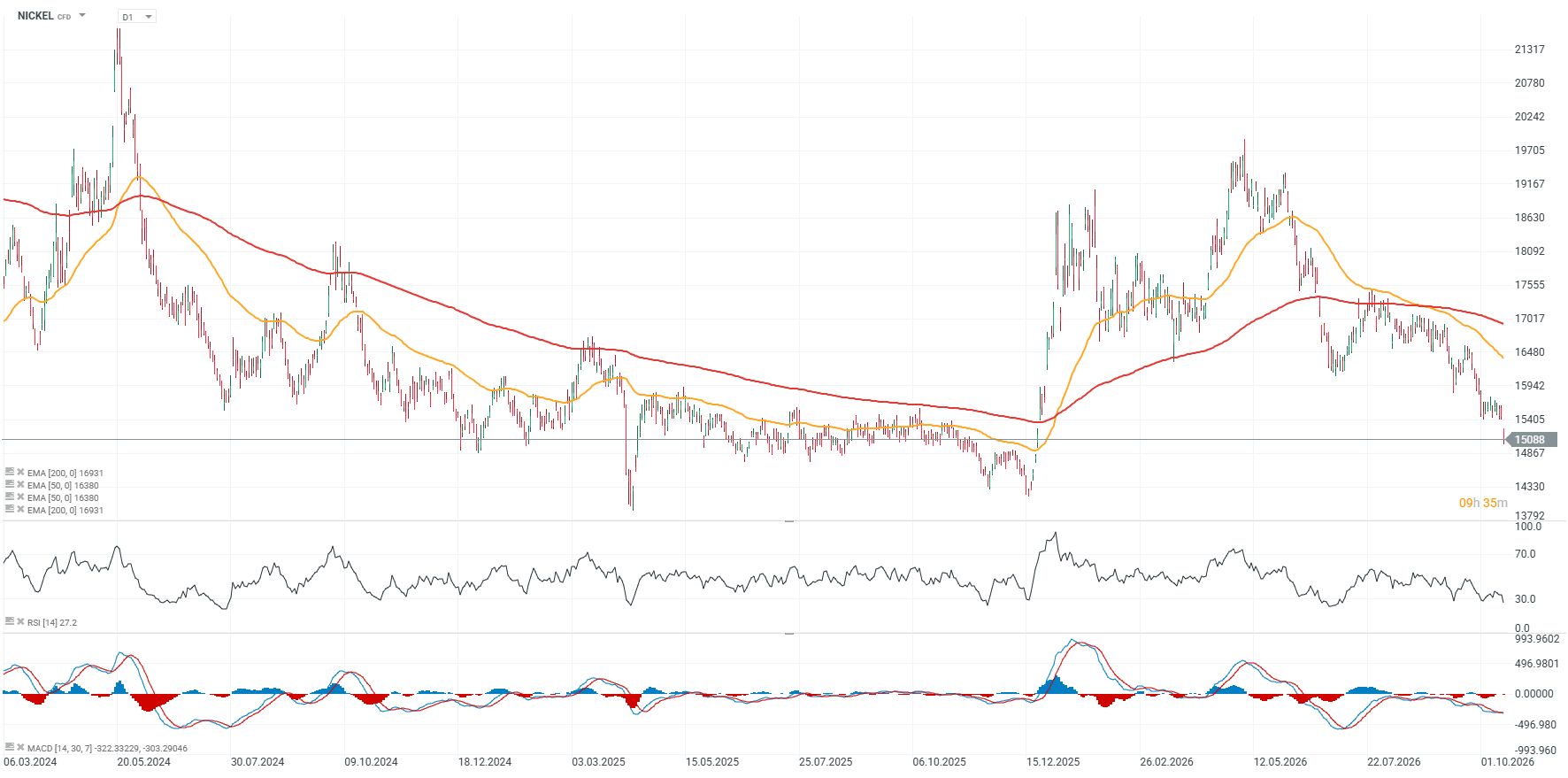
Nickel price chart (NICKEL), D1 interval
Looking at the nickel chart, the RSI has fallen below 30, indicating the most pronounced oversold conditions since early December 2025, while the price is trading around 10% below the 200-session exponential moving average (EMA200), clearly confirming the bearish trend. The first objective for bulls would be a recovery toward 15,600, with potentially key resistance around 16,500, while an important technical support zone can be found between 13,800 and 14,000. However, it is far from certain that the price will fall that low, as technically it has moved close to an important support area corresponding to the broad consolidation range seen in 2025. As a result, the market may at least temporarily begin to stabilize around current levels while waiting for an external catalyst.
 Source: XTB



Daily Summary: Friday offers no relief; the US100 drops 2%🚨


Three Markets to Watch Next Week (October 16, 2026)


Market wrap: European indices rebound 🔼 Defence stocks on the rise

🔼 EURUSD continues to rebound
The material on this page does not constitute as financial advice and does not take into account your level of understanding, investment objectives, financial situation or any other particular needs.
All the information provided, including opinions, market research, mathematical results and technical analyses published on the website or transmitted to you by other means is provided for information purposes only and should in no event be interpreted as an offer of, or solicitation for, a transaction in any financial instrument, nor should the information provided be construed as advice of legal or fiscal nature.
Any investment decisions you make shall be based exclusively on your level of understanding, investment objectives, financial situation or any other particular needs. Any decision to act on information published on the website or transmitted to you by other means is entirely at your own risk. You are solely responsible for such decisions.
If you are in doubt or are not sure that you understand a particular product, instrument, service, or transaction, you should seek professional or legal advice before trading.
Investing in OTC Derivatives carries a high degree of risk, as they are leveraged based products and often small movements in the market could lead to much larger movements in the value of your investment and this could work against you or for you. Please ensure that you fully understand the risks involved, taking into account your investments objectives and level of experience, before trading, and if necessary, seek independent advice.