

When investors think about semiconductor manufacturing, their attention almost automatically shifts toward TSMC fabs, ASML machines, or NVIDIA processors. These are the companies that most often appear in headlines and reports analyzing the development of artificial intelligence and the future of the global digital economy.
However, a question that is equally important for chip manufacturers is asked far less often.
How do you know that a finished chip has actually been manufactured correctly?
Just a dozen or so years ago, a single defect in the production process meant the loss of a relatively inexpensive component. Today, the situation is entirely different. The most advanced chips used in data centers consist of billions of transistors, multiple layers of memory, and extremely complex structures connecting individual elements into a single package. The value of a single chip can reach tens of thousands of dollars, and the cost of an error detected too late increases with each new generation of technology.
As a result, the modern semiconductor industry increasingly resembles less of a race focused purely on producing more chips, and more of a competition in detecting problems before they become costly. Every additional production step, every new material layer, and every new generation of lithography increases the number of places where defects can occur.
This is exactly the area in which KLA Corporation has operated for decades. It is a company that most investors hear about far less often than chip manufacturers, yet it plays a critical role in the functioning of the entire semiconductor ecosystem. Its systems do not design processors or manufacture silicon wafers. Their purpose is something far more fundamental: they help manufacturers detect errors, improve yields, and control the production process in a world where the margin for error is shrinking.
And the more advanced semiconductors become, the more important companies that can control this margin become.
The Invisible Layer of the Semiconductor Industry
The production of modern semiconductors is among the most complex industrial processes ever created by humans. A modern integrated circuit is built through hundreds, and often thousands, of precisely controlled operations performed on a silicon wafer. Each one must be executed with near-perfect accuracy, because even a minor deviation can reduce product quality or make it unusable altogether.
Most investors are familiar with the key players in this process. ASML provides lithography machines responsible for patterning wafers. Lam Research specializes in etching and material processing. Applied Materials delivers solutions used for depositing the successive layers that form the chip structure.
However, far less attention is paid to the question that arises after each of these steps: was everything done correctly?
This is where KLA comes in.
The company provides inspection, monitoring, and process control systems designed to detect defects and deviations before they become costly problems for manufacturers. In practice, this means analyzing wafers, lithography masks, and finished structures with nanometer-level precision—at a scale invisible to the human eye.
The simplest way to understand KLA’s business model is to think of semiconductor manufacturing as constructing a highly complex skyscraper. Companies like ASML, Lam Research, and Applied Materials provide the tools needed to build it. KLA acts as the inspector who checks after each stage whether the structure has been built according to the design.
The taller the building, the greater the consequences of overlooking even a small mistake. The same mechanism applies in semiconductors.
A decade or so ago, a single defect often meant the loss of a relatively inexpensive chip. Today, the same error may only be detected after hundreds of production steps, when the value of the processed wafer has already reached tens or even hundreds of thousands of dollars. In such a scenario, the cost of additional inspection tools becomes negligible compared to the potential losses from yield deterioration.
This is why process control has become one of the most important elements of modern semiconductor manufacturing. The more advanced chip technology becomes, the more valuable companies capable of detecting issues before they appear in the final product become.
And everything indicates that with the development of artificial intelligence, the importance of this capability will grow even faster than the number of chips produced.
The More Advanced the Chip, the More Expensive the Mistake
For many years, the semiconductor industry developed on a relatively simple principle: rising demand for electronics meant producing more chips, which drove investment in new fabs and production equipment.
Today, however, it is no longer just about the number of chips, but about their increasing complexity.
Modern processors and AI accelerators increasingly consist of multiple interconnected elements. They use HBM memory, chiplet architectures, and advanced packaging technologies that integrate different components into a single package. Each new generation adds production steps, additional material layers, and more demanding lithography processes.
This is good news for chip performance, but far more challenging for manufacturers trying to maintain yields.
The more complex a chip becomes, the more potential points of failure exist. More importantly, the cost of detecting an error late in the process grows much faster than the cost of inspection itself. For the most advanced chips, even a small improvement in yield can translate into hundreds of millions of dollars in additional value for a fab.
That is why the importance of process control is growing faster than the semiconductor market itself. Each new technological generation increases not only demand for production equipment, but also the number of measurements, analyses, and inspections required to maintain process quality.
As a result, companies like KLA benefit not only from the rising number of chips being produced. They benefit primarily from the fact that each successive chip becomes more difficult and more expensive to manufacture.
AI does not only increase the number of chips. It increases the number of places where mistakes can occur.
The AI boom is most often presented through the lens of explosive demand for GPUs and data centers. This is of course true, but from KLA’s perspective, another consequence of this transformation is far more important.
Artificial intelligence increases the complexity of the entire manufacturing process.
The most advanced AI systems today require the integration of multiple technologies that, just a few years ago, evolved relatively independently. A modern accelerator used for training language models is no longer a single chip. It is a complex system consisting of a GPU, HBM memory, and advanced interconnect infrastructure packaged into a single unit.
Each of these components must be manufactured separately and then combined with extreme precision. A small defect in any one component is enough to destroy the value of the entire package.
This is especially visible in the HBM memory segment, which has become one of the key elements of modern AI accelerators. Unlike traditional memory, HBM is built by stacking multiple silicon layers and connecting them with thousands of microscopic interconnects. This structure provides enormous bandwidth but also increases the number of potential failure points.
A similar process is occurring in advanced packaging. Only a few years ago, quality control focused mainly on wafer production. Today, increasing attention is paid to what happens afterward, when multiple chips are combined into a finished product.
This is why KLA is expanding its presence in the advanced packaging segment. Manufacturers no longer only need to ensure the quality of individual components; they must also ensure that the entire system functions correctly after integration.
From the company’s perspective, this is a highly attractive trend. Every additional inspection stage represents new opportunities to sell inspection systems, metrology tools, and process analysis software.
As a result, artificial intelligence does not only increase the number of chips entering data centers. It also increases the number of inspections, measurements, and analyses required to produce them.
This is why KLA has become one of the less obvious but at the same time most important beneficiaries of the current wave of AI infrastructure investment.
KLA’s Most Underestimated Advantage
In the semiconductor world, technological monopolies and dominant market positions are often discussed. ASML is associated with EUV lithography, NVIDIA with AI accelerators, and TSMC with the most advanced chip manufacturing.
Far less often do similar associations arise with KLA, even though the company has held a dominant position in process control for many years.
This is not solely due to the quality of its products. KLA’s advantage is based on a combination of technology, experience, and customer relationships built over decades.
Inspection and monitoring systems are deeply integrated into the production processes of the largest semiconductor fabs. Their purpose is not only to detect defects but also to collect data, analyze processes, and identify sources of yield issues.
In practice, this means that each new installation increases not only the number of machines operating at a customer’s site, but also the amount of knowledge and data used to optimize production. This creates a natural barrier to entry for competitors.
A manufacturer building a fab worth tens of billions of dollars is not looking for the cheapest quality control supplier. It is looking for a solution that maximizes yield and enables full-scale production as quickly as possible.
The second element of KLA’s advantage is its enormous installed base.
Over the years, the company has delivered thousands of systems operating in fabs worldwide. Each of these systems requires regular servicing, software updates, spare parts, and technical support.
As a result, a significant portion of KLA’s revenue does not come from one-time equipment sales, but from long-term support of existing infrastructure.
This is particularly important because the service business is one of the most stable and predictable segments of the company. In recent years, services and software accounted for about one-fifth of revenue, and their importance has been steadily increasing as the installed base expands.
This means KLA is not only a supplier of semiconductor equipment.
An increasing share of its business is based on a recurring revenue model that generates stable cash flows even during periods of weaker investment activity from customers.
The combination of technological dominance, high switching costs, and growing service revenue makes KLA uniquely positioned within the semiconductor ecosystem.
The Numbers Show That KLA Sells More Than Equipment
The most interesting feature of KLA’s financial performance is not just revenue growth, but how that growth translates into profitability and cash generation.
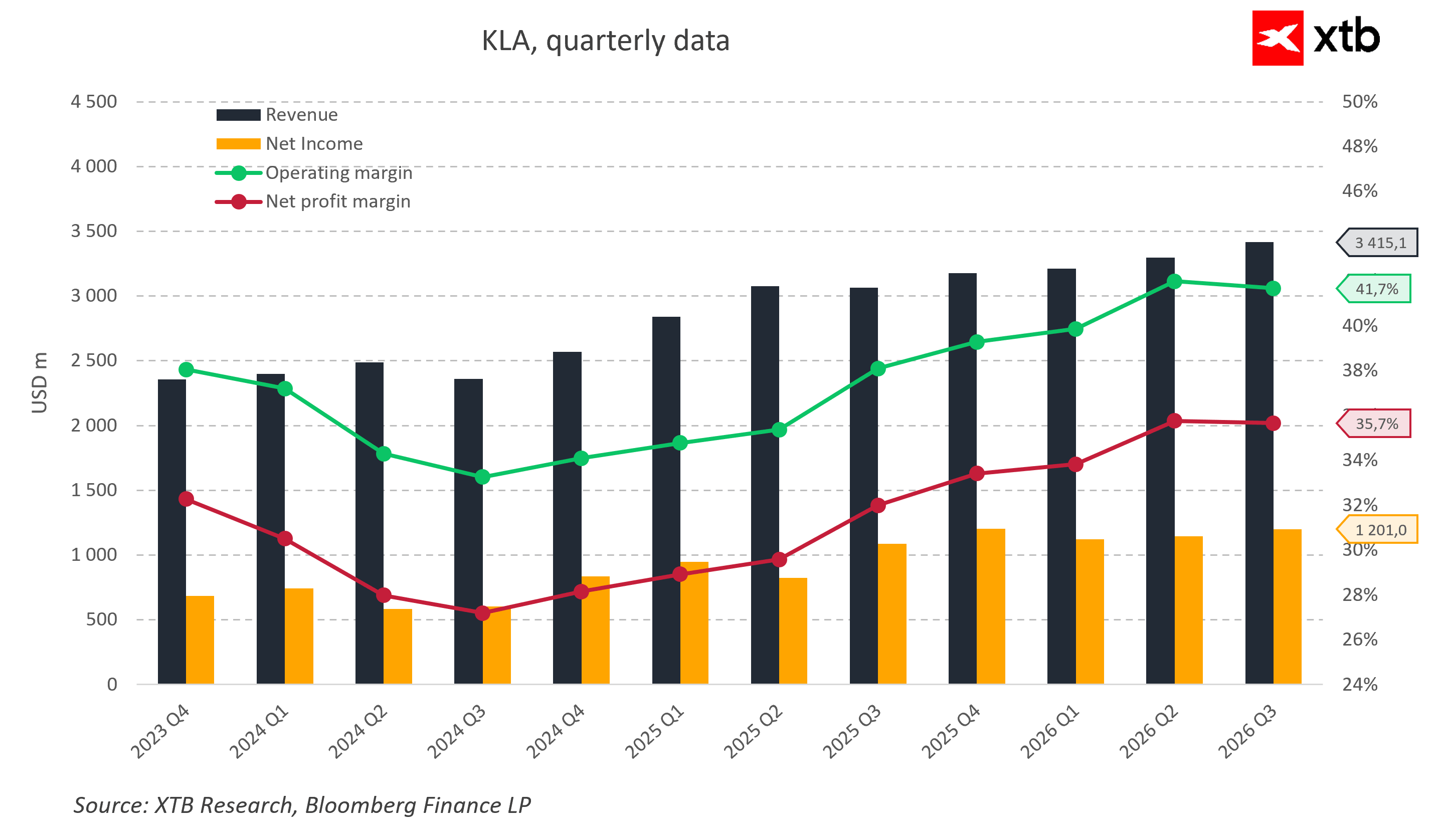
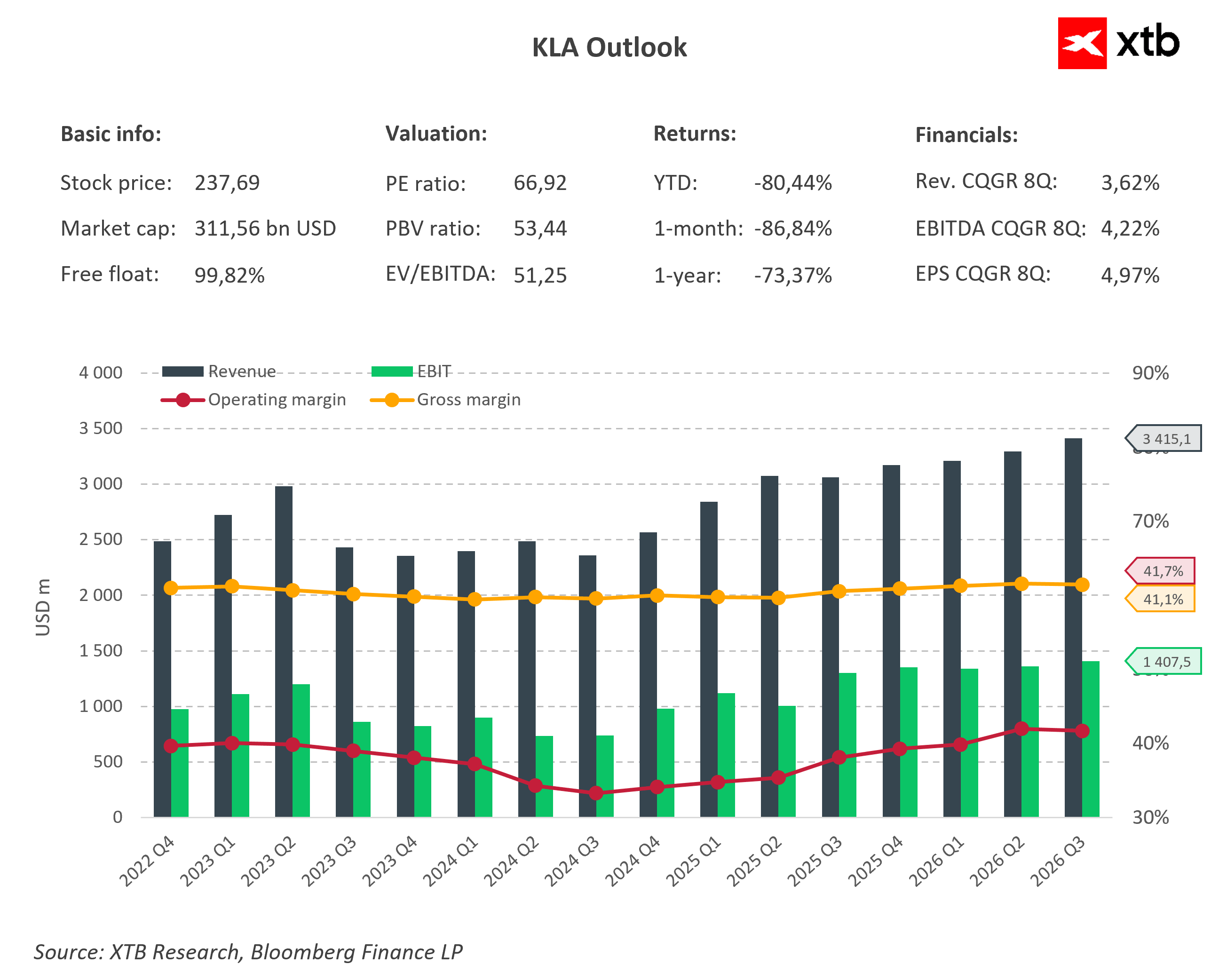
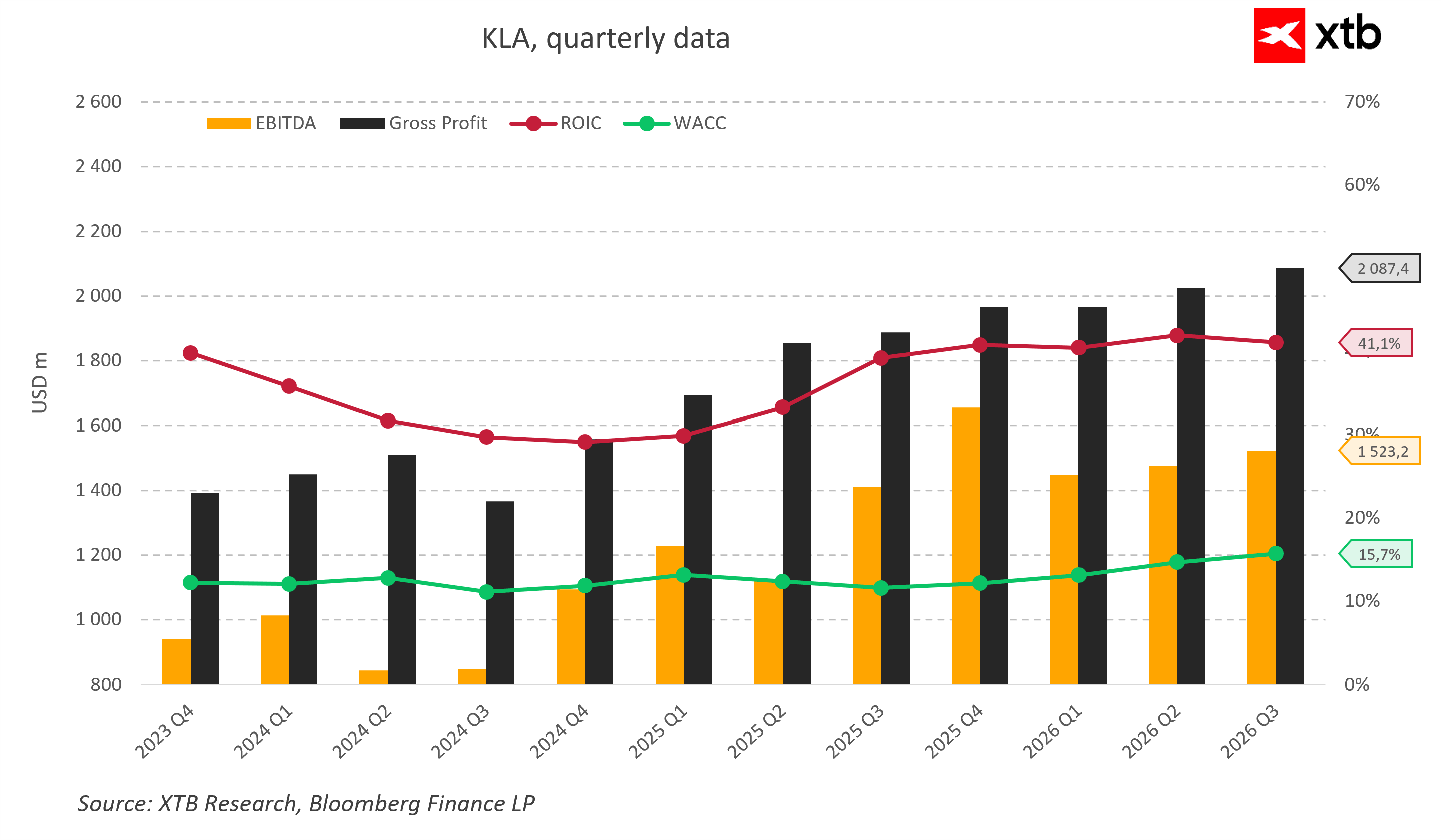
Over the past several quarters, revenue has increased from around $2.4 billion to more than $3.4 billion per quarter. Even more impressive is the growth in earnings. Over the same period, operating margins rose above 40%, while net margins approached 36%.
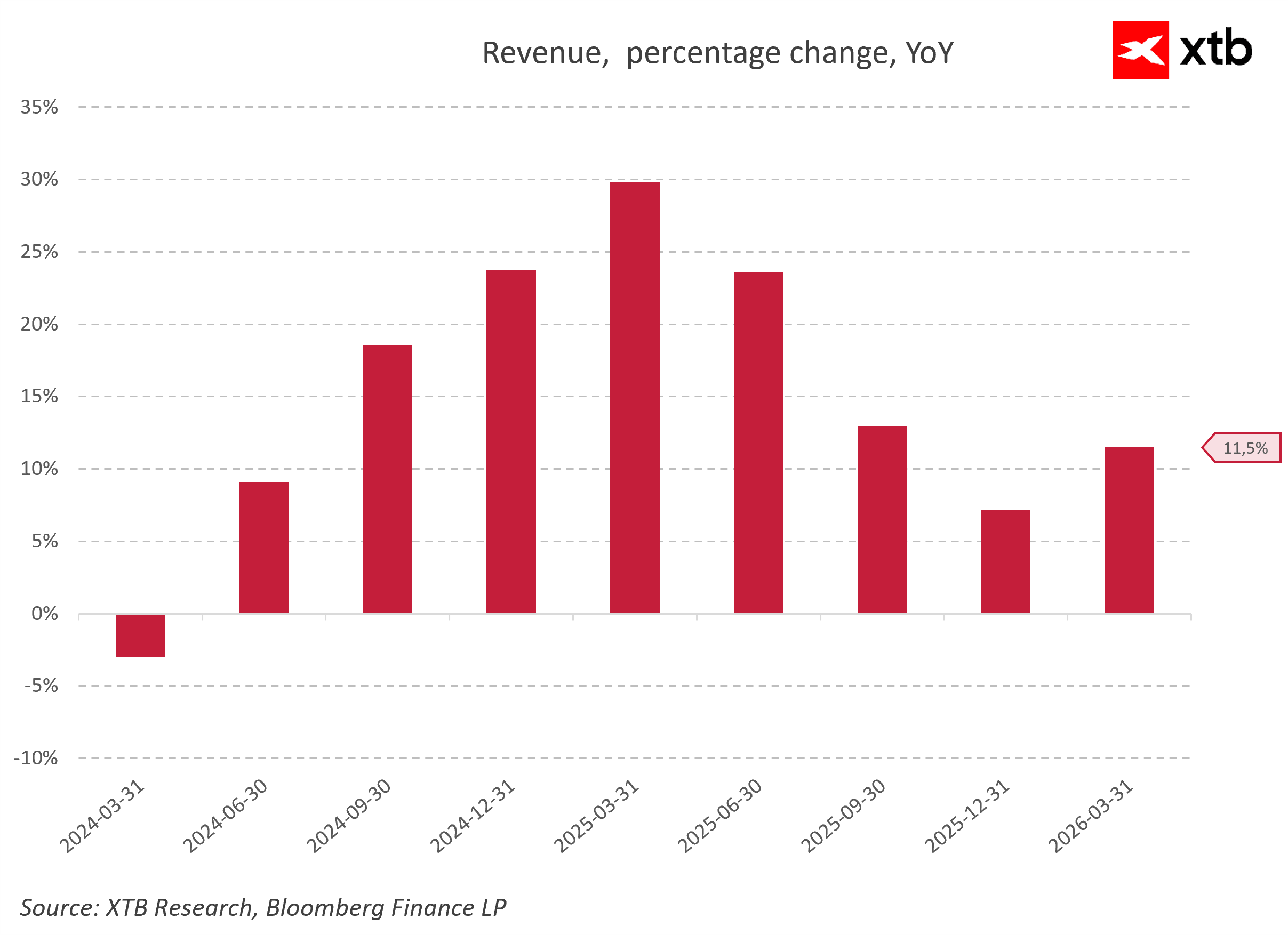
This is well illustrated by the story of the last two years, when the company quickly recovered from a temporary downturn in early 2024. Within just a few months, annual revenue growth swung from a slight decline to an impressive 30% in early 2025. Although such rapid growth could not be sustained indefinitely and naturally cooled, the latest data from early 2026 confirms that KLA continues to ride the wave, growing at a stable 11.5% year over year.
For investors, this means something very important. KLA does not increase sales by aggressively cutting prices or sacrificing profitability to gain market share. On the contrary, the company is able to capture an increasing share of the value created by the entire semiconductor industry.
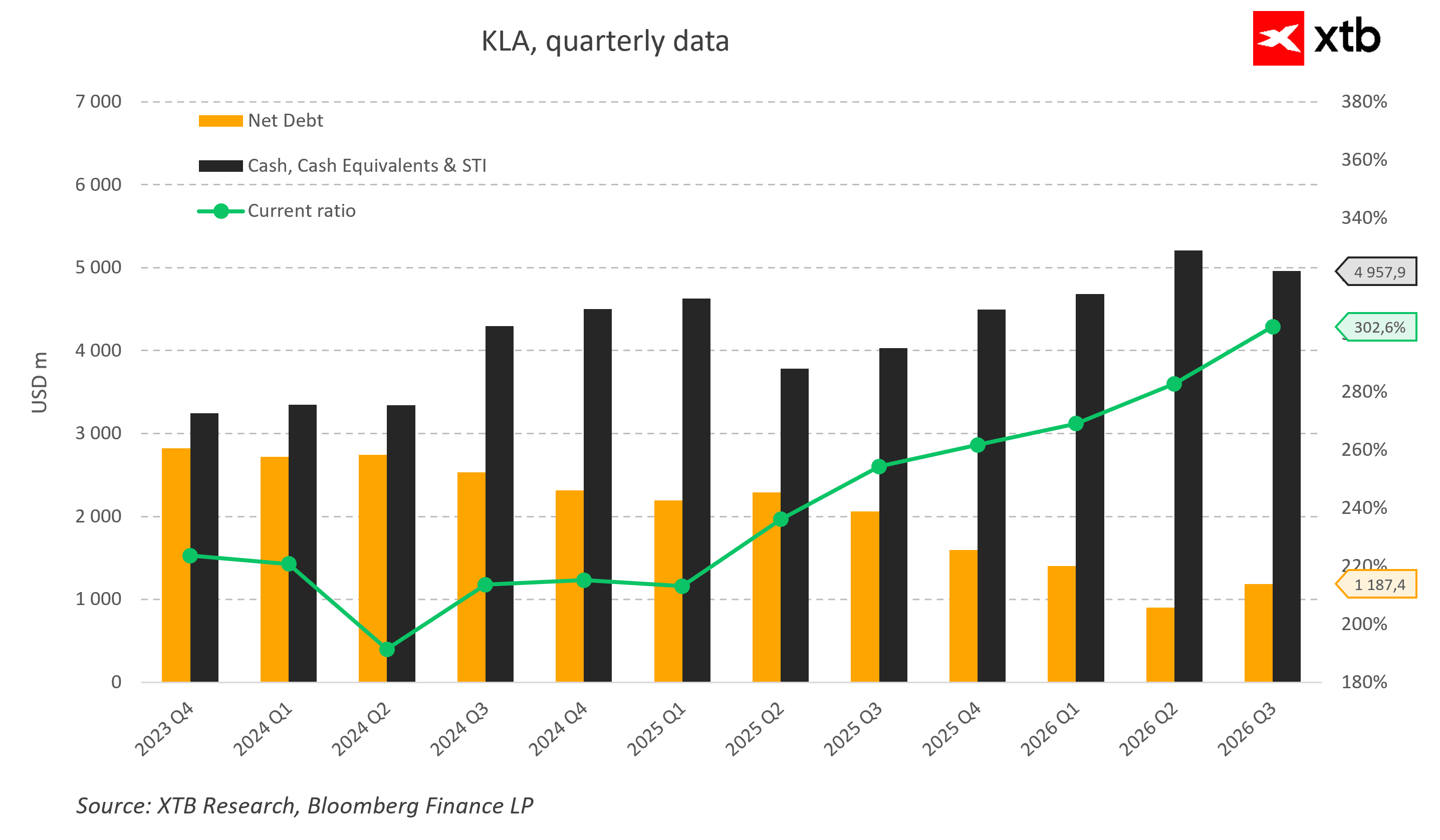
This is also visible in cash flow generation. Rising profits translate into increasing cash on the balance sheet, while net debt has been steadily declining. At the end of the last quarter, the company held nearly $5 billion in cash against net debt of just over $1 billion.
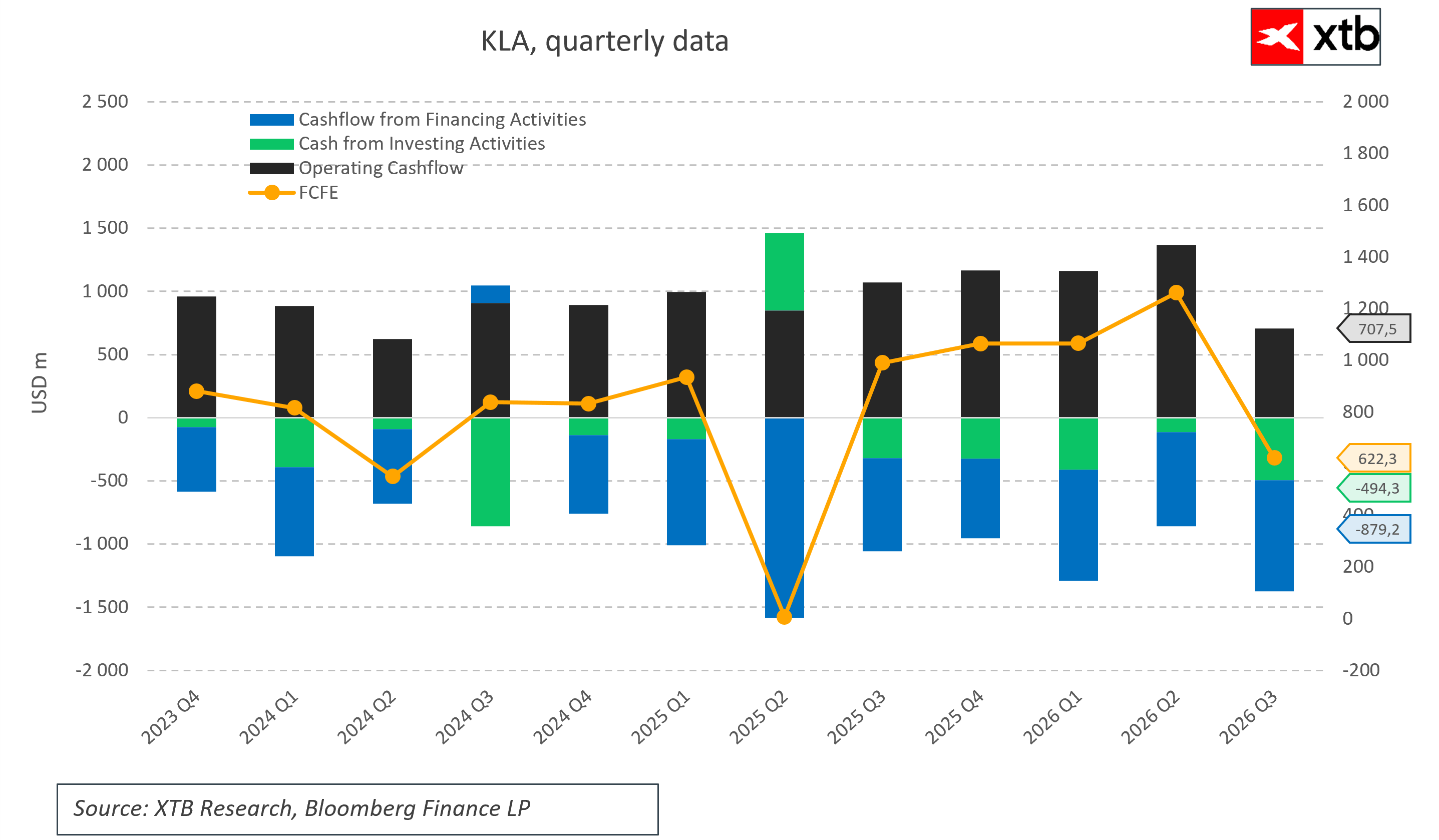
Looking deeper into the financial structure, what stands out most is the remarkable consistency of this cash-generating machine. The core business consistently produces substantial quarterly cash surpluses exceeding $1 billion. Importantly for shareholders, KLA does not need to spend all of it on maintenance or debt repayment. Free cash flow available to shareholders has been on a clear upward trend for some time. There was a weaker quarter in mid-2025 due to one-time financial expenses, but by the following year, free cash flow reached a record $1 billion.
Even better is the quality of the business as measured by ROIC, which remains around 40%. This means that every dollar reinvested in the business generates returns significantly above the cost of capital. Such results are rare even among top-tier technology companies.
In practice, this means KLA is not only a beneficiary of the semiconductor investment boom. It is also one of the companies that can most effectively convert that growth into cash available to shareholders.
What Could Go Wrong?
Despite its strong market position, KLA is not without risks.
The biggest remains geopolitics. A few years ago, China accounted for more than 40% of the company’s revenue, but tightening export restrictions have gradually reduced the importance of this market. Although KLA has partially offset this through investments in Taiwan, South Korea, Japan, and the United States, further escalation of US–China tensions remains a significant risk.
The second risk is the cyclical nature of the semiconductor industry. Demand for KLA’s solutions is closely tied to capital spending by major chipmakers, so periodic slowdowns in investment can affect financial performance. However, this risk is partly mitigated by the growing share of service and software revenue.
It is also worth noting customer concentration. Investment decisions by companies such as TSMC, Samsung, or SK Hynix have a significant impact on the company’s growth rate, and delays in new fab construction can increase short-term volatility.
At the same time, none of these risks undermines the long-term investment thesis. Regardless of where new production capacity is built, each new generation of semiconductors requires more measurements, inspections, and analyses—and this is exactly what KLA’s business is built on.
Does the Current Valuation Still Offer a Margin of Safety?
We present a valuation of KLA using a discounted cash flow (DCF) model. It should be emphasized that this is for informational purposes only and should not be treated as an investment recommendation or precise valuation. Due to the model’s high sensitivity to assumptions, even small changes in revenue growth, margins, or cost of capital can lead to significantly different outcomes.
KLA’s story is now well known among investors. The market recognizes both the benefits of artificial intelligence and the growing importance of process control in advanced semiconductor manufacturing. It is therefore no surprise that the company’s shares have performed very strongly in recent years.
Nevertheless, the DCF valuation suggests that the current share price still does not fully reflect the business’s potential. In the base case, fair value is estimated at $290 per share, implying about 20% upside relative to the current market price.
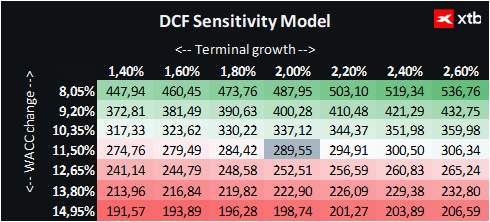
This is not a level that suggests deep undervaluation. Nor would that be expected from a company with such high profitability, dominant market position, and exposure to one of the most important technological trends of the decade.
At the same time, the valuation suggests that the market may still be underestimating the scale of benefits arising from increasing semiconductor complexity. Unlike many AI beneficiaries whose results depend primarily on the number of chips sold, KLA benefits from something far more durable: the growing importance of quality control, yield improvement, and process optimization.
This is what makes the company one of the more interesting ways to gain exposure to the development of artificial intelligence and the broader semiconductor sector.



Amazon Eyes External Sales of Custom AI Chips, Threatening Nvidia’s Dominance



US OPEN: Indices Recover Amid More Expensive iPhones and GTA 6 Preorders (18.06.2026)

Accenture shares sink after earnings



China nears bear market territory 🚩 Alibaba and Tencent lead selloff
The material on this page does not constitute as financial advice and does not take into account your level of understanding, investment objectives, financial situation or any other particular needs.
All the information provided, including opinions, market research, mathematical results and technical analyses published on the website or transmitted to you by other means is provided for information purposes only and should in no event be interpreted as an offer of, or solicitation for, a transaction in any financial instrument, nor should the information provided be construed as advice of legal or fiscal nature.
Any investment decisions you make shall be based exclusively on your level of understanding, investment objectives, financial situation or any other particular needs. Any decision to act on information published on the website or transmitted to you by other means is entirely at your own risk. You are solely responsible for such decisions.
If you are in doubt or are not sure that you understand a particular product, instrument, service, or transaction, you should seek professional or legal advice before trading.
Investing in OTC Derivatives carries a high degree of risk, as they are leveraged based products and often small movements in the market could lead to much larger movements in the value of your investment and this could work against you or for you. Please ensure that you fully understand the risks involved, taking into account your investments objectives and level of experience, before trading, and if necessary, seek independent advice.
