



As expected by the market, the Swiss National Bank (SNB) left its policy rate unchanged at 0%, while Sweden’s Riksbank also made no move, keeping rates at 1.75%. The SNB’s statement looked very cautious and slightly dovish, while the Riksbank much more clearly signaled the possibility of a rate hike.
SNB decision and a softer tone?
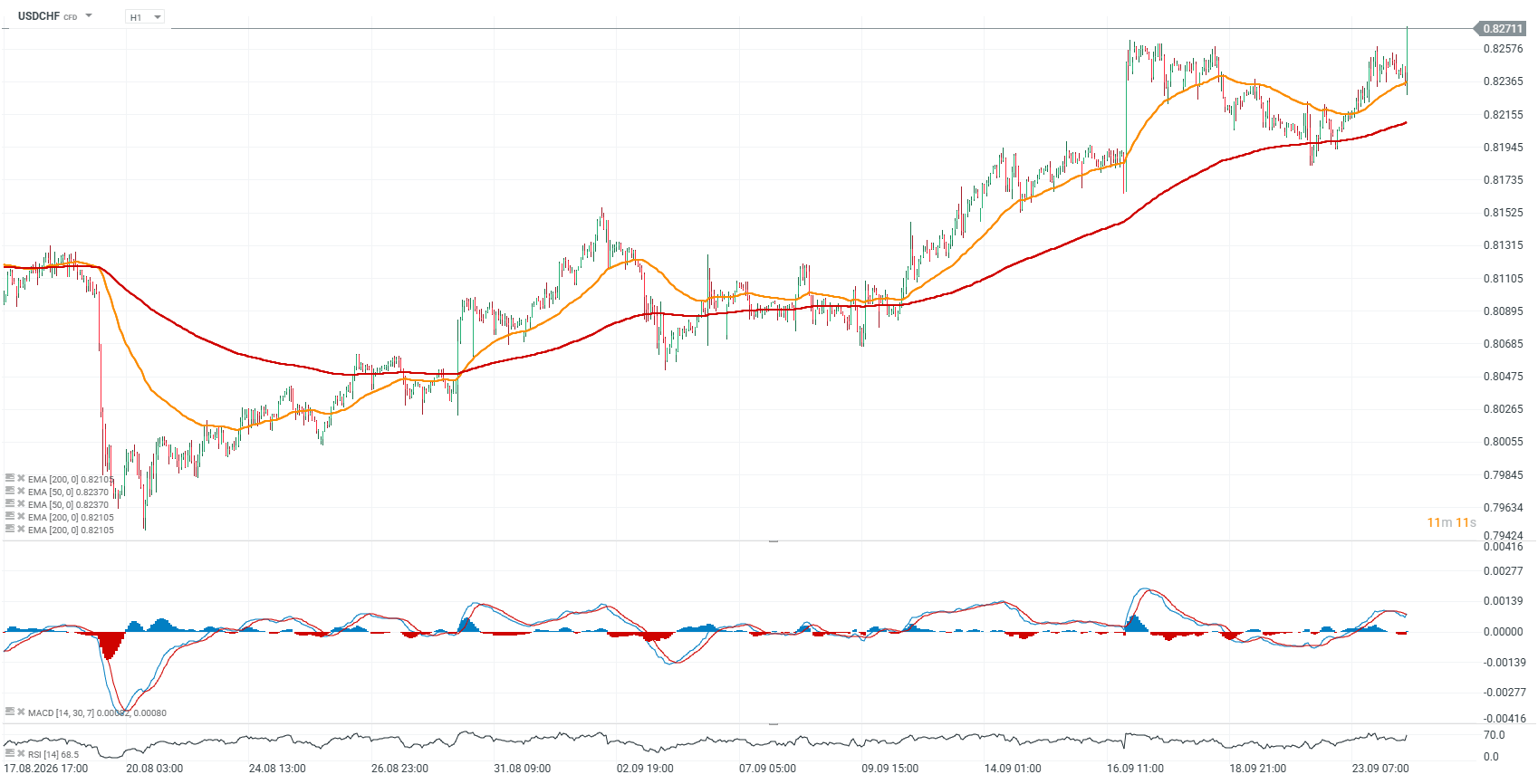
The SNB softened its language regarding potential interventions aimed at weakening the franc and raised its inflation forecasts. The bank is increasingly acknowledging that a weaker franc and more expensive imports could once again add to price pressures, which over time may reduce the scope for maintaining an ultra-loose policy stance. Despite this, the franc weakened after the decision, clearly reflected in the jump in USDCHF.
- The SNB kept its key policy rate unchanged at 0% for a fifth consecutive quarter.
- The bank removed its previous wording about an “increased willingness” to sell the franc, which may suggest a lower propensity to intervene in the FX market.
- The SNB assessed that medium-term inflationary pressures had increased, although only slightly.
- Swiss inflation stood at 0.8% in August and remains within the 0–2% range that the bank considers consistent with price stability.
- The franc weakened to its lowest level in 17 months against the euro and its lowest since June against the U.S. dollar, increasing import costs and potentially adding to inflation.
- Such a setup could gradually lay the groundwork for a future rate hike, although most economists do not expect one before 2028.
- An alternative to rate hikes could be FX-market action, such as selling foreign assets to strengthen the franc and limit imported inflation.
- The SNB had already highlighted rising inflation risks, while August price growth was the fastest in nearly two years.
USDCHF chart (H1 timeframe)
 Source: xStation5
Riksbank signals a possible hike this year
The Riksbank kept its key policy rate unchanged at 1.75%, but at the same time signaled that a hike may be needed later this year if the economic recovery continues to strengthen. The bank said the outlook for inflation and economic activity had not changed significantly, although price pressures remain elevated.
- The Riksbank left its policy rate unchanged at 1.75%, the lowest level in the European Union.
- The decision was in line with expectations from all 18 economists surveyed by Bloomberg.
- The bank indicated that rates could be raised later this year if inflation stabilizes around 2% and the economy continues to recover.
- The Riksbank emphasized that the outlook for inflation and economic activity remains broadly unchanged compared with its previous assessment.
- In August, the bank estimated the probability of a 25 bp rate hike in 2026 at around 50%.
- Sweden’s economy returned to growth in Q2, supported by tax cuts on food and fuel as well as an improvement in household consumption.
- Earlier rate cuts also supported demand, although concerns are rising over the impact of the war with Iran and higher energy prices on inflation.
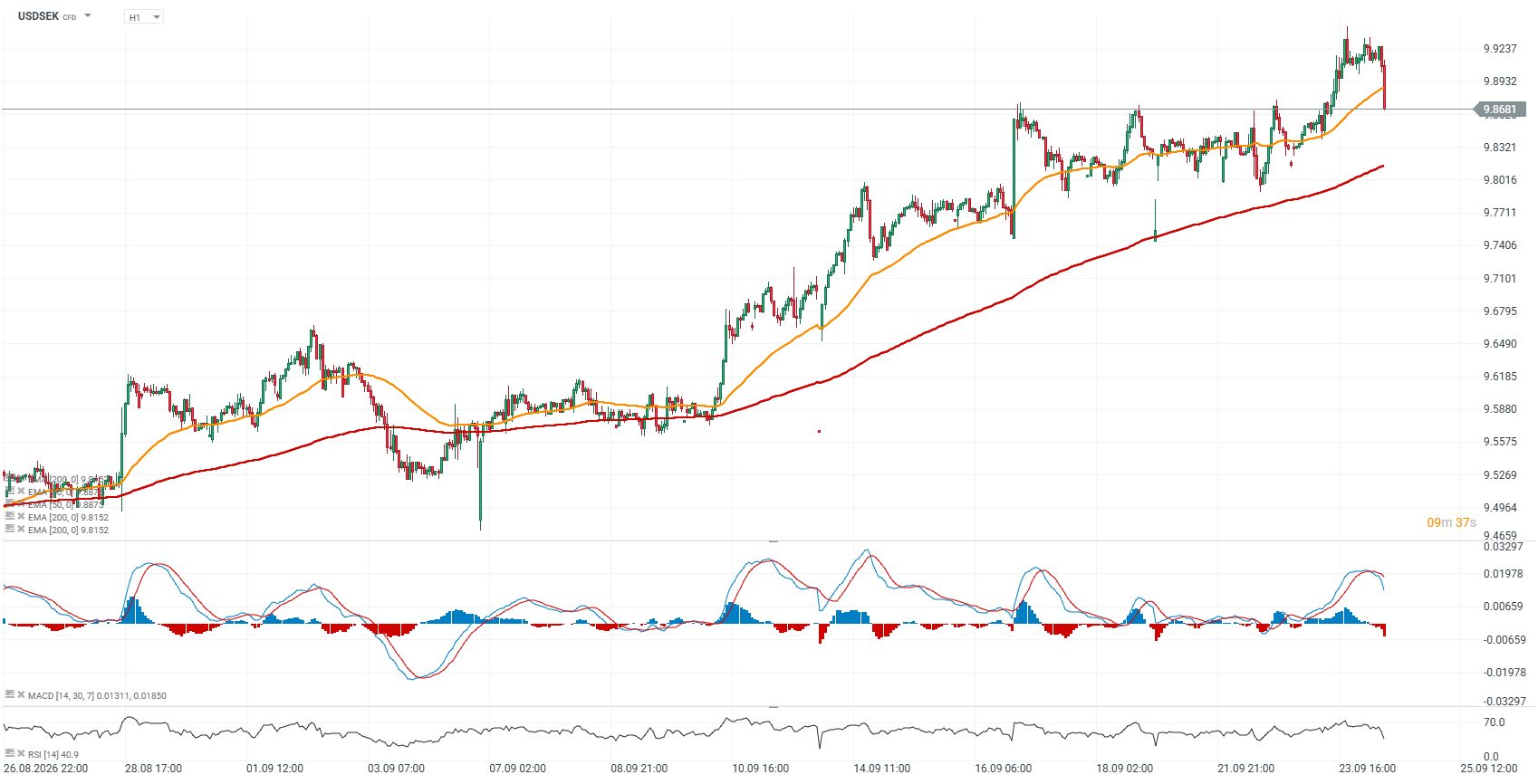
- The Riksbank’s decision fits into the broader trend of tighter monetary policy following recent moves by both the ECB and the Fed. The Swedish krona is strengthening after the decision.
USDSEK chart (H1 timeframe)
 Source: xStation5


Norges Bank raises intrest rates


Morning Wrap: Equity indices fall as bond yields surge 🚩 Mixed data from Australia (24.09.2026)


US Open: Nasdaq drops from the all-time high (23.09.2026)


US PMIs skyrocket to a 5-year high
The material on this page does not constitute as financial advice and does not take into account your level of understanding, investment objectives, financial situation or any other particular needs.
All the information provided, including opinions, market research, mathematical results and technical analyses published on the website or transmitted to you by other means is provided for information purposes only and should in no event be interpreted as an offer of, or solicitation for, a transaction in any financial instrument, nor should the information provided be construed as advice of legal or fiscal nature.
Any investment decisions you make shall be based exclusively on your level of understanding, investment objectives, financial situation or any other particular needs. Any decision to act on information published on the website or transmitted to you by other means is entirely at your own risk. You are solely responsible for such decisions.
If you are in doubt or are not sure that you understand a particular product, instrument, service, or transaction, you should seek professional or legal advice before trading.
Investing in OTC Derivatives carries a high degree of risk, as they are leveraged based products and often small movements in the market could lead to much larger movements in the value of your investment and this could work against you or for you. Please ensure that you fully understand the risks involved, taking into account your investments objectives and level of experience, before trading, and if necessary, seek independent advice.