



Wall Street got exactly what it was waiting for today. Jensen Huang is returning as CEO of Nvidia, and investors are greeting the news with a level of enthusiasm not seen in the tech market for a long time. Shares of the artificial intelligence chipmaker are up about 30 percent, semiconductor stocks are rebounding strongly, and the major Wall Street indices are posting strong gains. For the market, Huang’s return has become a much bigger event than a mere change in the CEO position. Investors have regained a man whose name has been synonymous with a tech bull market for years.
Since early November, the semiconductor sector and the broader market for artificial intelligence-related companies have been under increasing pressure. Investors began to take a closer look at the costs of the technology race, the scale of investment in data centers, and the feasibility of maintaining the current pace of growth. Even Nvidia’s record results were not enough to allay concerns about valuations and the profitability of massive investments. The market was increasingly asking how long such costly expansion could be financed and whether revenues from AI development would grow fast enough to justify current expectations.
The scandal surrounding Huang proved to be an additional burden. Reports of his affairs—including a relationship with a woman suspected by U.S. intelligence agencies of having ties to Chinese intelligence—triggered a serious public relations crisis and called his continued role at the company into question. With the founder’s departure, Nvidia lost not only its longtime CEO but also the most prominent face of the entire AI revolution. Uncertainty regarding leadership at the company—which has become one of the pillars of the global technology market—further heightened investor anxiety.
Now there has been a turnaround that would have been hard to foresee just a few days ago. The board of directors unanimously decided to reinstate Huang as CEO and a member of the board. In a statement, the company announced that, following discussions with the founder and consultations with representatives of the U.S. government, the board sees no threat to national security resulting from his return. However, the investigation into allegations of foreign intelligence activities will continue. Huang himself has declared his willingness to cooperate with those conducting the investigation.
The stock market’s reaction shows just how closely Huang’s position is tied to Nvidia’s valuation and sentiment surrounding the entire sector. One might ask whether the chipmaker’s founder has become something of an “too big to fail” institution for the tech bull market. The comparison to the “too big to fail” principle, familiar from the U.S. financial sector crisis, is obviously a stretch, but it aptly captures the scale of Huang’s importance. Nvidia is a central provider of infrastructure for the development of artificial intelligence, and its health influences sentiment among chipmakers, data center providers, and the largest tech companies. The market interprets the return of the man who built this position as a restoration of stability at the very heart of the tech boom.
This does not mean that all risks have disappeared. Nvidia continues to face investigations by U.S. authorities, including an SEC probe into accounting issues and inquiries from the Department of Justice related, among other things, to allegations of illegal trade in advanced chips. There is also an ongoing case concerning possible activities by Chinese intelligence and information security agencies. Added to this is Washington’s export policy. The U.S. administration is considering further restrictions on the sale of advanced chips to other countries, which could affect Nvidia’s access to certain markets and limit its growth potential.
Monetary policy remains a separate challenge. Concerns are growing that the Federal Reserve may be forced to raise interest rates, which would be detrimental to companies whose valuations are based on high growth in the coming years. More expensive capital increases the cost of financing infrastructure, and a higher discount rate reduces the attractiveness of future profits. Even Huang’s return does not change the economic case behind investments in artificial intelligence.
Today, however, Wall Street isn’t focusing on these risks. After weeks of uncertainty, investors received news that restored their confidence in the sector’s most important company. Jensen Huang is returning to NVIDIA, and with him comes the figure the market associates with the success of the technological revolution. The company’s founder and Nvidia itself still face many difficult issues to address, and the fundamentals of the bull market will continue to require careful evaluation. In today’s trading session, however, the return itself is what matters most. Wall Street once again has its leader, and Jensen Huang can celebrate not only regaining his position but also an exceptionally enthusiastic reception from the market.
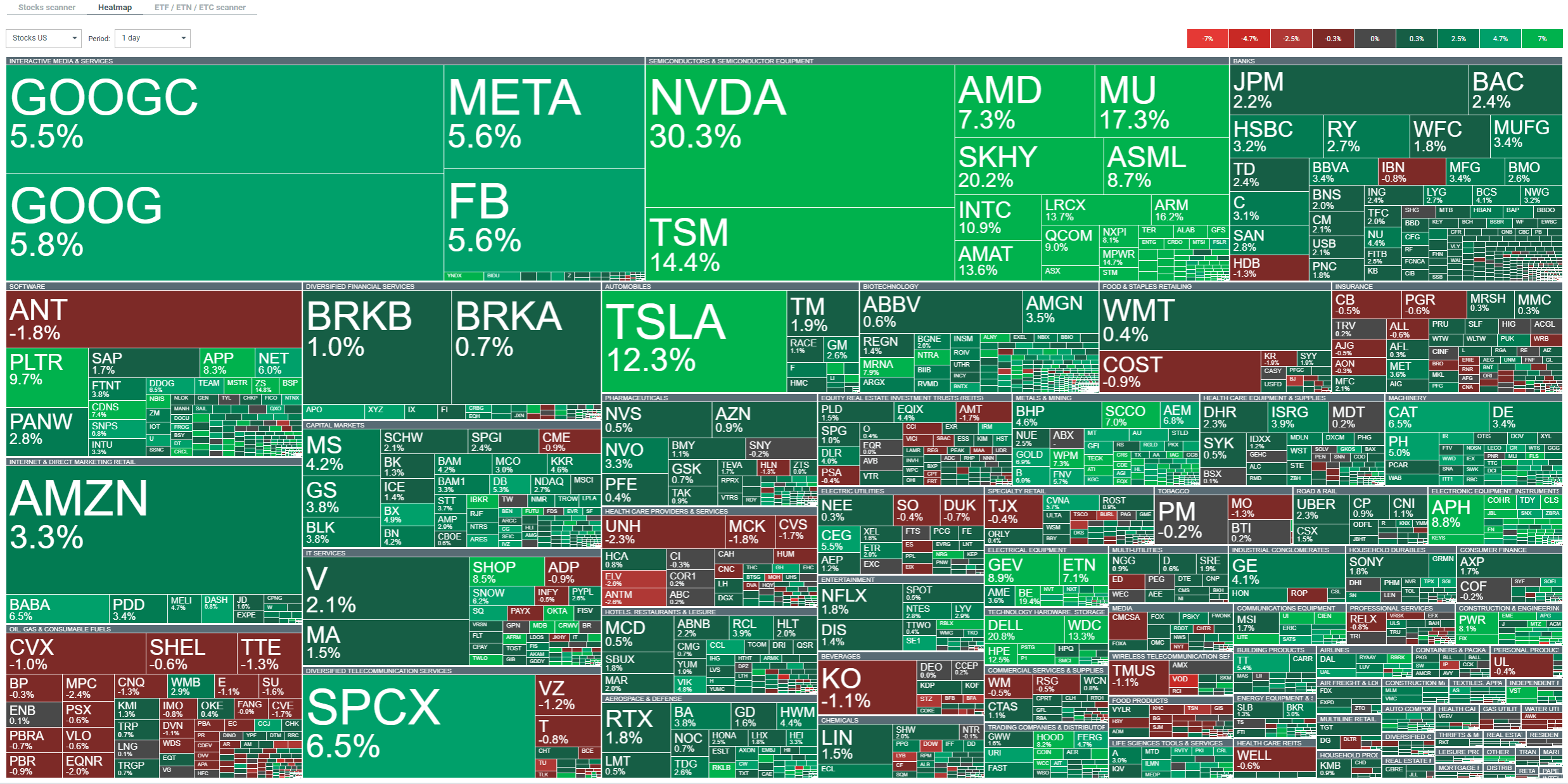
Source: XTB



Daily Summary: Nvidia CEO's Return Restores Hope That the Bull Market Will Continue 💥
BREAKING: Jensen Huang Returns as Nvidia’s Chairman and Chief Executive Officer



Market Warp: The market catches its breath
📈US futures rebound ahead of the market open🚨
The material on this page does not constitute as financial advice and does not take into account your level of understanding, investment objectives, financial situation or any other particular needs.
All the information provided, including opinions, market research, mathematical results and technical analyses published on the website or transmitted to you by other means is provided for information purposes only and should in no event be interpreted as an offer of, or solicitation for, a transaction in any financial instrument, nor should the information provided be construed as advice of legal or fiscal nature.
Any investment decisions you make shall be based exclusively on your level of understanding, investment objectives, financial situation or any other particular needs. Any decision to act on information published on the website or transmitted to you by other means is entirely at your own risk. You are solely responsible for such decisions.
If you are in doubt or are not sure that you understand a particular product, instrument, service, or transaction, you should seek professional or legal advice before trading.
Investing in OTC Derivatives carries a high degree of risk, as they are leveraged based products and often small movements in the market could lead to much larger movements in the value of your investment and this could work against you or for you. Please ensure that you fully understand the risks involved, taking into account your investments objectives and level of experience, before trading, and if necessary, seek independent advice.