



Financial markets have seen a noticeable improvement in sentiment today following reports from Al Arabiya of progress in negotiations between the United States and Iran. According to sources cited by Arab media, both sides have made concessions, while Washington has reportedly approved a draft memorandum of understanding, triggering a sharp decline in oil prices and a rebound in US equity indices.
-
The US and Iran have reportedly made mutual concessions in peace negotiations, according to sources cited by Al Arabiya. The reports suggest that the two countries' positions are moving closer together, although the details of the concessions have not been disclosed.
-
Washington has reportedly approved a draft memorandum of understanding with Tehran, according to Al Jazeera.
-
These developments do not yet constitute a final agreement, but they could represent an important step towards de-escalating the conflict.
-
The US dollar index weakened in response to the reports. If an agreement is reached, a potential decline in Treasury yields could help US equity indices stabilise following their recent losses.
Are the US and Iran moving closer to an agreement? Nuclear negotiations in focus
According to Al Arabiya, negotiations between Washington and Tehran are currently focused on reaching a preliminary agreement that could ease tensions and establish a framework for further peace talks. The first stage would reportedly involve announcing an initial understanding, followed by more detailed negotiations concerning Iran's nuclear programme and frozen financial assets. Saudi Arabia has also reportedly urged mediators to accelerate efforts towards a compromise. Donald Trump has signalled a willingness to continue negotiations but has not ruled out further military action if diplomacy fails to produce the desired results. Despite reports of mutual concessions, the specific terms of a potential agreement have not yet been disclosed, and the information comes from media sources rather than an official joint announcement by the two governments.
Oil prices plunge, Wall Street rebounds as markets price in de-escalation
Reports of progress in US-Iran negotiations triggered an immediate reaction across financial markets, leading to a sharp decline in the geopolitical risk premium embedded in energy prices. Both WTI and Brent crude retreated, while S&P 500 futures rebounded towards 7,589 points and the US dollar index (USDIDX) weakened to around 101.7. A potential easing of tensions in the Middle East could reduce the risk of further disruptions to oil supplies, thereby alleviating inflationary pressures and expectations of additional Federal Reserve interest-rate hikes. Such a scenario would be particularly supportive of technology stocks, whose valuations remain sensitive to changes in bond yields. However, risks remain elevated, as no formal agreement has been announced, and a breakdown in negotiations could quickly restore upward pressure on oil prices.
US500 chart (H1, D1 timeframes)
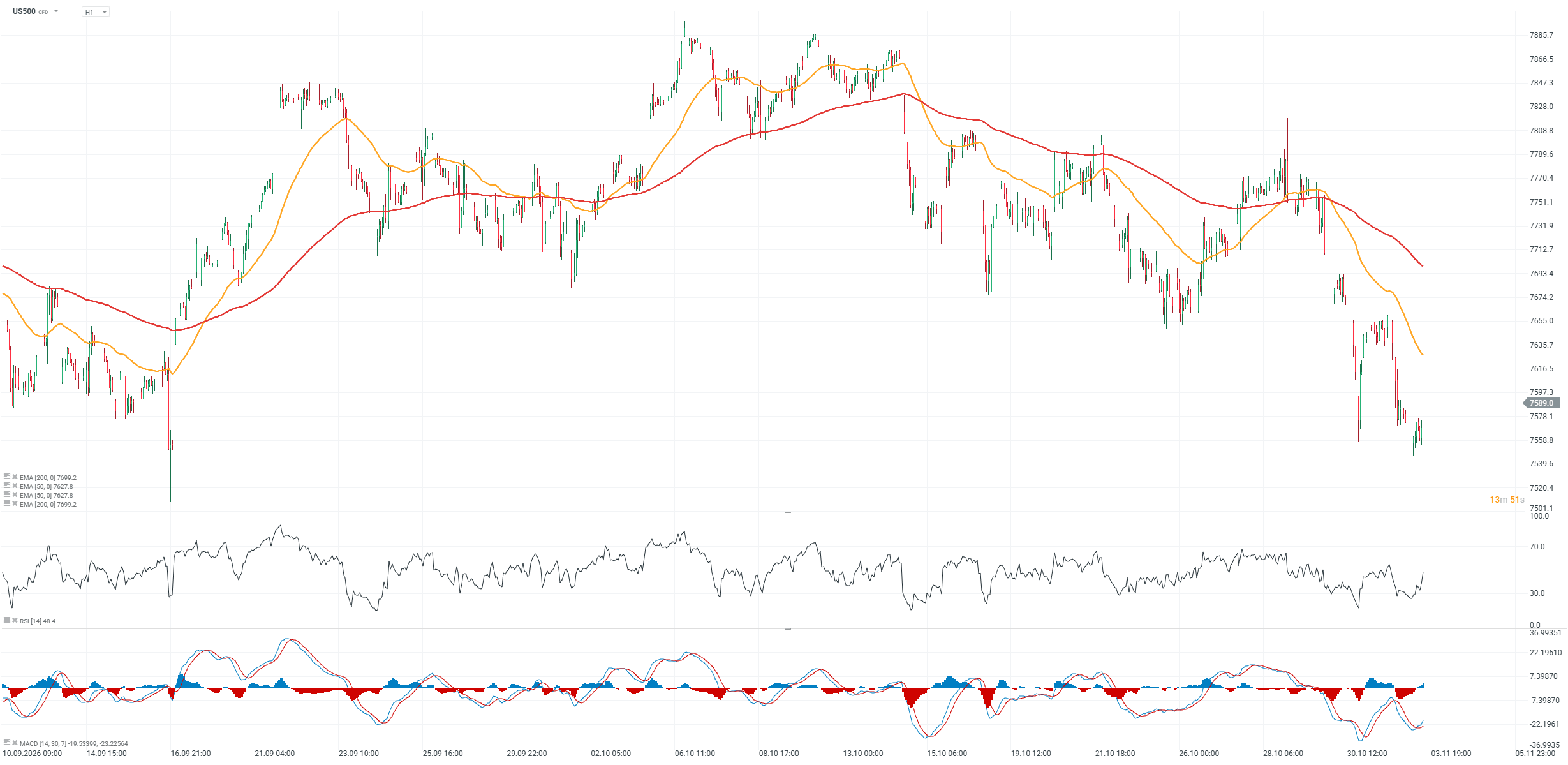
S&P 500 futures are attempting to establish a bottom around 7,600 points, with sustained gains on elevated trading volume now crucial to the strength of any recovery. If the rebound fails to develop into a V-shaped recovery, not only in US500 but particularly in US100, investors may interpret this as a sign of underlying weakness and a potential return of selling pressure at higher levels. Key resistance for US500 currently stands at 7,655 points, where significant price reactions have occurred, followed by the 7,700-point level, which coincides with the 200-period exponential moving average (EMA200, red line).
Source: xStation5
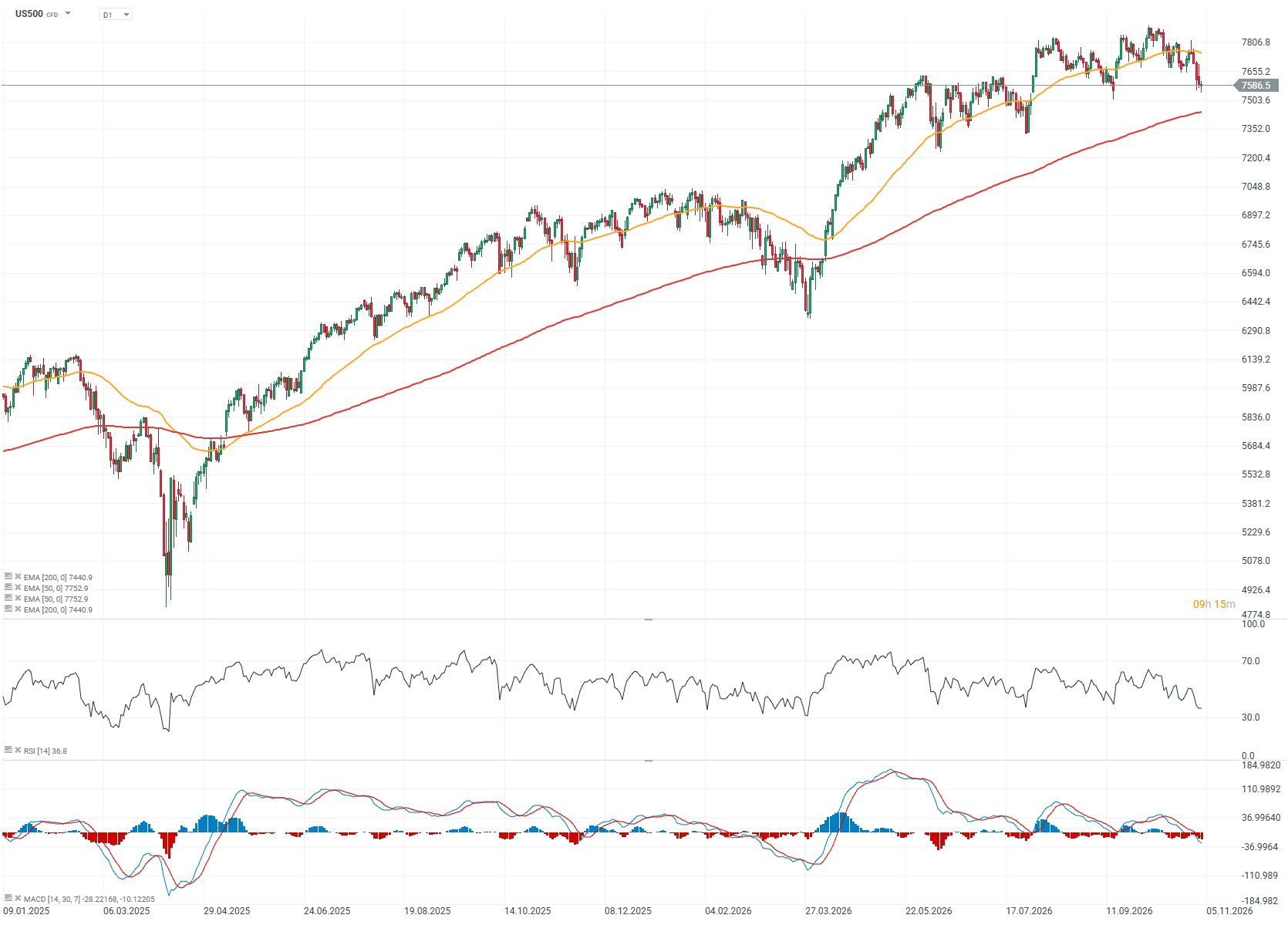
Looking at the daily timeframe, we can see that US500 has experienced three significant downward moves since May and is currently undergoing a fourth. On each previous occasion, declines below the 50-day exponential moving average (EMA50, orange line) were followed by a relatively swift return of buyers. If this pattern is to repeat, renewed buying activity during today's session or over the coming days will be crucial. A deeper decline below the EMA50, or a failed attempt to break above 7,630 points, where the moving average currently stands, could signal a more pronounced correction, potentially resembling the scenario seen this spring, when a recovery above the EMA50 ultimately proved to be a false breakout.
Source: xStation5



Daily Summary: The Honeymoon Is Over: Wall Street Plunges Into a Massive Sell-Off

Nasdaq Sell-Off 🚩 Technology Stocks Suffer Heavy Losses

US Open: Wall Street’s post-election rally loses steam as reality sets in



Market Wrap: European Gas Rebounds as Rheinmetall Plunges
The material on this page does not constitute as financial advice and does not take into account your level of understanding, investment objectives, financial situation or any other particular needs.
All the information provided, including opinions, market research, mathematical results and technical analyses published on the website or transmitted to you by other means is provided for information purposes only and should in no event be interpreted as an offer of, or solicitation for, a transaction in any financial instrument, nor should the information provided be construed as advice of legal or fiscal nature.
Any investment decisions you make shall be based exclusively on your level of understanding, investment objectives, financial situation or any other particular needs. Any decision to act on information published on the website or transmitted to you by other means is entirely at your own risk. You are solely responsible for such decisions.
If you are in doubt or are not sure that you understand a particular product, instrument, service, or transaction, you should seek professional or legal advice before trading.
Investing in OTC Derivatives carries a high degree of risk, as they are leveraged based products and often small movements in the market could lead to much larger movements in the value of your investment and this could work against you or for you. Please ensure that you fully understand the risks involved, taking into account your investments objectives and level of experience, before trading, and if necessary, seek independent advice.