

- Germany's composite PMI rose to 55.0 points in November, reaching its highest level since March 2022.
- France's composite PMI fell to 46.2 points, signaling ongoing economic contraction and a rising risk of recession.
- Strong German data and sticky inflation support expectations for a December interest rate hike by the ECB.
Preliminary November PMIs from the two largest economies in the eurozone showed a clear divergence. In Germany, the composite index rose to 55.0 pts, the highest since March 2022, clearly exceeding expectations. In France, activity has been contracting for a second consecutive month, with the risk of a technical recession growing in Q4. In Germany, both key indicators are in expansion territory, while in France they remain in contraction.
Germany
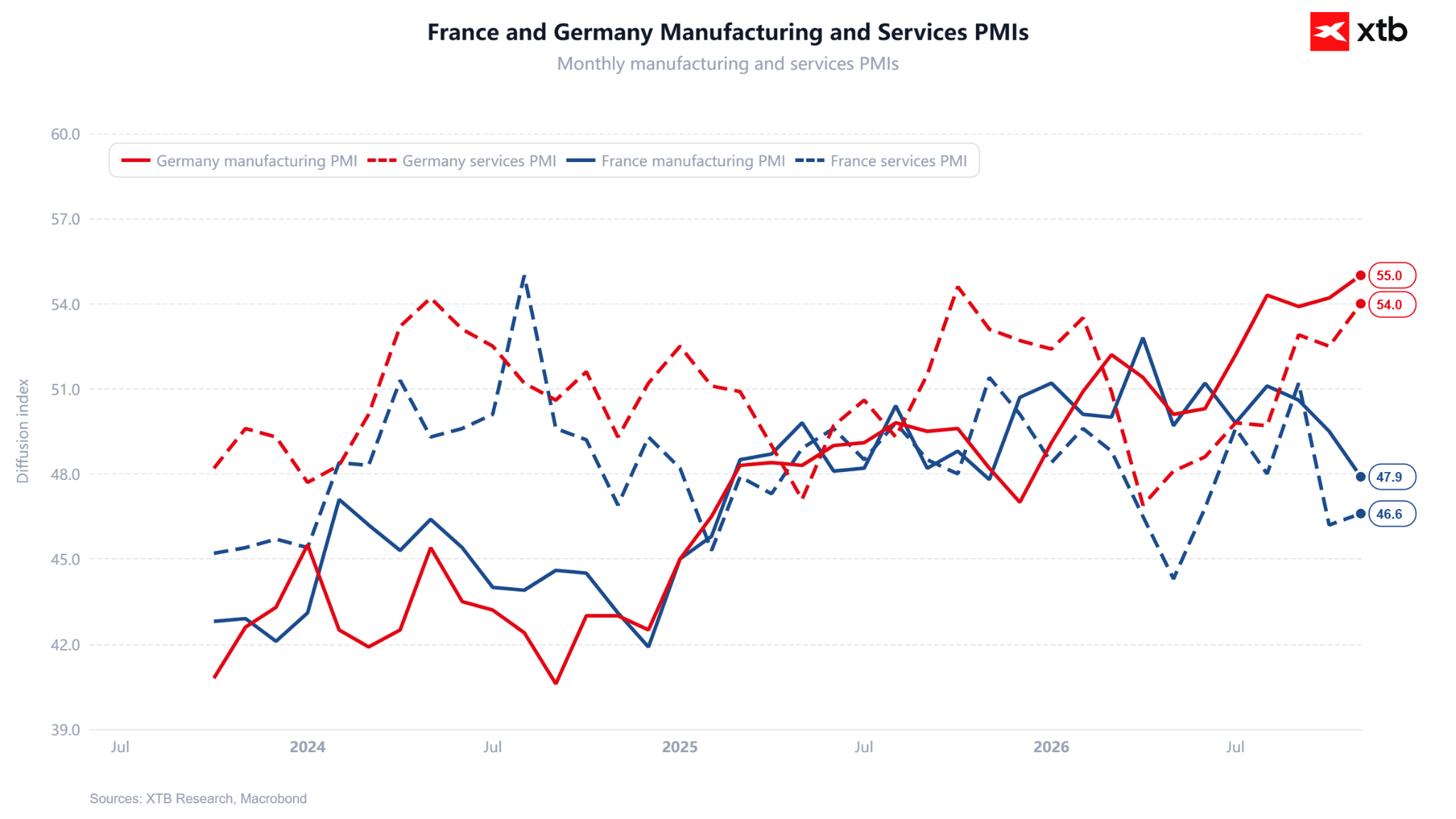
- Composite PMI: 55.0 pts. Previously 53.4, with the consensus expecting a drop to 53.2. This is the highest reading since March 2022 and the fifth consecutive month of expansion.
- Manufacturing: 55.0 pts (previously 54.2). Highest since March 2022 and the tenth month of growth. New orders rose to 54.8 from 53.9, mainly driven by export orders.
- Services: 54.0 pts (previously 52.5), a 13-month high. New business rose to 52.6 from 49.6, returning above the 50-point mark.
- Manufacturing employment is growing again. The longest streak of job cuts in the survey's history has ended. However, the overall labor market remains weak.
France
- Composite PMI: 46.2 pts. Previously 46.6, against market expectations of an improvement to 47.9. This is the lowest level since May 2026 and the second consecutive month of decline.
- Manufacturing: 47.9 pts (previously 49.5). New orders fell to 43.6 pts, the lowest since July 2025, contracting for the seventh month in a row.
- Services: 46.6 pts (previously 46.2). A slight improvement, but the sector remains firmly in contraction.
- New orders economy-wide have been falling for 12 consecutive months.
Commentary
The German economy is emerging from years of stagnation, driven by massive public spending on infrastructure and defense as well as strong exports. Crucially, the improvement now extends to services—the part of the economy reliant on domestic demand. S&P Global explicitly highlights a “broadening recovery.” The German Council of Economic Experts raised its GDP growth forecast for Germany this year to 1.3%, more than double its spring projection.
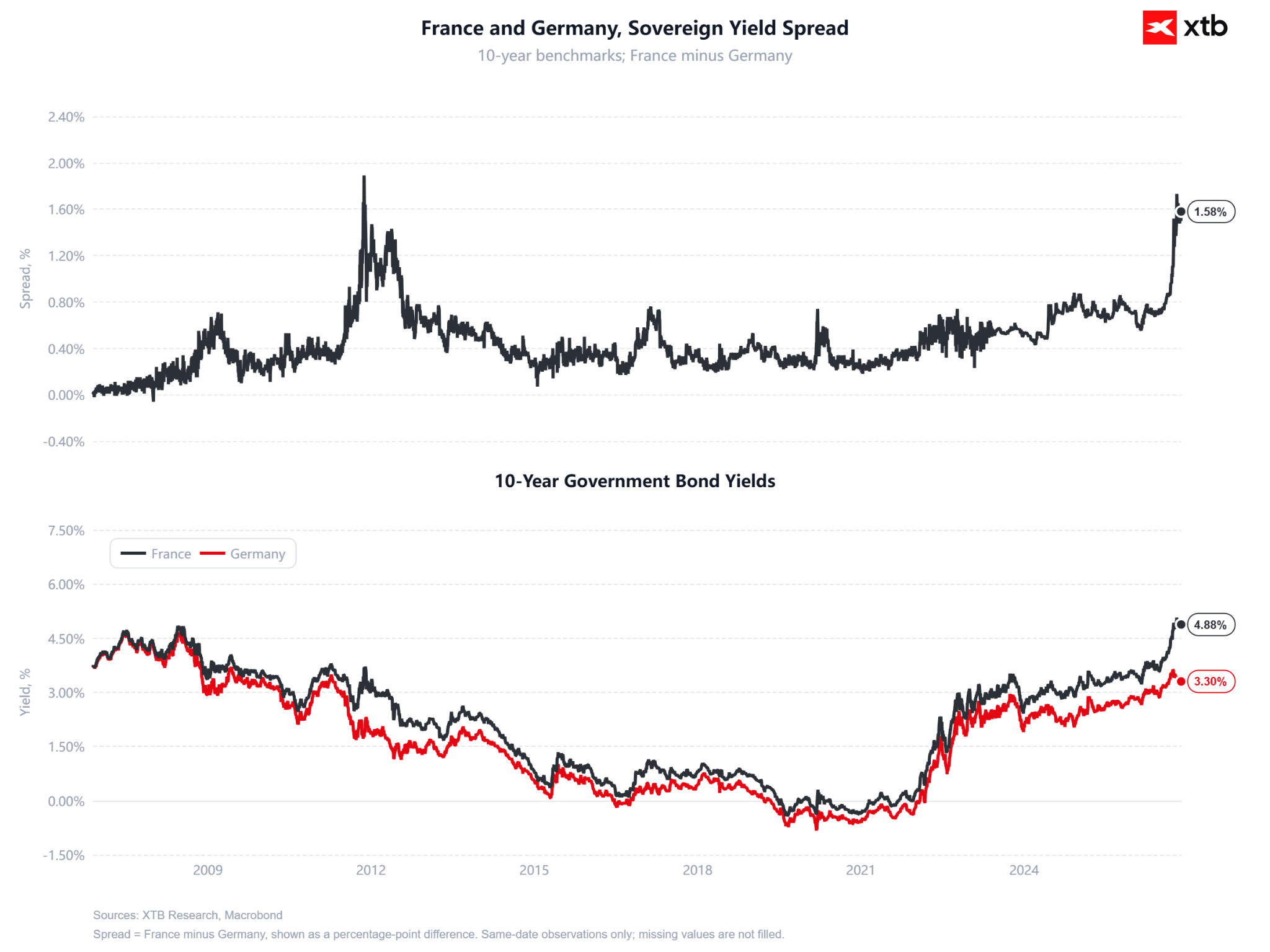
In France, the situation is the complete opposite. Businesses and consumers are holding off on decisions ahead of next year's presidential election. Concerns over public finances are resurfacing, and French bond yields have risen noticeably. The European Commission expects French GDP growth of just 0.4% this year. According to S&P Global, November's data increases the likelihood of a technical recession in Q4. Additionally, social protests further complicate efforts to reduce the deficit.
The shared backdrop for both nations includes high energy commodity prices following the war with Iran, persistent inflation, and policy tightening by the ECB. The central bank has already raised rates twice this year, with markets expecting a third hike in December. Rising global bond yields are further tightening financial conditions and could eventually slow Germany down as well. Nevertheless, looking at bond yields, German yields have recently pulled back noticeably, while French yields resumed their upward path.
Impact on the Euro
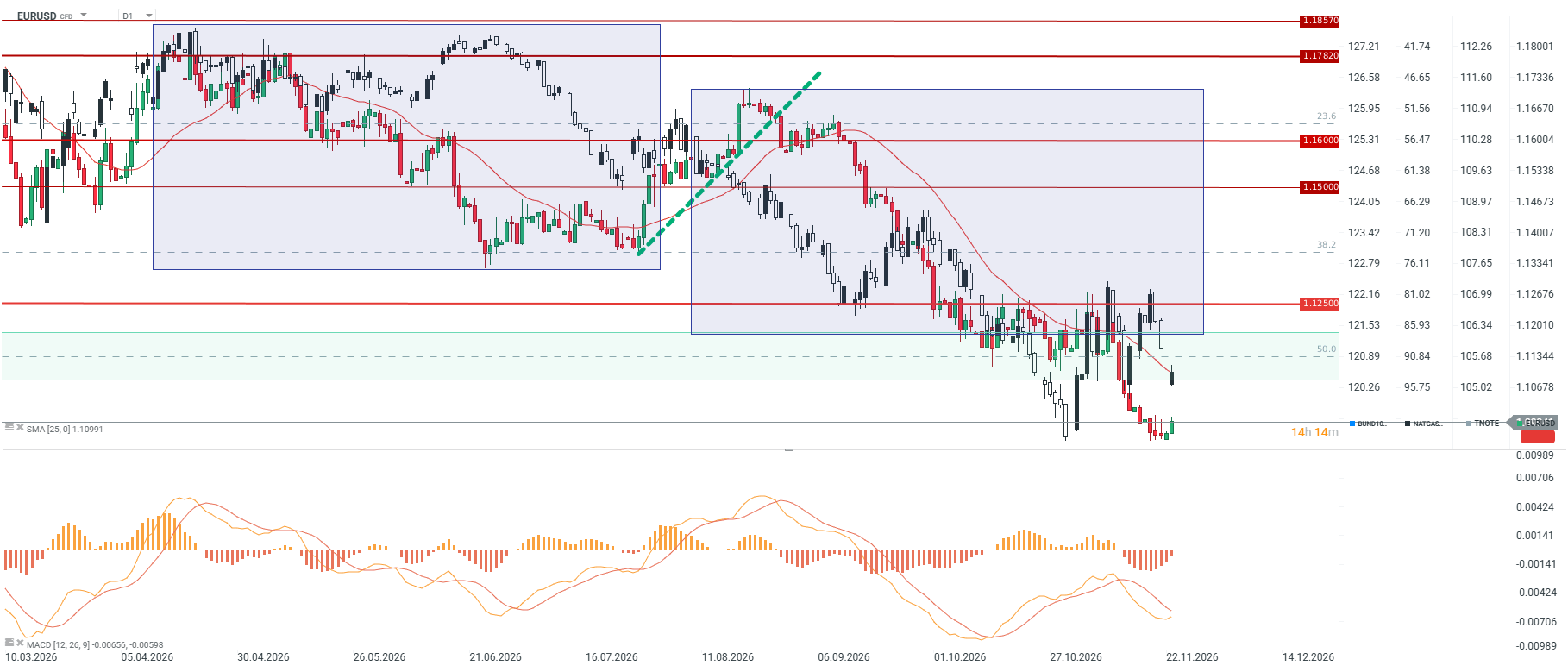
German data matters more for the single currency, as Germany is the eurozone's largest economy and holds the largest weight in the aggregate PMI. Strong readings, especially in services and alongside sticky inflation, bolster the case for a December rate hike by the ECB. This supports EUR on the EURUSD pair. However, weakness in France limits the upside. Paris's fiscal and political troubles increase the risk of a widening OAT–Bund spread, which has historically weighed on the euro. Still, it is worth noting that today's euro rebound is largely technical and driven by profit-taking after the recent sell-off. Another headwind for the euro is the resurgence in European gas prices amid a cold snap across Europe.
Impact on Stock Indices
- DAX: Strong export orders, a recovery in manufacturing employment, and a turnaround in services are positive news for cyclical, industrial, and defense stocks. The main headwinds are rising bond yields and the prospect of further interest rate hikes, which cap valuations.
- CAC 40: Data is particularly negative for companies reliant on the French domestic market, such as banks, construction, and retail. The index is partially cushioned by global conglomerates with large revenues outside France, e.g., in the luxury goods sector. Pre-election political risk and rising debt service costs favor underperformance in Paris relative to Frankfurt.
- Broader European Market (Euro Stoxx 50): A stronger Germany could offset French weakness. However, divergence between member states is widening, so performance gaps between the DAX and CAC 40 may deepen in the coming weeks.
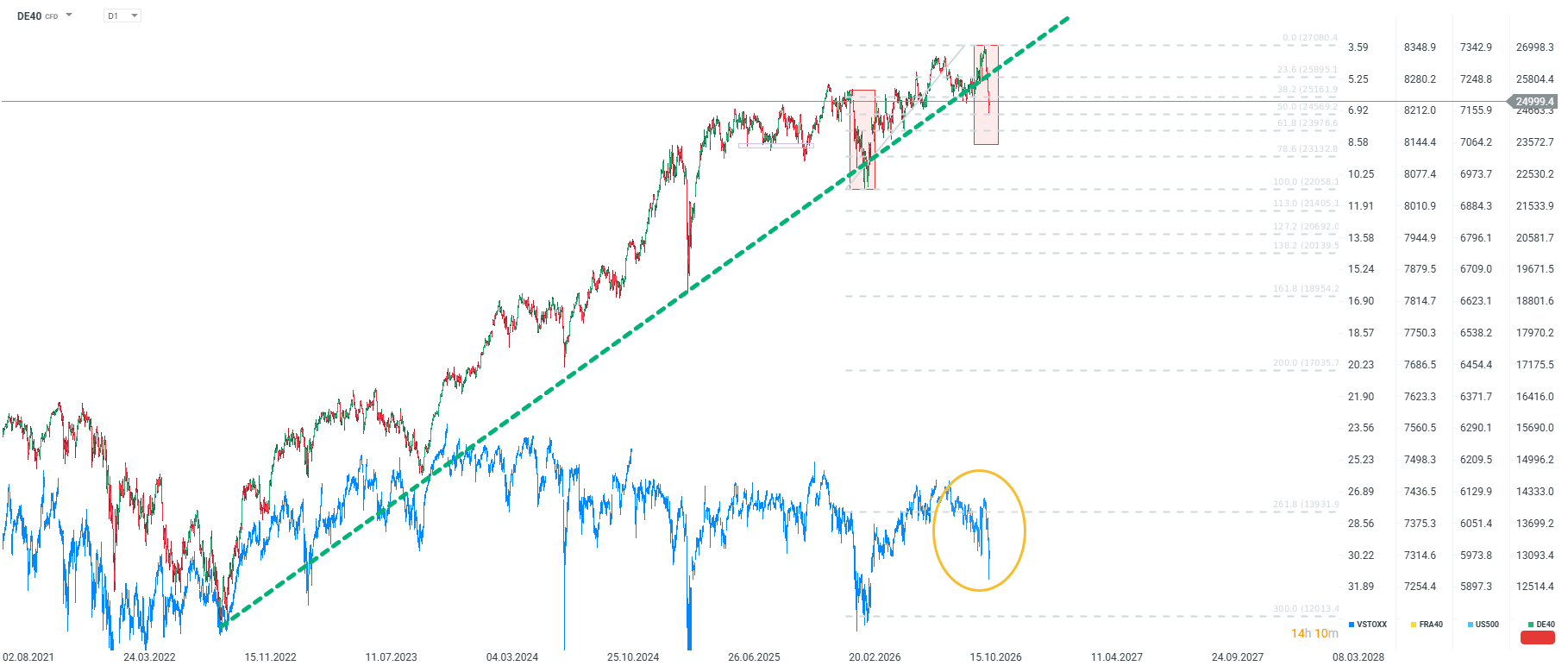 Germany's DAX experienced a heavy sell-off triggered by a sharp decline in tech stocks. From a long-term perspective, however, the move remains relatively minor. The long-term upward trendline was only slightly breached, and European equity volatility remains much lower than levels seen in February or in 2024–2025. Key support lies around the 24,000-point area. Source: XTB


🔴Morning Wrap: Technical rebound after AI crash and Asian interventions


Market Wrap: Global stocks post 7th consecutive session of losses, Anthropic failed to reassure the market (20.11.2026)

Gold loses a third of its value. It's liquidity and the Fed, not peace in Shenzhen


Economic Calendar: Trump-Xi Jinping-Putin summit ongoing, time for Walmart results (19.11.2026)
The material on this page does not constitute as financial advice and does not take into account your level of understanding, investment objectives, financial situation or any other particular needs.
All the information provided, including opinions, market research, mathematical results and technical analyses published on the website or transmitted to you by other means is provided for information purposes only and should in no event be interpreted as an offer of, or solicitation for, a transaction in any financial instrument, nor should the information provided be construed as advice of legal or fiscal nature.
Any investment decisions you make shall be based exclusively on your level of understanding, investment objectives, financial situation or any other particular needs. Any decision to act on information published on the website or transmitted to you by other means is entirely at your own risk. You are solely responsible for such decisions.
If you are in doubt or are not sure that you understand a particular product, instrument, service, or transaction, you should seek professional or legal advice before trading.
Investing in OTC Derivatives carries a high degree of risk, as they are leveraged based products and often small movements in the market could lead to much larger movements in the value of your investment and this could work against you or for you. Please ensure that you fully understand the risks involved, taking into account your investments objectives and level of experience, before trading, and if necessary, seek independent advice.