



The past week was the worst for the Nasdaq since April 2025 and the infamous “Liberation Day”, which introduced considerable turmoil to the market regarding tariffs. Today, US indices are rising strongly, with futures contracts on the Nasdaq 100 up by over 1.3% and on the S&P 500 by around 0.8%.
Figure 1: Percentage of Nasdaq 100 Companies Above 50-Day Moving Average (2024 - 2026)
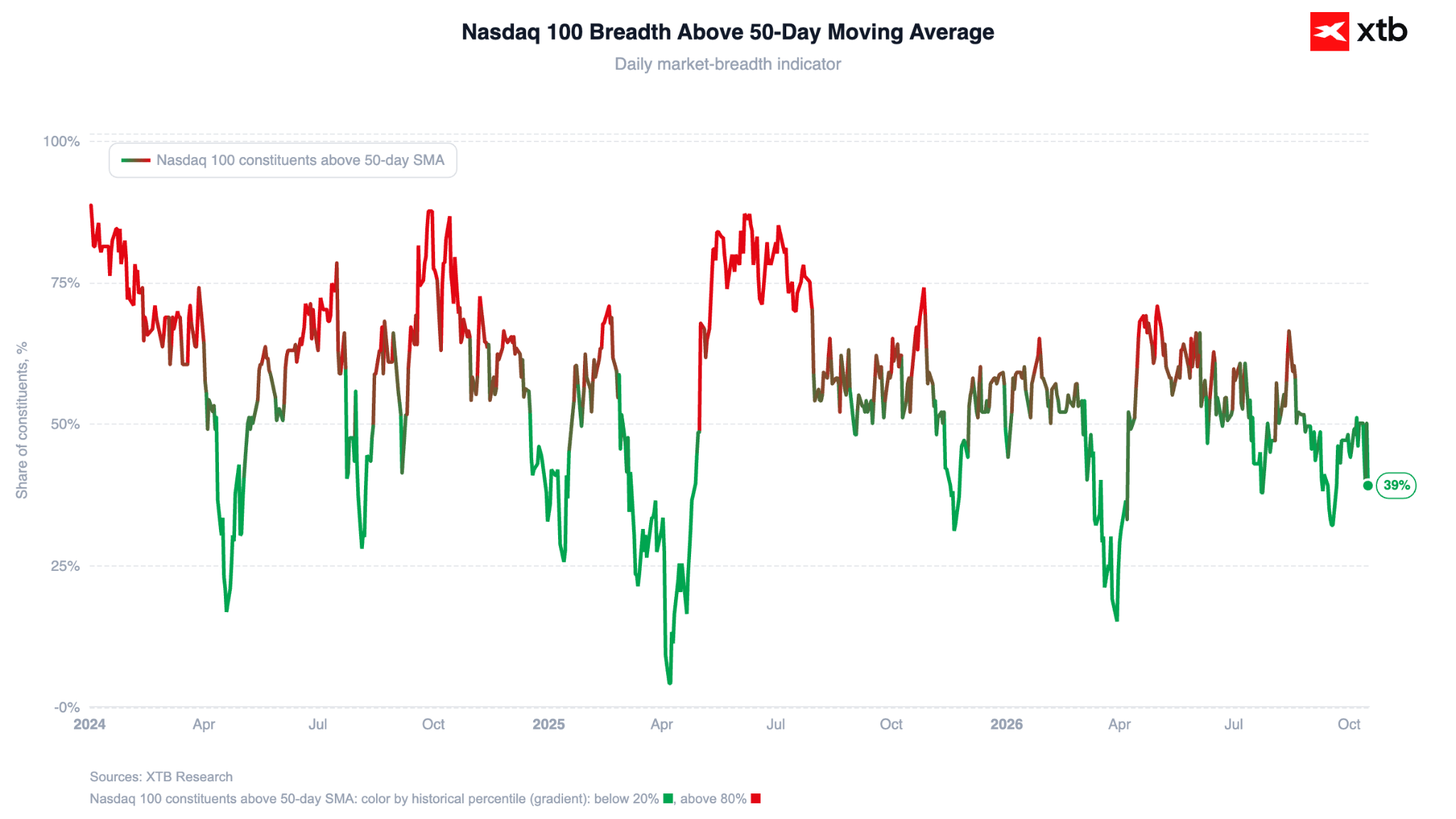 Source: XTB Research, 19.10.2026
Investors are awaiting quarterly reports scheduled for this week from the largest technology companies: Tesla, Meta, and IBM will publish their results on Wednesday, following Netflix a day earlier.
Figure 2: Dashboard for Tesla (2024 - 2026)
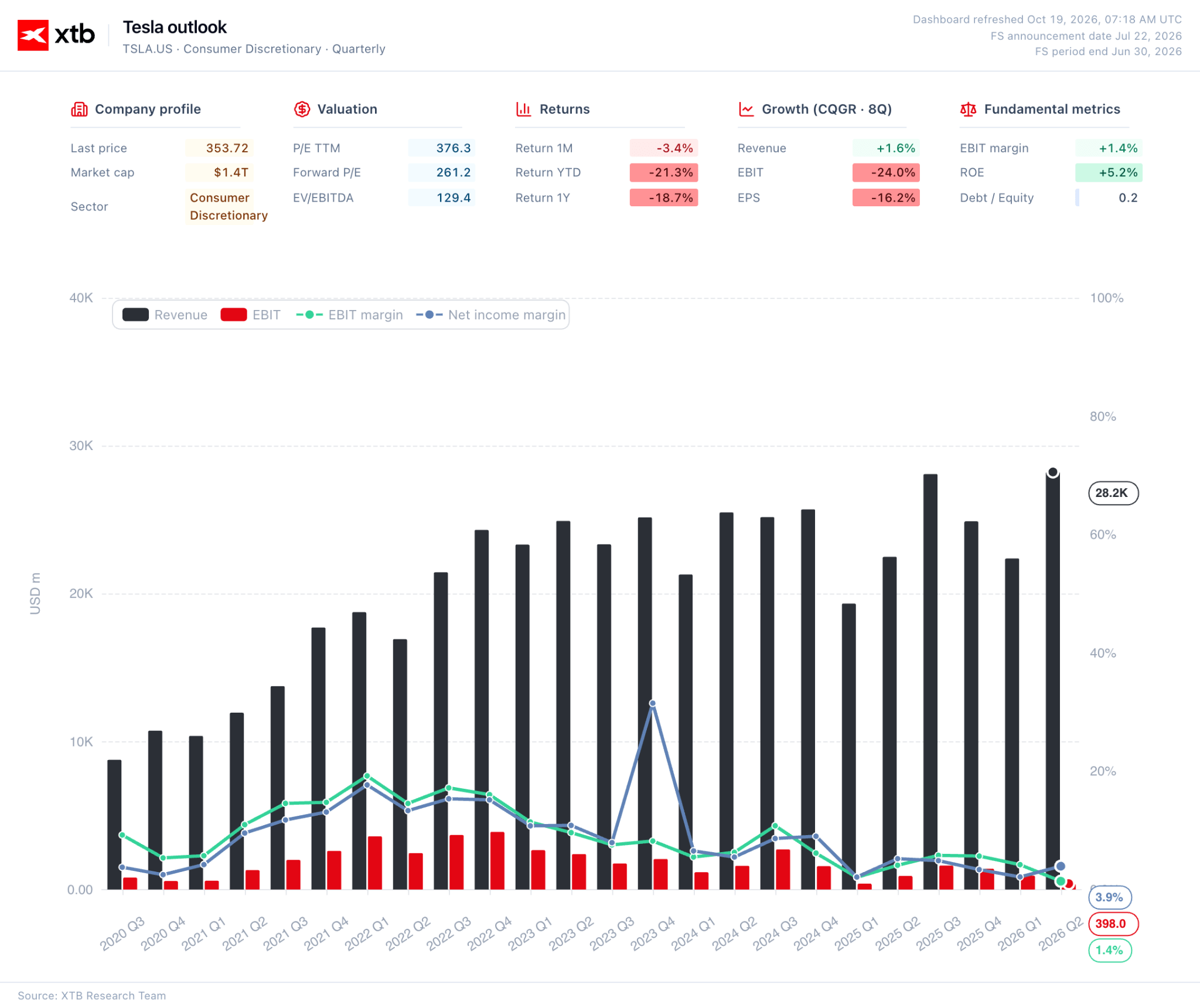 Source: XTB Research, 19.10.2026
In the background, however, at least five key issues remain that will weigh on market sentiment: growing doubts surrounding the financing of the AI boom, US Treasuries returning to their role as a safe haven, crude oil falling from a five-month peak, a marked escalation of geopolitical tensions between the US and Ukraine, and anxiety over France’s fiscal situation following weekend protests.
📈 Equities
Behind us lies the largest jump in the VIX index since June and the longest losing streak for the SOXX index since 2008. Today, risk appetite is returning to the markets. As noted earlier, Nasdaq 100 futures are up 1.3%, while S&P 500 futures are up 0.8%.
Figure 3: Nasdaq 100 – Semiconductors (2026)
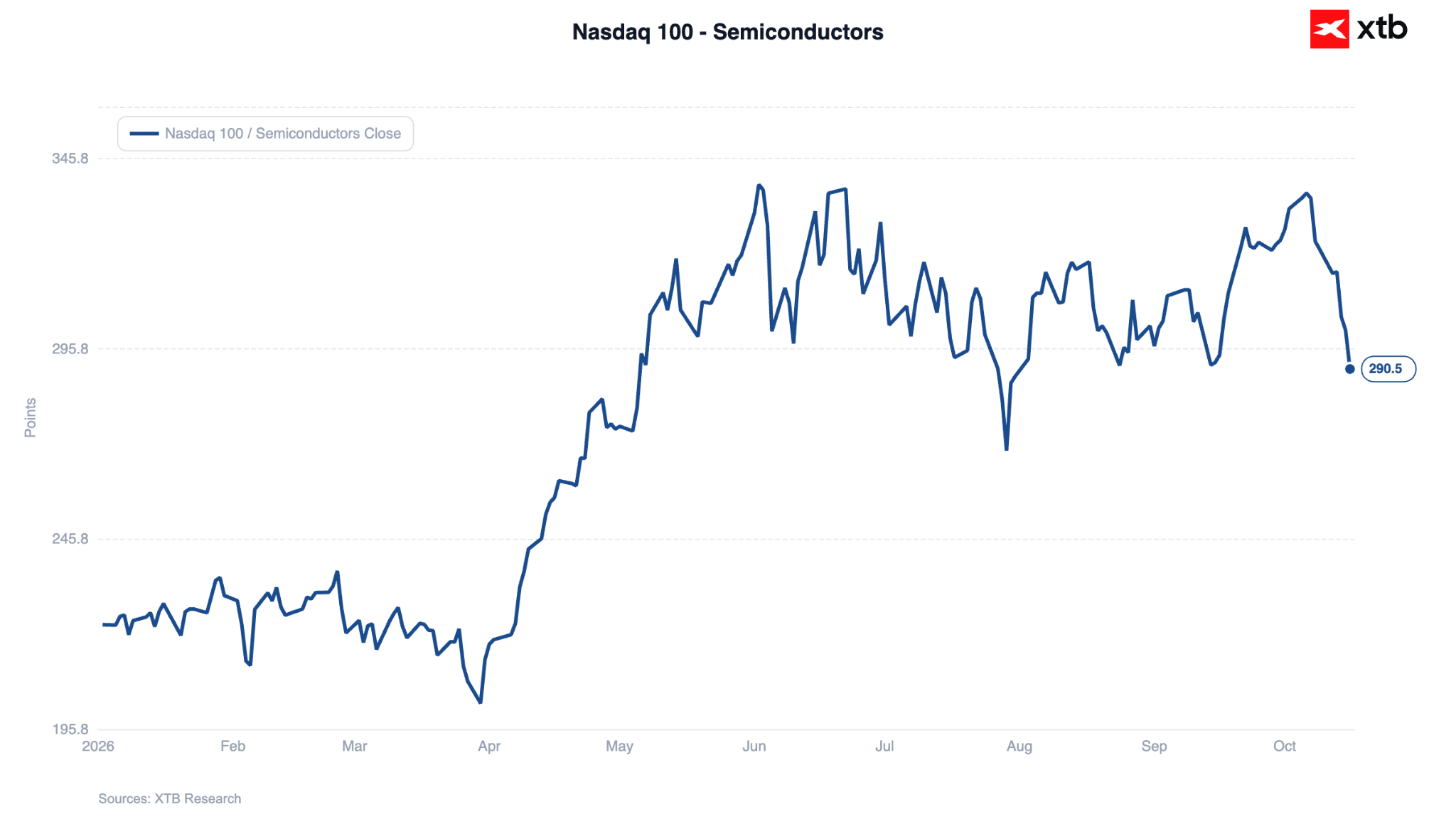 Source: XTB Research, 19.10.2026
In Asia, the picture is mixed: Japan's Nikkei 225 is down 0.8%, while South Korea's Kospi gains around 0.2%. The Shanghai SE Composite remains stable following a better-than-expected GDP reading (more below). European futures are losing ground, with the Euro Stoxx 50 down 0.3% following weekend protests in France.
It is worth mentioning the new DeepSeek model, which revived concerns that AI development may require less computing power than the market assumes, and consequently lower demand for microchips. This led to a brief sell-off in Asian chipmakers, though most of those losses have already been recovered.
This week, earnings season will take centre stage. On Tuesday, Netflix will publish its results, followed a day later by Tesla, Meta, and IBM. This represents the first real test of investor confidence in the "AI play" after recent turbulence; the market will look to hyperscalers' results for confirmation of whether giant capital expenditures are beginning to translate into profits.
The recent sell-off hit CoreWeave hardest, a cloud service provider whose major shareholders include Nvidia. Yields on its bonds briefly touched 15%. A further source of nervousness came from signs of slowing revenue growth at Anthropic (notably, the company announced it would allocate 5% of its shares to a new "public benefit" fund aimed at mitigating AI's negative impact on the labor market).
📈 Debt market
The most interesting trend of recent days is the turnaround in the bond market. US debt instruments are beginning to regain their traditional role as a safe haven. Last week, the 10-year yield fell by around 17 bps. Over the same period, the Nasdaq 100 lost around 5.5%. The last time such a sharp move occurred in tandem was April 2025, following the announcement of the highest tariffs on US imports in over 100 years.
Figure 4: Bond Yields and WTI Crude Oil Prices (2026)
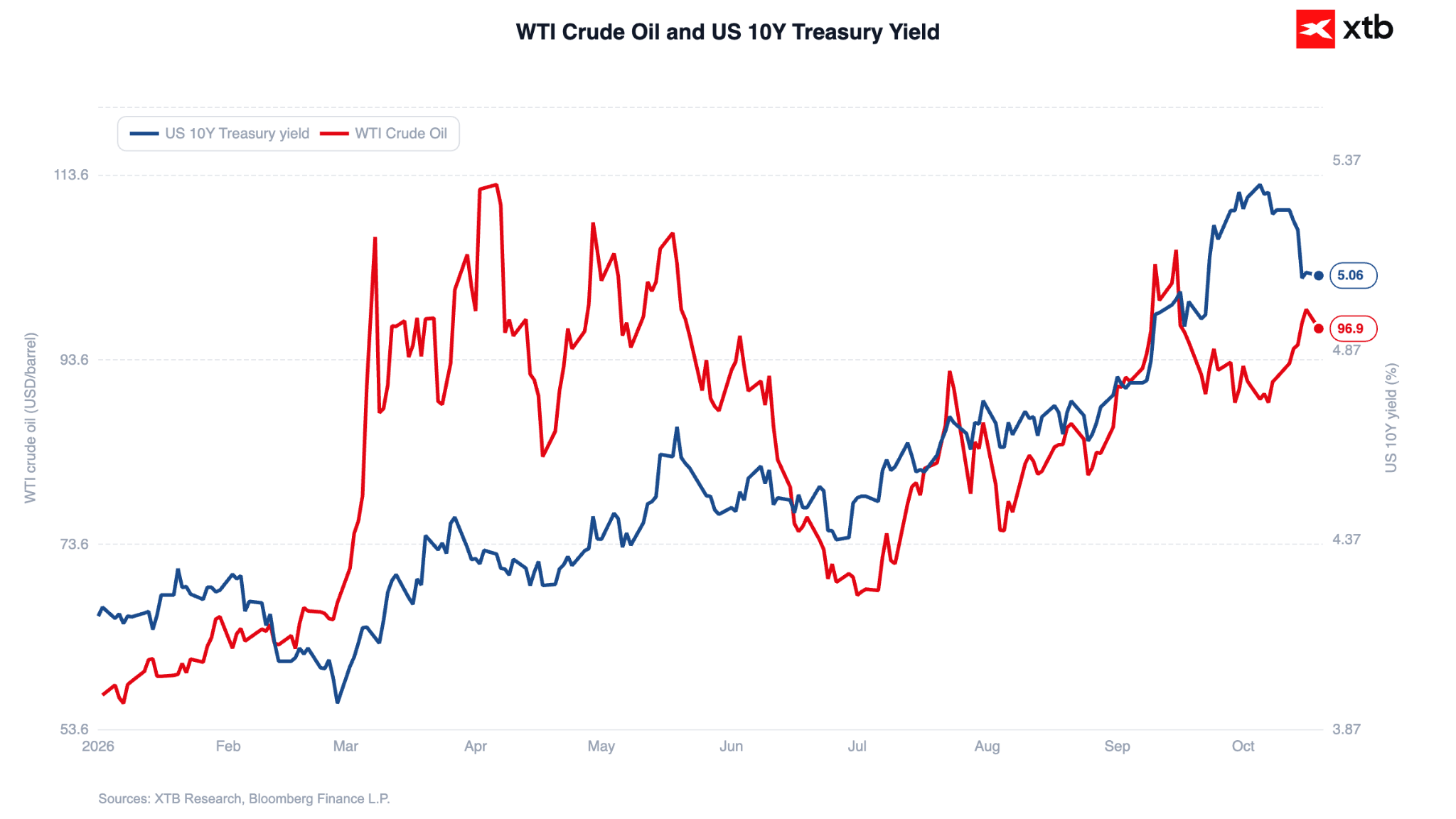 Source: XTB Research, 19.10.2026
The rebound in the debt market is significant because bonds had failed as a hedge over previous months: high inflation, a resilient economy, and a flood of government and corporate debt issuance (partly to finance the AI boom) pushed 10-year yields to their highest levels in over two decades. The current move is amplified by exceptionally aggressive investor positioning, which created scope for short covering. Naturally, voices remain warning that the rebound may be short-lived given persistent inflation risks.
📈 Monetary policy
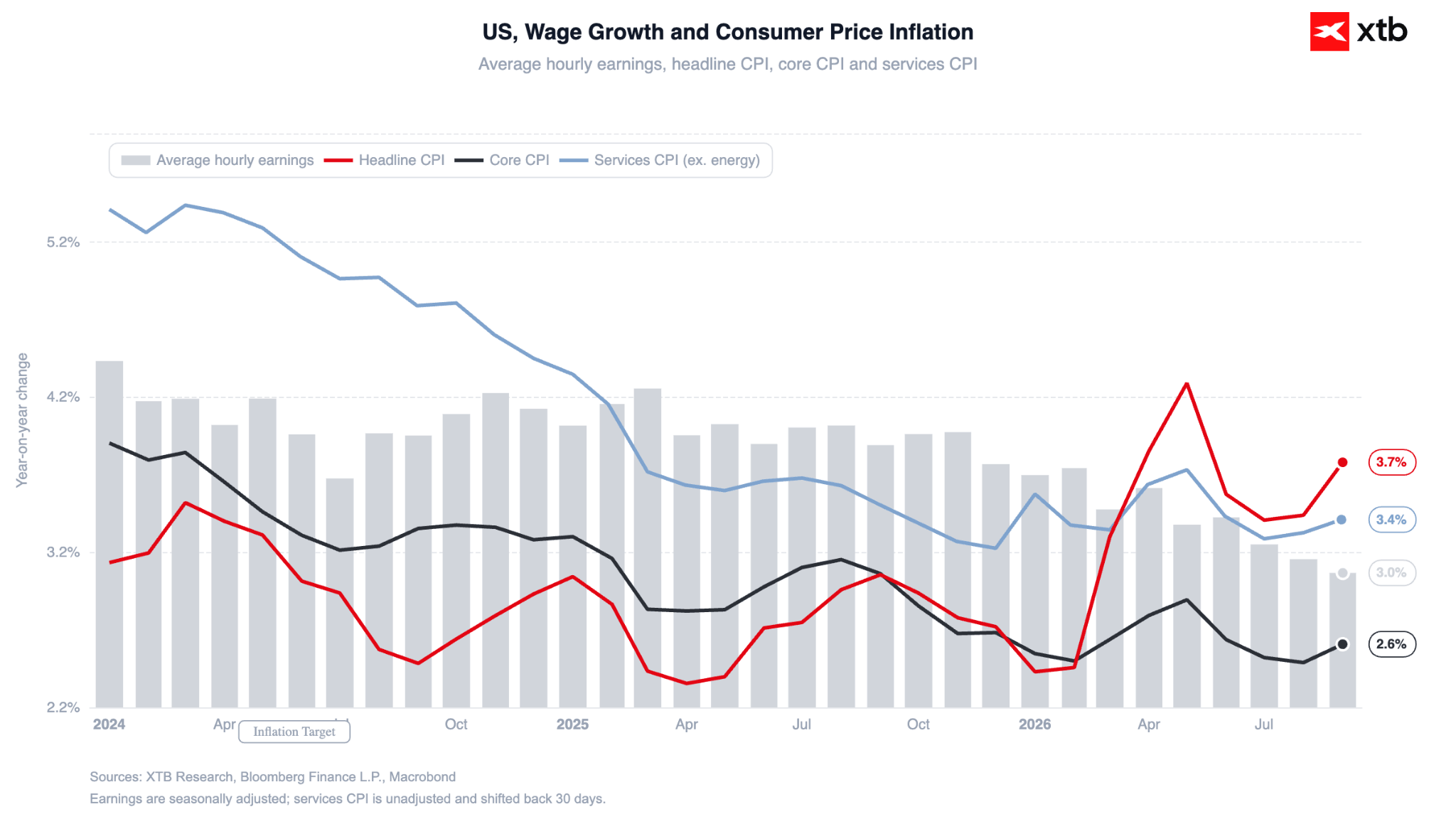
A hotter-than-expected CPI inflation reading failed to boost bets on an October interest rate hike. The market appears reluctant to believe in a continuation of the tightening cycle at the upcoming meeting, assigning less than a 15% probability to such a scenario.
Figure 5: CPI Inflation and Wage Growth in the US (2024 - 2026)
 Source: XTB Research, 19.10.2026
The equity sell-off and Friday's speech by Fed Chair Kevin Warsh at the IMF annual meeting provided little support; he did not refer directly to future FOMC actions regarding monetary policy or the US economic outlook, reiterating only that the Fed remains committed to price stability.
Investors continue to price in further tightening later this year. A rate hike in December is almost fully priced in.
📈 Economic data
In China, third-quarter GDP grew by 4.5% year-on-year, slightly above the forecast of 4.4%, boosting the chances of meeting Beijing's annual target.
In the coming days, key releases include September wage growth data in Poland (Tuesday), CPI inflation in the UK (Wednesday) and Japan (Friday). On the macro front, main attention will likely center on October PMI figures from the eurozone and the United States (Friday).
🛢️ Energy commodities
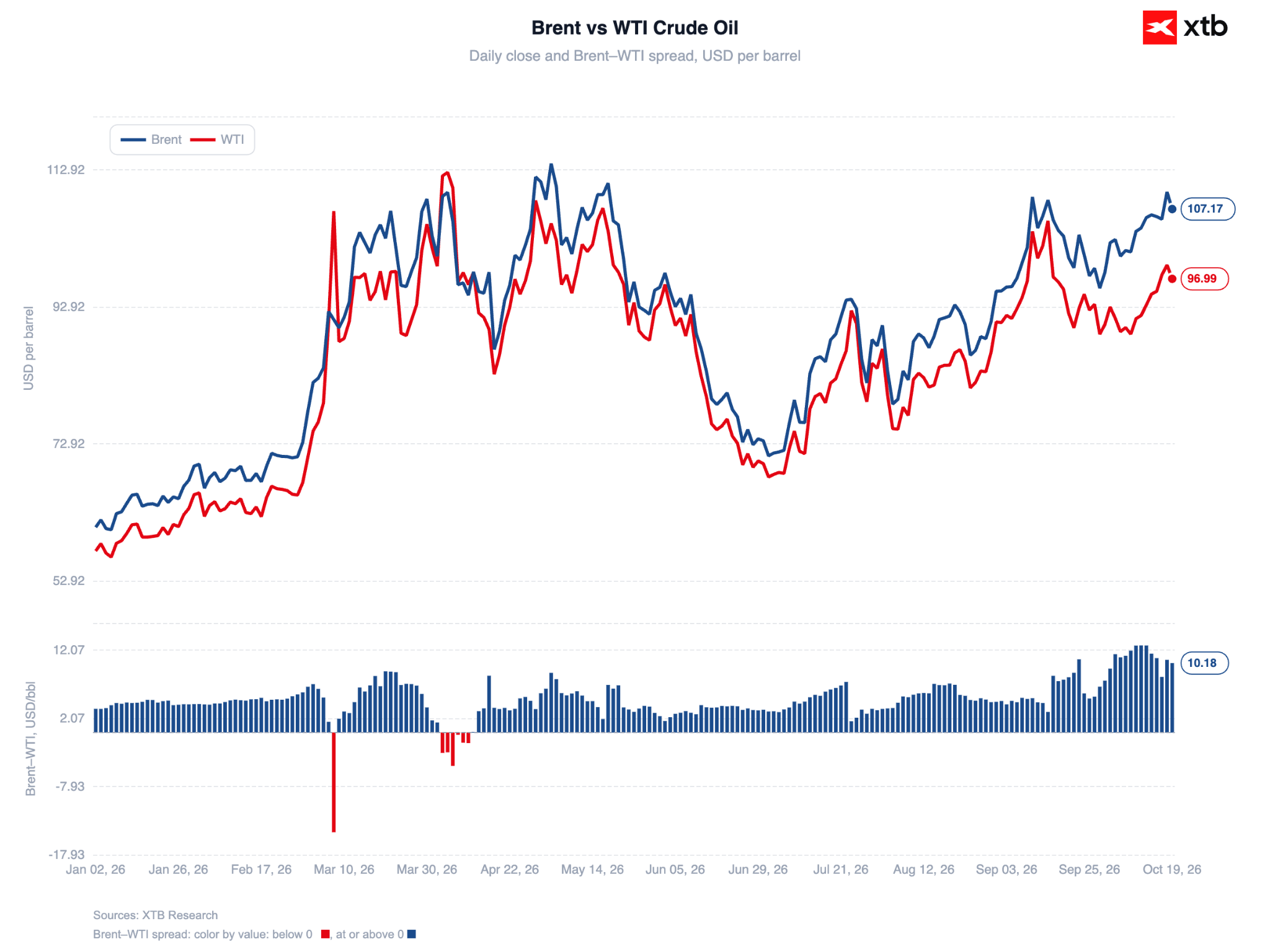
Crude oil is pulling back from its five-month high. Brent is down 1.7% to around USD 108 per barrel, after surging nearly 4% on Friday, while WTI is easing towards USD 97. Investors must weigh two competing factors: the return of crude flows near pre-war levels versus the emergence of fresh flashpoints.
Figure 6: Brent and WTI Crude Oil (2026)
 Source: XTB Research, 19.10.2026
Over the weekend, a Saudi helicopter crashed near the Yemeni border, the Houthis attacked Yanbu, a key export terminal, and British maritime authorities reported strikes on two tankers in the Persian Gulf.
Nevertheless, according to US Energy Secretary Chris Wright, crude oil flows from the Persian Gulf stand at around 80% of pre-conflict levels. A more pressing issue lies in the transport of refined fuels, with diesel prices rising significantly faster and further than crude.
Crucial political decisions remain in the background: Donald Trump confirmed that the US reached an agreement with Russia regarding diesel exports and suspended a portion of tariffs and sanctions on Russian energy supplies. This drew cross-party criticism in Congress, where a bill blocking these purchases has been introduced.
🌍 Geopolitics
Tensions between the US and Ukraine are mounting. President Volodymyr Zelensky accused Trump of attempting to pressure Kyiv into capitulation to Russia, citing a series of unfriendly actions from Washington: throttling Starlink service, delaying Patriot missile deliveries, and failing to provide warnings about Russian missile strikes. Crucially for markets, both Ukraine and Russia continue to target energy infrastructure.
In Europe, focus remains on France, where mass weekend protests deepened concerns regarding the health of the country's public finances.
🪙 Precious metals
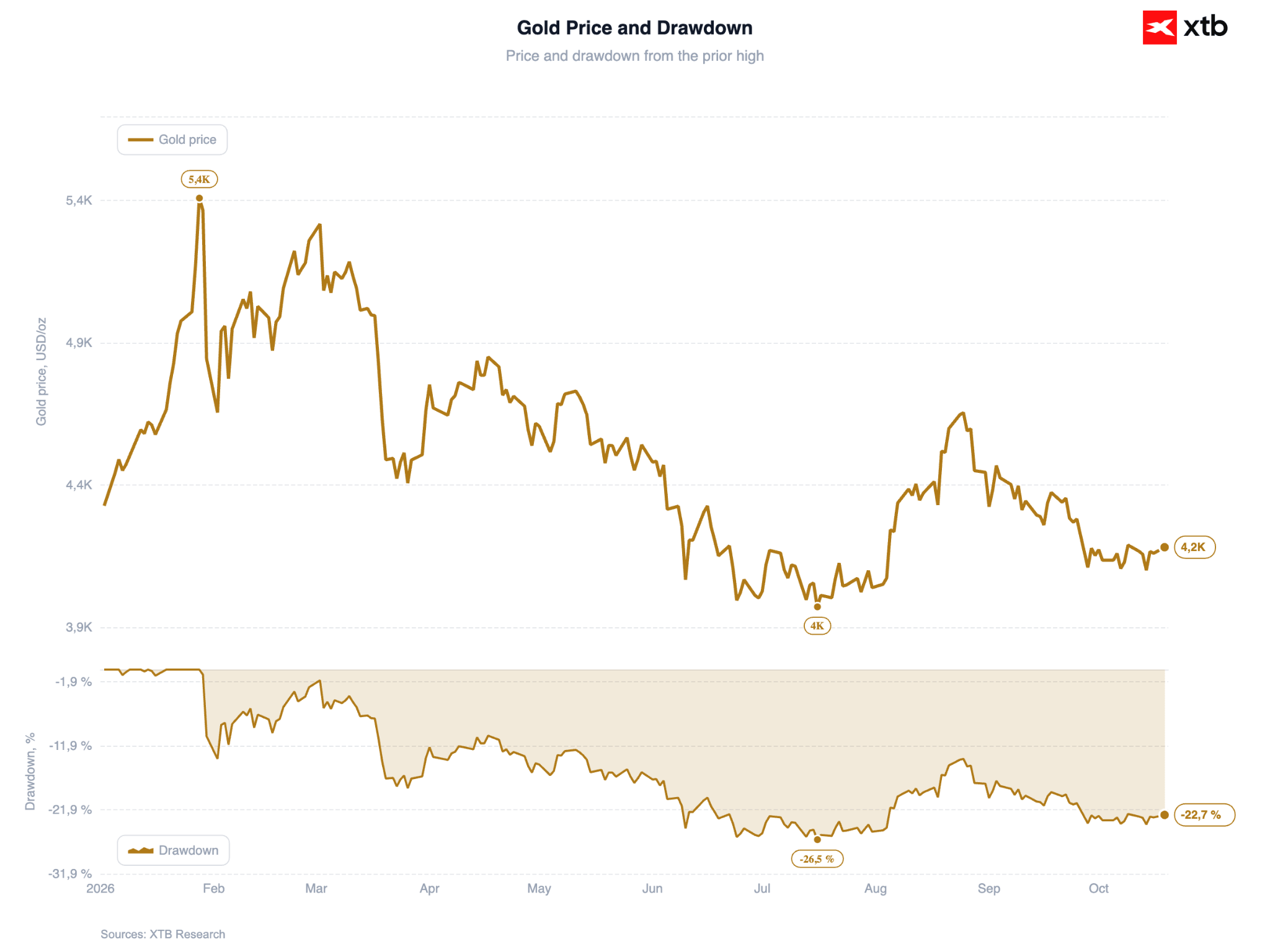
Gold is advancing, trading near USD 4,185 per ounce and recovering most of the previous week's losses. Support stems primarily from falling bond yields. Silver is up around 1% to USD 57.6 per ounce.
Figure 7: Gold (2026)
 Source: XTB Research, 19.10.2026
💱 Currencies
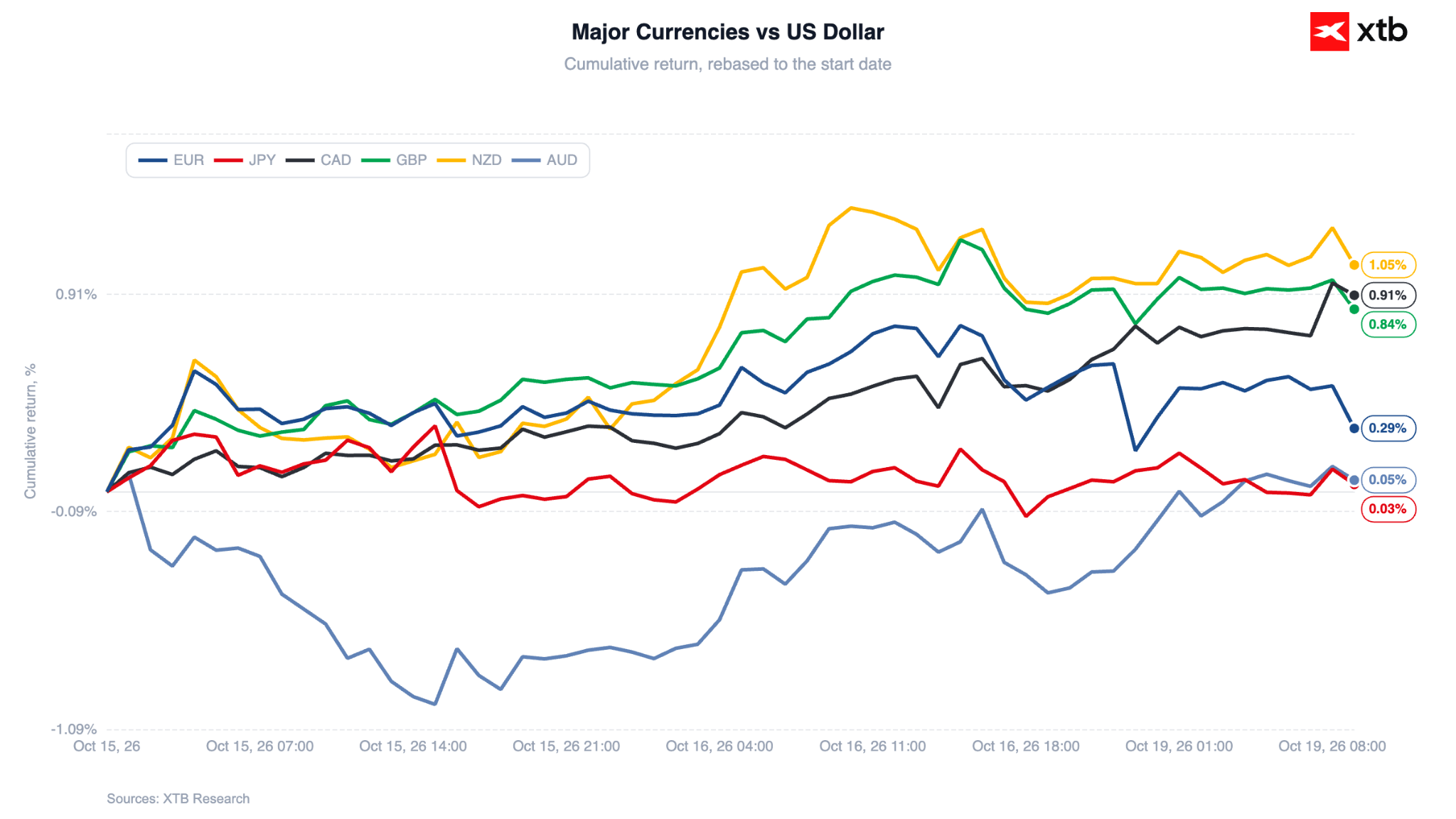
The euro is weakening against most G10 currencies. The EURUSD pair is edging slightly higher despite growing concerns over French public finances. The Australian dollar stands out as the strongest performer in the G10 basket, gaining around 0.4% following better-than-expected Chinese GDP data and improved sentiment.
Figure 8: Performance of Major Currencies Against the US Dollar (15.10.2026 - 19.10.2026)
 Source: XTB Research, 19.10.2026
₿ Cryptocurrencies
Bitcoin has moved back above USD 82,000 (+2.1%), rebounding alongside other risk assets on lower oil prices and improved sentiment. Ethereum is up over 3% (around USD 2,425), and Solana is up over 4%. Institutional demand is weakening: US spot BTC ETFs recorded a second consecutive week of outflows (USD 229m following USD 681m the previous week).
—
Michał Jóźwiak, Financial Markets Analyst at XTB


Chart of the Day: What’s next for tech stocks after the deepest sell-off since April 2025? (19.10.2026)


Economic Calendar: Big tech earnings week and test for the AI rally (19.10.2026)


Morning Briefing: Warsh's silence on interest rates. AI debt fears cooled sentiment, but a rebound is visible



Sell-off in the semiconductor market 📉🖥️
The material on this page does not constitute as financial advice and does not take into account your level of understanding, investment objectives, financial situation or any other particular needs.
All the information provided, including opinions, market research, mathematical results and technical analyses published on the website or transmitted to you by other means is provided for information purposes only and should in no event be interpreted as an offer of, or solicitation for, a transaction in any financial instrument, nor should the information provided be construed as advice of legal or fiscal nature.
Any investment decisions you make shall be based exclusively on your level of understanding, investment objectives, financial situation or any other particular needs. Any decision to act on information published on the website or transmitted to you by other means is entirely at your own risk. You are solely responsible for such decisions.
If you are in doubt or are not sure that you understand a particular product, instrument, service, or transaction, you should seek professional or legal advice before trading.
Investing in OTC Derivatives carries a high degree of risk, as they are leveraged based products and often small movements in the market could lead to much larger movements in the value of your investment and this could work against you or for you. Please ensure that you fully understand the risks involved, taking into account your investments objectives and level of experience, before trading, and if necessary, seek independent advice.