



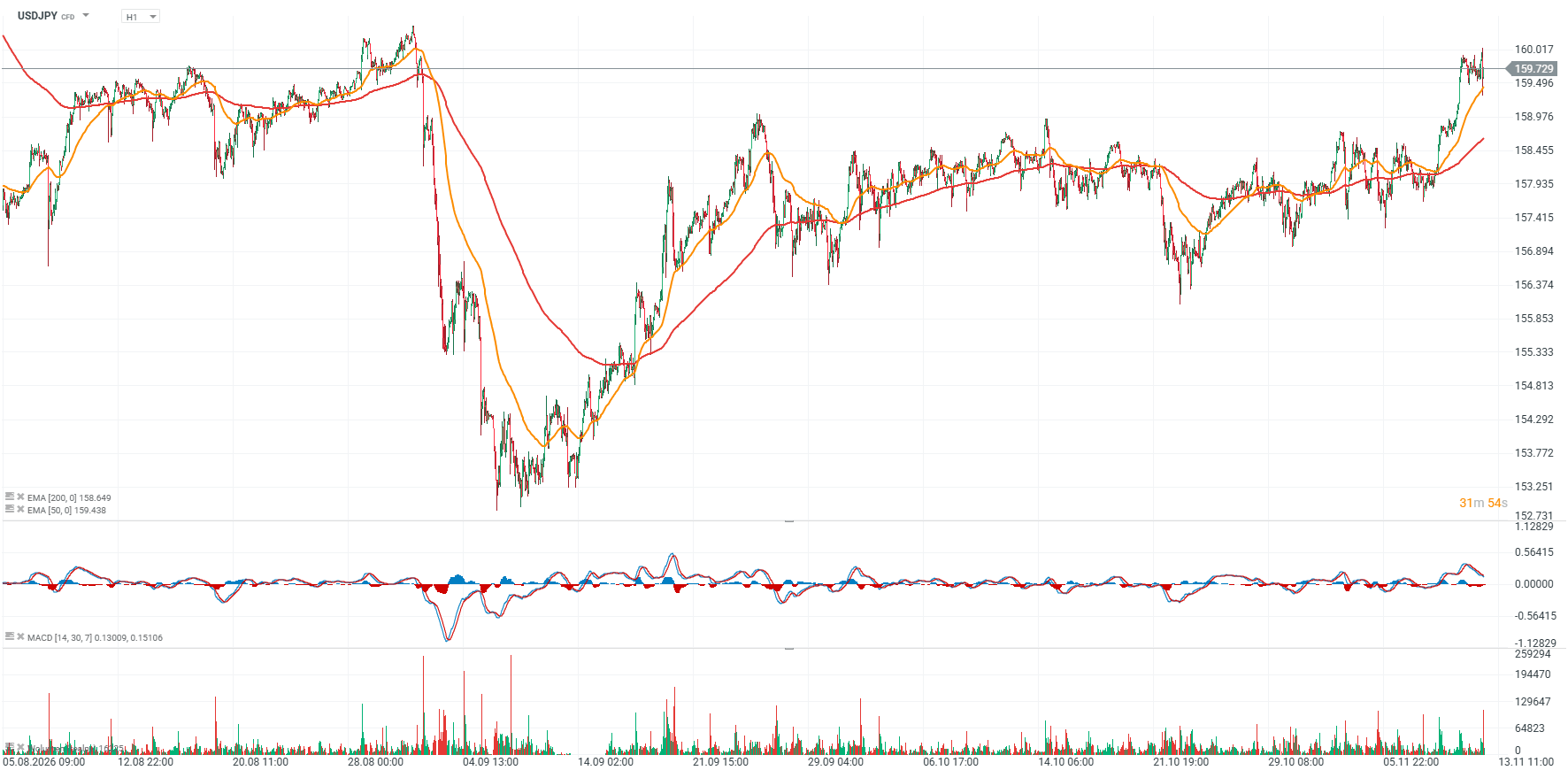
The Japanese yen strengthened sharply after briefly breaching the psychological 160-per-dollar threshold, a level that markets have for months viewed as a potential line of defence for Japanese authorities, fueling speculation about possible FX intervention. USDJPY had earlier moved above 160 for the first time since September, but the move was quickly reversed and the pair retreated toward 159.33, immediately reviving concerns over intervention risk.
-
The significance of the 160 level stems not only from technical analysis, but also from its political and psychological importance. Such pronounced yen weakness raises the cost of imported energy and food, adds to inflationary pressure and can weigh on household sentiment, making further depreciation increasingly uncomfortable for Tokyo.
-
The sudden reversal does not necessarily mean that direct intervention took place. The market may have been reacting to profit-taking, a reduction in long USDJPY positions and concerns that the Ministry of Finance or the Bank of Japan could step in if the pair makes another sustained attempt to break above 160.
Tokyo again warns of possible FX intervention
The risk of direct Japanese intervention had already risen a day earlier, when top currency diplomat Atsushi Mimura warned investors that it was “still too early to forget” the authorities’ actions earlier this summer. His remarks were a clear signal that Tokyo is once again closely monitoring the pace of yen depreciation and may respond if moves in USDJPY become excessively rapid. Mimura described recent currency moves as overly fast, bringing the 160-per-dollar level back into the centre of market attention.
The scale of Japan’s previous actions shows that the threat is not merely verbal. Between July 30 and August 3, Japan intervened in the FX market on three separate days, spending a record total of 15.4 trillion yen to support its currency after USDJPY approached 164. Inflationary pressure provides an additional argument for defending the yen: Japan’s yen-based import price index rose by as much as 24.8% year over year in October, increasing the cost of energy and other imported goods.
Japanese officials are also signalling that the weak yen has a broader political dimension. Chief Cabinet Secretary Minoru Kihara acknowledged that an excessively undervalued currency is viewed as problematic, while Tokyo remains in close contact with the US Treasury on maintaining orderly FX markets.
USDJPY chart (H1 interval)
The area around 160 may remain a zone of elevated volatility, where investors are likely to be much more cautious about building positions against the yen. Today, very strong selling volume is visible near that level. If USDJPY breaks sustainably above 160 and further yen weakness begins to add more clearly to inflationary pressure, Japanese intervention could become a very realistic scenario.
 Source: XTB



Morning Wrap - Will the markets recover from the scandal involving Nvidia's ousted CEO❓


Oil Gains Nearly 2% Despite a Sharp Rise in US Inventories 📈


🚩 Gold loses almost 3%

US Open: Wall Street Sentiment Weakens 📉 AMD and Broadcom Benefit from Nvidia’s Sell-Off?
The material on this page does not constitute as financial advice and does not take into account your level of understanding, investment objectives, financial situation or any other particular needs.
All the information provided, including opinions, market research, mathematical results and technical analyses published on the website or transmitted to you by other means is provided for information purposes only and should in no event be interpreted as an offer of, or solicitation for, a transaction in any financial instrument, nor should the information provided be construed as advice of legal or fiscal nature.
Any investment decisions you make shall be based exclusively on your level of understanding, investment objectives, financial situation or any other particular needs. Any decision to act on information published on the website or transmitted to you by other means is entirely at your own risk. You are solely responsible for such decisions.
If you are in doubt or are not sure that you understand a particular product, instrument, service, or transaction, you should seek professional or legal advice before trading.
Investing in OTC Derivatives carries a high degree of risk, as they are leveraged based products and often small movements in the market could lead to much larger movements in the value of your investment and this could work against you or for you. Please ensure that you fully understand the risks involved, taking into account your investments objectives and level of experience, before trading, and if necessary, seek independent advice.