

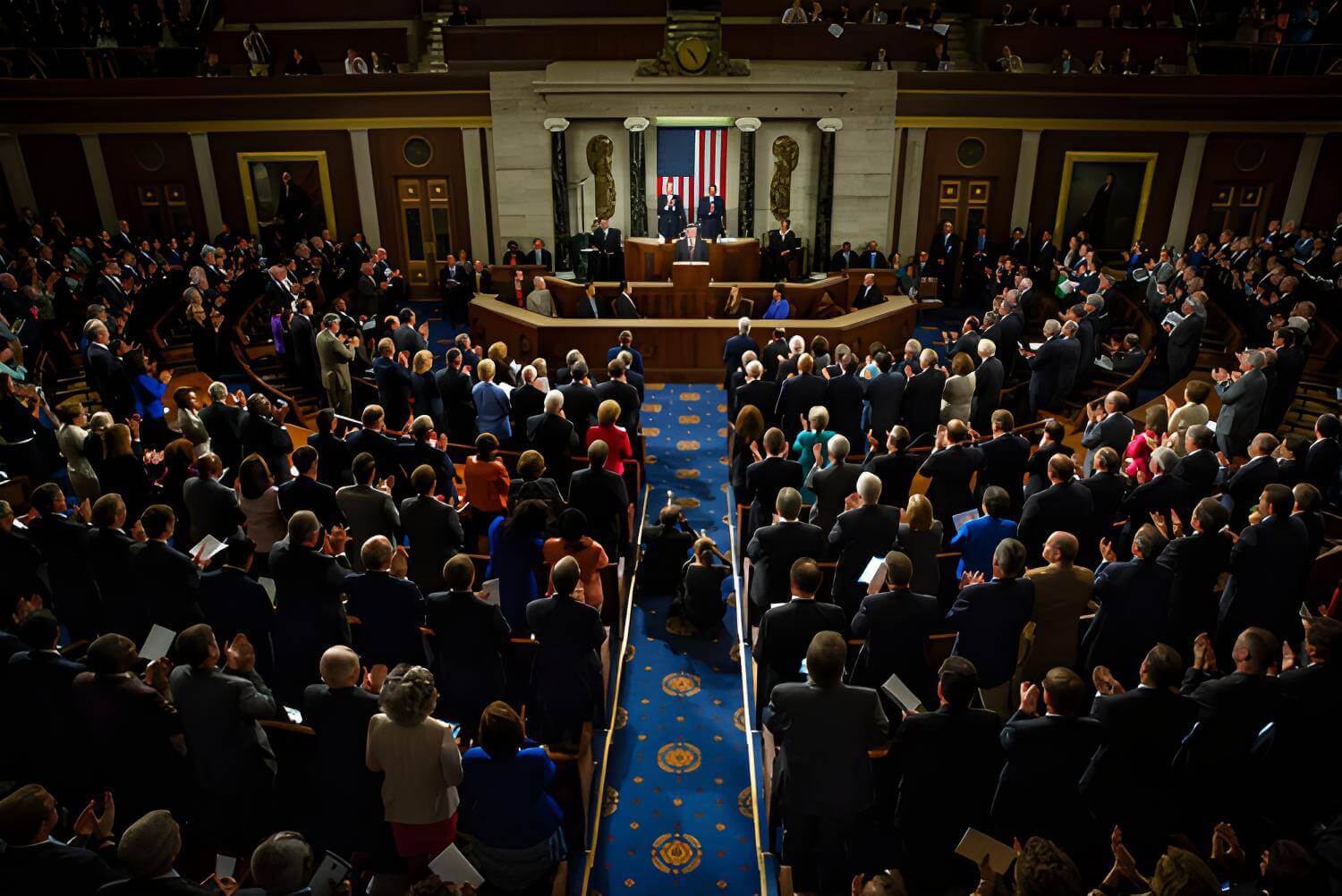
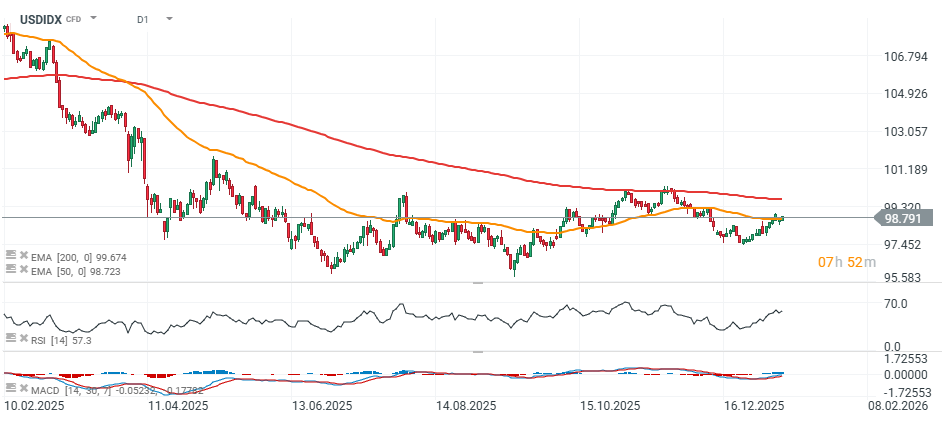
Donald Trump is ramping up pressure on the Supreme Court ahead of a pivotal ruling that could invalidate his tariffs, warning that such an outcome would trigger “complete chaos” for the U.S. economy and public finances. There is a real possibility that a decision striking down the tariff regime would inject fresh volatility into markets, hit the U.S. dollar in particular, and weaken demand for U.S. government debt amid fears of broader, systemic instability in the world’s largest economy. For now, markets appear to be somewhat underpricing the legal risk, while the Trump administration signals it already has fallback options designed to keep its trade policy in place even in the event of an adverse ruling. This scenario may raise wider questions about institutional credibility in the United States and, more broadly, the resilience of the rules-based capitalist and legal system in the long term.
- The central risk revolves around refunds. Trump argues that if the tariffs are deemed unlawful, the government could be forced to roll them back and potentially repay enormous sums—an outcome he says would entail a multi-year, highly complex administrative and legal process.
- The tariffs face broad legal challenges from small businesses and a group of U.S. states, which claim the president exceeded his authority by imposing sweeping duties without congressional approval.
- The legal basis is the 1977 International Emergency Economic Powers Act (IEEPA), which grants the president extraordinary powers in emergency situations; opponents counter that IEEPA does not even mention “tariffs,” and that under the Constitution, Congress holds the exclusive power to levy taxes.
- The financial stakes are substantial: tariffs imposed under IEEPA have generated more than $130 billion in revenue, meaning any cancellation or large-scale refunds would be both financially and politically fraught.
- Lower courts have already ruled against Trump on the question of authority, paving the way for a Supreme Court decision that investors and businesses are watching closely.
- Judges have signaled skepticism. During the November hearing, several conservative justices reportedly questioned the White House’s reasoning, including the notion that the trade deficit constitutes an “emergency.”
- The White House is also floating a Plan B. If the court rules against it, the administration is considering alternative legal pathways, including provisions that could allow tariffs of up to 15% for 150 days.
Which stocks could benefit?
As uncertainty builds, tariff-exposed companies—especially large importers—are hoping the duties are ruled unlawful, while the prospect of refunds, new regulations, or prolonged litigation could keep market volatility elevated (though not necessarily in equities). Which sectors and companies could stand to gain if the Supreme Court finds the tariffs illegal?
Retail could benefit, including:
-
Walmart (WMT): significant exposure to imports from China
-
Target (TGT): similar profile, high sensitivity to tariffs
-
Home Depot (HD) and Lowe’s (LOW): building materials, appliances, and home improvement goods
-
Costco (COST): large-scale import footprint
For these companies, tariffs are a direct cost that pressures margins and can only be partially passed on to consumers.
Apparel (low margins, Asia-based production)
-
Nike (NKE)
-
VF Corp (VFC)
-
Levi Strauss (LEVI)
-
Under Armour (UAA)
-
Gap (GPS)
For these firms, refunds would effectively mean a one-off cash inflow and improved cash flow dynamics.
Manufacturers and technology
Tariffs affected components as well as finished goods, lifting production costs. Refunds could improve financial results, reduce cost pressure, and support EBIT margins.
Potential names include:
-
Ford (F) and General Motors (GM)
-
Tesla (TSLA) (components, batteries, electronics)
-
Caterpillar (CAT)
-
Deere (DE)
-
Apple (AAPL)
-
HP (HPQ)
-
Cisco Systems (CSCO)
Source: xStation5


US OPEN: Wall Street Rallies on Soft PPI Data

Novo Nordisk announces a strategic partnership with OpenAI🧬🤖
Wells Fargo Q1 2026: Profit Growth Masks Deterioration in Earnings Quality

BREAKING: US PPI comes in weaker than expected. EURUSD gains ground
The material on this page does not constitute as financial advice and does not take into account your level of understanding, investment objectives, financial situation or any other particular needs.
All the information provided, including opinions, market research, mathematical results and technical analyses published on the website or transmitted to you by other means is provided for information purposes only and should in no event be interpreted as an offer of, or solicitation for, a transaction in any financial instrument, nor should the information provided be construed as advice of legal or fiscal nature.
Any investment decisions you make shall be based exclusively on your level of understanding, investment objectives, financial situation or any other particular needs. Any decision to act on information published on the website or transmitted to you by other means is entirely at your own risk. You are solely responsible for such decisions.
If you are in doubt or are not sure that you understand a particular product, instrument, service, or transaction, you should seek professional or legal advice before trading.
Investing in OTC Derivatives carries a high degree of risk, as they are leveraged based products and often small movements in the market could lead to much larger movements in the value of your investment and this could work against you or for you. Please ensure that you fully understand the risks involved, taking into account your investments objectives and level of experience, before trading, and if necessary, seek independent advice.
