


One of the session’s top performers in the technology sector on Monday is ARM Holdings, up about 14%.
Admittedly, this move was part of a broader rebound among semiconductor makers, supported among other things by falling bond yields and oil prices. In Arm’s case, however, an additional reference point is last week’s comments by CEO Rene Haas, which significantly raised expectations for the commercial success of the company’s own processors.
In an interview with CNBC on September 16, Haas said his confidence in the company’s ability to meet demand for an “AGI CPU,” a proprietary chip specialized for agentic AI, with a value of USD 2 billion has increased since the July earnings presentation. Earlier, Arm had indicated customer interest exceeding the sales level for which it had secured supply. The CEO’s statement therefore strengthens expectations that potential orders will translate into recognized revenue.
The timing of these declarations remains important. In the July update, demand exceeding USD 2 billion related to fiscal years 2027 and 2028 combined, and secured capacity corresponded to the previously stated ability to sell USD 1 billion. Growing management confidence provides a basis for optimism, but the statement alone does not determine a formal guidance increase.
AGI CPU Changes Arm’s Economics
Arm is in a situation similar to most makers of the most advanced chips and AI development and operations hardware. The problem is no longer demand; the challenge is manufacturing capacity, which can clearly pressure the investment timeline through the pace at which revenue converts into profit and cash flows.
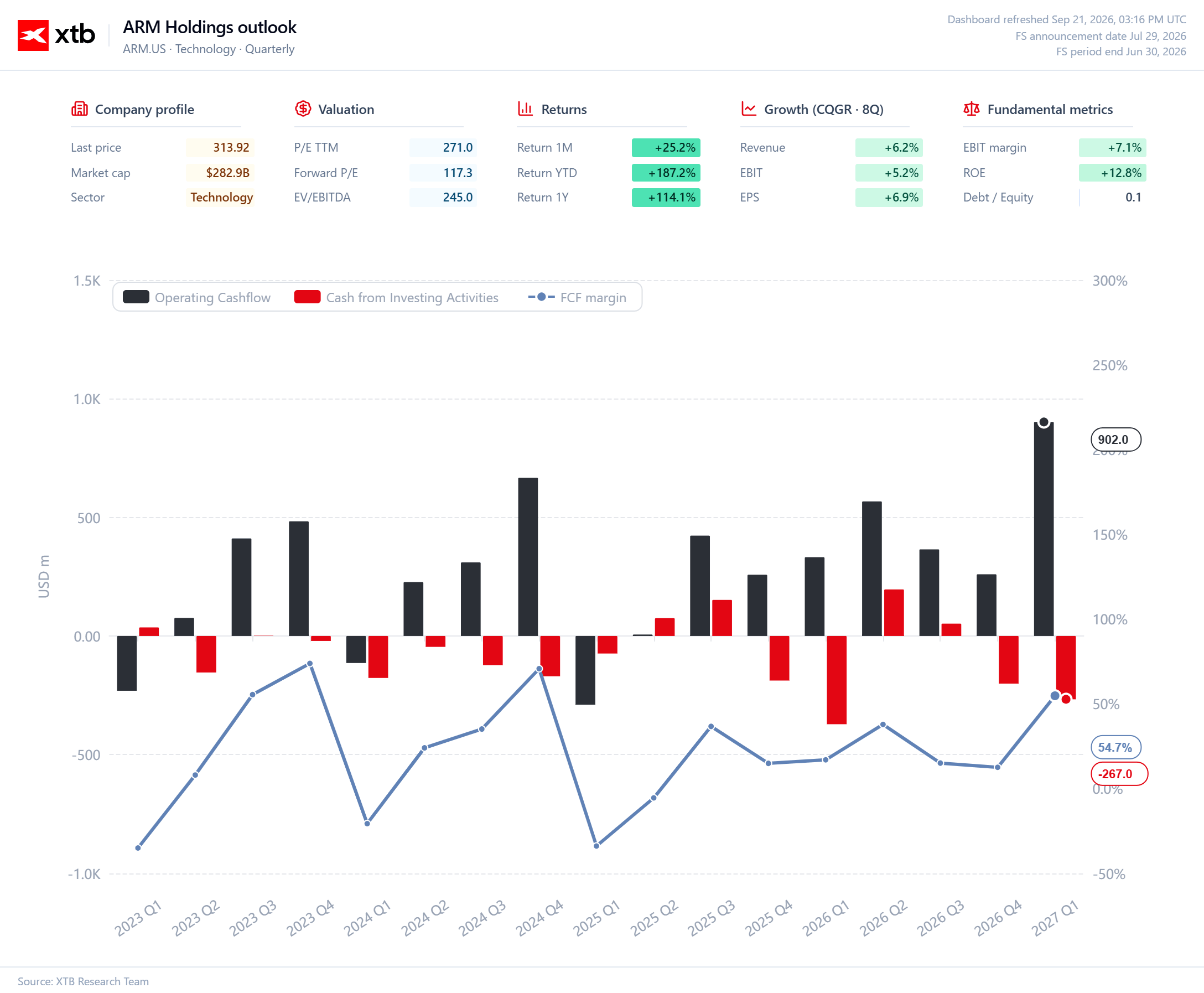
For the past decades, Arm operated on a licensing model. A structural change in demand has partly enabled and partly forced a shift of production capabilities in house. This is a major strength and asset, but beyond the costs, a key challenge is bringing additional capacity partitions online.
This shift means the ability to capture a larger share of spending on computing infrastructure. Selling finished processors increases potential revenue per deployment while also increasing the importance of manufacturing costs, supply management, and working capital.
The new processor expands Arm’s business into selling its own chips for data centers. According to Haas’s description, the product is intended to support cloud computing, work with GPU accelerators, and support applications using AI agents. Its value proposition for customers is based mainly on performance and energy efficiency, while reducing the cost and complexity of designing their own hardware.
SoftBank Increases Financing and Its Dependence on Arm’s Valuation
At the same time, SoftBank increased financing secured by Arm shares by USD 5 billion to USD 25 billion, according to Reuters. The stake in the processor designer therefore plays an important role in financing the Japanese group’s broader investment strategy.
SoftBank has also launched a bond offering totaling USD 10 billion and EUR 1 billion. The funds are intended to support the next tranche of investment in OpenAI and replace bridge financing planned for that purpose. The transaction shows the scale of capital mobilization around AI, although its announcement comes before the issuance is completed.
For Arm and SoftBank, these investments are both an opportunity and an additional risk channel. A rising share price improves the value of SoftBank’s collateral, while a deep selloff could increase pressure to post additional collateral or reduce leverage, depending on contract terms.
These obligations burden the shareholder’s financing, and their impact on Arm is primarily through the ownership structure and potential share supply.
ARM Price Chart (D1)
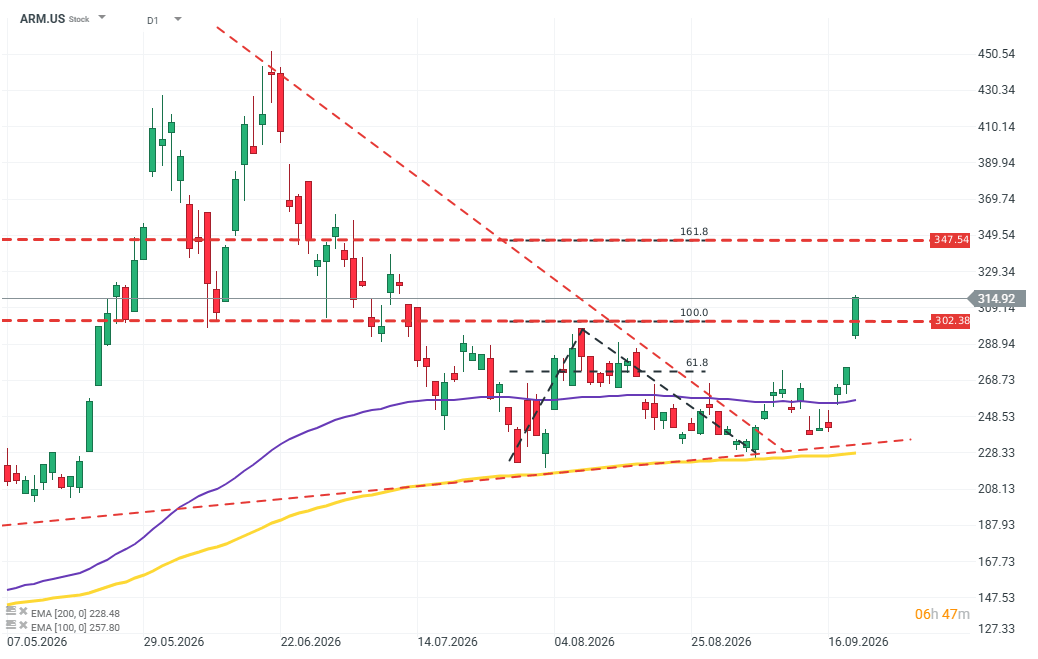
On the chart, one can observe a breakout from a descending triangle formation after holding the EMA200. Fibonacci expansion levels indicate around USD 350 as the next significant resistance level. Source: xStation5



SEC eases regulations: Does Bitcoin and Strategy benefit the most?



Daily Summary: Hawkish Fed fails to scare the markets (17.09.2026)


Nasdaq 100 Up 1.7%

US Open: Nasdaq, gold and silver surge following... an interest rate hike (17.09.2026)
The material on this page does not constitute as financial advice and does not take into account your level of understanding, investment objectives, financial situation or any other particular needs.
All the information provided, including opinions, market research, mathematical results and technical analyses published on the website or transmitted to you by other means is provided for information purposes only and should in no event be interpreted as an offer of, or solicitation for, a transaction in any financial instrument, nor should the information provided be construed as advice of legal or fiscal nature.
Any investment decisions you make shall be based exclusively on your level of understanding, investment objectives, financial situation or any other particular needs. Any decision to act on information published on the website or transmitted to you by other means is entirely at your own risk. You are solely responsible for such decisions.
If you are in doubt or are not sure that you understand a particular product, instrument, service, or transaction, you should seek professional or legal advice before trading.
Investing in OTC Derivatives carries a high degree of risk, as they are leveraged based products and often small movements in the market could lead to much larger movements in the value of your investment and this could work against you or for you. Please ensure that you fully understand the risks involved, taking into account your investments objectives and level of experience, before trading, and if necessary, seek independent advice.