


Goldman Sachs has published an insightful report indicating that US stock purchases have increased at their fastest pace in 6 months. Does this signify unequivocal enthusiasm among institutional investors for the US stock market?
Market sentiment is deeply uneven; market purchases are primarily ETFs and stocks. However, an important detail not easily found in the report, as Bloomberg analyses indicate, is that stock purchases are largely "short cover" trades, meaning buying shares to limit losses from short positions (selling).
The local peak for long positions (open interest) among asset managers (according to TFF) occurred in 2024, when it stood at approximately 27%. A few months ago, it was still nearly 25%, but today it has fallen to around 15%.
Based on Goldman Sachs data, three negative trends are visible across three different sectors.
- Finance - Allocation has increased sixfold, yet total allocation remains at 5-year lows. Importantly, almost the entire exposure to the sector consists of banks.
- Industry - Pessimism persists regarding American industry. Net declines were seen in 7 out of the last 8 weeks, and short positions in this sector are at their highest since 2024.
- Semiconductors - Following fantastic gains, many institutions (including Goldman) declared they were liquidating a large portion of their positions in this industry.
Does this mean inevitable declines?
No, although it points to a clear problem. The properties and conditions present in today's derivatives market ensure that corrections are shallow and gains are pronounced.
Low "paper" volatility masks real risks. Fund managers remain positive, but this sentiment is running out of fuel. Currently, the market lives on increasingly unrealistic dreams of a swift end to the conflict in Iran and increasingly esoteric returns on AI investments.
Given the indicators and current levels, the market is currently exposing itself to a devastating correction the moment the target macroeconomic scenario clearly changes.
VIX (D1)
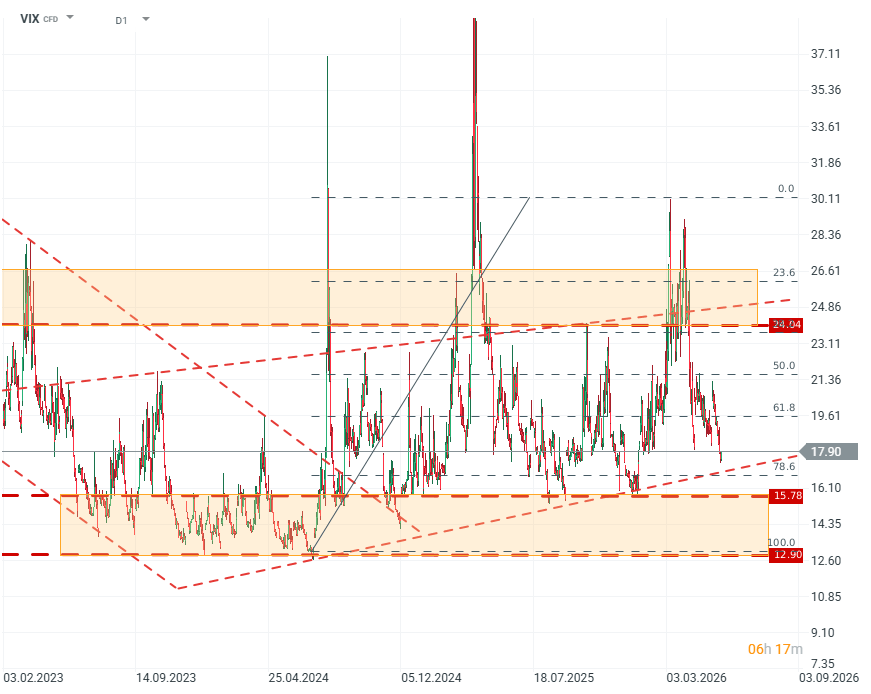
The volatility index (VIX) is currently indicating the lower limit of the channel in which it has been moving since around 2024. Source: xStation5



US Open: weaker labor market and AI weigh on Wall Street ❗



EU Wrap: session remains stable amid sector rotation 🔎


US100 runs out of steam above the 30,000 level? 📌
Broadcom beats forecasts, yet shares fall nearly 13% ⚔️
The material on this page does not constitute as financial advice and does not take into account your level of understanding, investment objectives, financial situation or any other particular needs.
All the information provided, including opinions, market research, mathematical results and technical analyses published on the website or transmitted to you by other means is provided for information purposes only and should in no event be interpreted as an offer of, or solicitation for, a transaction in any financial instrument, nor should the information provided be construed as advice of legal or fiscal nature.
Any investment decisions you make shall be based exclusively on your level of understanding, investment objectives, financial situation or any other particular needs. Any decision to act on information published on the website or transmitted to you by other means is entirely at your own risk. You are solely responsible for such decisions.
If you are in doubt or are not sure that you understand a particular product, instrument, service, or transaction, you should seek professional or legal advice before trading.
Investing in OTC Derivatives carries a high degree of risk, as they are leveraged based products and often small movements in the market could lead to much larger movements in the value of your investment and this could work against you or for you. Please ensure that you fully understand the risks involved, taking into account your investments objectives and level of experience, before trading, and if necessary, seek independent advice.
