



Ahead of Intel’s earnings release, the key question on investors’ minds was whether the company’s lengthy restructuring efforts were finally starting to deliver tangible results. The second-quarter report provided a much stronger answer than expected. Intel not only comfortably beat analysts’ estimates on both revenue and earnings, but also issued a stronger-than-expected outlook for the third quarter, a development that was welcomed enthusiastically by investors.
Key Second-Quarter Highlights
-
Revenue: $16.1 billion vs. $14.4 billion expected
-
Adjusted EPS: $0.42 vs. consensus of $0.21
-
Data Center & AI revenue: $6.3 billion, up 59% year over year
-
Intel Foundry revenue: $5.8 billion, up 31% year over year
-
Gross margin: 40.4% vs. 39.2% expected
-
Q3 revenue guidance: $15.8–16.8 billion vs. consensus of around $15.1 billion
-
Q3 EPS guidance: $0.38 vs. expectations of $0.27
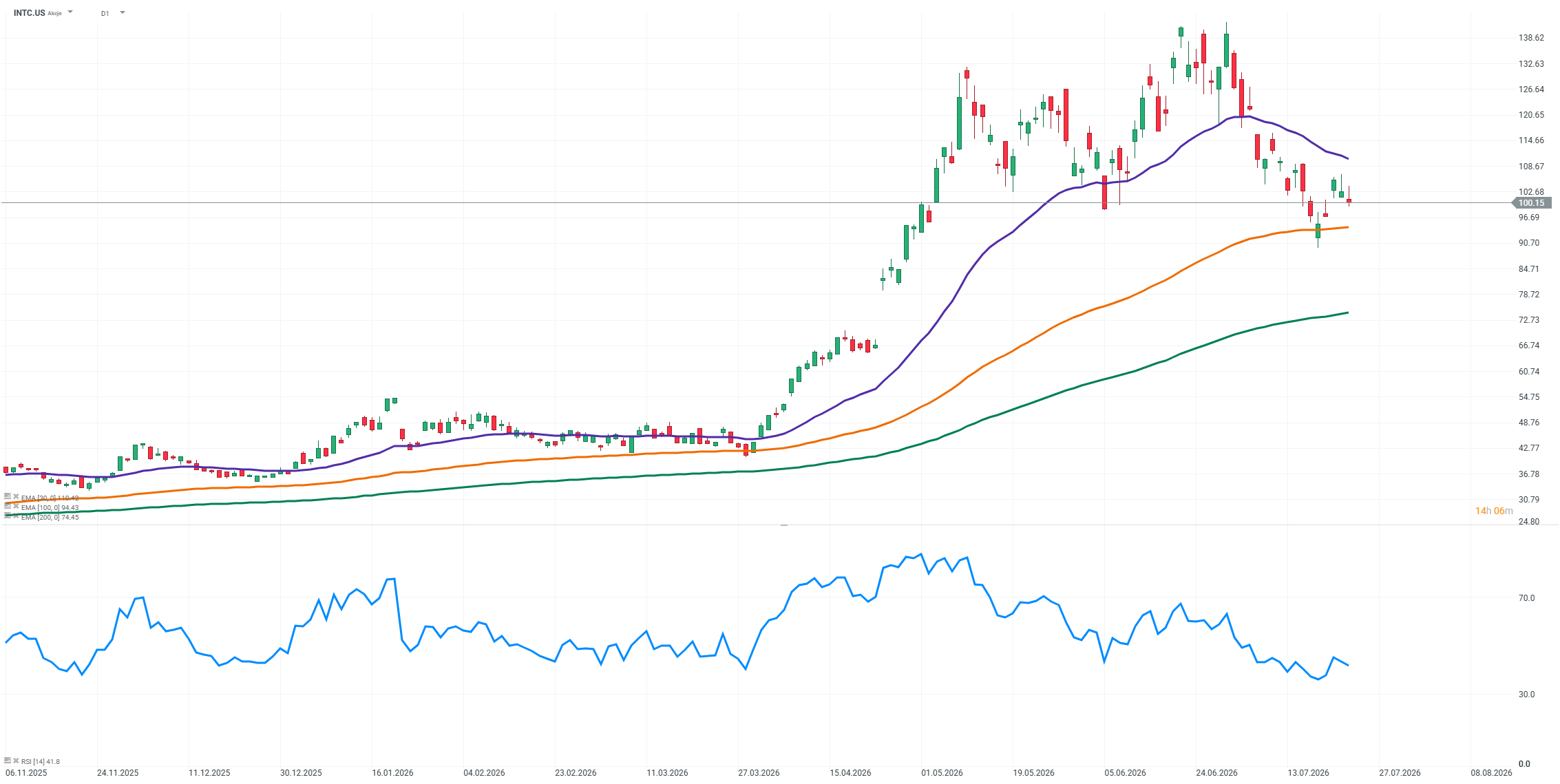
Following the earnings release, Intel shares moved sharply higher in after-hours trading. Investors were encouraged not only by the stronger-than-expected quarterly results but also by management’s decision to raise guidance for the coming quarter. In the technology sector, forward-looking guidance often carries even greater weight than historical results.
One of the strongest aspects of the report was the Data Center & AI business, where revenue surged 59% year over year. The performance suggests Intel is beginning to benefit from the massive wave of investment in computing infrastructure. As more companies expand their data center capacity, demand for server processors—one of Intel’s core products—continues to accelerate.
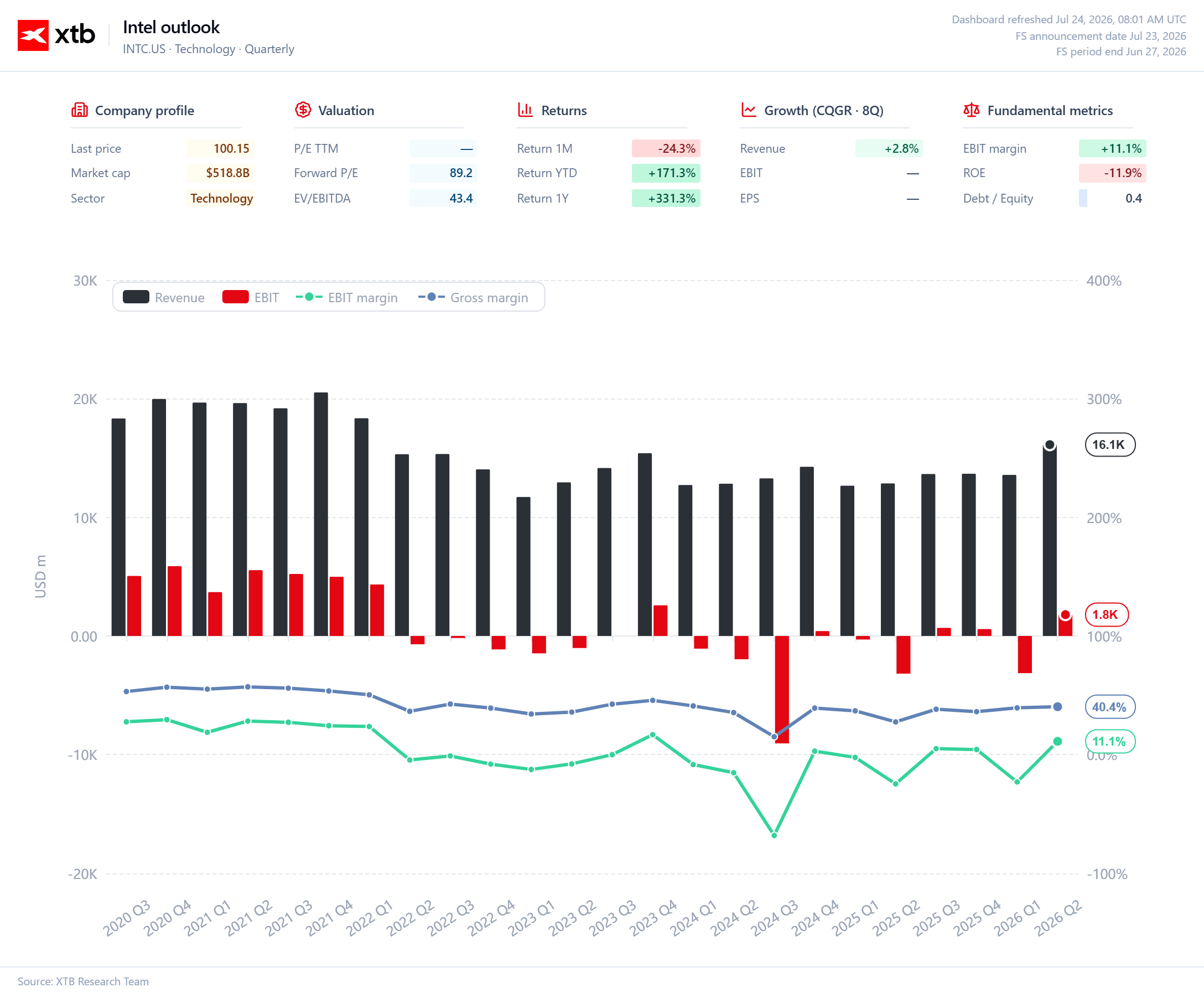
Management’s commentary also reinforced the positive outlook. CEO Lip-Bu Tan stated that demand for Intel’s server processors is currently exceeding the company’s manufacturing capacity. In response, Intel plans to increase capital spending to expand production and meet growing demand for both its own chips and foundry services provided to external customers.
This reflects a broader shift in the AI investment cycle. Early in the boom, most attention was focused on chips used to train artificial intelligence models. Increasingly, however, the market is turning its attention to the infrastructure required to deploy and run those models at scale. In that environment, server CPUs remain a critical foundation of modern data centers.
Another encouraging sign was the significant improvement in profitability. Gross margin rose to 40.4%, up from 29.7% a year earlier, while Intel returned to positive operating income. At the same time, the company announced plans to increase this year’s capital expenditures to approximately $20 billion, citing robust demand for computing infrastructure and continued expansion of its manufacturing business.
That said, Intel’s turnaround is far from complete. The company is still rebuilding after years of losing technological leadership and market share. Profit margins remain well below historical peak levels, and the foundry business continues to rely primarily on internal demand from Intel’s own business units. Winning more external customers and sustaining the current pace of improvement remain key challenges.
Still, today’s earnings report delivers something investors have been waiting for: evidence that Intel’s restructuring is no longer just about cost cuts and workforce reductions. The benefits are now becoming visible in the financial results. Stronger revenue, improving profitability, and higher guidance all suggest that Intel is beginning to regain its footing in one of the semiconductor industry’s most important segments.
Today’s report does not mean Intel has fully returned to its former position. It does, however, suggest that the turnaround is no longer just a story told in investor presentations. For the first time in quite a while, it is being backed up by the numbers.
Źródło: xStation5


Russia is taking over Nestlé's domestic assets 🍫 Shares are down nearly 3% 💥



Market warp: Rate Forecasts and Semiconductors in the Spotlight


Daily Summary: Hawkish Fed fails to scare the markets (17.09.2026)


Nasdaq 100 Up 1.7%
The material on this page does not constitute as financial advice and does not take into account your level of understanding, investment objectives, financial situation or any other particular needs.
All the information provided, including opinions, market research, mathematical results and technical analyses published on the website or transmitted to you by other means is provided for information purposes only and should in no event be interpreted as an offer of, or solicitation for, a transaction in any financial instrument, nor should the information provided be construed as advice of legal or fiscal nature.
Any investment decisions you make shall be based exclusively on your level of understanding, investment objectives, financial situation or any other particular needs. Any decision to act on information published on the website or transmitted to you by other means is entirely at your own risk. You are solely responsible for such decisions.
If you are in doubt or are not sure that you understand a particular product, instrument, service, or transaction, you should seek professional or legal advice before trading.
Investing in OTC Derivatives carries a high degree of risk, as they are leveraged based products and often small movements in the market could lead to much larger movements in the value of your investment and this could work against you or for you. Please ensure that you fully understand the risks involved, taking into account your investments objectives and level of experience, before trading, and if necessary, seek independent advice.