


- The largest U.S. defense contractors surprised investors with strong quarterly earnings.
- Lockheed Martin and RTX shares are up more than 5% following their earnings reports.
- Both companies raised their full-year guidance and delivered stronger-than-expected growth.

- The largest U.S. defense contractors surprised investors with strong quarterly earnings.
- Lockheed Martin and RTX shares are up more than 5% following their earnings reports.
- Both companies raised their full-year guidance and delivered stronger-than-expected growth.
Shares of U.S. defense giants Lockheed Martin and RTX are rising after both companies reported strong second-quarter results. Both firms exceeded Wall Street expectations for revenue and earnings while raising their full-year guidance. The results reinforce that the global defense spending boom continues to translate into record order inflows and improving financial performance for the world's largest defense contractors.
Key facts
- Lockheed Martin increased revenue by 11% year-over-year to $20.06 billion, reported EPS of $7.94, and raised its full-year 2026 guidance.
- RTX posted 14% year-over-year revenue growth to $24.71 billion, while adjusted EPS increased to $1.89. The company also raised its full-year revenue, earnings, and free cash flow outlook.
- The combined order backlog of both companies now exceeds $500 billion, highlighting that demand for defense equipment continues to outpace the industry's production capacity.
Lockheed Martin benefits from rising missile and ammunition production
Lockheed Martin generated $20.06 billion in second-quarter revenue, up 11% from a year earlier. Net income reached $1.84 billion, while earnings per share increased to $7.94, comfortably beating market expectations.
Growth was broad-based across nearly every business segment, including Aeronautics, Missiles & Fire Control, Rotary & Mission Systems, and Space. Management emphasized that increasing production of missiles and ammunition remains one of the company's primary growth drivers.
The company also raised its full-year 2026 guidance, now expecting revenue of $79.75-81.75 billion and earnings per share of $29.95-30.65. Lockheed Martin finished the quarter with an order backlog of approximately $230 billion, providing exceptional long-term revenue visibility.
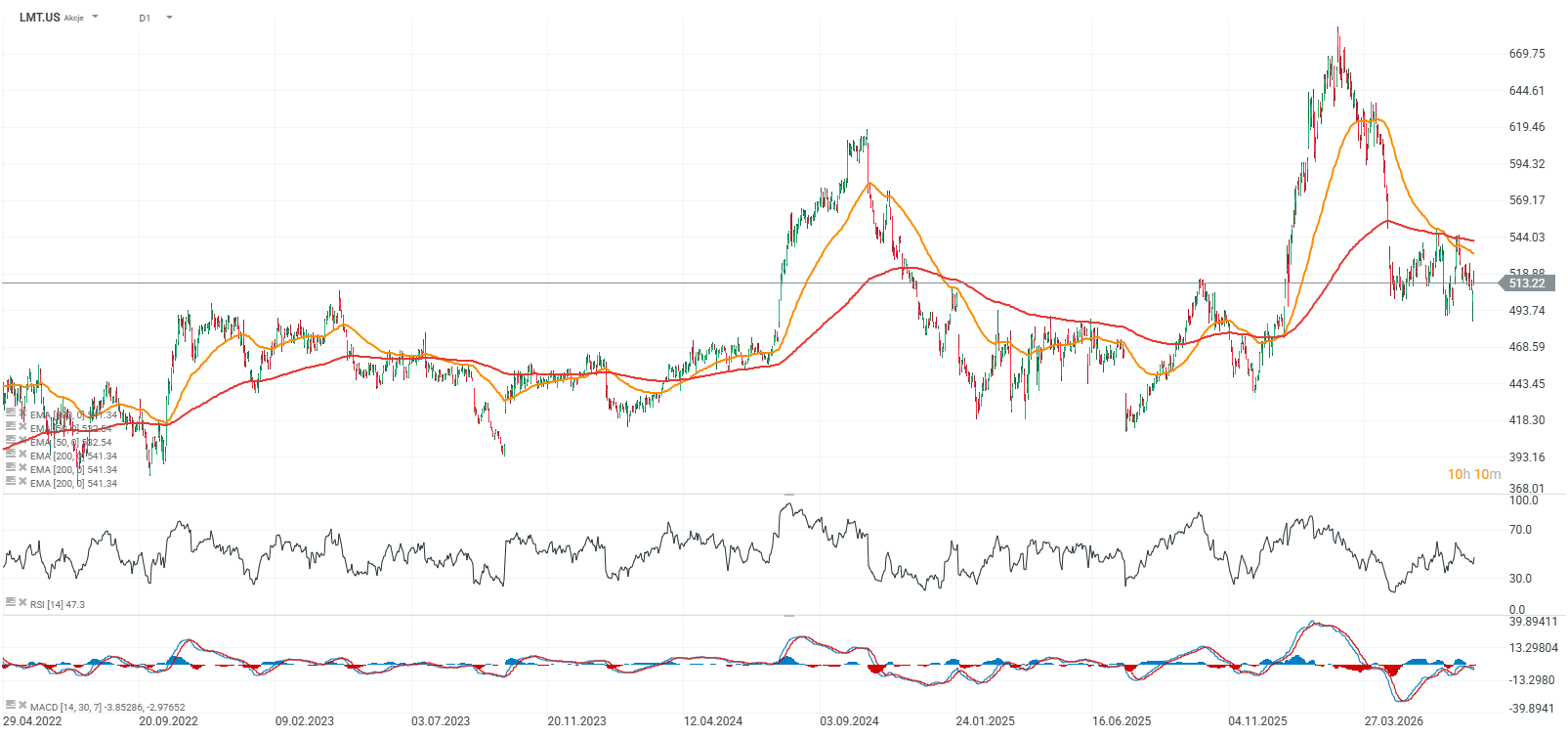
Lockheed Martin shares are trading around $542 in pre-market trading, suggesting a potential test of the long-term downtrend and the 200-day exponential moving average (EMA200), represented by the red line, which separates bearish from bullish long-term momentum.
 Source: xStation5
RTX benefits from both the commercial aerospace recovery and higher defense spending
RTX also reported results ahead of consensus estimates. Revenue increased 14% year-over-year to $24.71 billion, while adjusted earnings per share reached $1.89. Unlike many defense contractors, RTX continues to benefit from two independent growth engines: rising military spending and the ongoing recovery in global commercial aviation.
Sales at the Raytheon segment increased 18%, Pratt & Whitney grew 16%, while Collins Aerospace delivered 8% revenue growth. RTX also raised its full-year outlook, now expecting revenue of $95-96 billion and adjusted EPS of $7.10-7.25.
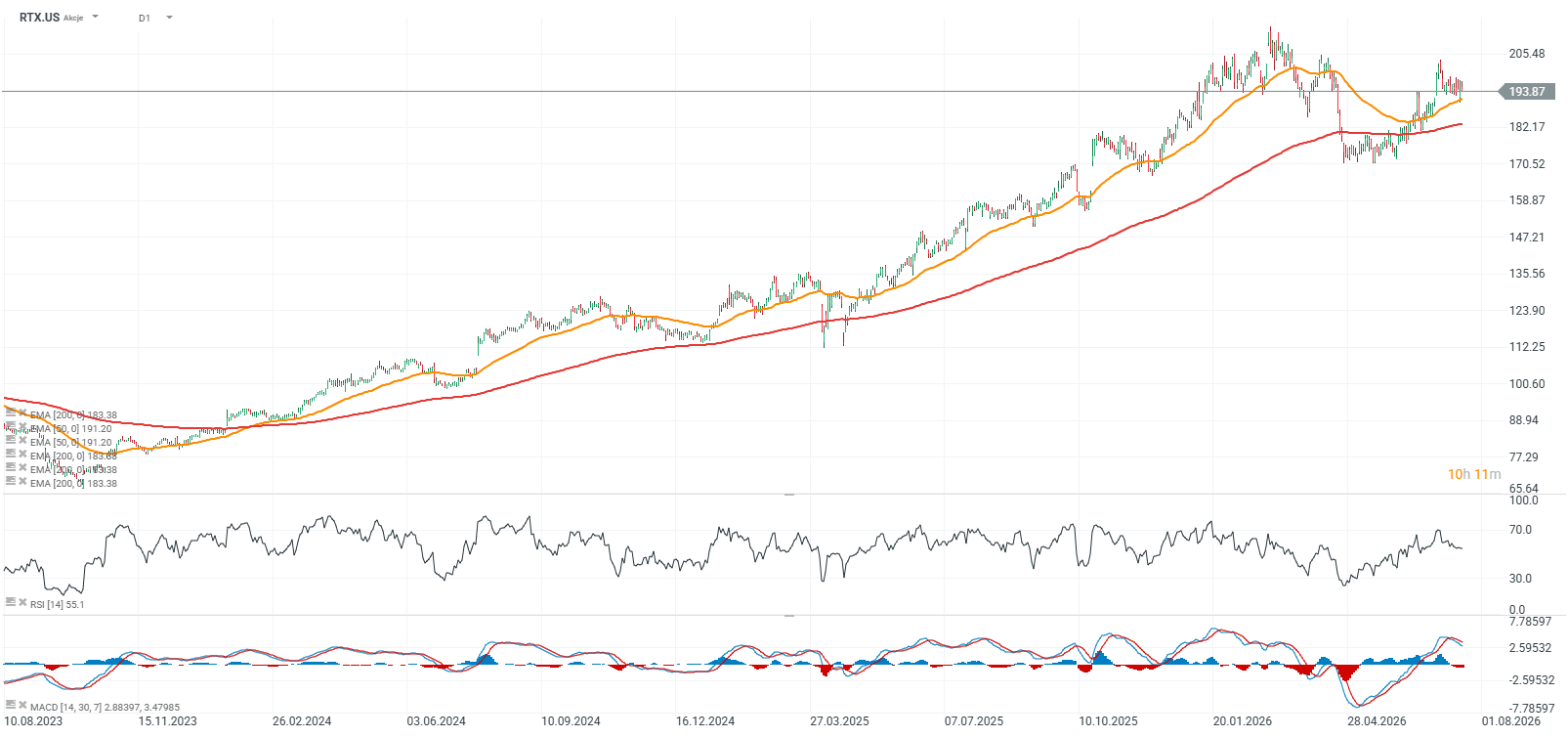
RTX shares are trading around $204 in pre-market trading, close to their all-time highs. If the stock opens near this level, it would represent a rebound of roughly 20% from its local low recorded in May.
 Source: xStation5
Record order backlogs suggest production capacity—not demand—is becoming the industry's biggest constraint
The most important takeaway from both earnings reports is not simply the quarterly earnings beat, but the continued expansion of their order books.
Lockheed Martin ended the quarter with an order backlog worth approximately $230 billion, while RTX increased its backlog to a record $289 billion, including roughly $119 billion in defense contracts. Combined, the two companies now hold more than $519 billion in future orders awaiting execution.
For investors, this provides further evidence that the world's defense industry is no longer constrained by demand or government funding. Instead, the key challenge is rapidly expanding manufacturing capacity for missiles, munitions, air defense systems, and other critical military equipment to meet NATO's multi-year rearmament plans and replenish depleted inventories.


Russia is taking over Nestlé's domestic assets 🍫 Shares are down nearly 3% 💥



Market warp: Rate Forecasts and Semiconductors in the Spotlight


Daily Summary: Hawkish Fed fails to scare the markets (17.09.2026)


Nasdaq 100 Up 1.7%
The material on this page does not constitute as financial advice and does not take into account your level of understanding, investment objectives, financial situation or any other particular needs.
All the information provided, including opinions, market research, mathematical results and technical analyses published on the website or transmitted to you by other means is provided for information purposes only and should in no event be interpreted as an offer of, or solicitation for, a transaction in any financial instrument, nor should the information provided be construed as advice of legal or fiscal nature.
Any investment decisions you make shall be based exclusively on your level of understanding, investment objectives, financial situation or any other particular needs. Any decision to act on information published on the website or transmitted to you by other means is entirely at your own risk. You are solely responsible for such decisions.
If you are in doubt or are not sure that you understand a particular product, instrument, service, or transaction, you should seek professional or legal advice before trading.
Investing in OTC Derivatives carries a high degree of risk, as they are leveraged based products and often small movements in the market could lead to much larger movements in the value of your investment and this could work against you or for you. Please ensure that you fully understand the risks involved, taking into account your investments objectives and level of experience, before trading, and if necessary, seek independent advice.