


There are companies that grow rapidly, companies that can increase the scale of their operations for years, and then there is NVIDIA. Yesterday’s results once again showed how difficult it is to find another company on the global market that combines growth, profitability, and scale of operations at a similar level. Revenue in the second quarter of fiscal 2027 reached $96.2 billion, clearly exceeding market expectations, while guidance for the following quarter was raised to $108 billion. Even more importantly, NVIDIA is achieving these results with revenue growth of more than 100% year over year, while its core market—AI computing infrastructure—is still only in the early stages of global expansion. This is precisely why the thesis that NVIDIA is the best company in the world is no longer merely a catchy slogan. It is a question of whether there is another company in the market capable of simultaneously growing at such a pace, generating such high margins, and sitting at the very center of the largest investment cycle in technology in decades.
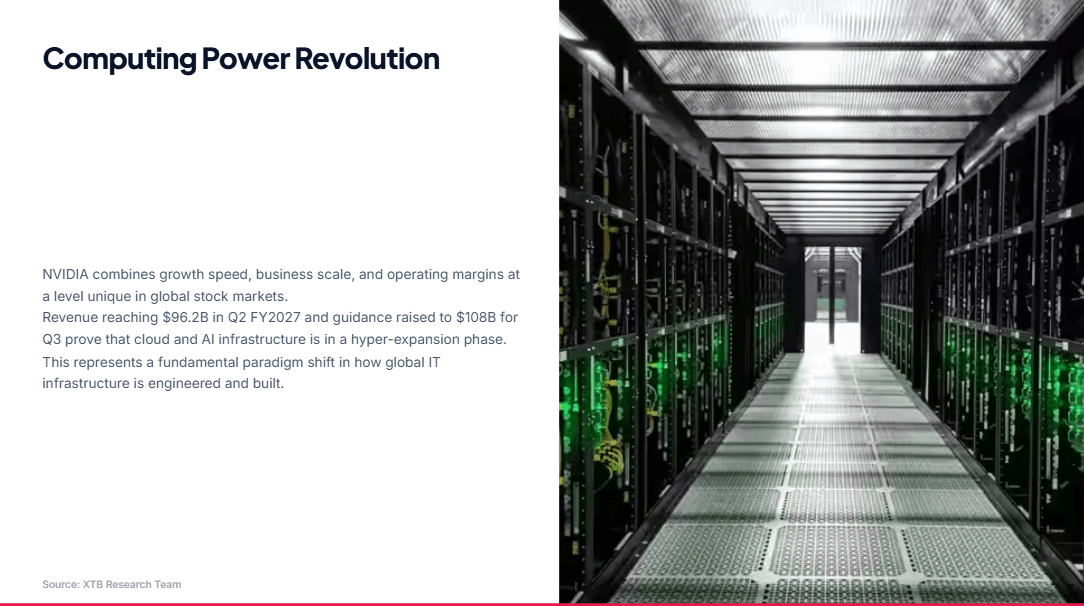
What is most remarkable about this story, however, is that NVIDIA is not achieving these results thanks to a one-off boost or a short-lived surge in demand. The company is at the very center of a fundamental transformation in the way the world builds computing power. Successive generations of its chips are being deployed in data centers designed to train and run increasingly advanced artificial intelligence models, and the scale of these investments is growing every quarter. This creates a unique situation for NVIDIA. The larger the models become, the more important inference becomes, and the more companies want to use AI in their real-world operations, the greater the demand for the infrastructure NVIDIA provides. That is why the key question for the company is no longer whether AI will be an important technology of the future. The question is how quickly the world will need to increase computing capacity to build that future—and how much of that market NVIDIA will be able to capture.
Results That Raise the Bar Once Again
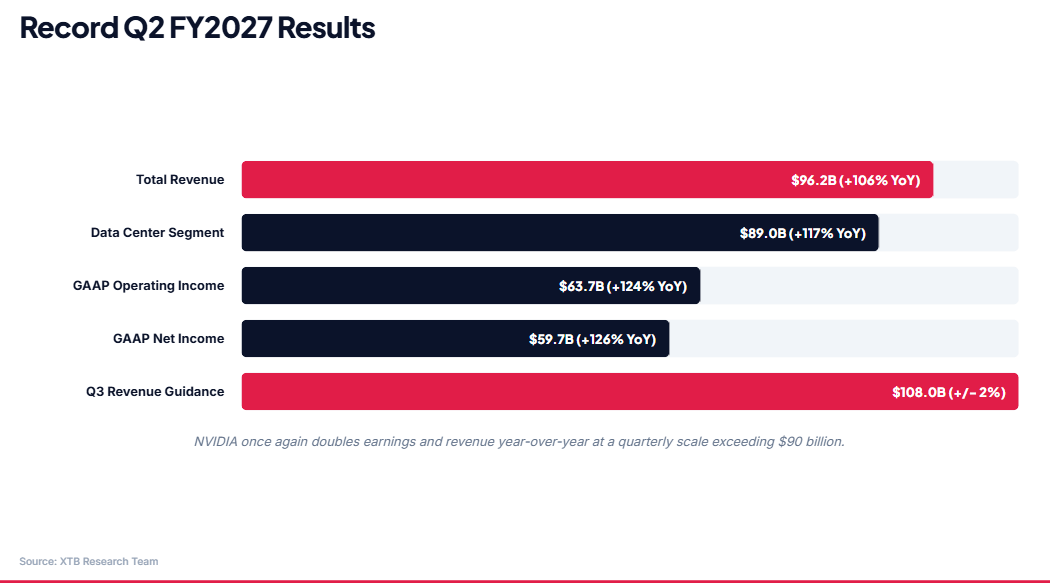
NVIDIA ended the second quarter of fiscal 2027 with revenue of $96.2 billion, representing an 18% increase quarter over quarter and as much as 106% year over year. The result was significantly better than market expectations. Earnings growth looks even more impressive. GAAP net income reached $59.7 billion, compared with $26.4 billion a year earlier, while earnings per share reached $2.46. On a non-GAAP basis, net income was $54.0 billion and earnings per share were $2.22. NVIDIA once again demonstrated something particularly impressive at this scale of operations. Revenue exceeding $96 billion continues to grow at a triple-digit rate, while the company simultaneously maintains a gross margin of 75%.
Key figures from the second quarter of fiscal 2027:
-
Revenue: $96.2 billion, up 106% year over year and 18% quarter over quarter
-
Data Center revenue: $89.0 billion, up 117% year over year and 18% quarter over quarter
-
Operating income: $63.7 billion, up 124% year over year
-
Net income: $59.7 billion, up 126% year over year
-
GAAP EPS: $2.46, up 128% year over year
-
Non-GAAP EPS: $2.22, up 120% year over year
-
Gross margin: 75.0%, compared with 72.4% a year earlier
-
Edge Computing revenue: $7.2 billion, up 27% year over year
Guidance for the third quarter:
-
Projected revenue for the next quarter: $108.0 billion
-
Projected gross margin: 74.0%
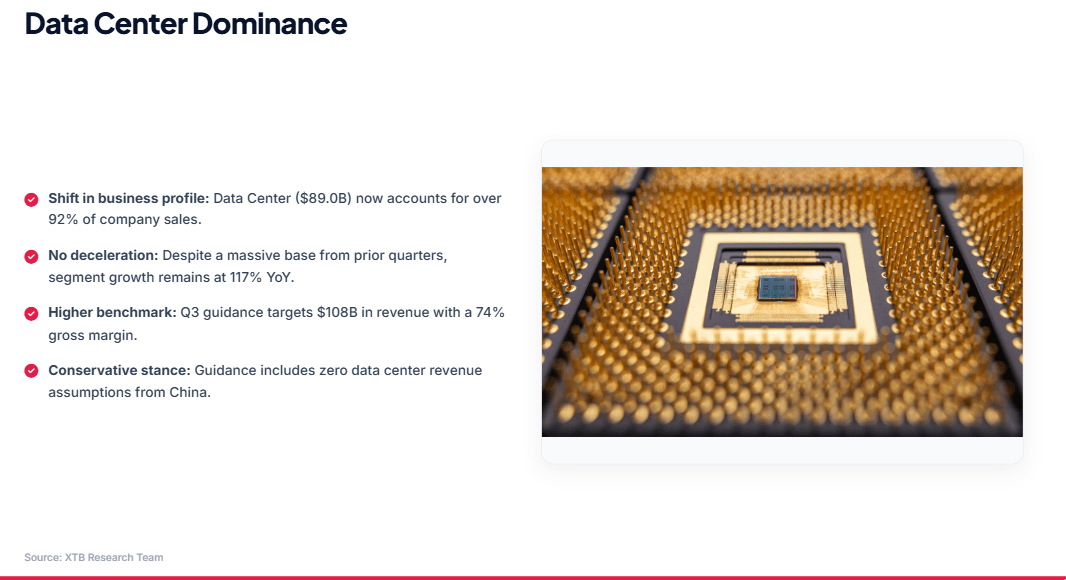
The results are primarily driven by the Data Center segment, whose revenue reached a record $89.0 billion. That already represents more than 92% of NVIDIA’s total revenue, showing just how strongly the company’s profile has become tied to the development of AI infrastructure. Particularly significant is the fact that growth has not stalled despite the enormous base established in previous quarters. Data Center revenue increased by 117% year over year, meaning NVIDIA can still nearly double the scale of its most important business. At the same time, gross margin remained at 75%, demonstrating that rapid sales growth continues to go hand in hand with exceptional profitability.
Even more important than the report itself, however, is the guidance provided by management. NVIDIA expects $108 billion in revenue in the third quarter, with the possibility of a 2% deviation in either direction. This means the company itself is assuming it will exceed the $100 billion quarterly revenue threshold, while its forecast does not include any revenue from data centers in China. Moreover, despite the continued increase in scale, management expects a gross margin of 74%. NVIDIA therefore not only beat expectations for the completed quarter, but immediately raised the benchmark for the next one.
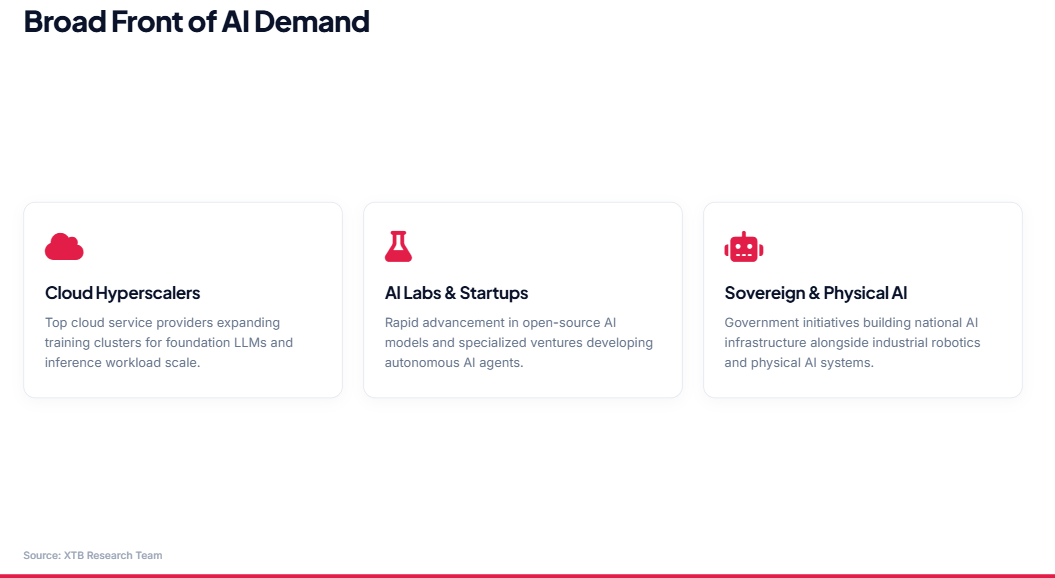
This is where the report begins to look truly exceptional. With a company generating nearly $100 billion in quarterly revenue, one might expect growth to gradually slow. Yet NVIDIA is still increasing revenue by more than 100% year over year, more than doubling net income, and maintaining margins at levels that most technology companies have never achieved. Following the results, Jensen Huang emphasized that artificial intelligence is now at a turning point because models are beginning to perform useful, revenue-generating work, and as a result demand for computing power is increasing. According to management, the current cycle is broader than it was a year ago because the largest AI laboratories, startups, open-source models, and applications related to so-called physical AI are all developing simultaneously.
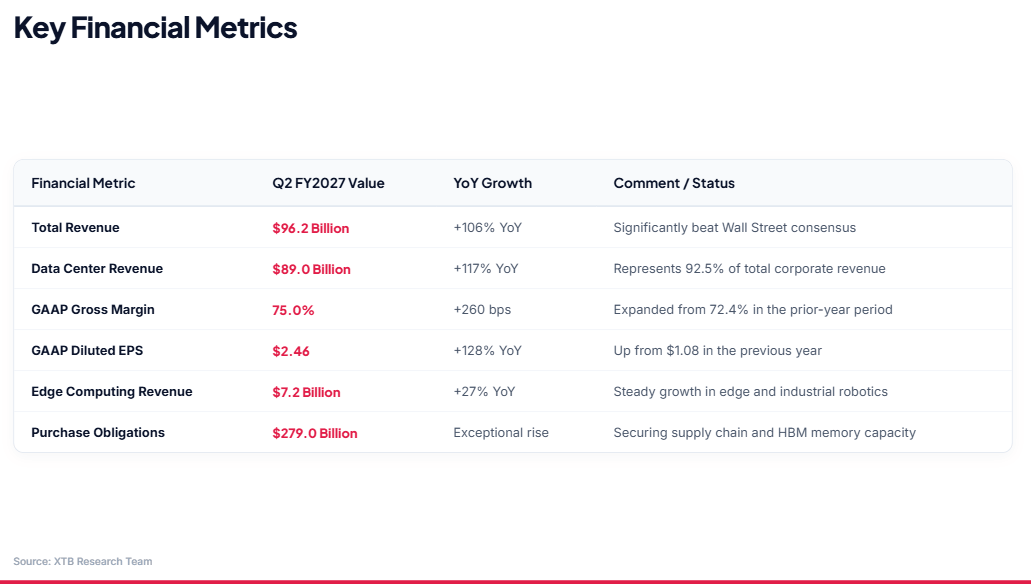
This leads to the most important conclusion from the entire report. NVIDIA no longer needs to prove that demand for its products exists. Its main challenge now is to increase its ability to meet that demand. The company reported that its commitments related to deliveries and production capacity had risen to $279 billion, partly due to securing memory supplies. This shows that management is preparing the company for another phase of growth rather than simply maintaining the current level of sales. In NVIDIA’s case, this may be one of the most important pieces of information in the entire report: the company is not behaving like a business preparing for demand normalization. It is behaving like a company assuming that demand for AI infrastructure will continue to grow.
Blackwell and the Coming Era of Vera Rubin
The current growth of NVIDIA is driven primarily by the Blackwell architecture, which has become the foundation of the latest generation of AI infrastructure. Its importance, however, goes beyond the performance of the chips themselves. NVIDIA is increasingly selling customers complete computing infrastructure, meaning that as data centers grow in scale, the value of individual deployments also increases. Blackwell, followed by its enhanced version, Blackwell Ultra, is currently the main driver of Data Center revenue and will remain so for the next several quarters.
At the same time, NVIDIA is already preparing its next generation. Vera Rubin is expected to begin broader deployments in the second half of 2026, and according to the company, the platform is already in full production. Rubin is designed to provide a significant increase in performance for training and running AI models and, above all, to improve the economics of entire data centers. This second element may prove to be the most important. At the current scale of customer investments, every improvement in performance and computing costs increases the economic attractiveness of subsequent generations of NVIDIA infrastructure.
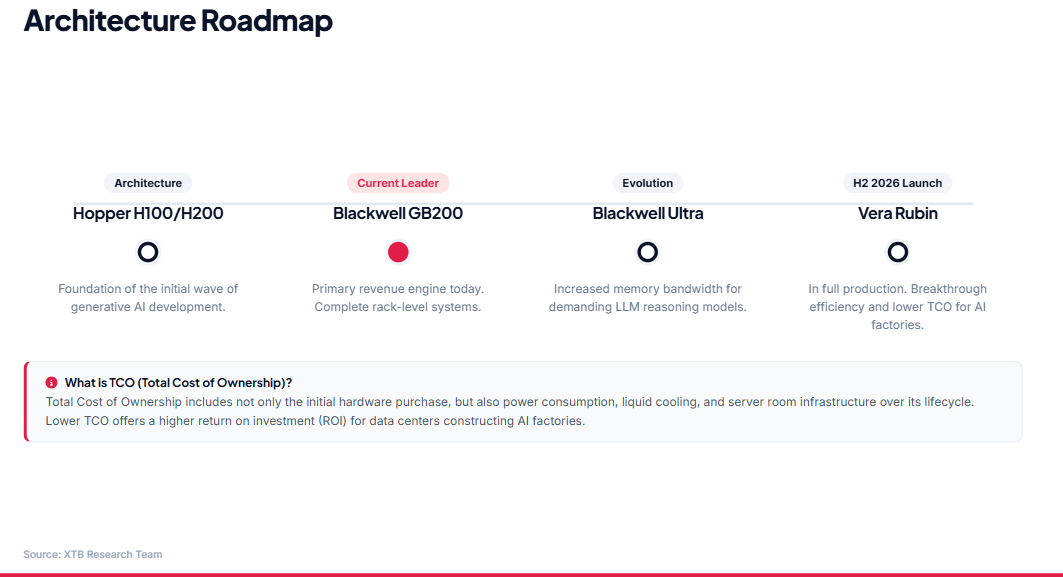
The timeline is just as important as the technology itself. The first Vera Rubin systems are expected to reach customers in the second half of 2026, with the largest technology companies and cloud providers among those preparing deployments. This means the transition from Blackwell to Rubin will not be a single event, but another stage in an ongoing investment cycle. NVIDIA therefore finds itself in a situation where the current generation is still generating record revenue while the next generation is already being prepared for deployment. For investors, this primarily means one thing: today’s record Blackwell sales do not necessarily mark the peak of the current cycle; they may instead form the foundation for the next one.
It is worth paying attention to the way NVIDIA manages its successive product generations. The company is consistently working to shorten the cycle between new architectures, meaning customers do not have to wait several years for a significant increase in infrastructure capabilities. Blackwell is currently the main driver of results, but its successor is already prepared for deployment, and NVIDIA is announcing additional generations on a similar schedule. From a business perspective, this creates a highly favorable situation. The company does not have to rely on a single product being sold for many years. Instead, it can regularly persuade the same customers to increase their spending on successive generations of infrastructure. With demand for computing power rising, this model could allow NVIDIA to maintain strong revenue growth even when the growth rate of an individual generation gradually begins to slow.
NVIDIA: A Financial Machine
If revenue growth demonstrates the scale of NVIDIA’s success, its income statement shows just how extraordinary the quality of this business is. The company is not only increasing sales at a rate exceeding 100% year over year, but is doing so with a gross margin of 75%. Moreover, as the company expands, NVIDIA is not losing control over costs. In the second quarter, operating income reached $63.7 billion, while net income amounted to $59.7 billion. This means that for every $100 of revenue, the company retains approximately $62 in net profit after operating expenses. Such profitability is exceptional even among the largest technology companies and shows that NVIDIA’s advantage is not based solely on sales volume, but also on the exceptionally attractive economics of its entire business.
Even more important is the company’s ability to convert those profits into cash. NVIDIA generates enormous cash flows, allowing it to simultaneously finance further growth, secure the supplies needed to produce subsequent generations of chips, and return capital to shareholders. In the second quarter alone, the company allocated approximately $26 billion to share buybacks and dividends, while after the end of the quarter it still had approximately $99 billion of authorization available for additional buybacks. This is significant because it shows that at its current scale, NVIDIA does not have to choose between investing in the future and rewarding shareholders. It can do both at the same time.
The balance sheet is equally strong. NVIDIA has enormous liquidity and does not need to rely heavily on debt to finance the current investment cycle. This gives the company substantial flexibility in an environment where the overall AI market is still growing rapidly. Importantly, its current financial strength has not been built at the expense of investment. NVIDIA is increasing spending while simultaneously increasing cash flow, which is one of the best possible combinations for a company in an expansion phase. The result is a business that combines high profitability, enormous cash generation, a strong balance sheet, and the ability to continue increasing its scale.
What is most impressive, however, is that all these characteristics exist simultaneously. NVIDIA is not a company that has to sacrifice margins in order to gain market share. Nor is it a company that generates high accounting profits while struggling with cash flow. Finally, it does not need significant debt to finance its expansion. Its model works in exactly the opposite way. The larger the AI infrastructure becomes, the more money the company generates, and the more money it generates, the greater its ability to invest in future generations of products and develop the broader ecosystem. This combination of growth, profitability, cash generation, and balance-sheet strength is one of the strongest arguments behind the thesis that NVIDIA is currently one of the best, if not the best-quality company on the global market.
The AI Bull Market Is Only Gaining Momentum
The biggest question for investors is no longer whether technology companies will spend money on artificial intelligence. They already are—and at a scale that would have seemed unrealistic just a few years ago. The largest cloud providers continue to increase spending on data centers, computing hardware, and the infrastructure required to support AI models, while according to the latest forecasts NVIDIA expects approximately 70% revenue growth in the next fiscal year. Importantly, management is not currently signaling any clear slowdown in demand. Quite the opposite: it points to demand expanding beyond the largest hyperscalers to AI laboratories, enterprises, government customers, and the industrial sector.
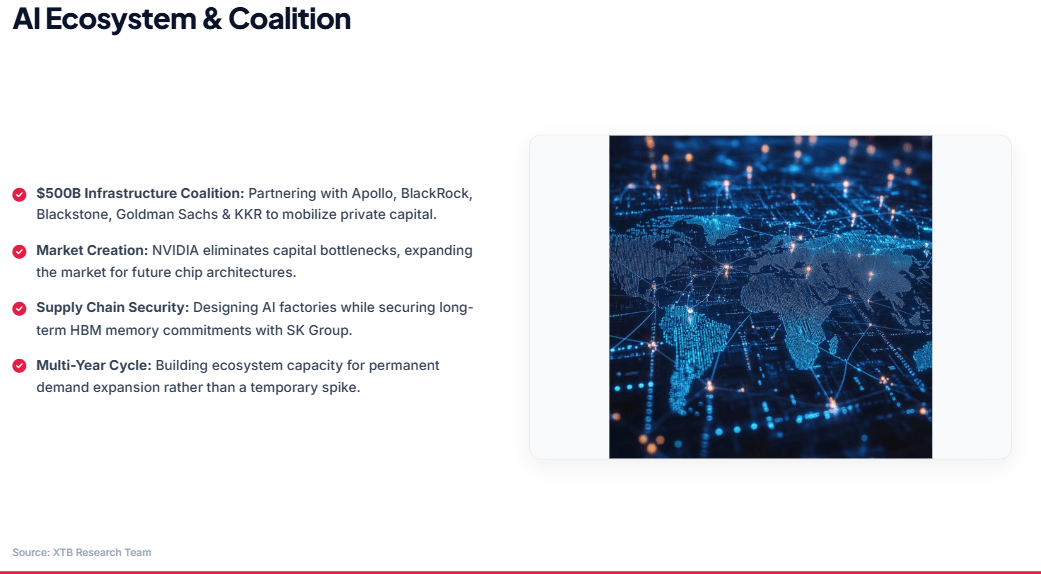
This expansion of the market could be one of the most important elements of the next phase of the AI boom. Until now, the main source of demand has been the largest technology companies, which have been building infrastructure for their own models and cloud services. NVIDIA is increasingly trying to create a situation in which access to computing power becomes much broader. In August, the company announced cooperation with Apollo, BlackRock, Blackstone, Brookfield, Goldman Sachs, and KKR, aimed at mobilizing more than $500 billion in external capital for the development of AI infrastructure. This is not direct NVIDIA revenue, but strategically the initiative is extremely important. The company is attempting to ensure that the development of AI is no longer constrained simply by a lack of capital to build data centers.
In practice, NVIDIA is therefore beginning to play a role much broader than that of a chip manufacturer. It wants to participate in building the entire computing-power market, which will subsequently generate demand for its next generations of products. If institutional capital finances the construction of new data centers, cloud providers increase the availability of computing capacity, and enterprises and AI laboratories rent that capacity, NVIDIA can benefit from every subsequent stage of the chain. This creates a highly favorable dynamic. The easier it is to finance infrastructure construction, the more infrastructure can be built, and the more infrastructure that is built, the greater the demand for NVIDIA chips.
 There is another important signal as well. NVIDIA is not only securing supplies of key components, but is also participating in the construction of future AI factories together with partners from other parts of the ecosystem. Cooperation with SK Group includes, among other things, the development of data centers and long-term security of the memory supplies required for future generations of AI systems. The scale of these projects shows that companies throughout the supply chain are preparing for continued growth in demand rather than for a rapid end to the current cycle.
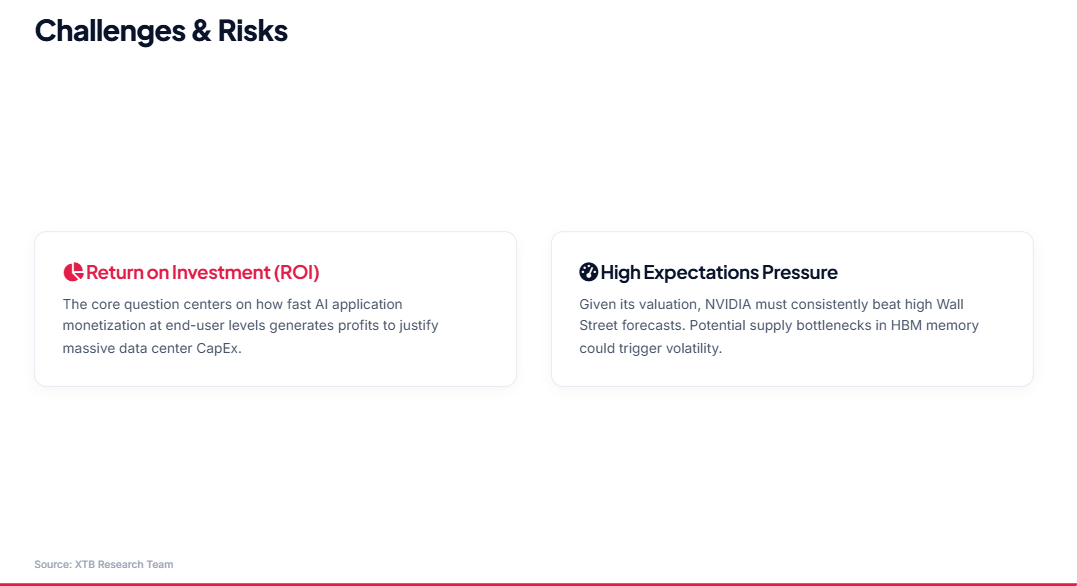
Of course, this is precisely where the biggest risk in the entire story emerges. The larger AI investments become, the more important the question of their economic return will be. Today’s boom is based on the assumption that enormous computing power will eventually translate into productivity gains, new revenue streams, and entirely new business models. If that happens, current investments could be only the beginning of a multi-year infrastructure cycle. If, however, AI monetization proves slower than the pace at which data centers are being built, the market will have to deal with excess computing capacity. For now, NVIDIA’s data suggests that demand remains significantly stronger than supply, and the company continues to prepare for another phase of expansion.
This is precisely why NVIDIA is now more than just the biggest beneficiary of the AI boom. It is one of the key players attempting to extend, broaden, and build an entire financial and technological infrastructure around this boom. If this strategy succeeds, the current cycle may prove not to be the end of NVIDIA’s exceptional growth, but merely the first stage of a much larger economic transformation.
Key Takeaways
After analyzing the results, financial position, and successive product generations, it is difficult to find another company on the global market that combines so many advantages simultaneously. NVIDIA is growing at a rate that seems almost unbelievable given its current scale of operations, while at the same time maintaining margins and generating cash flows characteristic of the most profitable technology businesses. In the second quarter, revenue increased by 106% year over year, Data Center revenue by 117%, and management forecasts $108 billion in revenue for the following quarter. An even stronger signal is the expected approximately 70% increase in revenue in the next fiscal year, significantly above Wall Street’s previous expectations.
The second element of the equation is technological leadership. Blackwell is currently the main driver of growth, but NVIDIA is already moving toward the next generation in the form of Vera Rubin. This means the company does not have to wait for the current cycle to run out before launching another one. If demand for computing power continues to increase, NVIDIA can increase the value of its products with each successive generation. This combination of a growing market and a very rapid product cycle could allow the company to maintain its advantage for much longer than a traditional analysis of the semiconductor cycle might suggest.
The third advantage is the sheer size of the market itself. The largest hyperscalers continue to allocate enormous amounts of money to expanding AI infrastructure, but demand is clearly beginning to move beyond a handful of major technology companies. NVIDIA points to the growing importance of AI laboratories, enterprises, government customers, startups, and industrial applications. The company is also attempting to expand this market by involving institutional capital in financing additional data centers and AI infrastructure. If this process continues, the market available to NVIDIA could be significantly larger than the spending of its biggest customers today.
All of this leads back to the thesis with which we began this article. NVIDIA may be the best company in the world today not because it is the largest, but because its most important advantages reinforce one another. It has technology that the market needs, products positioned at the center of the largest investment cycle in technology, exceptional profitability, enormous cash generation, and the ability to rapidly introduce successive generations. Moreover, instead of simply benefiting from the AI boom, NVIDIA is increasingly participating in the construction of the market that is intended to drive that boom for years to come.
Of course, this is also where the greatest risk lies. At NVIDIA’s scale, the company can no longer simply grow. It has to keep growing faster than the market expects. Any slowdown in AI spending, faster development of proprietary chips by its largest customers, supply-chain problems, or pressure on margins could have a much greater impact than in the case of an ordinary technology company. There is also the question of whether the enormous investments in AI infrastructure will ultimately generate sufficiently high returns. For now, however, NVIDIA’s financial results and forecasts indicate that the cycle is still accelerating rather than fading.
Therefore, describing NVIDIA as the best company in the world should not be interpreted as a statement that it is the safest investment or that its stock price must continue to rise. It is primarily an assessment of the quality of the underlying business. In terms of the combination of growth, profitability, technological advantage, balance-sheet strength, and its position within the most important technological trend of our time, it is difficult to find another company that is equally complete. NVIDIA is not merely selling the products needed to build the AI-powered future. Increasingly, it is becoming one of the companies actually designing that future.
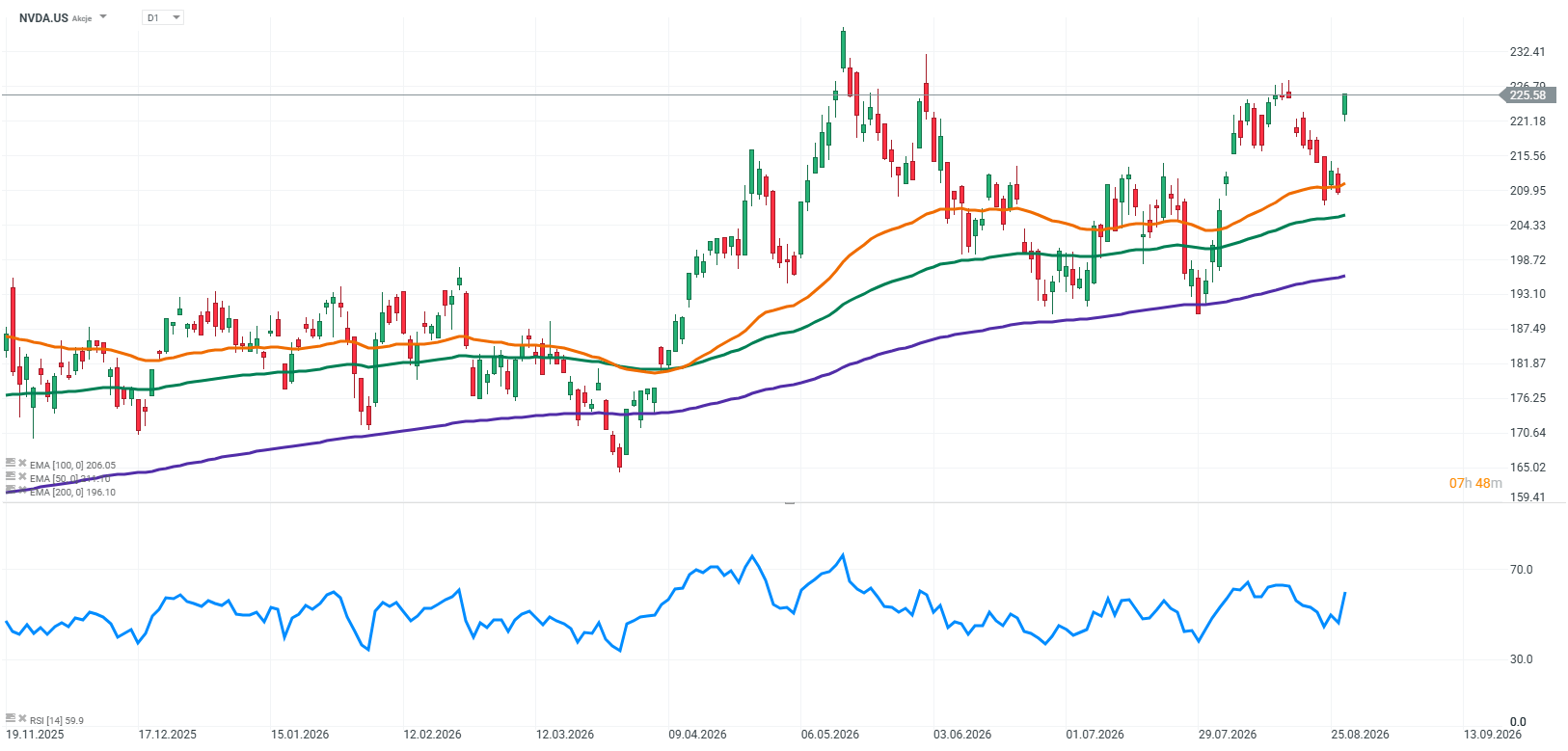
Source: xStation5


Russia is taking over Nestlé's domestic assets 🍫 Shares are down nearly 3% 💥



Market warp: Rate Forecasts and Semiconductors in the Spotlight


Daily Summary: Hawkish Fed fails to scare the markets (17.09.2026)


Nasdaq 100 Up 1.7%
The material on this page does not constitute as financial advice and does not take into account your level of understanding, investment objectives, financial situation or any other particular needs.
All the information provided, including opinions, market research, mathematical results and technical analyses published on the website or transmitted to you by other means is provided for information purposes only and should in no event be interpreted as an offer of, or solicitation for, a transaction in any financial instrument, nor should the information provided be construed as advice of legal or fiscal nature.
Any investment decisions you make shall be based exclusively on your level of understanding, investment objectives, financial situation or any other particular needs. Any decision to act on information published on the website or transmitted to you by other means is entirely at your own risk. You are solely responsible for such decisions.
If you are in doubt or are not sure that you understand a particular product, instrument, service, or transaction, you should seek professional or legal advice before trading.
Investing in OTC Derivatives carries a high degree of risk, as they are leveraged based products and often small movements in the market could lead to much larger movements in the value of your investment and this could work against you or for you. Please ensure that you fully understand the risks involved, taking into account your investments objectives and level of experience, before trading, and if necessary, seek independent advice.