

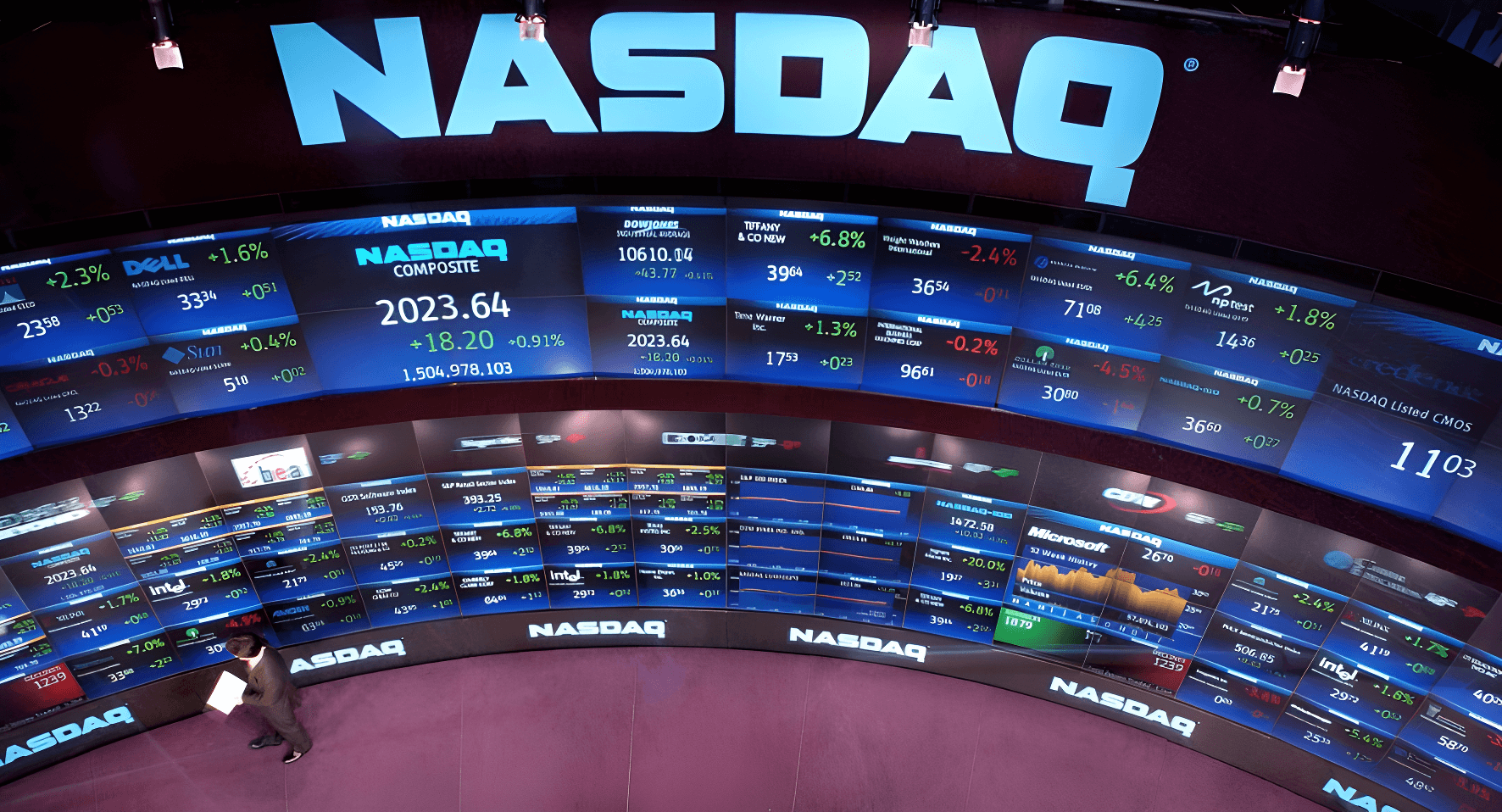

The enthusiasm seen at the start of the week proved to be extremely short-lived. Futures on the U.S. technology index US100 are down about 2.5% today, giving back nearly all of the sharp rebound from the euphoric trading session on November 23, when markets reacted enthusiastically to Jensen Huang’s reinstatement as Nvidia’s CEO.
Pressure on the tech sector is mounting again—in pre-market trading, both Nvidia (-5.3%) and Anthropic (-6%) are trading significantly lower, with the latter slipping below the price of its recent record-breaking IPO ($83). Investors are returning to deeper concerns about the profitability of massive capital expenditures (capex) on AI infrastructure and about the macroeconomic outlook ahead of today’s PCE inflation reading.
Another factor dampening the mood is the resurgence of the tariff issue. According to media reports, the U.S. administration is preparing a new wave of tariffs (under Section 301) targeting China, the European Union, and a dozen or so other economies. These are intended to replace the tariffs previously overturned by the Supreme Court and will primarily affect industrial goods, adding another brick to the market’s risk-off mode.
US100 – Technical Analysis (D1 timeframe)
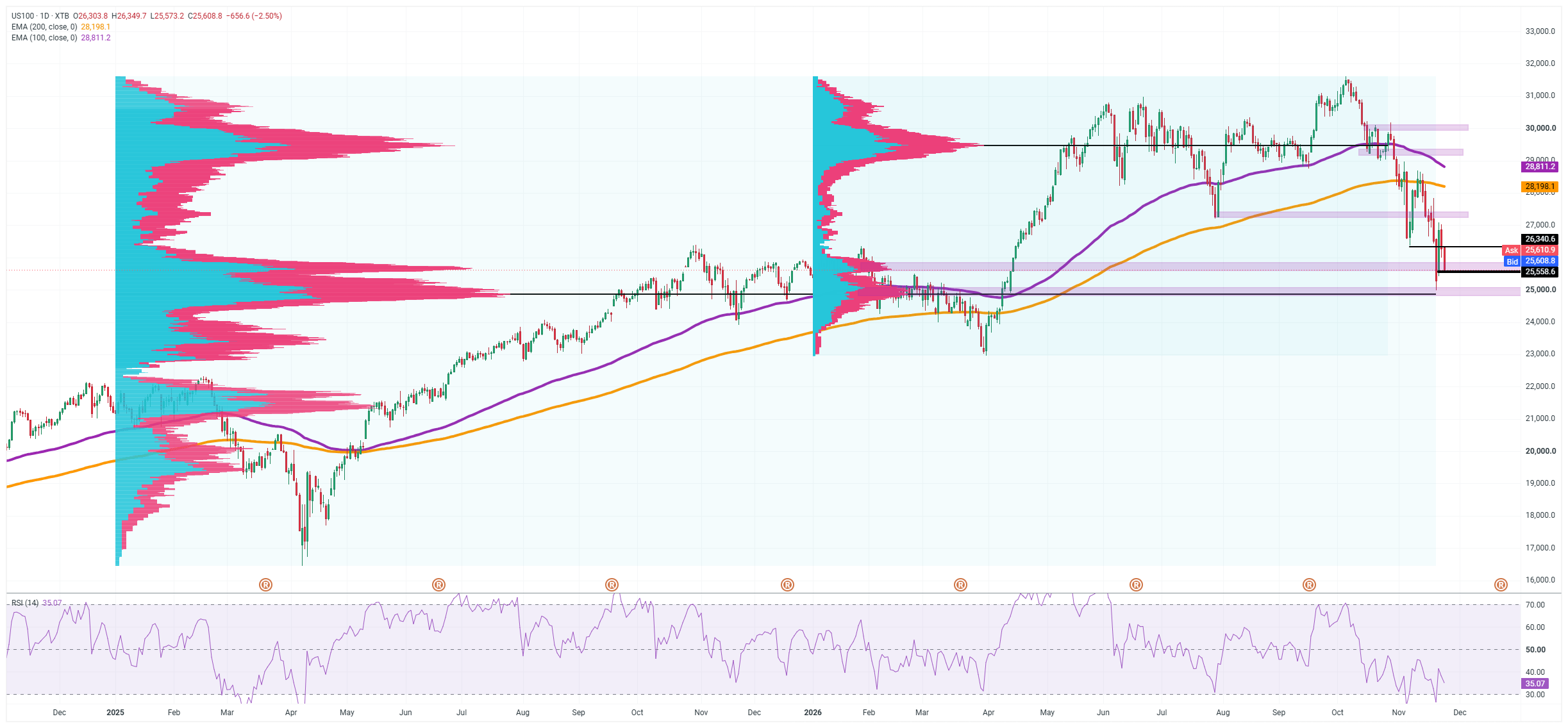
On the daily chart for US100, the price is falling toward 25,600 points (daily low at 25,573 points), returning exactly to the range seen during the November 23 session. The chart structure remains under strong supply pressure—the price is clearly below the key 200-day EMA (28,150 points) and 100-day EMA (28,811 points).
-
Nearest support (25,550–25,600 points): The market is currently testing a local demand zone defined by recent lows. If this zone holds, it could help stabilize the market ahead of tomorrow’s Thanksgiving holiday in the U.S.
-
Possible demand zone (24,800–25,000 points): If today’s lows are broken, the next significant reference point on the chart is the purple support zone in the 24,800–25,000 point range, where the main Point of Control (POC) from the last two years also converges.
-
Potential resistance zones (26,300–26,350 points and 27,300 points): The first barrier to a possible rebound remains near today’s opening price (26,308 points), followed by a supply zone around 27,300 points.
-
Momentum (RSI): The daily RSI (14) fell to 35.07 points, confirming the strength of the supply side, although the oscillator remains above the technical oversold threshold (30 points).


🐻Nasdaq 100 (US100) on the brink of a bear market



US OPEN: AI sector slump and return of inflation push Wall Street toward 7,000 pts


BREAKING: US Oct. PCE Inflation Mostly in Line With Estimates



European Automakers Surge: Market Reacts to New Regulations
The material on this page does not constitute as financial advice and does not take into account your level of understanding, investment objectives, financial situation or any other particular needs.
All the information provided, including opinions, market research, mathematical results and technical analyses published on the website or transmitted to you by other means is provided for information purposes only and should in no event be interpreted as an offer of, or solicitation for, a transaction in any financial instrument, nor should the information provided be construed as advice of legal or fiscal nature.
Any investment decisions you make shall be based exclusively on your level of understanding, investment objectives, financial situation or any other particular needs. Any decision to act on information published on the website or transmitted to you by other means is entirely at your own risk. You are solely responsible for such decisions.
If you are in doubt or are not sure that you understand a particular product, instrument, service, or transaction, you should seek professional or legal advice before trading.
Investing in OTC Derivatives carries a high degree of risk, as they are leveraged based products and often small movements in the market could lead to much larger movements in the value of your investment and this could work against you or for you. Please ensure that you fully understand the risks involved, taking into account your investments objectives and level of experience, before trading, and if necessary, seek independent advice.