



Oil futures (OIL) have recovered part of their earlier losses and are moving back toward $95 per barrel.
- EIA crude oil inventories fell by 4.45 million barrels, compared with expectations for a 0.06 million increase and the previous 0.095 million rise.
- EIA gasoline inventories declined by 1.173 million barrels, versus expectations for a 1.6 million drop and the previous 2.536 million decline.
- EIA distillate inventories increased by 0.796 million barrels, compared with expectations for a 1.5 million decline and the previous 2.228 million drop.
- Crude oil inventories at Cushing rose by 0.08 million barrels, following the previous 1.176 million increase.
OPEC+ decision due on Sunday – what should we expect?
OPEC+ is most likely to leave its October production policy unchanged. According to Reuters sources, Sunday’s meeting is expected to focus primarily on assessing market conditions rather than introducing new supply decisions. The group is currently completing the rollback of a 1.65 million barrel-per-day production cut introduced in 2023. In theory, this means more oil returning to the market, but in practice actual output continues to lag behind formal quotas.
- The gap between quotas and actual production is now crucial. Conflicts and export disruptions linked to Iran and Ukraine are constraining supply, leaving OPEC+ with less control over the real increase in global production than headline quota decisions might suggest.
- From a market perspective, this means that the absence of a new OPEC+ decision does not automatically have to be bearish for oil prices. If physical supply remains constrained by geopolitics, higher production limits may matter less for the overall market balance.
- Increasing attention is shifting toward 2027 production quotas. Group members are currently reviewing their production capacity, laying the groundwork for potentially difficult negotiations over the future allocation of output limits.
- This matters because some producers have invested in expanding capacity and may push for higher quotas, while others may seek to defend their current share of the group’s total production.
- The key takeaway for the oil market is therefore that Sunday’s meeting may be relatively neutral for prices, while the real internal tensions within OPEC+ could emerge later, when new production baselines and 2027 quotas are negotiated.
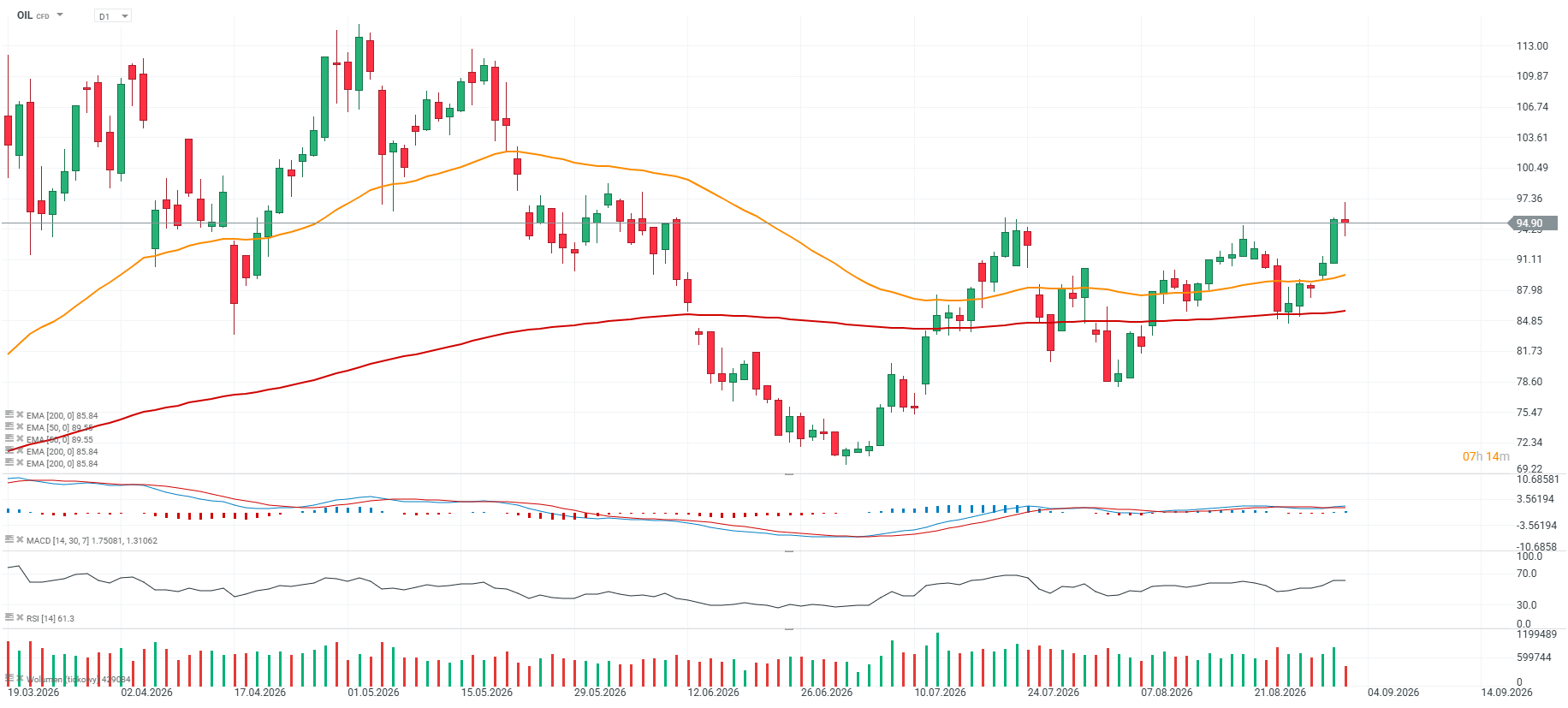
Oil futures chart (OIL), D1 interval
Oil has moved back above both the 50-day and 200-day moving averages, pointing to a genuine return of bullish momentum. From a price action perspective, the key resistance zone is around $98–100, while support is located near $85, additionally reinforced by the 200-day EMA (red line). In the short term, oil prices are likely to remain more sensitive to actual export volumes, developments in Iran and Ukraine, and global demand than to the absence of any change in official OPEC+ policy.
Source: xStation5



US CPI above expectations!🔥📈



Market Wrap: ASML lifts tech sentiment, EU yields pull back


Dollar in Limbo Ahead of CPI 🚨


Economic Calendar: US CPI Inflation Data in Focus (14.10.2026)
The content of this report has been created by XTB S.A., with its registered office in Warsaw, at Prosta 67, 00-838 Warsaw, Poland, (KRS number 0000217580) and supervised by Polish Supervision Authority ( No. DDM-M-4021-57-1/2005). This material is a marketing communication within the meaning of Art. 24 (3) of Directive 2014/65/EU of the European Parliament and of the Council of 15 May 2014 on markets in financial instruments and amending Directive 2002/92/EC and Directive 2011/61/EU (MiFID II). Marketing communication is not an investment recommendation or information recommending or suggesting an investment strategy within the meaning of Regulation (EU) No 596/2014 of the European Parliament and of the Council of 16 April 2014 on market abuse (market abuse regulation) and repealing Directive 2003/6/EC of the European Parliament and of the Council and Commission Directives 2003/124/EC, 2003/125/EC and 2004/72/EC and Commission Delegated Regulation (EU) 2016/958 of 9 March 2016 supplementing Regulation (EU) No 596/2014 of the European Parliament and of the Council with regard to regulatory technical standards for the technical arrangements for objective presentation of investment recommendations or other information recommending or suggesting an investment strategy and for disclosure of particular interests or indications of conflicts of interest or any other advice, including in the area of investment advisory, within the meaning of the Trading in Financial Instruments Act of 29 July 2005 (i.e. Journal of Laws 2019, item 875, as amended). The marketing communication is prepared with the highest diligence, objectivity, presents the facts known to the author on the date of preparation and is devoid of any evaluation elements. The marketing communication is prepared without considering the client’s needs, his individual financial situation and does not present any investment strategy in any way. The marketing communication does not constitute an offer of sale, offering, subscription, invitation to purchase, advertisement or promotion of any financial instruments. XTB S.A. is not liable for any client’s actions or omissions, in particular for the acquisition or disposal of financial instruments, undertaken on the basis of the information contained in this marketing communication. In the event that the marketing communication contains any information about any results regarding the financial instruments indicated therein, these do not constitute any guarantee or forecast regarding the future results.