


- European and US equity indices are trading relatively flat around 4.5 hours ahead of the US market open.
- Oil prices are up more than 2% amid the ongoing impasse over the Strait of Hormuz.
- Shares of Swiss eye-care giant Alcon are rising following its earnings report, while energy stocks are leading gains across Europe.

- European and US equity indices are trading relatively flat around 4.5 hours ahead of the US market open.
- Oil prices are up more than 2% amid the ongoing impasse over the Strait of Hormuz.
- Shares of Swiss eye-care giant Alcon are rising following its earnings report, while energy stocks are leading gains across Europe.
- The Stoxx Europe 600 remains close to record highs, but European equities have entered a wait-and-see phase in which geopolitical developments and energy prices are having a greater impact on short-term sentiment.
- Negotiations over the Strait of Hormuz have reached another impasse after the Donald Trump administration hardened its stance toward proposals put forward by Iran and Oman, reducing the chances of a swift de-escalation in the region.
- Brent crude has climbed above $84 per barrel to its highest level since late July, supporting European energy stocks while simultaneously raising costs for industry and increasing the risk of renewed inflationary pressure.
- The European earnings season remains broadly solid, particularly in healthcare, energy infrastructure and defense, although technology and industrial companies are facing a much more demanding response from investors.
- Among individual stocks, Alcon stands out, with shares rising almost 4% after the company raised its full-year earnings outlook.
Markets are beginning to take a more cautious view of the AI investment boom. Heavy spending on data centers, semiconductors and AI infrastructure is no longer enough to sustain share-price gains unless it is accompanied by a clear path toward rapid revenue growth. For equity markets, the combination of high energy prices and weaker economic growth is becoming particularly important: more expensive oil can increase cost and inflation pressures, while the latest weak U.S. labor market report has raised concerns about the pace of growth in the world’s largest economy. The main macroeconomic event will be Wednesday’s U.S. CPI report. Softer inflation could ease concerns related to higher energy prices and support expectations for a more accommodative Fed, while a stronger-than-expected reading could put renewed pressure on equity valuations, particularly in the most interest-rate-sensitive areas of the market.
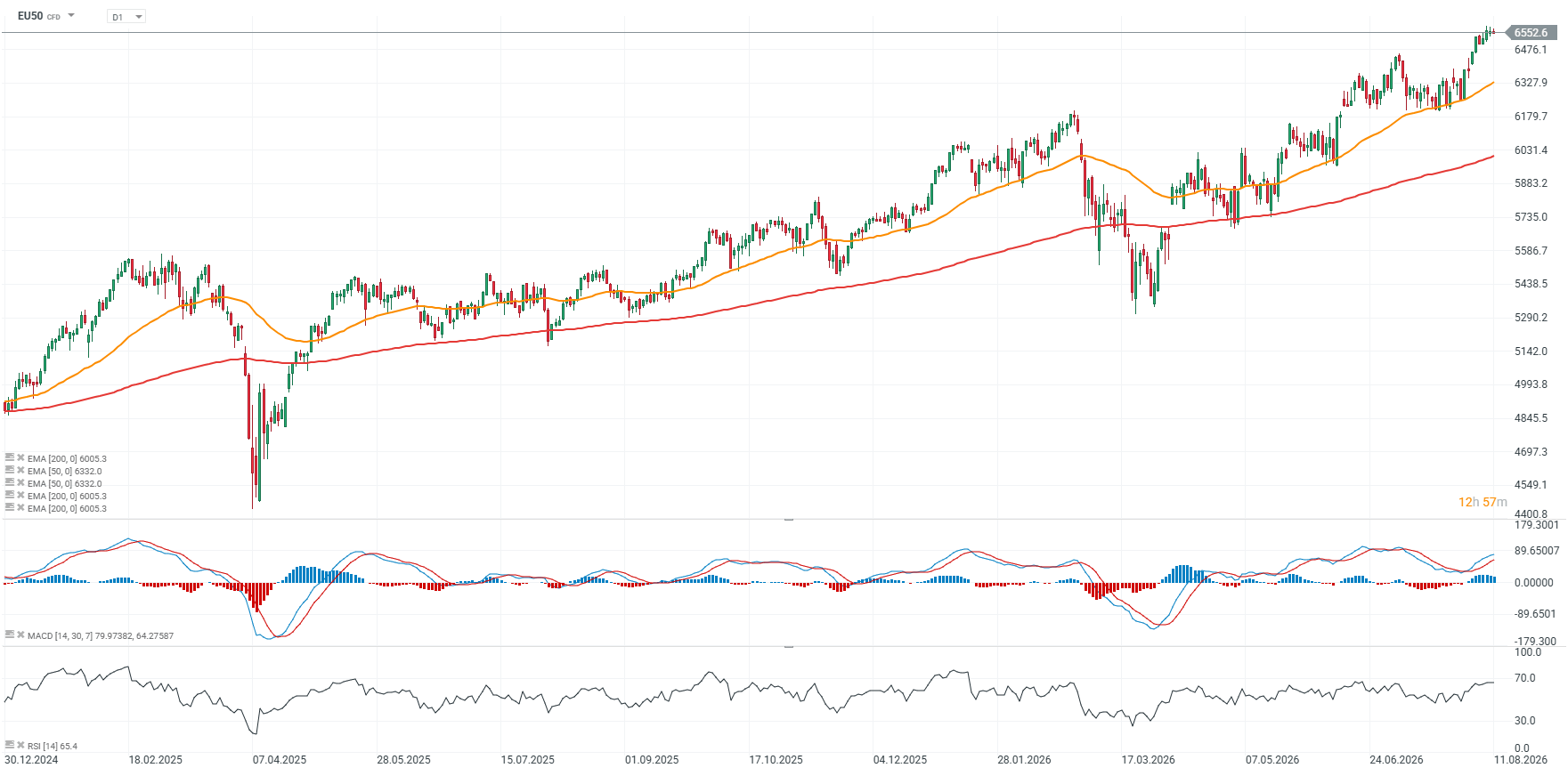
EU50 chart (D1 timeframe)
Euro Stoxx 50 futures are not experiencing any significant spike in volatility today, with sentiment across European markets remaining relatively calm. U.S. index futures are also trading without major changes.
 Source: xStation5
Euro Stoxx 50 – market overview
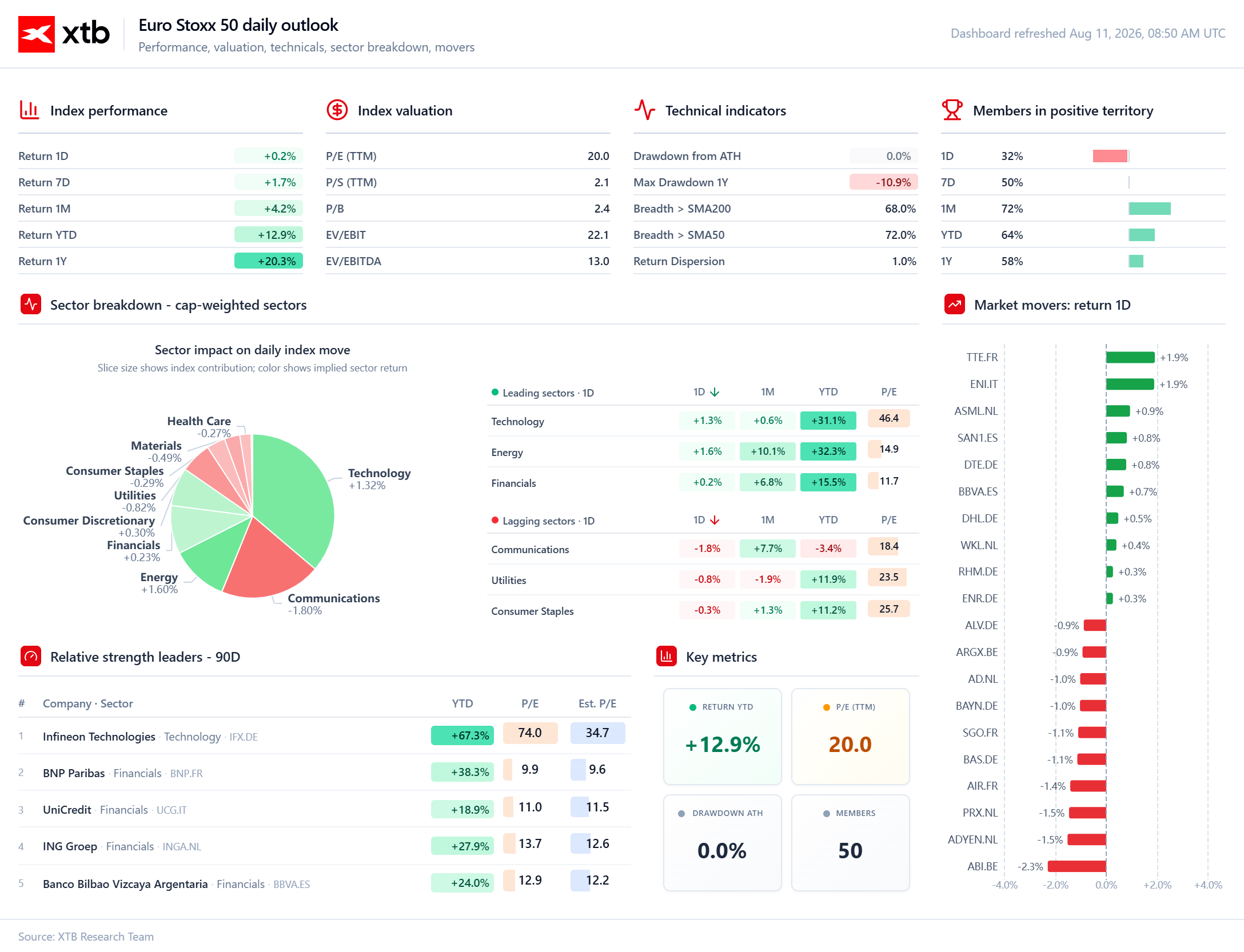
The Euro Stoxx 50 remains in a very strong trend, up 12.9% year-to-date and 20.3% over the past 12 months, with the index trading close to all-time highs. Market breadth remains particularly constructive: 72% of constituents are trading above their 50-day moving average and 68% above their 200-day SMA, indicating that the rally is not being driven solely by a handful of the largest companies. At the same time, a P/E ratio of around 20x shows that investors are already paying a premium for European blue chips, meaning that further gains will require confirmation from corporate earnings and guidance. In the short term, the market therefore remains fundamentally strong, but after gaining 4.2% over the past month and approaching record highs, it has become more vulnerable to profit-taking in response to negative macroeconomic or geopolitical catalysts.
Source: XTB Research
Stock heatmap – ASML and energy offset weaker segments
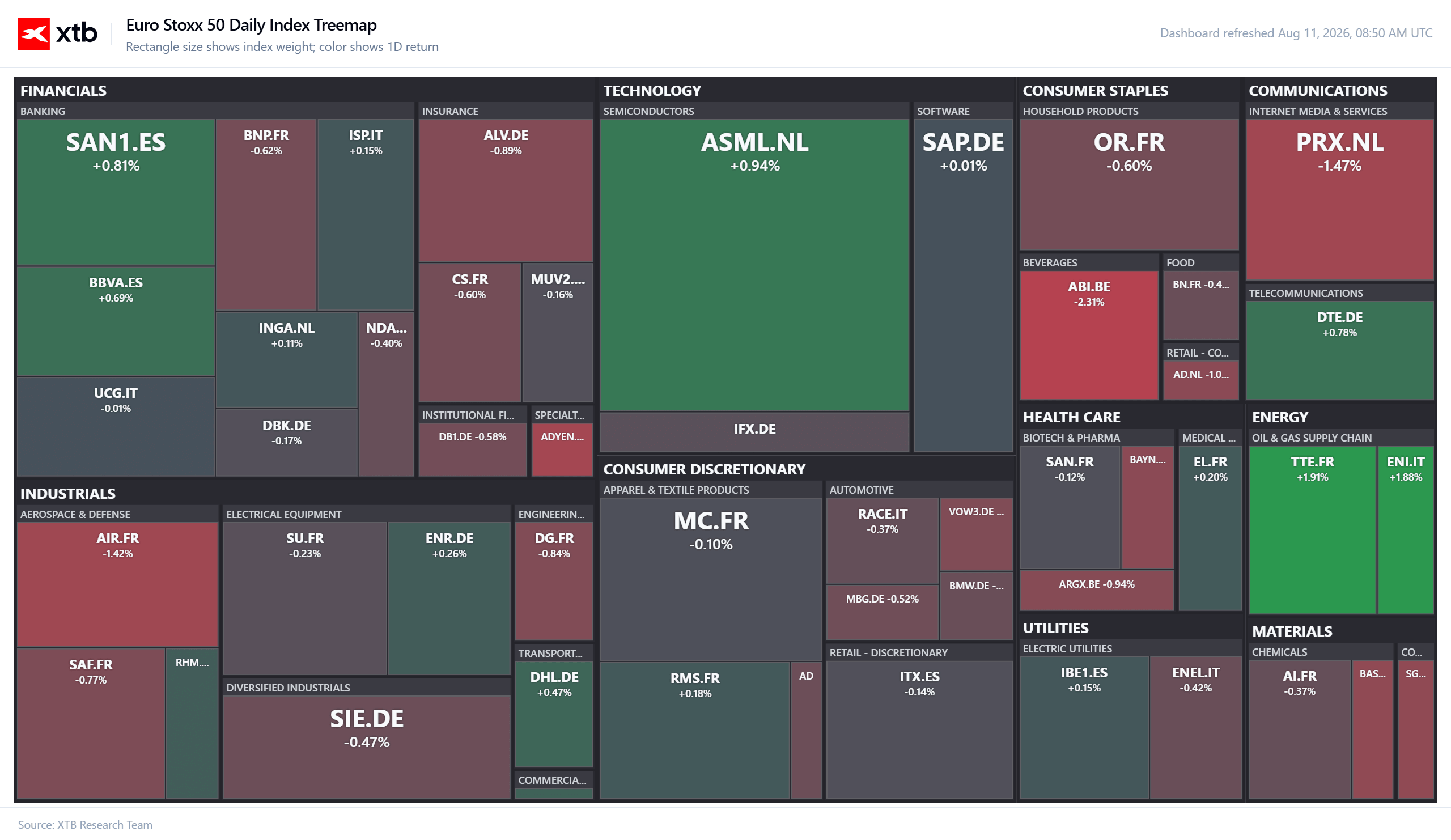
The Euro Stoxx 50 heatmap points to significant rotation within the index, with relatively calm benchmark performance masking much larger moves among individual stocks. ASML (+0.94%) remains one of the index’s key pillars due to its substantial weighting, while TotalEnergies (+1.91%) and Eni (+1.88%) are benefiting from the renewed rise in oil prices. On the other side, AB InBev (-2.31%), Prosus (-1.47%) and Airbus (-1.42%) are among the laggards, indicating that today’s gains are far from broad-based. This market structure points primarily to capital rotation between sectors rather than a broad risk-on move across European equities. The strength of European energy stocks alongside higher oil prices is also visible more broadly across the continent.
Source: XTB Research
Higher oil prices support energy stocks, weigh on travel
Elevated oil prices are creating clear divergence between individual sectors of the European equity market. The energy sector gained around 1% as crude prices reached their highest level this month. The next move may depend largely on developments surrounding the Strait of Hormuz and upcoming macroeconomic data.
- The energy sector gained around 1%, supported by oil prices climbing to their highest levels in August.
- Donald Trump responded to Iran’s conditions with demands of his own, including compensation payments, potentially further complicating negotiations over the reopening of the Strait of Hormuz.
- Travel and leisure stocks fell around 0.7% as higher fuel prices renewed concerns over operating costs.
- European technology stocks performed better, with the sector index gaining around 0.4%.
- Europe’s earnings season is approaching its final stages, shifting market attention toward macroeconomic data, particularly eurozone employment and GDP figures.
Leaders and laggards – market rewards exposure to higher oil prices
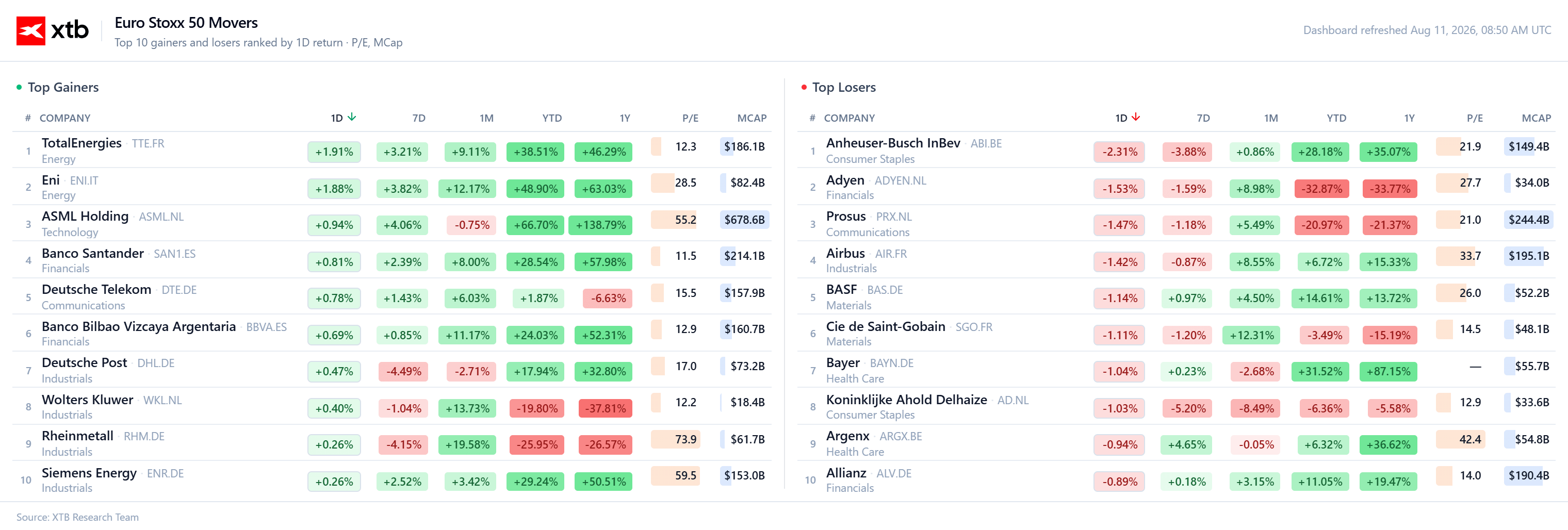
TotalEnergies (+1.91%) and Eni (+1.88%) are among the strongest performers, showing how higher crude prices are once again translating directly into relative strength among energy producers. ASML is also performing strongly, with shares up 0.94% during the session and as much as 66.7% year-to-date, although its P/E ratio of around 55x illustrates how much future growth is already priced into the stock. On the downside, AB InBev (-2.31%), Adyen (-1.53%), Prosus (-1.47%) and Airbus (-1.42%) stand out, once again highlighting the selective nature of today’s trading. From a broader perspective, however, the strongest signal comes from the energy sector. TotalEnergies and Eni are up approximately 38.5% and 48.9% year-to-date, respectively, suggesting that today’s move is a continuation of an established trend rather than merely a one-day reaction to higher oil prices.
Source: XTB Research
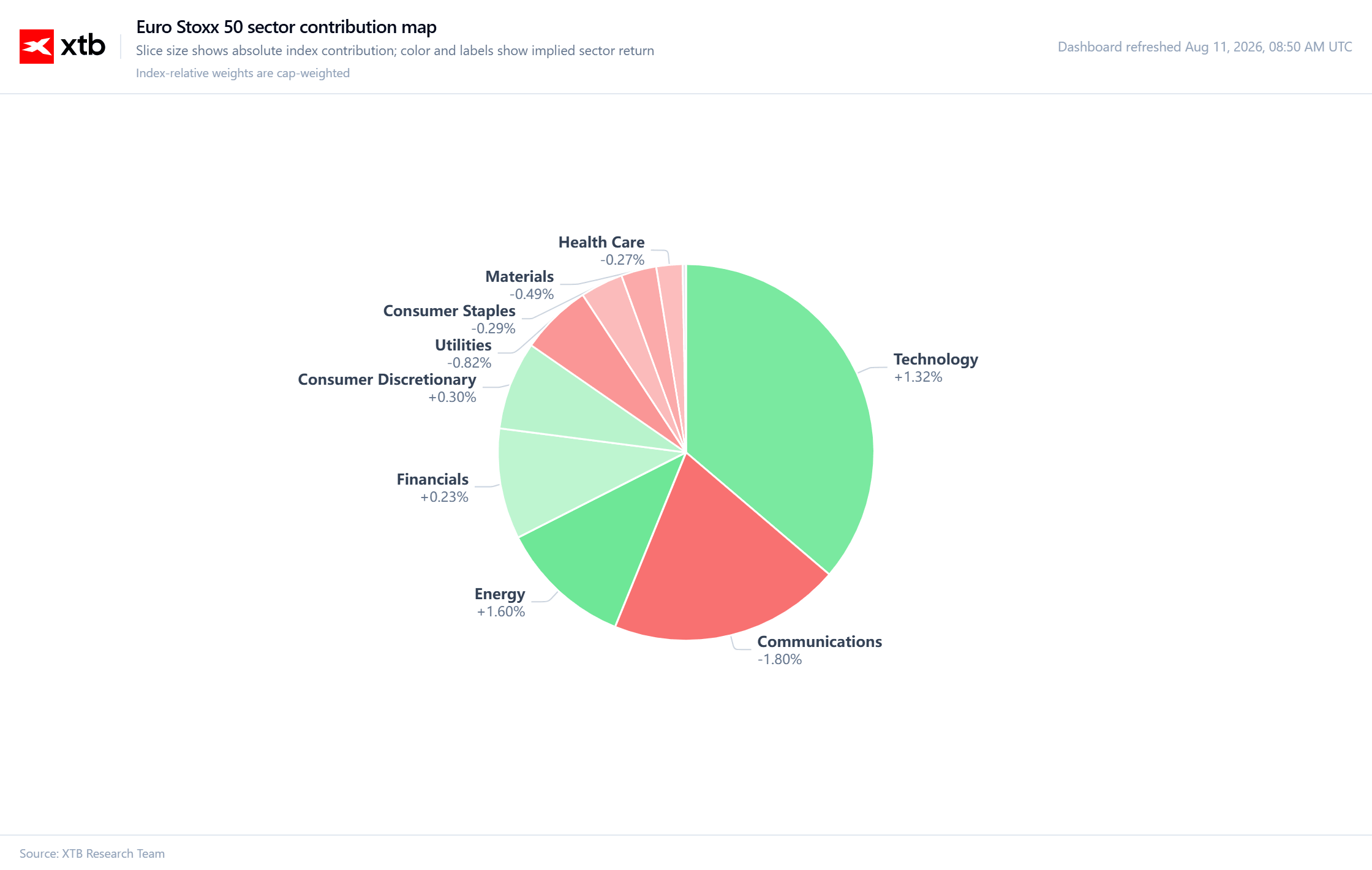
Sectors – technology and energy take the lead
Technology is the strongest driver of today’s market, gaining 1.32%, while energy is another clear leader with a 1.60% advance. This creates an interesting combination of two very different investment themes: technology is benefiting from structural demand for semiconductors and AI, while energy is responding primarily to higher oil prices and the geopolitical risk premium. Communication services (-1.80%) are the largest drag, while declines in utilities (-0.82%) and materials (-0.49%) are also limiting the broader index move. From an index perspective, the key question is whether technology can maintain its momentum, as the sector’s substantial weighting means that ASML and other large constituents may have a greater impact on the direction of the Euro Stoxx 50 than the overall number of sectors trading higher.
Source: XTB Research
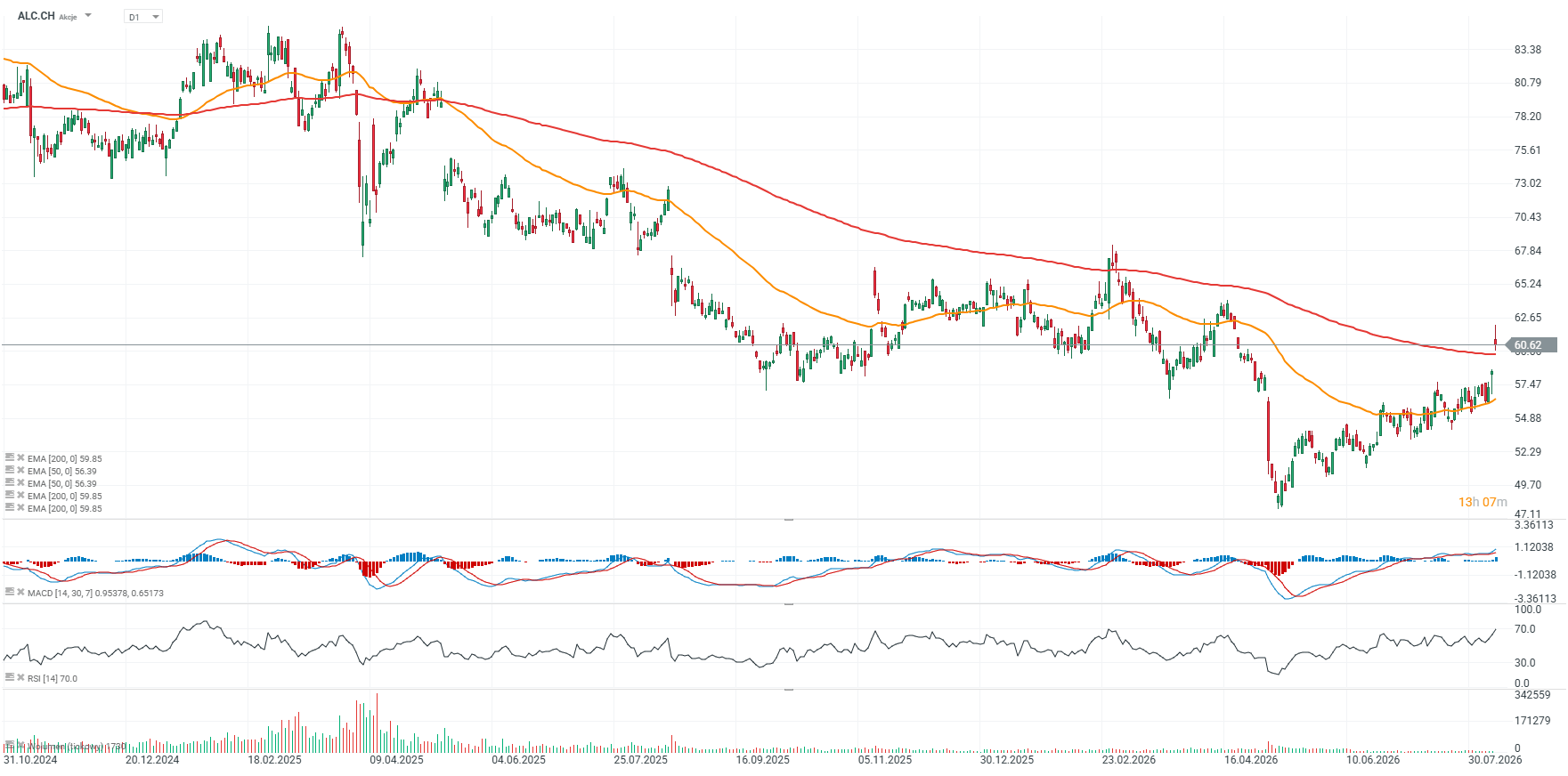
Alcon rallies after earnings and higher profit guidance
Alcon shares are rising sharply following the company’s second-quarter results, as investors focus primarily on an improved outlook for the full 2026 financial year. Revenue increased 8% year-over-year and slightly exceeded analysts’ expectations, while management raised its adjusted EPS and operating margin guidance. The positive share-price reaction suggests that investors view the one-off PowerVision charge as less relevant to the underlying health of the company’s core business.
- Alcon generated second-quarter revenue of $2.78 billion, up 8% year-over-year and slightly above the consensus estimate of approximately $2.77 billion.
- The company raised its 2026 adjusted EPS guidance to $3.44–$3.53, compared with analysts’ expectations of $3.41, while also increasing its full-year operating margin outlook.
- Full-year sales guidance was widened to $10.835–$11.041 billion, compared with a consensus estimate of approximately $11.087 billion, meaning the midpoint of the range remains below market expectations.
- Reported EPS fell to $0.00 from $0.35 a year earlier, although the figure was affected by a one-off, non-cash after-tax charge of approximately $287 million related to the discontinuation of intraocular lens programs acquired from PowerVision.
- Investors focused on the performance of Alcon’s underlying business and the improved guidance, treating the PowerVision impairment as a one-off event that does not reflect the current health of the Surgical and Vision Care segments.
Alcon share price chart (D1 timeframe, ALC.CH)
Source: xStation5


ASML disappoints on revenue but delivers stronger profits and raises guidance 🍳 What’s next for the AI sector?



Daily Summary: Earnings Season Kicks Off on Wall Street Amid Mixed Sentiment


SpaceX Wants to Fly Starship Almost Every Day. Musk’s Business Empire Is Betting on It

Micron Expands Share Buybacks to $35 Billion!
The content of this report has been created by XTB S.A., with its registered office in Warsaw, at Prosta 67, 00-838 Warsaw, Poland, (KRS number 0000217580) and supervised by Polish Supervision Authority ( No. DDM-M-4021-57-1/2005). This material is a marketing communication within the meaning of Art. 24 (3) of Directive 2014/65/EU of the European Parliament and of the Council of 15 May 2014 on markets in financial instruments and amending Directive 2002/92/EC and Directive 2011/61/EU (MiFID II). Marketing communication is not an investment recommendation or information recommending or suggesting an investment strategy within the meaning of Regulation (EU) No 596/2014 of the European Parliament and of the Council of 16 April 2014 on market abuse (market abuse regulation) and repealing Directive 2003/6/EC of the European Parliament and of the Council and Commission Directives 2003/124/EC, 2003/125/EC and 2004/72/EC and Commission Delegated Regulation (EU) 2016/958 of 9 March 2016 supplementing Regulation (EU) No 596/2014 of the European Parliament and of the Council with regard to regulatory technical standards for the technical arrangements for objective presentation of investment recommendations or other information recommending or suggesting an investment strategy and for disclosure of particular interests or indications of conflicts of interest or any other advice, including in the area of investment advisory, within the meaning of the Trading in Financial Instruments Act of 29 July 2005 (i.e. Journal of Laws 2019, item 875, as amended). The marketing communication is prepared with the highest diligence, objectivity, presents the facts known to the author on the date of preparation and is devoid of any evaluation elements. The marketing communication is prepared without considering the client’s needs, his individual financial situation and does not present any investment strategy in any way. The marketing communication does not constitute an offer of sale, offering, subscription, invitation to purchase, advertisement or promotion of any financial instruments. XTB S.A. is not liable for any client’s actions or omissions, in particular for the acquisition or disposal of financial instruments, undertaken on the basis of the information contained in this marketing communication. In the event that the marketing communication contains any information about any results regarding the financial instruments indicated therein, these do not constitute any guarantee or forecast regarding the future results.