


- Risk aversion dominates trading as the euro weakens against all G10 currencies.
- EURUSD drops below 1.12.
- French 10-year government bond yield spreads widen as fiscal deficit concerns grow.
- Crude oil prices advance toward 102 USD per barrel following tanker attacks in the Strait of Hormuz.
- European equity indices post losses led by semiconductor stocks, automakers, and banks.

- Risk aversion dominates trading as the euro weakens against all G10 currencies.
- EURUSD drops below 1.12.
- French 10-year government bond yield spreads widen as fiscal deficit concerns grow.
- Crude oil prices advance toward 102 USD per barrel following tanker attacks in the Strait of Hormuz.
- European equity indices post losses led by semiconductor stocks, automakers, and banks.
Wednesday's trading session is dominated by rising risk aversion. The euro is weakening against all other G10 currencies, government bond yields are climbing higher once again, and surging crude oil prices are weighing on European stock indices, almost all of which are posting losses today.
EURUSD drops below 1.12
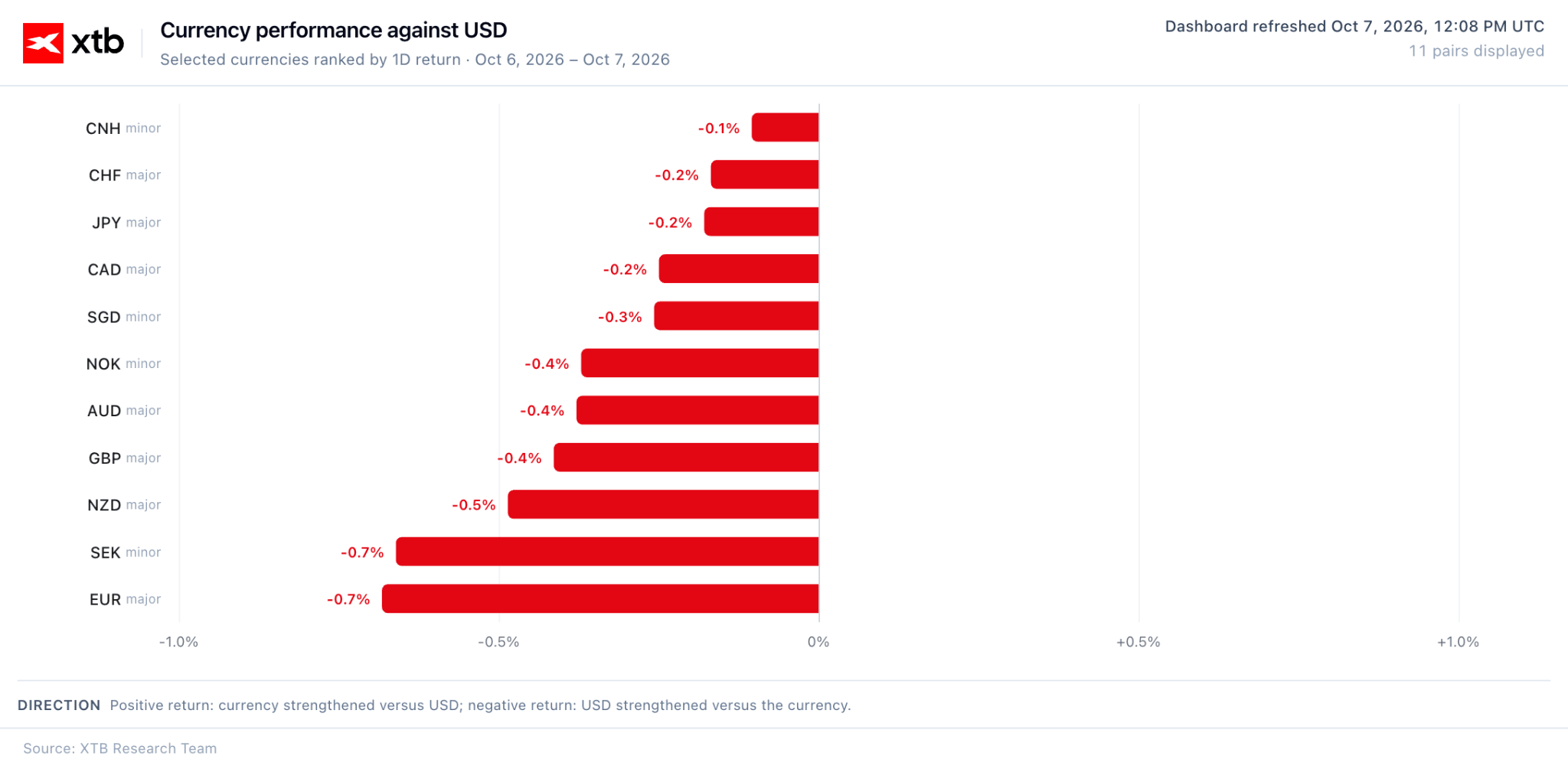
The EURUSD currency pair is down over 0.6% today, breaking below the 1.12 mark. A combination of factors is weighing on the single currency: US dollar strength, elevated crude oil prices, a global rise in sovereign bond yields, broader investor risk aversion, heightened fiscal and political risks in France, and the prospect of the ECB taking a less hawkish monetary policy path.
Figure 1: Performance of Major Currencies Against the US Dollar (07.10.2026)
 Source: XTB Research, 07.10.2026
France in the spotlight
The yield spread between French and German 10-year government bonds has widened further, approaching levels not seen since 2011. While the yield on French debt (around 4.9%) remains below that of US Treasuries (over 5.3%), the trajectory is causing concern among investors.
The primary source of anxiety is not the level of debt itself (just over 115% of GDP in 2025 and around 119% of GDP in 2026), but rather the absence of a credible stabilization trajectory. France's public sector deficit is projected to reach 5.4% of GDP in 2026, significantly above the original target of 4.6% of GDP. This is particularly problematic given that the domestic economy remains in stagnation, with GDP growth forecasts for the current year hovering around 0.5%.
Consequently, the minority government cannot rely on growing out of the problem and must begin pushing through politically unpopular budget cuts. On 1 October, it presented its draft budget for 2027. It targets a modest deficit reduction to 5% of GDP, primarily achieved through freezing nominal expenditure (excluding defense and a few other sectors). It is worth noting that the original target for 2026 was lower, at 4.6%.
Markets remain skeptical regarding the effectiveness of the planned tightening. Somewhat ambitious GDP growth assumptions (1%) are also raising concern. However, the key risk lies in the fact that the budget requires parliamentary approval, where the government lacks a majority. With presidential elections scheduled for 2027, the risk of political dilution of these spending cuts is further heightened.
Energy commodities
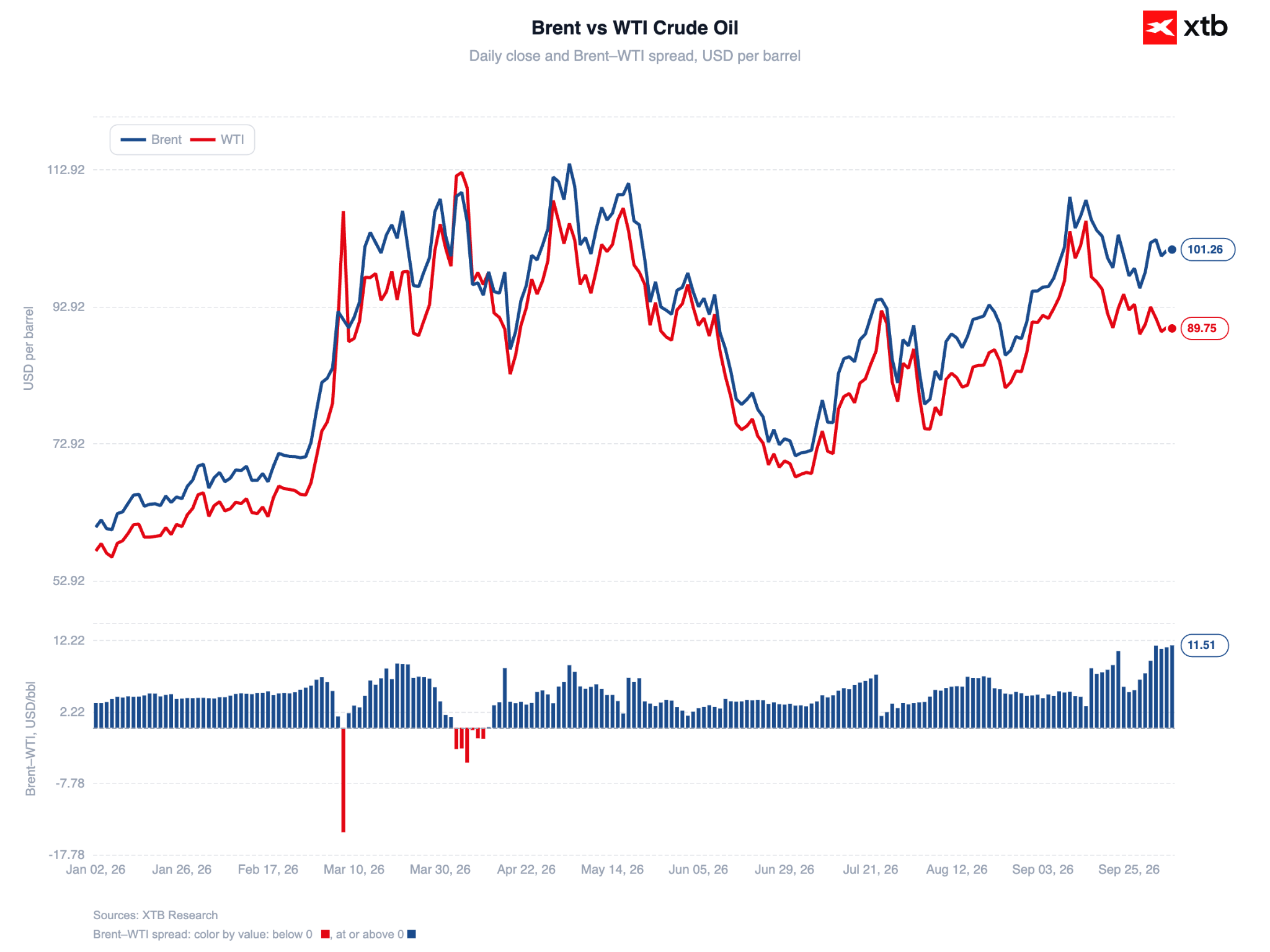
Crude oil prices are advancing in response to intensifying attacks on tankers in the Strait of Hormuz. Brent crude is up approximately 1.3% today, approaching $102 per barrel, while WTI has gained over half a percent to trade near $90. In October alone, nine attacks have already been recorded in the area, matching the total number seen across the entire Strait of Hormuz and Persian Gulf region throughout September. Oil flows from the region have recovered to roughly 80% of pre-conflict levels, though the situation regarding refined fuels remains significantly more constrained.
Figure 2: Brent and WTI Crude Oil (2026)
 Source: XTB Research, 07.10.2026
Equity markets
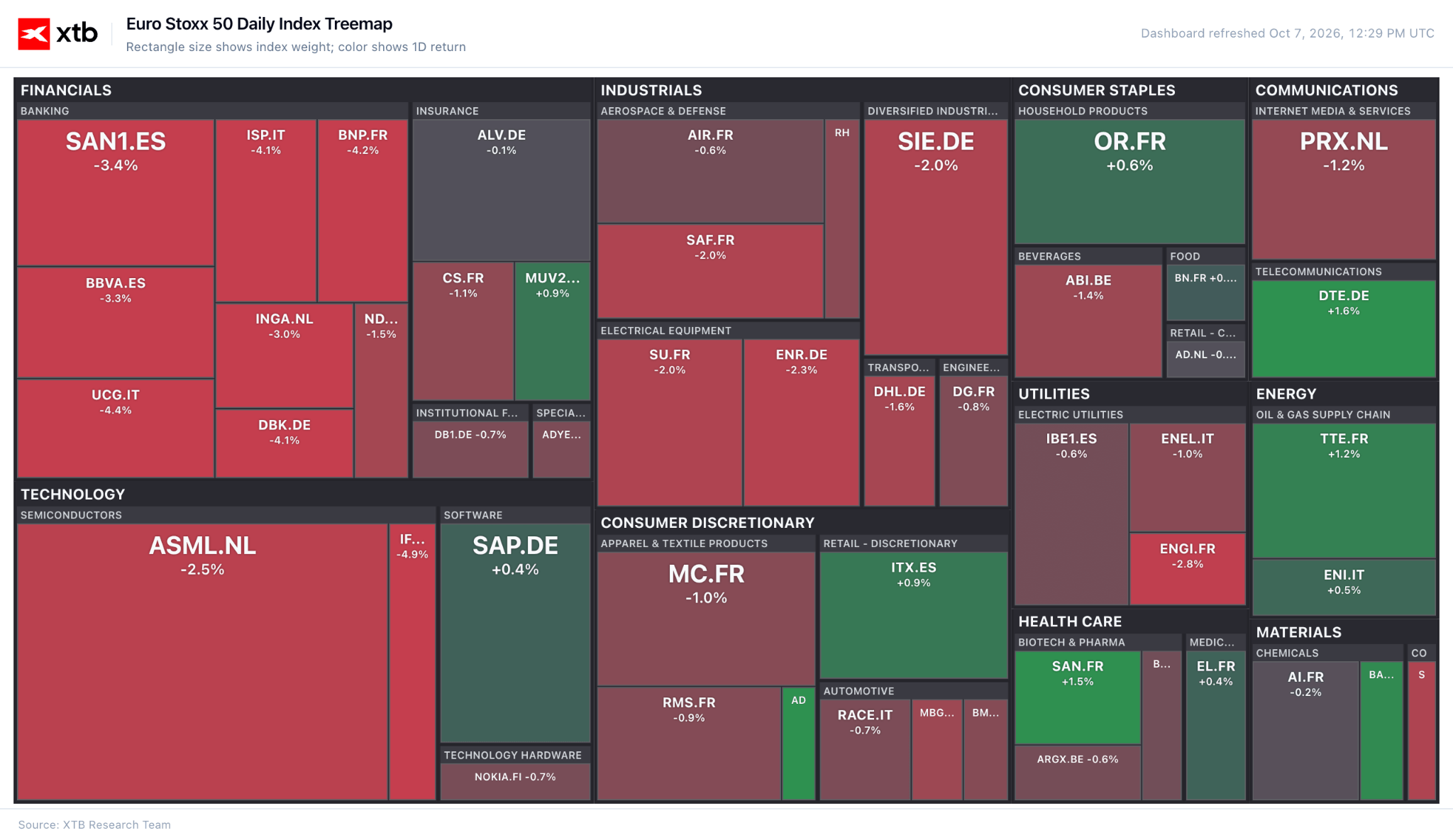
European equity markets are predominantly in the red today. The Italian FTSE MIB (-2.5%) and the pan-European Euro Stoxx 50 (-1.7%) are registering the steepest declines. The German DAX (-1.3%) and Spanish IBEX 35 (-1.8%) are also trading lower.
Figure 3: Euro Stoxx 50 Treemap (07.10.2026)
 Source: XTB Research, 07.10.2026
Within the Euro Stoxx 50, semiconductor stocks, premium German automakers, and banks are the weakest performers today, being the most sensitive to rising yields and pressure for a less hawkish ECB stance.
Infineon is down nearly 5%, mirroring broader weakness across the technology sector. Investors are taking a cautious approach ahead of earnings from Asian semiconductor giants (Samsung, SK Hynix), while UBS downgraded its recommendation on BE Semiconductor to "sell" (sending the stock down around 8%).
Mercedes-Benz (-1.5%) and BMW (-1%) are also notably lower, having posted modest early gains following reports that the EU is considering limiting imports of Chinese hybrid vehicles. The reversal suggests the market has begun weighing the risk of retaliation from Beijing, given that China remains a critical market for both manufacturers (Mercedes sales in China fell 31% year-on-year in Q3).
Precious metals and cryptocurrencies
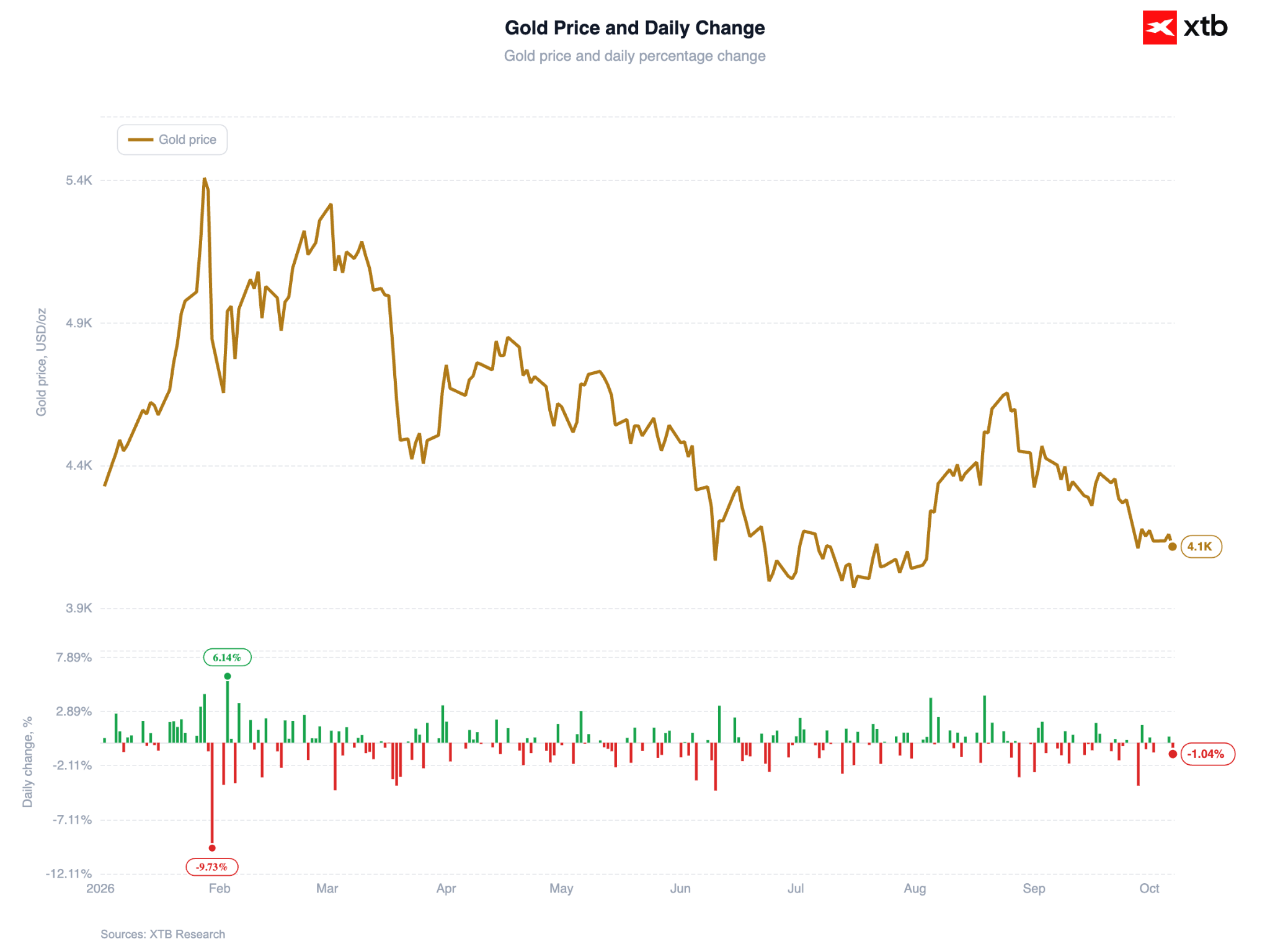
A firmer US dollar and rising yields are weighing on gold, which is down over 1% today, slipping below $4,120 per ounce. Silver is also posting losses of over 2%, while Bitcoin is trading down around 2%.
Figure 4: Gold (2026)
 Source: XTB Research, 07.10.2026
—
Michał Jóźwiak, Financial Markets Analyst at XTB



Oil falls below $100🚨


💶Chart of the Day: EURUSD at Lowest Since May 2025 Amid French Fiscal Crisis

Morning Briefing: Dollar gains, oil falls. EURUSD at multi-month lows



Morning Wrap: Tech Rally in Asia Following Micron Results and Weakening Yen Despite Hawkish BoJ
The content of this report has been created by XTB S.A., with its registered office in Warsaw, at Prosta 67, 00-838 Warsaw, Poland, (KRS number 0000217580) and supervised by Polish Supervision Authority ( No. DDM-M-4021-57-1/2005). This material is a marketing communication within the meaning of Art. 24 (3) of Directive 2014/65/EU of the European Parliament and of the Council of 15 May 2014 on markets in financial instruments and amending Directive 2002/92/EC and Directive 2011/61/EU (MiFID II). Marketing communication is not an investment recommendation or information recommending or suggesting an investment strategy within the meaning of Regulation (EU) No 596/2014 of the European Parliament and of the Council of 16 April 2014 on market abuse (market abuse regulation) and repealing Directive 2003/6/EC of the European Parliament and of the Council and Commission Directives 2003/124/EC, 2003/125/EC and 2004/72/EC and Commission Delegated Regulation (EU) 2016/958 of 9 March 2016 supplementing Regulation (EU) No 596/2014 of the European Parliament and of the Council with regard to regulatory technical standards for the technical arrangements for objective presentation of investment recommendations or other information recommending or suggesting an investment strategy and for disclosure of particular interests or indications of conflicts of interest or any other advice, including in the area of investment advisory, within the meaning of the Trading in Financial Instruments Act of 29 July 2005 (i.e. Journal of Laws 2019, item 875, as amended). The marketing communication is prepared with the highest diligence, objectivity, presents the facts known to the author on the date of preparation and is devoid of any evaluation elements. The marketing communication is prepared without considering the client’s needs, his individual financial situation and does not present any investment strategy in any way. The marketing communication does not constitute an offer of sale, offering, subscription, invitation to purchase, advertisement or promotion of any financial instruments. XTB S.A. is not liable for any client’s actions or omissions, in particular for the acquisition or disposal of financial instruments, undertaken on the basis of the information contained in this marketing communication. In the event that the marketing communication contains any information about any results regarding the financial instruments indicated therein, these do not constitute any guarantee or forecast regarding the future results.