



Yesterday's session brought a sell-off to the US market (and indeed beyond). This was particularly pronounced in the technology sector. The Nasdaq 100 index fell by approximately 1.7%, dragged down by companies in the semiconductor and memory sectors. CoreWeave recorded a 12% loss, while Lumentum fell by 10%. Seagate, Teradyne, and Sandisk each lost 9%.
Today's opening, despite further increases in oil and gas prices, was marked by a correction (relatively short-lived, as the Nasdaq 100 has currently returned to levels from Tuesday's close). The market reacted vigorously to the announcement of the expansion of the US Treasury Department's buyback programme (the so-called liquidity support buyback).
The programme aims to:
- at least double the maximum threshold for individual buyback operations (from $2 billion to $4 billion);
- focus on the long end of the curve, i.e., primarily purchasing Treasury bonds with long maturities (resulting in increased liquidity);
- come into effect on 9 September and remain in force at least until 4 November, when the Treasury Department will release new quarterly plans.
Bessent's decision is, of course, no coincidence. It is an intervention intended to calm the nervous situation in the bond market. In recent weeks, yields have risen at a very dynamic pace, especially at the long end of the curve. Tuesday brought a new 19-year maximum in this regard, with 30-year bond yields breaking the 5.33% threshold.
Technically, this is not a loosening of monetary policy (which falls under the jurisdiction of the Federal Reserve), yet for the market, the effect is similar. We are observing a significant drop in yields across the entire span of the curve, particularly strong at its long end.
Why is this important for the markets?
For many years, especially in the second decade of the 21st century, bond yields remained at low levels (30-year yields around 3%), not constituting a real alternative to the stock market. This phenomenon even had a specific name: TINA, meaning "there is no alternative".
Currently, many investors are starting to wonder whether it is worth taking the risk associated with stock market investments if the US government, the world's safest debtor, offers a certain rate of return of around 5.3% for 30 years.
Why are technology companies so sensitive to changes in the bond market?
Technology companies, particularly those referred to as growth stocks, are often valued through the prism of earnings expected in the distant future. When bond yields rise, the discount rate also increases. Consequently, the present value of future cash flows drops significantly.
Moreover, Treasury bond yields serve as a benchmark of sorts for all other credit in the economy. Their increase typically signifies a higher cost of credit for firms and higher interest rates on corporate bonds. This is especially painful for companies requiring massive investment outlays.
Corporate news
Figure 1: Winners and Losers in the S&P 500 (19.08.2026)
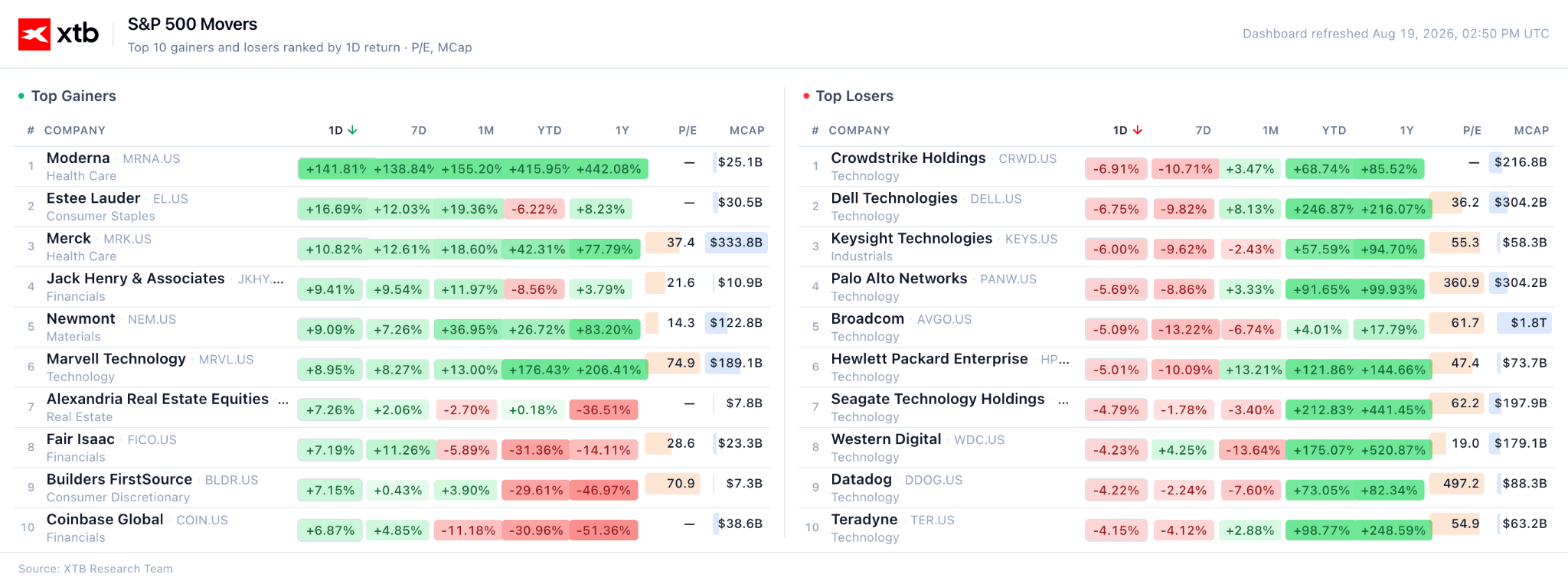 Source: XTB Research, 19.08.2026
Moderna ($MRNA.US)
Industry headlines are dominated today by an over 140% rise in Moderna's share price. This follows the announcement of positive late-stage trial results for a personalised cancer vaccine. In combination with Merck's immunotherapy drug Keytruda, it reduced melanoma recurrence more effectively than immunotherapy alone. It is tailored to the specific mutations of an individual patient's tumour, and the production process takes about six weeks. Moderna's CEO, Stephane Bancel, estimated that it could be approved as early as 2027.
Estee Lauder ($EL.US)
The share price of the cosmetics giant, Estee Lauder, is also rising (+16.7%), following impressive quarterly results. Revenues exceeded expectations and are again showing positive annual growth after three disappointing quarters. The company also raised its expectations for the adjusted operating margin. CEO Stephane de La Faverie, as part of efforts to improve profitability, also confirmed a planned reduction in employment of nearly 10,000 positions.
Target ($TGT.US)
Following initial declines, Target is also strengthening (+5.9%). The company exceeded analysts' expectations for comparable sales (+3.8% versus the consensus of 2.4%) and adjusted earnings per share ($4.11) for the second quarter. Management raised its forecasts for 2027, targeting adjusted earnings per share in the range of $9.90–$10.90 (previously $7.50–$8.50) and net sales growth of approximately 5%.
SK Hynix ($SKHY.US)
Also in the green, though less dramatically at 3.3%, is SK Hynix, which announced a share buyback plan worth 40 trillion won (approximately $29 billion). The company plans to acquire and cancel up to 24 million shares by 19 November.


Daily Summary: SpaceX and the tech sector drive Wall Street, oil retreats sharply below $97


Russia is selling off gold reserves. Why, to whom, and does it matter for the market?



Daily Summary: Buyers Refuse to Give In


📈Morning Brefieng: AI sector rebound collides with still-expensive oil (20.10.2026)
The content of this report has been created by XTB S.A., with its registered office in Warsaw, at Prosta 67, 00-838 Warsaw, Poland, (KRS number 0000217580) and supervised by Polish Supervision Authority ( No. DDM-M-4021-57-1/2005). This material is a marketing communication within the meaning of Art. 24 (3) of Directive 2014/65/EU of the European Parliament and of the Council of 15 May 2014 on markets in financial instruments and amending Directive 2002/92/EC and Directive 2011/61/EU (MiFID II). Marketing communication is not an investment recommendation or information recommending or suggesting an investment strategy within the meaning of Regulation (EU) No 596/2014 of the European Parliament and of the Council of 16 April 2014 on market abuse (market abuse regulation) and repealing Directive 2003/6/EC of the European Parliament and of the Council and Commission Directives 2003/124/EC, 2003/125/EC and 2004/72/EC and Commission Delegated Regulation (EU) 2016/958 of 9 March 2016 supplementing Regulation (EU) No 596/2014 of the European Parliament and of the Council with regard to regulatory technical standards for the technical arrangements for objective presentation of investment recommendations or other information recommending or suggesting an investment strategy and for disclosure of particular interests or indications of conflicts of interest or any other advice, including in the area of investment advisory, within the meaning of the Trading in Financial Instruments Act of 29 July 2005 (i.e. Journal of Laws 2019, item 875, as amended). The marketing communication is prepared with the highest diligence, objectivity, presents the facts known to the author on the date of preparation and is devoid of any evaluation elements. The marketing communication is prepared without considering the client’s needs, his individual financial situation and does not present any investment strategy in any way. The marketing communication does not constitute an offer of sale, offering, subscription, invitation to purchase, advertisement or promotion of any financial instruments. XTB S.A. is not liable for any client’s actions or omissions, in particular for the acquisition or disposal of financial instruments, undertaken on the basis of the information contained in this marketing communication. In the event that the marketing communication contains any information about any results regarding the financial instruments indicated therein, these do not constitute any guarantee or forecast regarding the future results.