


- Dell shares are down more than 10% despite the absence of any direct negative company-specific news.
- The company is widely regarded as one of the biggest beneficiaries of the AI infrastructure investment cycle.
- Global PC shipments declined by nearly 5% year over year in the second quarter

- Dell shares are down more than 10% despite the absence of any direct negative company-specific news.
- The company is widely regarded as one of the biggest beneficiaries of the AI infrastructure investment cycle.
- Global PC shipments declined by nearly 5% year over year in the second quarter
Dell Technologies shares are down more than 11% today, while other AI infrastructure names such as Micron and Sandisk are also trading lower despite the broader US market remaining slightly positive. The scale of the decline suggests investors are reacting less to overall market sentiment and more to growing concerns about the quality and long-term sustainability of the AI infrastructure boom. As one of the largest builders of Nvidia-powered AI servers, Dell sits directly in the AI supply chain, making its valuation highly sensitive to any changes in expectations for hyperscaler data center spending. Dell shares are trading near $400, marking one of the stock's sharpest single-session declines in recent quarters.
-
The main source of pressure stems from concerns that hyperscalers may have overbuilt AI infrastructure. Reports that Meta is considering leasing excess AI training and inference capacity to enterprise customers have raised fears that future AI server demand could slow.
- Dell is particularly exposed to this scenario because it manufactures Nvidia-based AI servers. Any slowdown in AI infrastructure spending would affect not only chipmakers but also system integrators such as Dell.
- Rising memory prices represent another headwind. AI-optimized servers already carry lower gross margins than Dell's traditional hardware business, meaning higher component costs could further compress profitability.
- Insider activity has also weighed on sentiment. Company insiders sold approximately $1.56 billion worth of shares over the past three months without meaningful insider buying, while two additional Form 4 filings were disclosed on July 14.
- Dell's selloff appears to be driven primarily by company- and sector-specific factors. Investors are increasingly questioning whether exceptionally high expectations for AI infrastructure remain justified after a period of explosive order growth and expanding backlogs.
- A short-term risk has also emerged from recent Windows 11 updates. Microsoft temporarily halted the rollout of update KB5101650 to certain Dell devices after reports of unexpected shutdowns, lower performance, overheating, and excessive battery drain.
- The issue has been traced to a compatibility conflict between Microsoft's new USB-C Connection Manager interface and Intel's Innovation Platform Framework driver, which manages processor power and thermal performance.
- Microsoft and Dell are currently working on a fix expected within the coming days. While the financial impact is likely to be limited, the incident could temporarily affect Dell's product quality perception and increase customer support activity.
- Investors are beginning to distinguish between revenue growth and profitability growth. In Dell's case, the key risk is that the AI server boom could ultimately prove less profitable and less durable than previously anticipated.
A Weaker PC Market Does Not Change Dell's Long-Term AI Story
Dell's second major business segment, personal computers, is facing pressure from rising memory and storage costs. Global PC shipments declined by nearly 5% year over year during the second quarter, as higher component prices forced manufacturers to increase selling prices and encouraged customers to postpone purchases. Even so, Dell continued to outperform the broader market, while AI servers remain the company's primary growth engine.
- Worldwide PC shipments declined 4.9% year over year during the second quarter of 2026, according to IDC, as memory and storage prices increased by 20% to 40%.
- Higher component costs translated into more expensive PCs, weakening demand and leading many customers to delay purchases.
- Dell shipped approximately 9.3 million PCs during the quarter and maintained a 14% share of the global market, demonstrating stronger relative performance than many competitors despite weaker industry conditions.
- Dell continues to benefit from its strong enterprise customer relationships and commercial business, allowing the company to gain market share even as consumer PC demand remains subdued.
- AI infrastructure remains Dell's largest growth driver. During fiscal first-quarter 2027, revenue increased 88% year over year to $43.8 billion, comfortably exceeding Wall Street expectations.
- Net income surged 256% to $3.44 billion, GAAP diluted EPS reached $5.24, adjusted EPS came in at $4.86, and free cash flow totaled approximately $3.2 billion.
- Revenue from the Infrastructure Solutions Group climbed 181% to $29 billion, driven by record demand for AI servers and enterprise storage systems used in AI data centers.
- The Client Solutions Group, which includes Dell's PC business, generated $14.6 billion in revenue, representing 17% year-over-year growth despite the weaker global PC market.
In practice, Dell is currently being pulled in two different directions. Its traditional PC business is facing pressure from weaker industry demand and rising component costs, while AI infrastructure continues to expand at a pace that is fundamentally reshaping the company's financial profile. The key question for investors is no longer whether Dell is benefiting from AI, but whether the current growth in AI servers and earnings will prove durable enough to justify today's premium valuation.
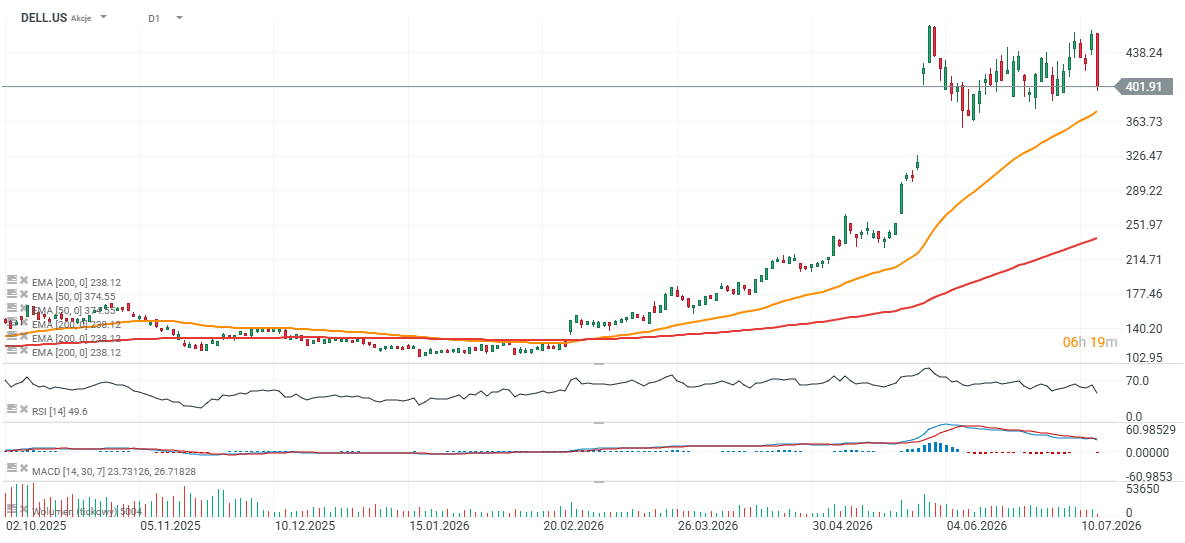
Dell Shares (D1 Interval)
Dell shares are testing the lower boundary of their broader uptrend today, pulling back toward the opening level of the May 29 bullish gap. Valuation remains one of the stock's biggest challenges. Dell currently trades at roughly 30-35 times forward earnings, well above traditional PC manufacturers such as HP. That premium assumes the AI server investment cycle will continue for many years. Any slowdown in enterprise AI spending, delays in infrastructure upgrades, or further increases in memory costs could quickly pressure margins and reduce investors' willingness to pay such elevated valuation multiples.
Source: xStation5


🚩 Caterpillar shares extend decline, down 30% from record high


Webull shares down 20% amid fears over potential China ties



US Open: Wall Street in the Red 🚩 Nasdaq Falls 1% From Record Highs, Constellation Brands Back at March 2020 Level



Market Wrap: Oil rises again, French fiscal concerns weigh on euro (07.10.2026)
The content of this report has been created by XTB S.A., with its registered office in Warsaw, at Prosta 67, 00-838 Warsaw, Poland, (KRS number 0000217580) and supervised by Polish Supervision Authority ( No. DDM-M-4021-57-1/2005). This material is a marketing communication within the meaning of Art. 24 (3) of Directive 2014/65/EU of the European Parliament and of the Council of 15 May 2014 on markets in financial instruments and amending Directive 2002/92/EC and Directive 2011/61/EU (MiFID II). Marketing communication is not an investment recommendation or information recommending or suggesting an investment strategy within the meaning of Regulation (EU) No 596/2014 of the European Parliament and of the Council of 16 April 2014 on market abuse (market abuse regulation) and repealing Directive 2003/6/EC of the European Parliament and of the Council and Commission Directives 2003/124/EC, 2003/125/EC and 2004/72/EC and Commission Delegated Regulation (EU) 2016/958 of 9 March 2016 supplementing Regulation (EU) No 596/2014 of the European Parliament and of the Council with regard to regulatory technical standards for the technical arrangements for objective presentation of investment recommendations or other information recommending or suggesting an investment strategy and for disclosure of particular interests or indications of conflicts of interest or any other advice, including in the area of investment advisory, within the meaning of the Trading in Financial Instruments Act of 29 July 2005 (i.e. Journal of Laws 2019, item 875, as amended). The marketing communication is prepared with the highest diligence, objectivity, presents the facts known to the author on the date of preparation and is devoid of any evaluation elements. The marketing communication is prepared without considering the client’s needs, his individual financial situation and does not present any investment strategy in any way. The marketing communication does not constitute an offer of sale, offering, subscription, invitation to purchase, advertisement or promotion of any financial instruments. XTB S.A. is not liable for any client’s actions or omissions, in particular for the acquisition or disposal of financial instruments, undertaken on the basis of the information contained in this marketing communication. In the event that the marketing communication contains any information about any results regarding the financial instruments indicated therein, these do not constitute any guarantee or forecast regarding the future results.