

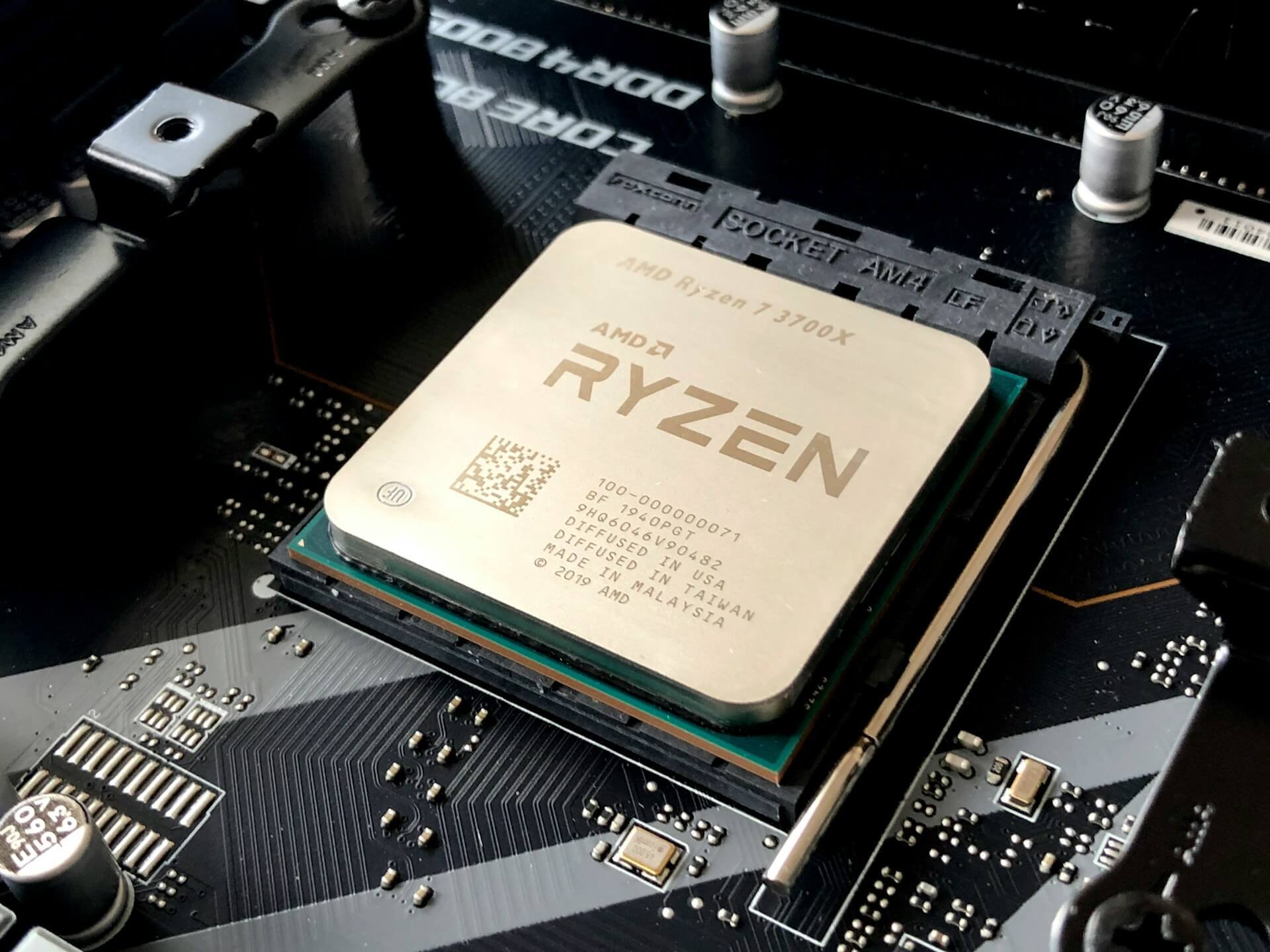

Advanced Micro Devices (AMD.US) reported record revenue of $13.4 billion in Q3 2026, beating Wall Street expectations and increasing sales by 45% year-over-year. The main growth driver remains the Data Center segment, where revenue nearly doubled to $8.55 billion, accounting for almost two-thirds of the company's total sales. AMD also recorded a 74% increase in adjusted earnings per share, demonstrating that its expansion into artificial intelligence is beginning to generate increasingly strong operating leverage. However, investors are particularly focused on the company's fourth-quarter guidance, with management projecting revenue of approximately $17 billion, significantly above analysts' consensus estimates. AMD shares initially surged nearly 7% in after-hours trading following the earnings release.
Before the report, AMD shares had lost approximately 23% over the preceding month, despite strong revenue growth and the company's increasing share of the data center market. The stock had been pressured by concerns about the sustainability of hyperscaler investments, the financing costs associated with AI infrastructure expansion, and elevated semiconductor valuations.
AMD Q3 2026: Key Financial Results
-
Revenue reached $13.40 billion, compared with expectations of $13.09 billion, representing 45% year-over-year growth and a consensus beat of just under 2.5%.
-
Adjusted earnings per share (non-GAAP EPS) reached $2.09, compared with expectations of $1.95, increasing 74% year-over-year.
-
Data Center revenue surged 97% year-over-year to a record $8.55 billion, exceeding analysts' expectations of $8.27 billion.
-
The Client and Gaming segment generated $3.70 billion in revenue, representing an 8% year-over-year decline.
-
Client revenue reached $2.95 billion (+7% year-over-year), slightly below the expected $3.03 billion.
-
Gaming revenue totaled $773 million (-40% year-over-year), but exceeded the $634 million consensus estimate.
-
Embedded revenue increased 29% year-over-year to $1.11 billion, above expectations of $1.07 billion.
-
Non-GAAP gross margin reached 56%, improving by 2 percentage points year-over-year.
-
Adjusted operating income increased 75% year-over-year to $3.92 billion, compared with expectations of $3.67 billion.
-
Adjusted EBITDA reached $4.16 billion, exceeding the $4.02 billion consensus and rising 71% year-over-year.
-
Free cash flow (FCF) totaled $554 million, significantly below expectations of $1.05 billion.
AMD Q4 2026 Guidance
-
AMD expects revenue of approximately $17 billion (+/-3%), implying a range of $16.49 billion to $17.51 billion, comfortably above analysts' consensus estimate of $16.23 billion.
-
The midpoint of the guidance implies potential revenue growth of nearly 27% quarter-over-quarter and approximately 66% year-over-year, suggesting a renewed acceleration in sales growth.
-
Non-GAAP gross margin is expected to reach approximately 55%, compared with 56% reported in Q3.
-
Management expects further acceleration in revenue and earnings growth, supported by demand for EPYC processors, Instinct accelerators, and the development of Helios systems.
Data Center Becomes AMD's Core Business, Accounting for 64% of Revenue
The most important takeaway from AMD's latest earnings report is the exceptionally strong performance of its Data Center segment, where revenue nearly doubled year-over-year to $8.55 billion. This means that almost two-thirds of the company's sales now come from data center solutions, compared with approximately 58% in the previous quarter. Relative to Q2 2026, segment revenue increased by more than $1.8 billion, accounting for almost all of AMD's sequential revenue growth. Such a strong concentration of growth suggests that AMD is increasingly resembling a specialized computing infrastructure supplier rather than a traditional PC processor manufacturer.
Two complementary product families are driving this expansion: EPYC server processors and Instinct accelerators used for training and running artificial intelligence models. EPYC enables AMD to gain market share in server CPUs, while Instinct provides access to the considerably larger AI accelerator market, which has historically been dominated by Nvidia. Having a presence in both segments allows the company to offer customers more integrated computing solutions rather than individual components alone. At the same time, it increases AMD's dependence on the investment plans of the largest cloud operators, which remain the primary buyers of AI infrastructure.
Helios Could Transform AMD's Position in AI. Competition With Nvidia Enters a New Phase
One of AMD's most important strategic projects remains Helios, a comprehensive AI infrastructure architecture integrating Instinct MI450 accelerators, sixth-generation EPYC processors codenamed Venice, Pensando networking technologies, and the ROCm software platform. Unlike the traditional business model based on selling individual chips, Helios enables AMD to deliver a more complete computing platform designed to operate large-scale artificial intelligence clusters. In the configuration developed jointly with HPE, a single Helios rack integrates 72 Instinct MI455X accelerators, together with the necessary networking and cooling infrastructure. The significance of this solution extends beyond simply increasing GPU sales volumes, as it allows AMD to compete for a larger share of the capital expenditure allocated to AI infrastructure development.
Strategically, Helios represents AMD's response to Nvidia's increasingly integrated platforms, whose competitive advantage comes not only from accelerator performance but also from their software ecosystem and networking technologies. AMD is pursuing an open architecture that could make it easier for customers to combine solutions from multiple suppliers and reduce dependence on a single vendor. However, CUDA remains a significant competitive barrier, as Nvidia's extensive software ecosystem is deeply embedded in numerous AI applications. Consequently, the long-term success of Helios will depend not only on hardware performance but also on ROCm's maturity, deployment efficiency, and the total cost of computing.
OpenAI, Microsoft, Meta, and Anthropic. AMD Is Building an Ecosystem of Major AI Customers
AMD's expanding list of strategic partnerships demonstrates that the company is increasingly establishing itself as an alternative computing infrastructure supplier for some of the world's largest technology companies. Its partners using or planning to deploy AMD solutions include OpenAI, Microsoft, Meta, Anthropic, and Oracle Cloud Infrastructure, although individual projects remain at different stages of implementation. Particularly important is the agreement with OpenAI, which предусматриvisions the deployment of AMD accelerator-based infrastructure with a target capacity of up to 6 GW under a multiyear partnership. Meanwhile, Anthropic has announced plans to use up to 2 GW of MI450 accelerators, with the first major deployment phase scheduled for the first half of 2027.
For AMD, agreements of this scale could provide not only multiyear visibility into future demand but also opportunities to optimize successive product generations for the requirements of the largest AI models. In October, Meta confirmed that it had begun testing initial Helios installations, marking an important step toward broader commercialization of the platform. At the same time, HPE secured a $1.2 billion order from Vultr to supply Helios infrastructure, demonstrating interest in the system beyond the largest US hyperscalers. However, the total value of these partnership agreements should not be treated as equivalent to AMD's future revenue, as the projects include components from other suppliers and their implementation and financial recognition may be spread over several years.
Earnings Are Growing Faster Than Revenue. AMD Demonstrates Increasing Operating Leverage
From a fundamental analysis perspective, one of the most important developments is that AMD increased adjusted operating income by 75% year-over-year while revenue grew by 45%. This indicates that the rapid expansion of its Data Center business is translating not only into greater scale but also into improving operating profitability. Non-GAAP gross margin increased to 56%, while adjusted operating margin, calculated using reported adjusted operating income, reached approximately 29.3%. These results demonstrate AMD's growing ability to spread substantial research and development costs across an expanding revenue base.
However, it is worth noting that the projected fourth-quarter gross margin stands at approximately 55%, slightly below the level reported in Q3. This could reflect changes in product mix, production ramp-up costs, and pricing conditions associated with large infrastructure contracts, although the precise contribution of each factor cannot be determined without a detailed cost breakdown. Furthermore, the transition from selling individual processors to supplying complete systems may increase revenue per customer without necessarily delivering a proportional improvement in gross margins. Consequently, one of the most important indicators for investors in the coming quarters will be the pace of operating income growth relative to revenue.
Free Cash Flow Disappoints. Strong Accounting Profits Do Not Automatically Translate Into Cash Generation
Despite record revenue and operating performance, AMD reported free cash flow significantly below expectations, reaching just $554 million against forecasts of $1.05 billion. This translates into an FCF margin of approximately 4.1%, considerably lower than the company's adjusted operating margin of more than 29%. This divergence is particularly relevant for rapidly expanding technology companies, as growth in accounting profits does not always translate immediately into stronger cash generation. Potential explanations include changes in working capital, inventory and receivables, and capital expenditures, although their precise impact requires a detailed examination of the cash flow statement.
Another important consideration is how AMD structures the financing and incentives associated with strategic agreements involving its largest AI customers. In the case of OpenAI and Meta, the partnerships also include conditional warrants to purchase AMD shares, with vesting dependent on achieving specific purchasing, technological, and market-related milestones. Such arrangements may strengthen long-term commercial relationships, but they also introduce potential dilution risks for existing shareholders and increase the complexity of financial reporting. From an earnings quality perspective, the most important test will be AMD's ability to sustain strong operating growth while improving the conversion of profits into cash.
AMD Reports $1.1 Billion in Warrant-Related Expenses. What Does This Mean?
One of the less obvious aspects of AMD's latest earnings report is an accounting expense of approximately $1.1 billion resulting from changes in the fair value of liabilities associated with warrants granted to selected customers. Under its strategic agreements with OpenAI and Meta, AMD granted each partner the right to acquire up to 160 million AMD shares at an exercise price of just $0.01 per share, subject to specific purchasing, technological, and stock-market milestones. Because some of these instruments are classified as financial liabilities, changes in their value must be periodically recognized in the income statement. In practice, this means that an increase in AMD's share price can raise the value of these liabilities and reduce reported GAAP earnings, even when there is no immediate cash outflow.
The scale of this effect is significant: AMD reported GAAP earnings per share of $1.46 in Q3, compared with adjusted EPS of $2.09. The difference between these two measures partly reflects the impact of warrant valuation, although other accounting and tax adjustments also contribute to the final reconciliation. From an economic perspective, such agreements may help AMD secure multiyear demand for its AI accelerators, but they simultaneously create potential dilution risks for existing shareholders. Therefore, investors assessing AMD's valuation should examine not only adjusted earnings but also the conditions governing warrant exercise, their potential value, and their impact on the future number of shares outstanding.
PCs and Gaming Remain in AI's Shadow. Is AMD Becoming Less Diversified?
The performance of AMD's remaining segments highlights significant differences in the underlying strength of its businesses. The Client segment generated revenue of $2.95 billion, increasing 7% year-over-year but slightly disappointing analysts who had expected sales of $3.03 billion. Gaming performed considerably worse, with revenue declining 40% year-over-year to $773 million, despite exceeding consensus expectations. Together, these results translated into an 8% decline in Client and Gaming revenue, contrasting sharply with the near doubling of the Data Center business.
This shift in AMD's business mix may be beneficial for its long-term growth potential, but it also increases the company's sensitivity to a single dominant investment cycle. The PC market remains relatively mature, while demand for AI accelerators is currently expanding much faster, supported by record spending among the world's largest technology companies. On the other hand, the Embedded segment, where revenue increased 29% to $1.11 billion, demonstrates AMD's potential in industrial applications, communications, and specialized computing systems. The long-term resilience of AMD's business model will depend on whether the company can develop several independent revenue streams without sacrificing its current growth momentum in Data Center.
AMD Revenue Could Reach $17 Billion in Q4. What Does This Mean for 2027?
AMD's fourth-quarter revenue guidance of approximately $17 billion is one of the strongest elements of its latest earnings report, as it points to further business acceleration despite an already demanding comparison base. On a sequential basis, the midpoint of the guidance implies revenue growth of approximately 27%, while year-over-year growth could approach 66%. If AMD delivers revenue at the midpoint of its forecast, full-year sales would reach approximately $52.2 billion, illustrating the scale of the company's business transformation. However, this figure is an estimate calculated by combining the reported results for the first three quarters with management's fourth-quarter guidance, rather than a guaranteed full-year outcome.
AMD's prospects for 2027 will depend heavily on the pace of Helios deployment, the introduction of successive generations of Instinct accelerators, and further adoption of EPYC processors across major data centers. If AMD maintains its ability to gain market share in AI accelerators, revenue growth could remain strong even after the current phase of infrastructure expansion. At the same time, the company's increasing scale is raising investor expectations, while potential production delays, component supply constraints, or slower hyperscaler spending could trigger significant earnings forecast revisions. The central question for AMD's valuation is therefore not only how quickly the company can expand its sales, but whether future earnings and cash flow growth will be sufficient to justify the expectations already reflected in its share price.
AMD Stock Chart (D1 Timeframe)
AMD shares recently declined to their lowest level since early September and are now trading almost 30% below their all-time high. Nevertheless, the year has been exceptionally strong for the company, with its stock gaining nearly 120%. The shares approached the 200-day exponential moving average (EMA200, red line) but ultimately held above it, while the initial reaction to the earnings report suggests that the stock could open tomorrow's trading session at around $520 per share. The $560 area remains an important resistance level, corresponding to the most recent downward price impulse and the 50-day exponential moving average (EMA50). Meanwhile, the $450 area represents a key support level, reinforced by the EMA200 and previous price reactions observed during the summer months.
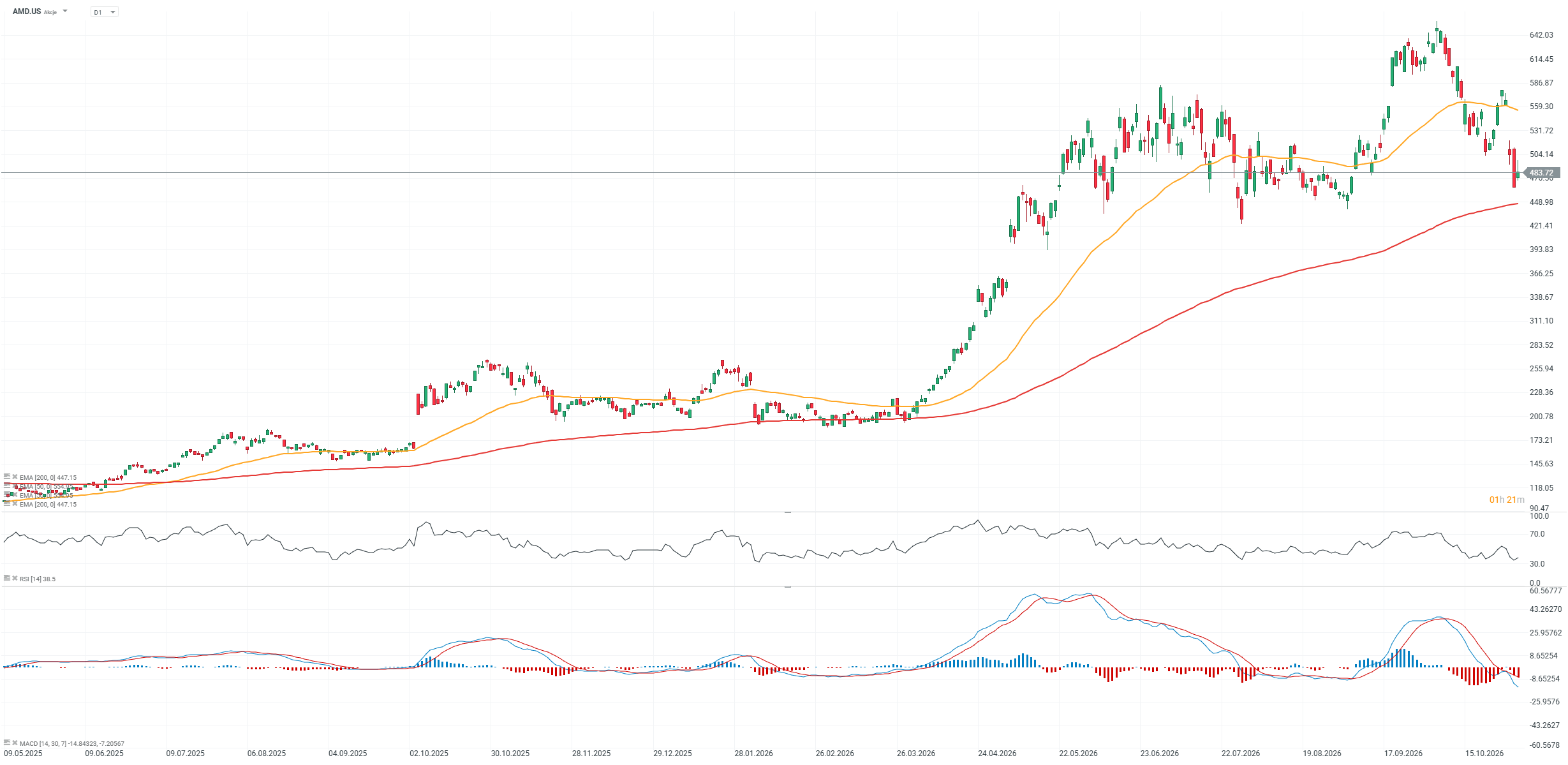 Source: xStation

Akcje AMD rosną 7% po świetnych wynikach 🔼 Półprzewodniki wrócą do wzrostów?



Daily Summary: Chips lift Wall Street on Election Day, oil drops amid progress in negotiations (03.11.2026)

US Open: Lower oil prices boost indices, markets await Midterms results (03.11.2026)



Market Wrap: Wall Street and Global Markets Under Pressure
The content of this report has been created by XTB S.A., with its registered office in Warsaw, at Prosta 67, 00-838 Warsaw, Poland, (KRS number 0000217580) and supervised by Polish Supervision Authority ( No. DDM-M-4021-57-1/2005). This material is a marketing communication within the meaning of Art. 24 (3) of Directive 2014/65/EU of the European Parliament and of the Council of 15 May 2014 on markets in financial instruments and amending Directive 2002/92/EC and Directive 2011/61/EU (MiFID II). Marketing communication is not an investment recommendation or information recommending or suggesting an investment strategy within the meaning of Regulation (EU) No 596/2014 of the European Parliament and of the Council of 16 April 2014 on market abuse (market abuse regulation) and repealing Directive 2003/6/EC of the European Parliament and of the Council and Commission Directives 2003/124/EC, 2003/125/EC and 2004/72/EC and Commission Delegated Regulation (EU) 2016/958 of 9 March 2016 supplementing Regulation (EU) No 596/2014 of the European Parliament and of the Council with regard to regulatory technical standards for the technical arrangements for objective presentation of investment recommendations or other information recommending or suggesting an investment strategy and for disclosure of particular interests or indications of conflicts of interest or any other advice, including in the area of investment advisory, within the meaning of the Trading in Financial Instruments Act of 29 July 2005 (i.e. Journal of Laws 2019, item 875, as amended). The marketing communication is prepared with the highest diligence, objectivity, presents the facts known to the author on the date of preparation and is devoid of any evaluation elements. The marketing communication is prepared without considering the client’s needs, his individual financial situation and does not present any investment strategy in any way. The marketing communication does not constitute an offer of sale, offering, subscription, invitation to purchase, advertisement or promotion of any financial instruments. XTB S.A. is not liable for any client’s actions or omissions, in particular for the acquisition or disposal of financial instruments, undertaken on the basis of the information contained in this marketing communication. In the event that the marketing communication contains any information about any results regarding the financial instruments indicated therein, these do not constitute any guarantee or forecast regarding the future results.