

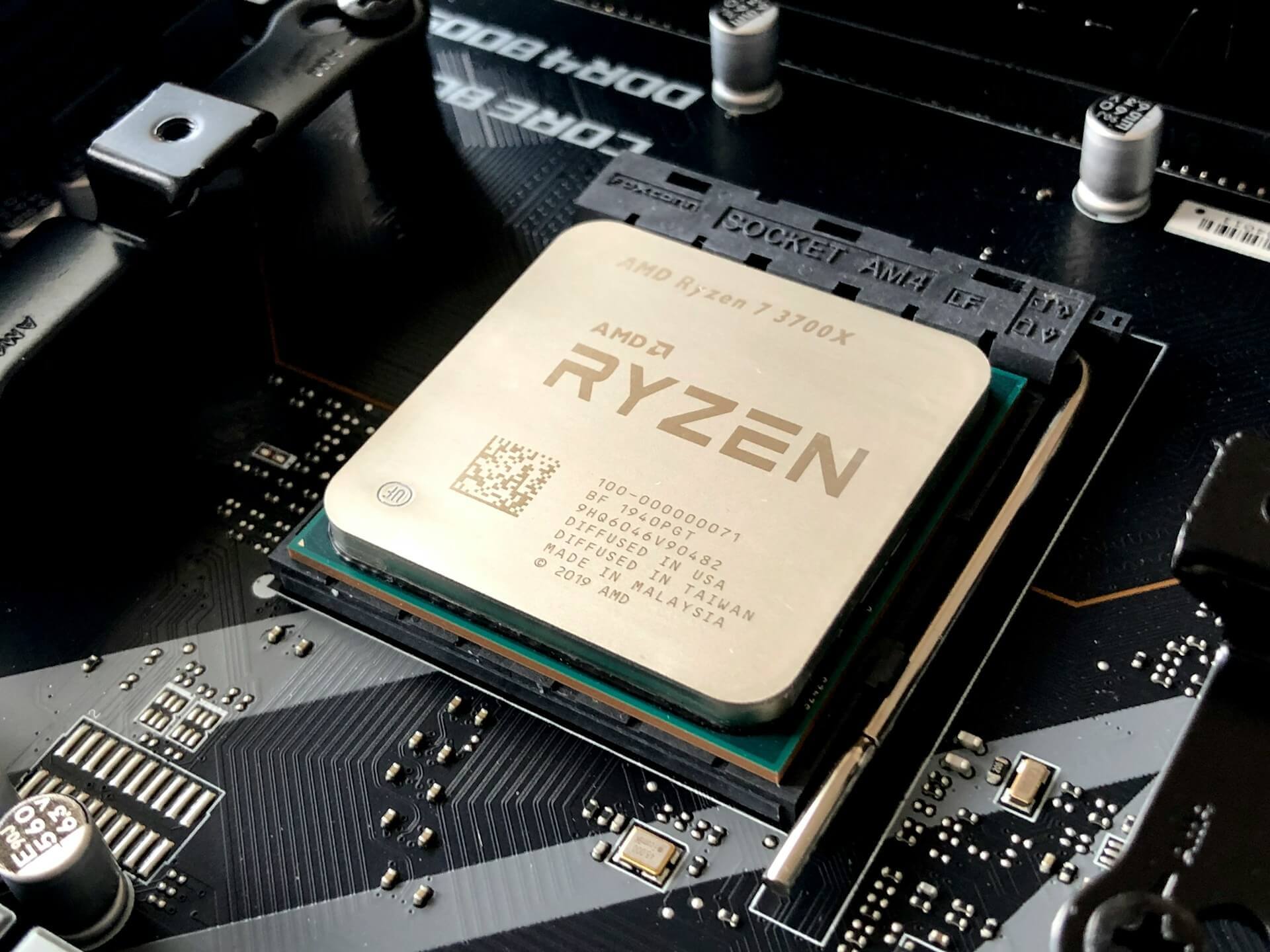

Advanced Micro Devices enters its Q1 2026 earnings release at a point where the company is increasingly navigating a more demanding phase of the investment cycle. On one hand, it is benefiting from one of the strongest demand impulses in history in AI-driven computing infrastructure. On the other hand, it is under pressure to demonstrate that it can translate this demand into durable and scalable market share in the highest value-added segments.
The market no longer views Advanced Micro Devices purely as a traditional semiconductor manufacturer whose performance is driven by the PC or server cycle. Instead, the company has been absorbed into a broader narrative around the global artificial intelligence race, where data center infrastructure and the ability to supply computing power to the largest technology platforms have become the key drivers. As a result, each earnings report is now less an assessment of historical performance and more a test of whether AMD is strengthening its position in the most strategic part of the AI market.
In such an environment, even solid financial results do not guarantee a positive market reaction if they are not accompanied by an improvement in the quality of revenue composition. Investors are increasingly distinguishing between growth driven by cyclical recovery and growth resulting from a genuine shift in AI market share. This distinction has become a central component of the company’s valuation.
Q1 2026 Market Expectations
-
Revenue: 10 billion dollars
-
Earnings per share (EPS): 1.28 dollars
-
Data center segment: 5.61 billion dollars
-
Gaming segment: 668 million dollars
-
Client segment: 2.73 billion dollars
-
Embedded segment: 868 million dollars
-
Gross margin: 55.1%
-
R&D expenses: 2.26 billion dollars
-
Capital expenditures (CapEx): approximately 215 million dollars
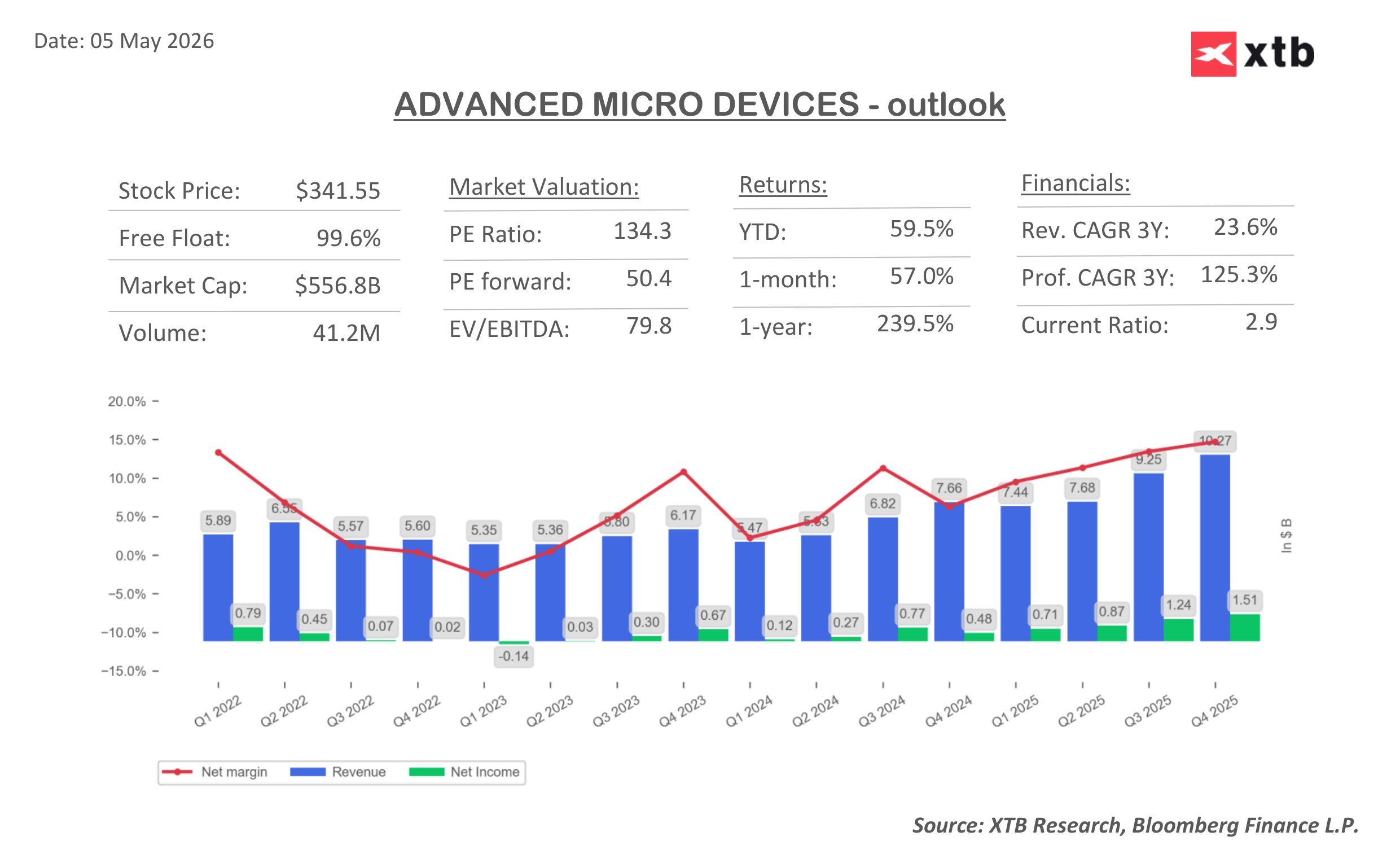
The consensus points to a relatively stable quarter with moderate growth. However, in the current macro and sector environment, it is not the pace of growth that matters most, but its internal composition. Once again, the primary focus is on the data center segment, which has become the core driver of the investment narrative and the main source of potential re-rating.
Data Center and AI as the Main Growth Engine
The data center segment remains the central pillar of AMD’s investment story. It is here that the market is trying to determine whether the company is genuinely increasing its share in the most valuable part of the AI market or remains primarily a secondary beneficiary of the broader infrastructure investment cycle.
The pace of adoption of the Instinct platform and the scalability of its deployment in a highly competitive environment are key variables. At the same time, the EPYC server CPU business continues to play an important stabilizing role, although its importance is increasingly seen as foundational rather than the primary driver of future growth.
In this context, a key question is whether AMD is moving into the most value-dense layers of the AI market, including large-scale model training and high-margin inference workloads, or whether it remains positioned more as a second-tier infrastructure provider.
CPUs as a Stabilizing Factor
CPU products continue to serve as a stabilizer for results, benefiting from rising investment in server infrastructure and a partial recovery in enterprise demand. This segment provides predictability and a revenue base, but it is no longer the primary source of re-rating for the company.
Increasingly, artificial intelligence is becoming the dominant growth vector and the key driver of valuation. At the same time, the PC segment remains under cyclical and structural pressure, partly due to constraints in the memory supply chain, which redirect production capacity toward AI infrastructure at the expense of traditional applications.
Hyperscaler CapEx as the Cycle Backbone
The entire cycle remains heavily dependent on capital expenditures from the largest technology companies, which act as the leading indicator for demand in computing infrastructure. Sustained high levels of data center investment create a favorable demand environment, but at the same time intensify competition for allocation within those budgets.
In practice, this means AMD operates in an environment of structurally strong demand, but not automatically rising market share. This gap has become one of the main sources of volatility in the investment narrative.
Quality of Growth as the Key Metric
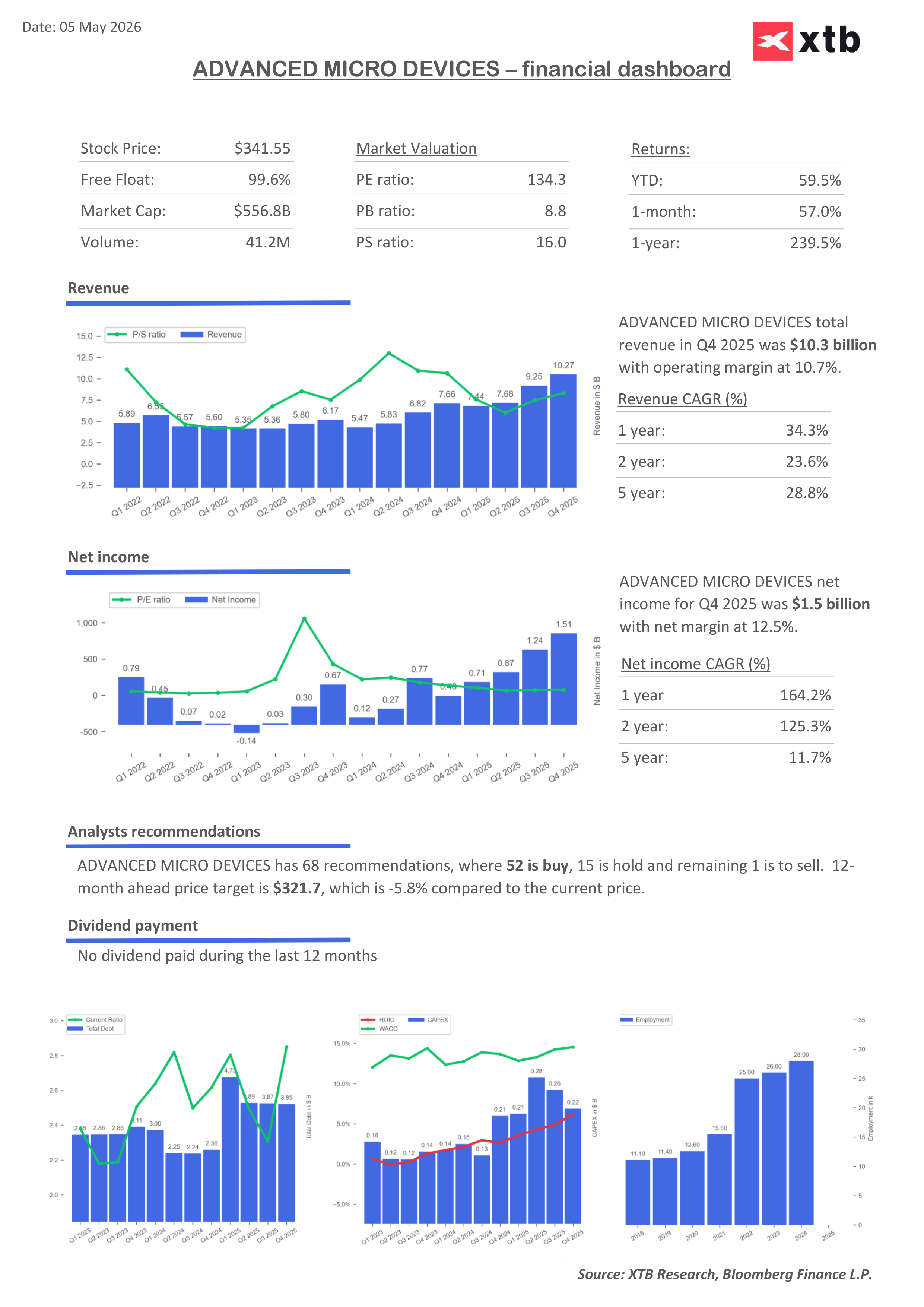
In the current market regime, the importance of growth itself is diminishing, while the focus on its source and durability is increasing. Investors are not only analyzing the pace of expansion, but also how much of it comes from genuine gains in AI-related segments versus cyclical rebounds in more traditional businesses.
As a result, AMD is increasingly being valued not as a pure growth company in the traditional sense, but as a participant in a structural race to define the architecture of future computing infrastructure.
Key Takeaways
-
AMD is in a transitional phase where AI-driven growth must be converted into durable market share rather than remaining a cyclical boost
-
The data center and AI segments are becoming the primary source of potential valuation re-rating, while CPUs act as a stabilizing factor
-
The key question is no longer the pace of growth, but its quality and exposure to the most valuable parts of the AI ecosystem
-
Hyperscaler CapEx remains the main demand catalyst, but it does not guarantee proportional market share gains for AMD
-
The PC segment remains under structural pressure and has limited relevance for the company’s current investment narrative
-
The main sensitivity for the market lies in whether AMD is truly moving up the AI value chain or simply benefiting from its overall expansion


Netflix Preview. It needs to prove it can still surprise


Chart of the Day: US100 (Nasdaq 100). Rebound in AI trade vs. weakening technical picture


Macro Calendar - UK Labor Market, ZEW Sentiment, and Wall Street Giants' Reports



Market Wrap: Rebound in China and Falling Oil Prices, France Leads EU Declines
The content of this report has been created by XTB S.A., with its registered office in Warsaw, at Prosta 67, 00-838 Warsaw, Poland, (KRS number 0000217580) and supervised by Polish Supervision Authority ( No. DDM-M-4021-57-1/2005). This material is a marketing communication within the meaning of Art. 24 (3) of Directive 2014/65/EU of the European Parliament and of the Council of 15 May 2014 on markets in financial instruments and amending Directive 2002/92/EC and Directive 2011/61/EU (MiFID II). Marketing communication is not an investment recommendation or information recommending or suggesting an investment strategy within the meaning of Regulation (EU) No 596/2014 of the European Parliament and of the Council of 16 April 2014 on market abuse (market abuse regulation) and repealing Directive 2003/6/EC of the European Parliament and of the Council and Commission Directives 2003/124/EC, 2003/125/EC and 2004/72/EC and Commission Delegated Regulation (EU) 2016/958 of 9 March 2016 supplementing Regulation (EU) No 596/2014 of the European Parliament and of the Council with regard to regulatory technical standards for the technical arrangements for objective presentation of investment recommendations or other information recommending or suggesting an investment strategy and for disclosure of particular interests or indications of conflicts of interest or any other advice, including in the area of investment advisory, within the meaning of the Trading in Financial Instruments Act of 29 July 2005 (i.e. Journal of Laws 2019, item 875, as amended). The marketing communication is prepared with the highest diligence, objectivity, presents the facts known to the author on the date of preparation and is devoid of any evaluation elements. The marketing communication is prepared without considering the client’s needs, his individual financial situation and does not present any investment strategy in any way. The marketing communication does not constitute an offer of sale, offering, subscription, invitation to purchase, advertisement or promotion of any financial instruments. XTB S.A. is not liable for any client’s actions or omissions, in particular for the acquisition or disposal of financial instruments, undertaken on the basis of the information contained in this marketing communication. In the event that the marketing communication contains any information about any results regarding the financial instruments indicated therein, these do not constitute any guarantee or forecast regarding the future results.