



Apple (AAPL.US) shares add about 1.5% despite deepening fall of the Nasdaq 100 index (US100: -1.4%). The stock benefits from a just announced resolution of the company's dispute with the European Commision, as well as from the outflows of AI-centred sectors amid rising debt and inflation fears.
The company announced revisions to its European Union developer terms to settle an ongoing antitrust dispute under the Digital Markets Act following a previous €500 million fine. Effective October 1, the updates unify developer terms under a single framework, adjust commission rates, and introduce safeguards barring apps from redirecting users under 13 away from the App Store for external payments.
The changes address EU regulatory mandates requiring platforms to permit alternative app distribution and unhindered customer steering toward third-party purchase options. The European Commission welcomed the adjustments and plans to oversee their implementation, helping Apple avert potential non-compliance penalties of up to 10% of annual worldwide revenue.
Technical Analysis: AAPL.US (D1)
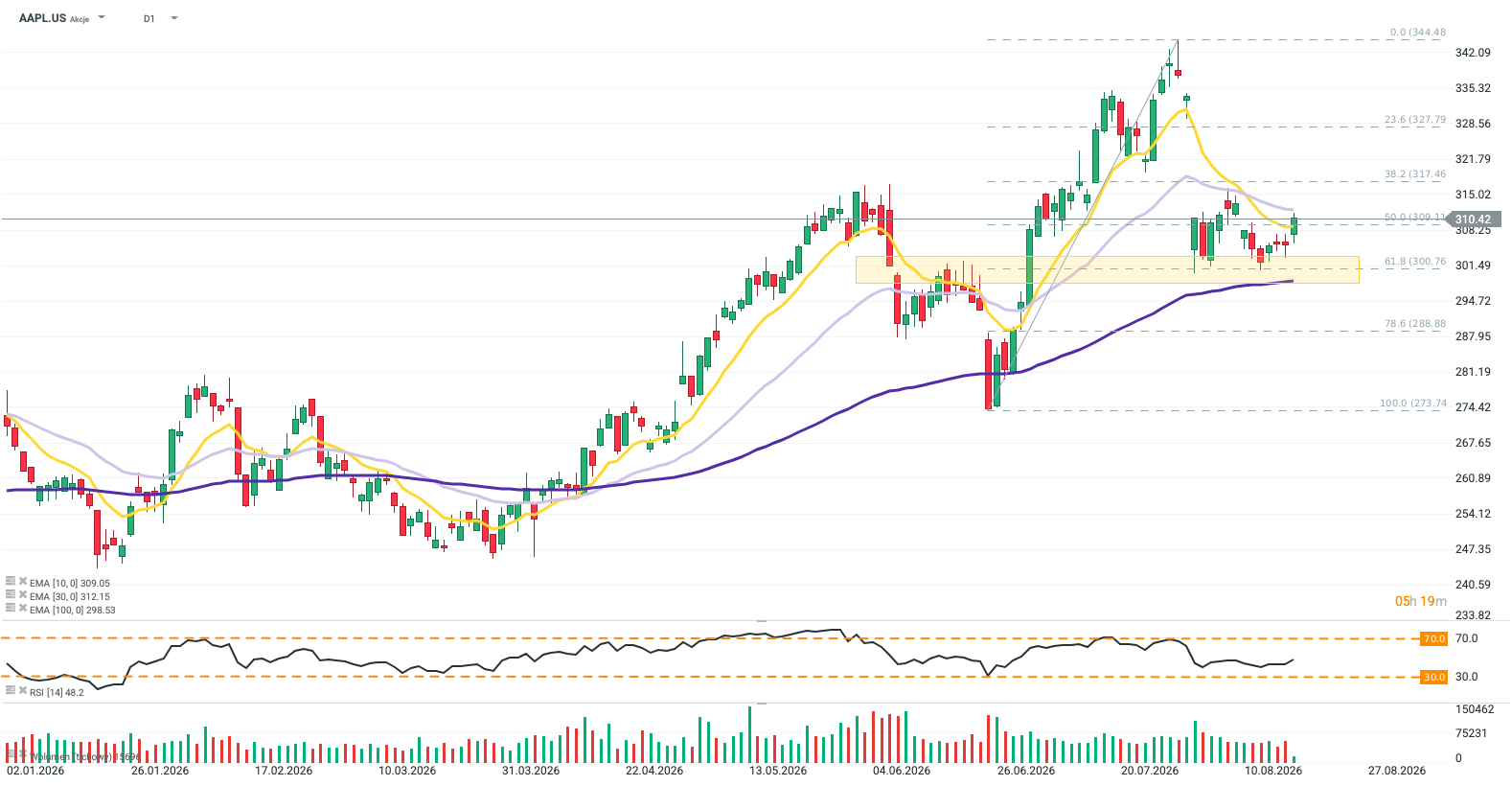
Apple shares are staging a steady recovery after finding resilient support in the highlighted demand zone near the 61.8% Fibonacci retracement level ($300). This floor held firm following the post-earnings pullback triggered by concerns over softer Chinese demand. Crucially, the price remains resilient above the rising 100-day EMA ($298.53), keeping the primary bullish trend intact. Currently pushing above the 50.0% retracement ($309.11) and EMA10 ($309.06), Apple is approaching an immediate test of the 30-day EMA ($312.15). A clean breakout above this dynamic hurdle could clear the path toward $317.46 (38.2% Fibo).
Source: xStation5
Does Apple Remain a Valid "Anti-AI" Trade?
Today’s gains in Apple shares also highlight its growing role as a hedge against the broader AI trade. The stock is trading in the green while semiconductor and memory heavyweights face renewed risk-off pressure (Nvidia: -2.3%, ASML: -4.6%, SK Hynix: -8.3%, SanDisk: -8.6%) as rising bond yields compress tech risk premiums.
This divergence first became prominent during the pre-FOMC selloff in AI names. Rather than committing massive capital expenditure to proprietary computing infrastructure, Apple has opted for strategic partnerships, driving its correlation with the semiconductor sector into negative territory.
However, this positioning comes with trade-offs. Soaring AI-driven demand has inflated memory component costs, threatening hardware margins ahead of key product launches. Furthermore, trading at 32 times forward earnings with moderating sales growth, Apple faces heightened valuation scrutiny and a string of analyst downgrades.
Even so, bulls contend that Apple's pristine balance sheet, aggressive buybacks, and decoupling from the chip cycle make it an attractive defensive haven whenever sentiment around aggressive AI infrastructure spending cools.
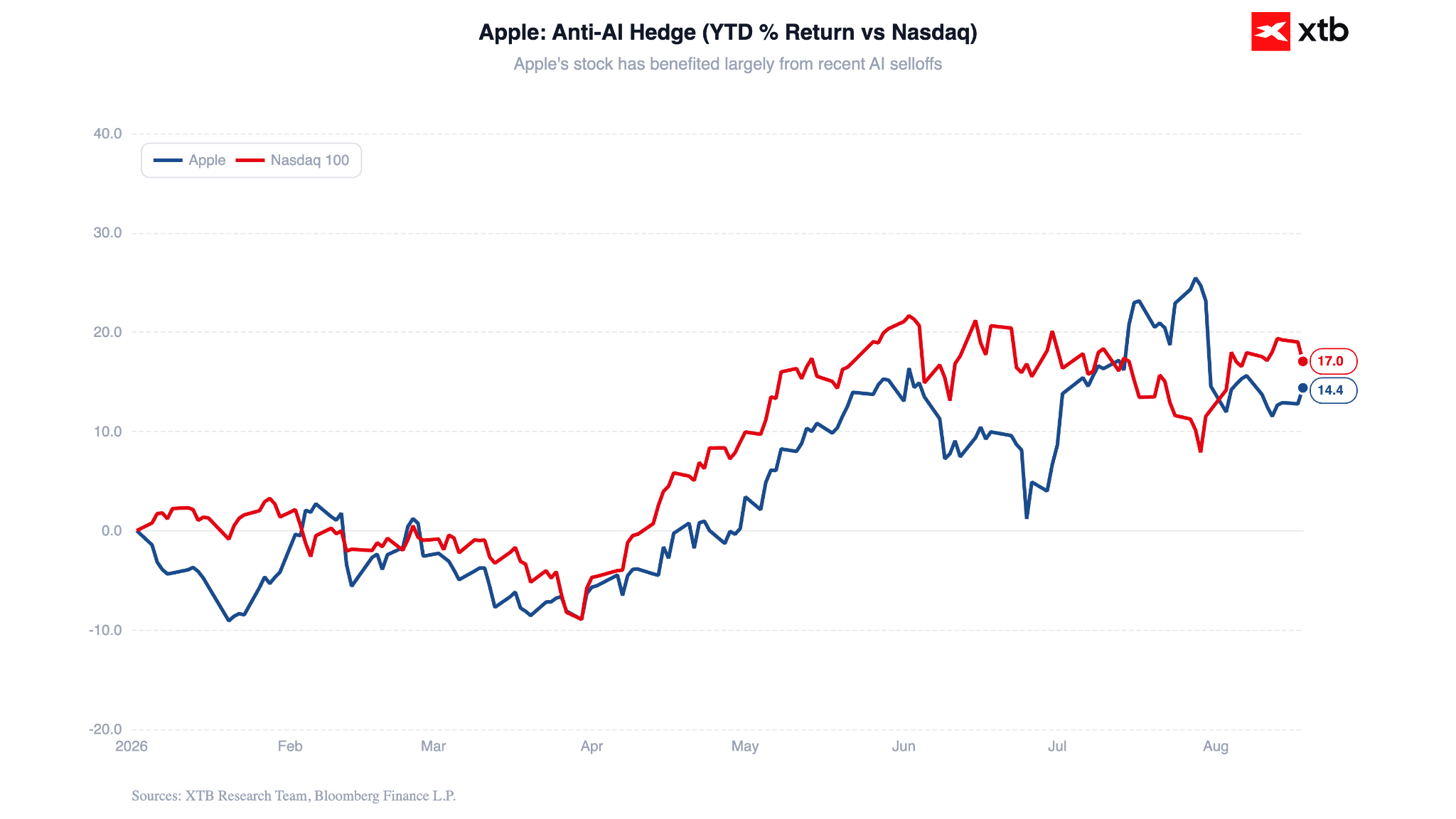
Year-to-Date returns of Apple and Nasdaq 100 futures. The two diverged heavily in July, revealing Apple’s anti-AI hedging capacity. Source: XTB Research



Daily Summary: Friday offers no relief; the US100 drops 2%🚨


Three Markets to Watch Next Week (October 16, 2026)


Market wrap: European indices rebound 🔼 Defence stocks on the rise

🔼 EURUSD continues to rebound
The content of this report has been created by XTB S.A., with its registered office in Warsaw, at Prosta 67, 00-838 Warsaw, Poland, (KRS number 0000217580) and supervised by Polish Supervision Authority ( No. DDM-M-4021-57-1/2005). This material is a marketing communication within the meaning of Art. 24 (3) of Directive 2014/65/EU of the European Parliament and of the Council of 15 May 2014 on markets in financial instruments and amending Directive 2002/92/EC and Directive 2011/61/EU (MiFID II). Marketing communication is not an investment recommendation or information recommending or suggesting an investment strategy within the meaning of Regulation (EU) No 596/2014 of the European Parliament and of the Council of 16 April 2014 on market abuse (market abuse regulation) and repealing Directive 2003/6/EC of the European Parliament and of the Council and Commission Directives 2003/124/EC, 2003/125/EC and 2004/72/EC and Commission Delegated Regulation (EU) 2016/958 of 9 March 2016 supplementing Regulation (EU) No 596/2014 of the European Parliament and of the Council with regard to regulatory technical standards for the technical arrangements for objective presentation of investment recommendations or other information recommending or suggesting an investment strategy and for disclosure of particular interests or indications of conflicts of interest or any other advice, including in the area of investment advisory, within the meaning of the Trading in Financial Instruments Act of 29 July 2005 (i.e. Journal of Laws 2019, item 875, as amended). The marketing communication is prepared with the highest diligence, objectivity, presents the facts known to the author on the date of preparation and is devoid of any evaluation elements. The marketing communication is prepared without considering the client’s needs, his individual financial situation and does not present any investment strategy in any way. The marketing communication does not constitute an offer of sale, offering, subscription, invitation to purchase, advertisement or promotion of any financial instruments. XTB S.A. is not liable for any client’s actions or omissions, in particular for the acquisition or disposal of financial instruments, undertaken on the basis of the information contained in this marketing communication. In the event that the marketing communication contains any information about any results regarding the financial instruments indicated therein, these do not constitute any guarantee or forecast regarding the future results.