



Geopolitical developments: U.S. President Donald Trump rejected Iran’s proposal for a conditional ceasefire and the reopening of the Strait of Hormuz within seven days, announcing that attacks would resume after the November elections. Tensions in the Middle East are rising—reports indicate that Iran fired a cruise missile in the Strait, while Yemen’s Houthis targeted Riyadh, disrupting airport operations. The US-China summit in Washington, D.C., which has concluded, yielded limited results, including a mere two-month extension of the trade truce and a preliminary agreement on tariff reductions and dialogue on artificial intelligence.
Economy: Profits in Chinese industry rose by just 4.2% year-over-year in August, the weakest performance this year, reflecting pressure from weak demand and high energy costs. In Japan, meanwhile, producer price inflation (PPI) jumped to 3.7% in August, reaching its fastest pace in more than two years. This coincided with the release of the minutes from the Bank of Japan’s July meeting, which indicate that some policymakers recognize the risk of higher inflation and support faster interest rate hikes.
Major market movements: U.S. stock futures (Dow Jones, S&P 500, Nasdaq-100) are trading lower ahead of the market open, erasing some of last week’s gains. These moves are a direct reaction to the sharp rise in U.S. Treasury yields, with the 10-year yield reaching 5.17–5.23%, its highest level since 2007. The rising cost of capital is particularly weighing on sentiment toward tech companies involved in AI infrastructure development, for which debt servicing is becoming increasingly expensive.
Asian Markets: The trading session in the Asia-Pacific region was marked by declines, driven by both the escalation in the Middle East and rising yields in the U.S. Japan’s Nikkei gave up its morning gains and is now trading slightly in the red, dragged down by a sell-off in U.S. Nasdaq futures. After a long weekend, South Korea’s Kospi plummeted 2.36% under the weight of a sell-off in tech giants, while China’s CSI 300 index lost 1.4% following weak industrial data. One of the few markets to post gains was Hong Kong, where the Hang Seng Index rose by about 0.6–0.7% thanks to strong performance in the energy sector.
Currencies: In the foreign exchange market, the major currency pairs are trading within fairly narrow ranges, with the New Zealand dollar currently performing the best. The U.S. dollar remains strong on the back of rising yields, and the USD/JPY exchange rate is up 0.32% this morning, trading around 157.75.
Commodities: Oil prices skyrocketed after the U.S. withdrew from the Iran deal—Brent crude rose 2.7% to nearly $100 per barrel, while WTI climbed 1.8% to about $94. Meanwhile, the strong bond market is taking a heavy toll on precious metals, raising the opportunity cost of holding them. Gold broke through a key technical support level, falling below $4,200 per ounce (-2.16%), while silver is down nearly 3.75%.
Companies: Shares of the Australian company Northern Star rose more than 9% after its board rejected a $27 billion takeover bid from Gold Fields, deeming it undervalued. In the United States, attention is focused on SpaceX, which is preparing the 14th test flight of its Starship rocket with the goal of achieving the first-ever entry into orbit. The U.S. administration is also considering a 90-day ban on diesel fuel exports, which, according to Goldman Sachs analysts, could lower domestic diesel prices but at the same time drive up gasoline costs for American consumers and hurt refinery margins.
Cryptocurrencies: The digital asset market is part of a broader trend of risk aversion triggered by rising yields. Bitcoin is down more than 1.6% this morning, slipping to just over $83,220.
Outlook for the Day: Markets will continue to react today to geopolitical turmoil and pressure from the bond market. Later in the week, key catalysts for investors will include Micron’s earnings report on Wednesday, which will set the tone for the semiconductor sector, and important U.S. macroeconomic data. Wednesday’s reading of the Fed’s preferred measure of inflation (PCE) and Friday’s U.S. jobs report are expected to determine the future path of interest rates.
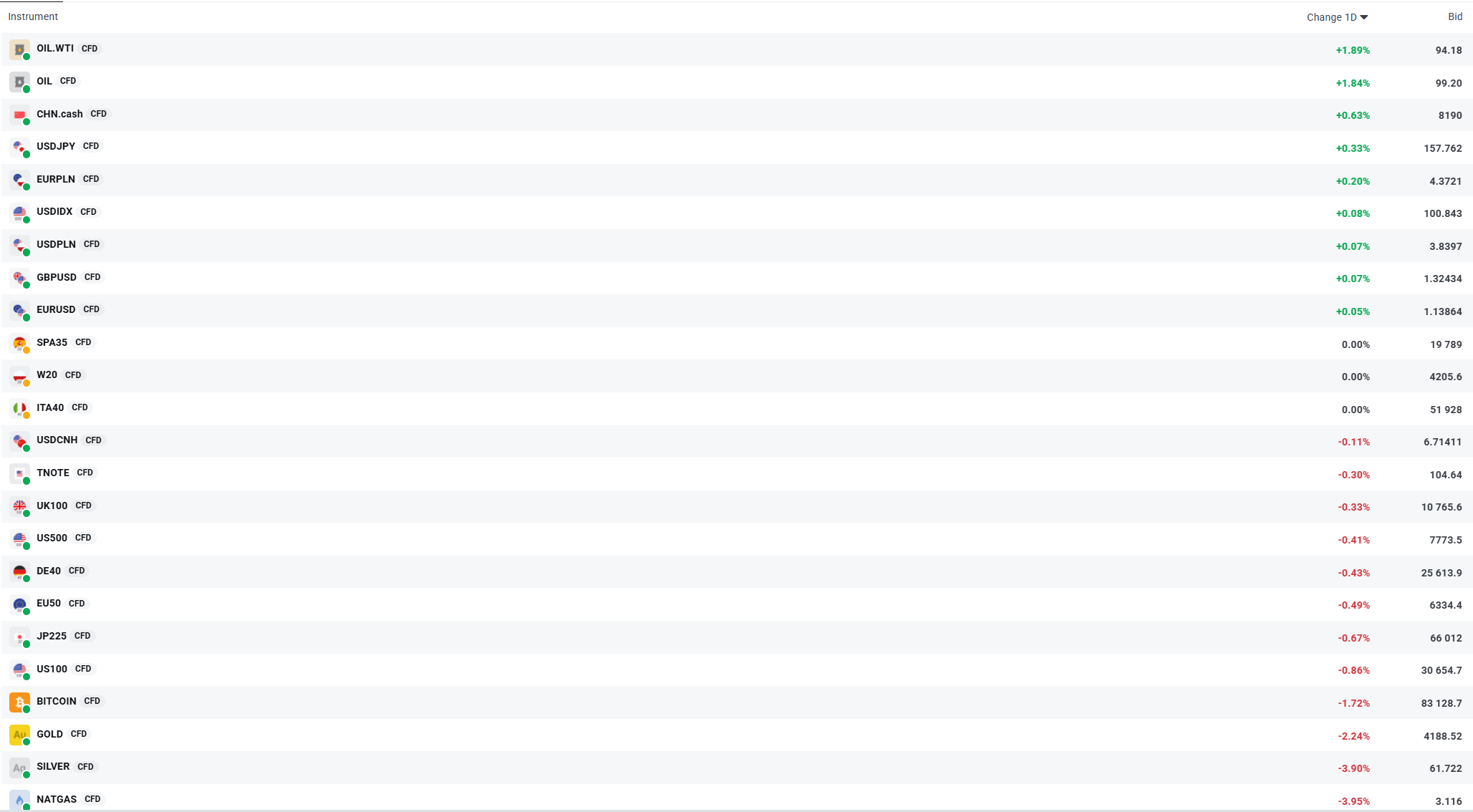
Volatility is currently evident in several selected instruments. GOLD is performing very poorly, down more than 2%, while SILVER is down nearly 4%. Source: XTB



Daily Summary: Friday offers no relief; the US100 drops 2%🚨


Three Markets to Watch Next Week (October 16, 2026)


Strong US macro data 🗽 Industrial production and prices rise

Market wrap: European indices rebound 🔼 Defence stocks on the rise
The content of this report has been created by XTB S.A., with its registered office in Warsaw, at Prosta 67, 00-838 Warsaw, Poland, (KRS number 0000217580) and supervised by Polish Supervision Authority ( No. DDM-M-4021-57-1/2005). This material is a marketing communication within the meaning of Art. 24 (3) of Directive 2014/65/EU of the European Parliament and of the Council of 15 May 2014 on markets in financial instruments and amending Directive 2002/92/EC and Directive 2011/61/EU (MiFID II). Marketing communication is not an investment recommendation or information recommending or suggesting an investment strategy within the meaning of Regulation (EU) No 596/2014 of the European Parliament and of the Council of 16 April 2014 on market abuse (market abuse regulation) and repealing Directive 2003/6/EC of the European Parliament and of the Council and Commission Directives 2003/124/EC, 2003/125/EC and 2004/72/EC and Commission Delegated Regulation (EU) 2016/958 of 9 March 2016 supplementing Regulation (EU) No 596/2014 of the European Parliament and of the Council with regard to regulatory technical standards for the technical arrangements for objective presentation of investment recommendations or other information recommending or suggesting an investment strategy and for disclosure of particular interests or indications of conflicts of interest or any other advice, including in the area of investment advisory, within the meaning of the Trading in Financial Instruments Act of 29 July 2005 (i.e. Journal of Laws 2019, item 875, as amended). The marketing communication is prepared with the highest diligence, objectivity, presents the facts known to the author on the date of preparation and is devoid of any evaluation elements. The marketing communication is prepared without considering the client’s needs, his individual financial situation and does not present any investment strategy in any way. The marketing communication does not constitute an offer of sale, offering, subscription, invitation to purchase, advertisement or promotion of any financial instruments. XTB S.A. is not liable for any client’s actions or omissions, in particular for the acquisition or disposal of financial instruments, undertaken on the basis of the information contained in this marketing communication. In the event that the marketing communication contains any information about any results regarding the financial instruments indicated therein, these do not constitute any guarantee or forecast regarding the future results.