


ASML delivered a very strong first quarter of 2026, with results landing in the upper end of its own guidance range and earnings per share coming in above analyst consensus. At the same time, the company raised its full-year outlook, which in the current macroeconomic and geopolitical environment is a very strong signal of demand durability.
The report clearly shows that the key growth driver remains artificial intelligence infrastructure, while the semiconductor investment cycle continues to strengthen. Management also communicated that 2026 is expected to be another year of growth across all segments, with the updated guidance range explicitly incorporating potential impacts from export restrictions.
In practice, this means that even under a more adverse regulatory scenario, the company still expects growth, which significantly strengthens the credibility of the outlook and points to very strong underlying demand fundamentals.
Key financial results
-
Revenue: EUR 8.8bn (reported EUR 8.767bn)
-
Net income: EUR 2.8bn (reported EUR 2.757bn)
-
Earnings per share (EPS): EUR 7.15 (approx. EUR +0.54 above consensus)
-
Gross margin: 53.0% (top end of guidance range)
-
Installed Base (services and modernization): ~EUR 2.5bn
-
System sales: 67 new systems + 12 used systems
-
Share buybacks: ~EUR 1.1bn in Q1
-
2025 dividend: EUR 7.50 per share (+17% YoY)
Financial performance and earnings quality
The most important aspect of the report is not only the scale of revenues, but their quality. The EUR 8.8bn revenue level confirms sustained very strong demand, with no visible signs of demand cooling.
Net income and EPS demonstrate very strong conversion of revenue into bottom-line profit. For ASML, this is particularly important as its business model is based on extremely high-value capital equipment, which requires strong operational efficiency.
A gross margin of 53% is one of the strongest indicators of business quality. It reflects both the company’s dominant technological position and an increasing contribution from higher-margin business segments.
Importantly, this is not a one-off effect but rather a more structural shift in the revenue mix.
Installed Base as a core pillar of the business model
The Installed Base segment refers to the installed base of machines already operating at customer sites. In practice, it includes service, upgrades, spare parts, additional options, and software that enhances system performance.
Installed Base generated approximately EUR 2.5bn in revenue, indicating a meaningful and growing share of total results. Crucially, this is a higher-margin, more recurring, and less cyclical business compared to equipment sales.
In the current environment, its importance is increasing further. Customers, constrained by limited availability of new tools and long lead times, are focusing on maximizing the productivity of existing equipment. Upgrades and service become the fastest way to expand effective production capacity.
From a strategic perspective, this represents a shift toward a more stable and predictable earnings and cash flow profile, which is particularly important in a historically highly cyclical industry.
Demand, AI, and the changing cycle
The key takeaway from the report is simple: chip demand currently exceeds supply.
Customers, especially in the memory segment, are already indicating that 2026 capacity is largely sold out, and they expect supply constraints to persist beyond that period. The main driver is the rapid expansion of artificial intelligence, which is fueling massive investment in new manufacturing capacity.
At the same time, semiconductor manufacturers are building new fabs and advancing more sophisticated process technologies, which increases the number of steps required to produce a single chip.
In practical terms, this translates into higher demand for lithography systems, which are the core products of ASML.
For the company, this is highly favorable, as increased process complexity directly translates into stronger demand for its technologies.
Q2 guidance
The second-quarter outlook calls for revenue in the range of EUR 8.4bn to 9.0bn, with Installed Base revenue expected to remain around EUR 2.5bn.
Gross margin is expected to come in between 51% and 52%, which represents a slight decline versus the exceptionally strong Q1, but still remains at historically elevated levels.
Operating expenses include approximately EUR 1.2bn in R&D and around EUR 0.3bn in SG&A, reflecting continued heavy investment in EUV and other advanced technology development.
Raised full-year outlook and its implications
The company raised its 2026 revenue guidance to EUR 36bn to 40bn, up from the previous range of EUR 34bn to 39bn. Even more importantly, the gross margin guidance was maintained at 51% to 53%, suggesting a durable improvement in profitability structure.
Management emphasized that this range incorporates potential scenarios related to export controls, particularly in relation to China. In practice, this implies that demand from other regions, including the United States, Europe, and the rest of Asia, is strong enough to offset potential restrictions.
Capacity constraints and supply limitations
One of the most important conclusions is that the main constraint on growth is not demand, but production capacity.
The company plans to reach at least 60 EUV system deliveries in 2026, with the potential to increase this to around 80 systems in 2027 under favorable conditions. Manufacturing these systems is highly complex and time-consuming, meaning supply increases only gradually.
As a result, ASML operates in an environment of structural supply shortage, which represents a fundamental shift compared to previous semiconductor cycles.
Risks
The most important risk remains geopolitics and potential export restrictions, particularly regarding China. Customer concentration is also a key factor, as the company depends heavily on investment decisions by a small number of leading semiconductor manufacturers. In addition, the long production cycle of its systems limits flexibility in responding to demand changes.
Opportunities and growth drivers
The primary growth driver remains artificial intelligence, which is fueling investment in data centers and advanced semiconductor chips. ASML sits at the center of the global semiconductor ecosystem as a critical technology supplier.
In addition, rising investment in regional supply chains and government support for semiconductor independence further strengthen long-term demand.
Outlook
In the coming quarters, the key focus will be sustaining strong demand and continuing to scale production capacity. If the current AI-driven trend persists, ASML may be entering a multi-year structural growth cycle.
However, the main uncertainty remains geopolitical developments and the pace of technological adoption.
Key conclusions
The first quarter of 2026 was very strong for ASML, both in terms of growth dynamics and earnings quality. The company not only beat expectations but also raised guidance, which is a strong signal for the market.
The report confirms that the business is undergoing a structural shift toward higher stability, stronger profitability, and greater predictability.
The AI boom continues to provide a long-term growth foundation, and ASML remains one of the key beneficiaries of this global trend.
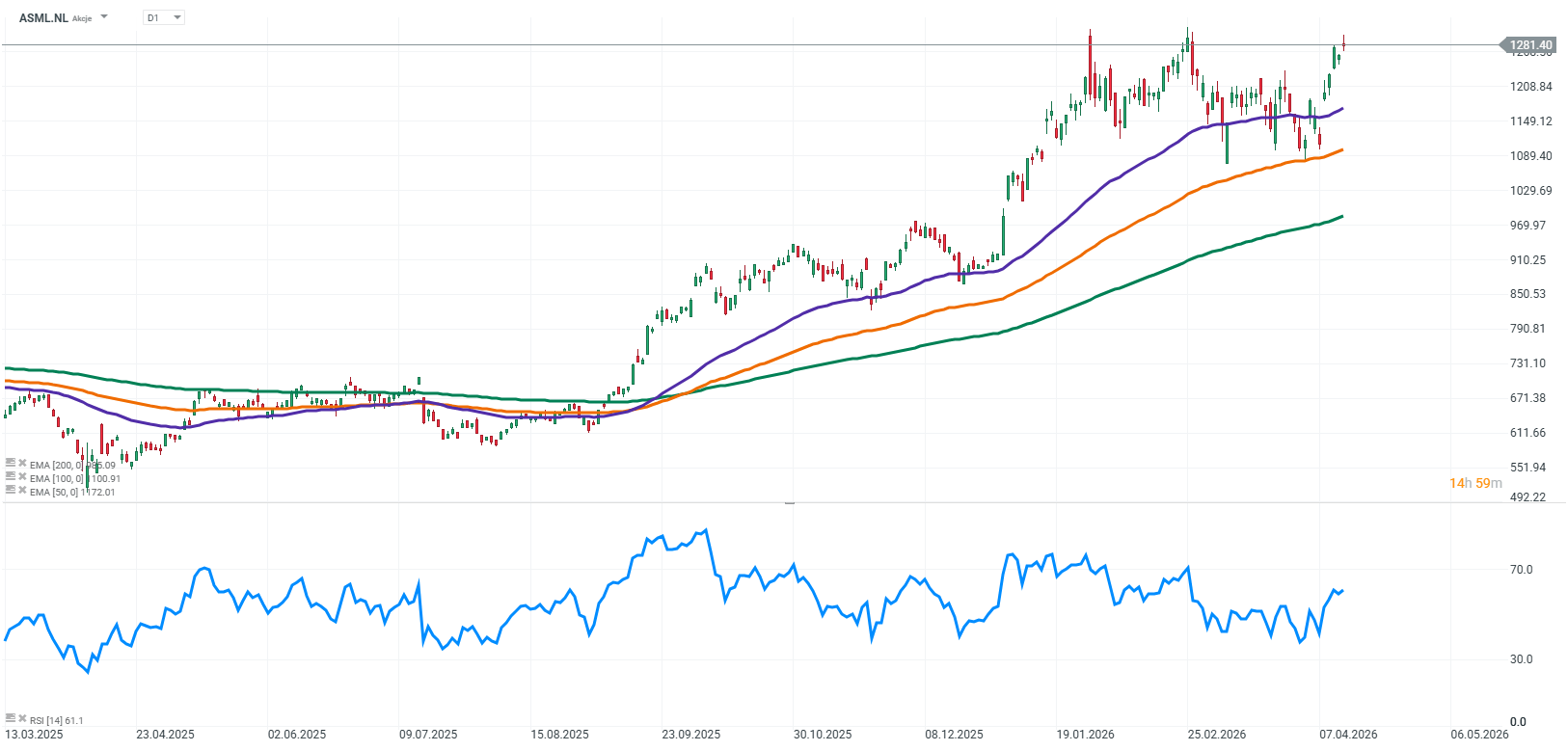
Source: xStation5

Market wrap: European indices rebound 🔼 Defence stocks on the rise


TSMC in Talks with Elon Musk Over Terafab


Daily summary 📈 Precious metals and stock indices rebound as Treasury yields fall


US Open: Nasdaq 100 extends losses 🚩 AI stocks under pressure, CoreWeave falls 8%
The content of this report has been created by XTB S.A., with its registered office in Warsaw, at Prosta 67, 00-838 Warsaw, Poland, (KRS number 0000217580) and supervised by Polish Supervision Authority ( No. DDM-M-4021-57-1/2005). This material is a marketing communication within the meaning of Art. 24 (3) of Directive 2014/65/EU of the European Parliament and of the Council of 15 May 2014 on markets in financial instruments and amending Directive 2002/92/EC and Directive 2011/61/EU (MiFID II). Marketing communication is not an investment recommendation or information recommending or suggesting an investment strategy within the meaning of Regulation (EU) No 596/2014 of the European Parliament and of the Council of 16 April 2014 on market abuse (market abuse regulation) and repealing Directive 2003/6/EC of the European Parliament and of the Council and Commission Directives 2003/124/EC, 2003/125/EC and 2004/72/EC and Commission Delegated Regulation (EU) 2016/958 of 9 March 2016 supplementing Regulation (EU) No 596/2014 of the European Parliament and of the Council with regard to regulatory technical standards for the technical arrangements for objective presentation of investment recommendations or other information recommending or suggesting an investment strategy and for disclosure of particular interests or indications of conflicts of interest or any other advice, including in the area of investment advisory, within the meaning of the Trading in Financial Instruments Act of 29 July 2005 (i.e. Journal of Laws 2019, item 875, as amended). The marketing communication is prepared with the highest diligence, objectivity, presents the facts known to the author on the date of preparation and is devoid of any evaluation elements. The marketing communication is prepared without considering the client’s needs, his individual financial situation and does not present any investment strategy in any way. The marketing communication does not constitute an offer of sale, offering, subscription, invitation to purchase, advertisement or promotion of any financial instruments. XTB S.A. is not liable for any client’s actions or omissions, in particular for the acquisition or disposal of financial instruments, undertaken on the basis of the information contained in this marketing communication. In the event that the marketing communication contains any information about any results regarding the financial instruments indicated therein, these do not constitute any guarantee or forecast regarding the future results.