



August advance retail sales beat across the board, and every layer beneath the headline came in stronger than the headline itself. With a 25bp hike already 92% priced going into today's FOMC, the report does not change September but it makes the case for stopping there considerably harder to argue.
Key numbers:
- Headline: +1.2% m/m vs +0.8% expected; prior -0.6% revised to -0.5%
- Ex-autos: +1.4% vs +0.5% expected, a near-triple beat
- Control group: +1.4% vs +0.4% expected, after -0.4% in July; this is the line that feeds PCE goods and GDP tracking
- Ex-autos and gas: +1.2% vs -0.3% prior, the cleanest read of underlying demand
- Y/Y nominal: 6.0% vs 5.01% prior
- Category detail: gasoline +3.1%, nonstore +2.6%, furniture +1.9%, electronics and appliances +1.6%, restaurants and bars +1.2%, sporting goods +1.2%, building materials -0.2%
- Market reaction: minimal. Hike odds unmoved at ~92%, two full hikes still priced through year-end, US10Y above 5%
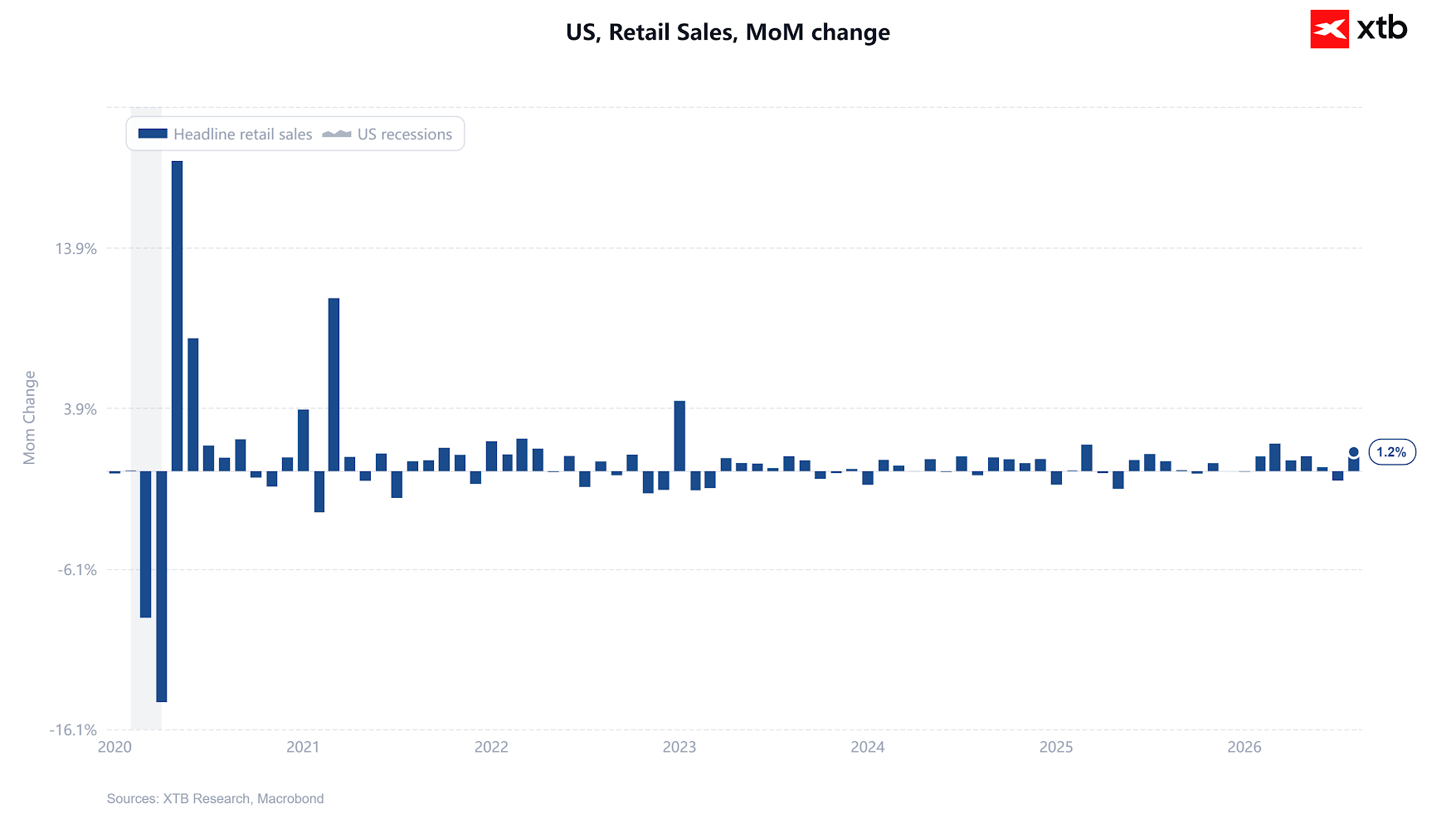
The gasoline objection does not hold
Retail sales are nominal, and August was the month the oil shock hit the pump. Gasoline stations at +3.1% m/m is price, not volume. Brent rose roughly 18% on the month. That is a real distortion of the headline
It is also already stripped out, and the ex-autos-and-gas measure still printed +1.2%. This is the whole story. Higher fuel costs normally act as a tax on the household budget: consumers pay more at the pump and pull back elsewhere. In August they did not. Restaurants and bars, the first line households cut when squeezed, rose 1.2%. Only building materials fell, and barely. The US consumer absorbed a significant energy shock without reallocating away from anything.
Why that matters for the Fed
Central banks are supposed to look through supply-side energy shocks, and the case for doing so rests on one assumption: that the shock destroys demand on its own. This report falsifies that assumption. When spending is strong enough to swallow a fuel price spike whole, the conditions for second-round effects are in place, firms facing higher input and freight costs will discover they can pass them on.
It also kills half of the equity market's stagflation narrative. The S&P 500 has slid to six-week lows on the assumption that an energy shock plus a tightening Fed produces a growth accident. This data says there is no "stag" right now, only the "flation." That is a worse mix for bonds than for stocks.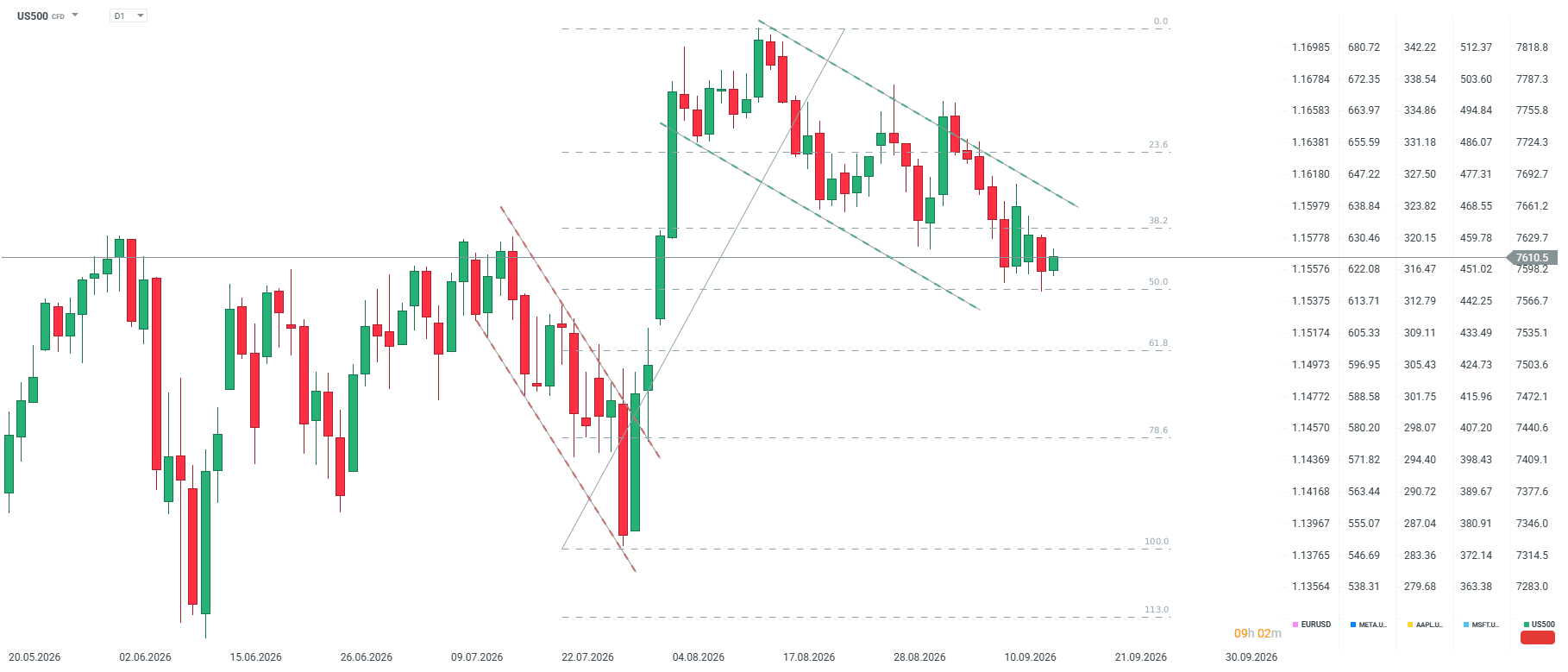 US500 is up today after hitting the lowest level since August 3. However, in first minutes after the data release, US500 lost about 7 points. Source: XTB
Three caveats, none of them dovish
This is a rebound from a negative month, so the two-month average is far more pedestrian than the headline implies. Some of the strength in furniture and electronics has the signature of pull-forward buying ahead of expected price increases, which borrows from future quarters, but is a symptom of unanchored inflation expectations and therefore an argument for hiking, not against. And energy-driven crowding-out usually works with a one- to two-month lag, so its absence in August says nothing about October.
The configuration the Fed faces is uncomfortably simple: a supply-side inflation impulse arriving while the demand side shows no sign of cooling. That is when central banks hike, and keep hiking.



Gold Falls Below $4,000


Chart of the Day: USDJPY Caught in a Trap. Tokyo Intervention and a Hawkish BoJ Loom



Economic Calendar: Conference Board Consumer Confidence and US Data in focus

Morning Wrap: Wall Street Rises on Anthropic News, Asian Markets Surge
The content of this report has been created by XTB S.A., with its registered office in Warsaw, at Prosta 67, 00-838 Warsaw, Poland, (KRS number 0000217580) and supervised by Polish Supervision Authority ( No. DDM-M-4021-57-1/2005). This material is a marketing communication within the meaning of Art. 24 (3) of Directive 2014/65/EU of the European Parliament and of the Council of 15 May 2014 on markets in financial instruments and amending Directive 2002/92/EC and Directive 2011/61/EU (MiFID II). Marketing communication is not an investment recommendation or information recommending or suggesting an investment strategy within the meaning of Regulation (EU) No 596/2014 of the European Parliament and of the Council of 16 April 2014 on market abuse (market abuse regulation) and repealing Directive 2003/6/EC of the European Parliament and of the Council and Commission Directives 2003/124/EC, 2003/125/EC and 2004/72/EC and Commission Delegated Regulation (EU) 2016/958 of 9 March 2016 supplementing Regulation (EU) No 596/2014 of the European Parliament and of the Council with regard to regulatory technical standards for the technical arrangements for objective presentation of investment recommendations or other information recommending or suggesting an investment strategy and for disclosure of particular interests or indications of conflicts of interest or any other advice, including in the area of investment advisory, within the meaning of the Trading in Financial Instruments Act of 29 July 2005 (i.e. Journal of Laws 2019, item 875, as amended). The marketing communication is prepared with the highest diligence, objectivity, presents the facts known to the author on the date of preparation and is devoid of any evaluation elements. The marketing communication is prepared without considering the client’s needs, his individual financial situation and does not present any investment strategy in any way. The marketing communication does not constitute an offer of sale, offering, subscription, invitation to purchase, advertisement or promotion of any financial instruments. XTB S.A. is not liable for any client’s actions or omissions, in particular for the acquisition or disposal of financial instruments, undertaken on the basis of the information contained in this marketing communication. In the event that the marketing communication contains any information about any results regarding the financial instruments indicated therein, these do not constitute any guarantee or forecast regarding the future results.