



Friday’s EURUSD session is dominated by expectations ahead of the most important release of the week, the NFP report. Over the past few days, the outlook for US monetary policy has become significantly more complicated. Kevin Warsh sounded particularly hawkish during the Jackson Hole symposium, arguing that inflation remains too high and that the Fed still has a lot of work to do. Christopher Waller, meanwhile, struck a much more dovish tone yesterday, suggesting that rates could remain unchanged in September if inflation continues to improve.
US Treasury yields have also risen sharply in recent weeks. The market now has to assess whether today’s labor market report will reinforce Warsh’s hawkish stance or support Waller’s view and the possibility of no rate hike in September.
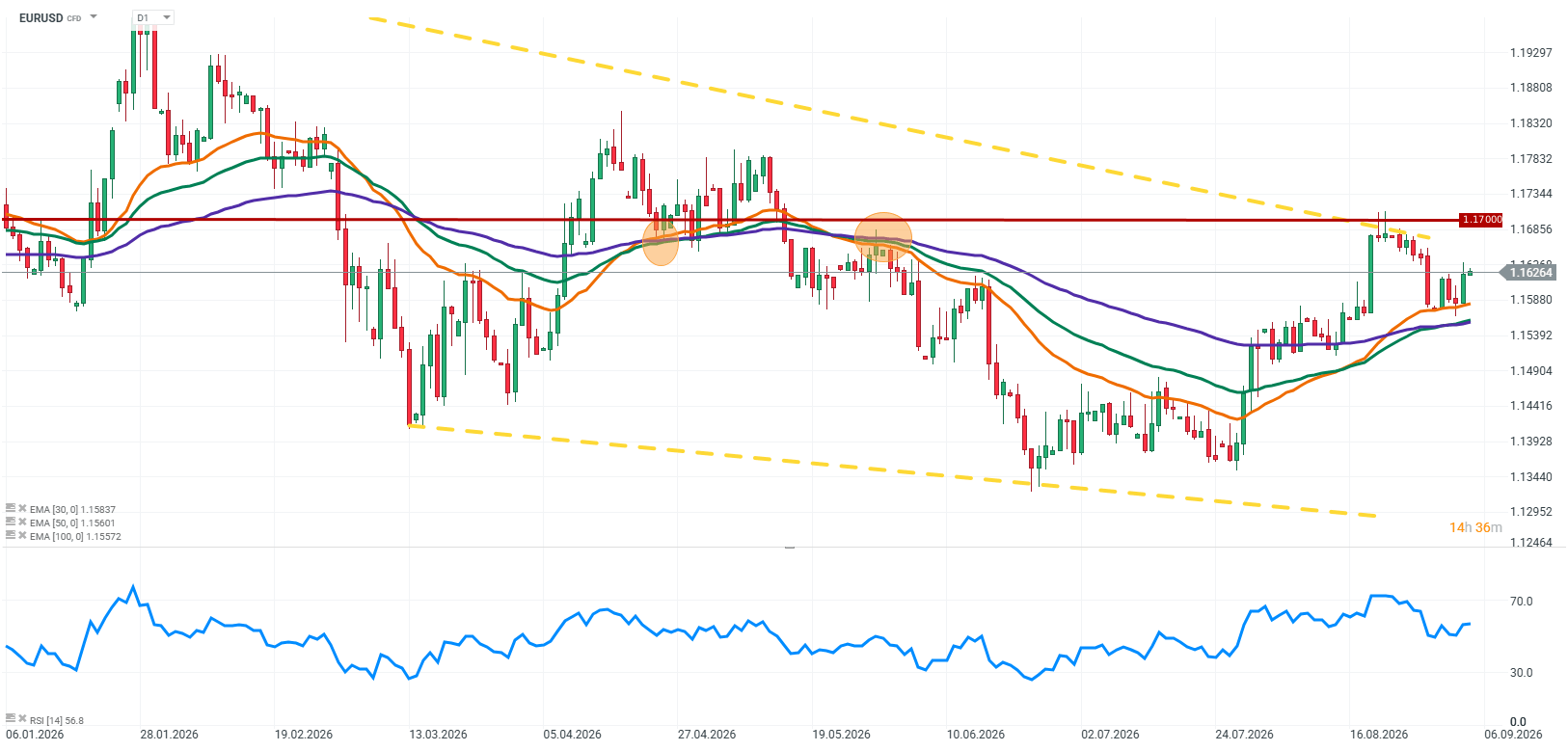
Source: xStation5
Key factors currently shaping EURUSD
Warsh raises the bar for a dovish Fed
The biggest change compared with previous weeks has been the communication from the new Fed Chair. During his Jackson Hole speech, Kevin Warsh argued that the Fed cannot consider the fight against inflation over simply because recent readings have improved somewhat.
Warsh pointed out that the improvement in inflation data is still not strong enough to provide confidence that inflation is moving toward the target at the right pace. In his view, the Fed still has work to do, while financial conditions are not restraining the economy enough. This matters for markets because even weak labor market data may no longer automatically signal the end of rate hike expectations.
Today’s NFP therefore needs to be assessed on more than just the headline payroll number. Wage growth, the unemployment rate and revisions to previous figures will be equally important.
Waller takes a much more dovish stance
Christopher Waller presented a much more dovish assessment the following day. In his view, recent data provide enough reason to wait for additional information. If August inflation continues to show improvement, Waller said he would be willing to support keeping rates unchanged at the Fed’s September meeting.
His comments came only days after Warsh delivered a strongly hawkish message. The market responded by reducing expectations for a September rate hike. The probability of such a move fell to around 50%, compared with well above 60% just a few days earlier.
Waller did not rule out a rate hike, however. His position is conditional on the incoming data. If inflation continues to slow, he favors keeping rates unchanged. If price pressures accelerate again, he could support a hike. The Fed therefore remains highly dependent on the next economic releases.
The bond market sends an important signal
Another key part of the current picture is the US Treasury market. Bond yields have risen significantly in recent weeks, with the 10 year Treasury yield reaching around 5%, its highest level in almost three years. Yields eased somewhat on Thursday following Waller’s dovish comments.
Investors now have to determine whether elevated yields are mainly the result of expectations for higher Fed rates or whether structural factors are also playing a role, including heavy Treasury supply, the fiscal outlook and elevated commodity prices.
This matters for EURUSD. If Treasury yields continue to rise, the dollar could remain supported even if the Fed does not immediately deliver another rate hike. If the bond market instead begins to price lower rates more aggressively, pressure on the dollar could increase.
NFP is now the key test
Today’s labor market report will be an important test of current market expectations. The consensus calls for around 56,000 to 58,000 new nonfarm payrolls in August. The unemployment rate is expected to remain around 4.1%, while wage growth is expected to slow to around 3% year over year.
The market is therefore not expecting a strong rebound in the US labor market. After payrolls fell by 23,000 in July, only a moderate increase is forecast for August. The report could also be distorted by one off factors, which means the headline NFP number alone may not provide a complete picture. Investors will be watching wages, unemployment and revisions to previous figures closely.
A weak NFP may no longer mean a strong EURUSD rally
In previous weeks, weak labor market data were almost automatically interpreted as an argument for the end of Fed rate hikes. The situation is different now because Warsh has placed a clear focus on inflation.
If today’s NFP is weak, EURUSD could initially move sharply higher. Treasury yields could fall and markets could further reduce expectations for a September rate hike. However, if wage growth remains elevated, unemployment does not increase and revisions to previous figures are not particularly negative, the initial reaction could quickly fade. The August CPI report on September 11 could also prove more important for the Fed than the NFP itself.
A strong NFP could revive the higher rates scenario
If payroll growth comes in significantly above expectations and wage growth remains strong, markets could once again increase the probability of a September rate hike. In that case, the data would provide support for Warsh’s message from Jackson Hole.
US Treasury yields could move higher again, giving the dollar additional support. For EURUSD, that would mean renewed downside pressure. However, what matters more than simply beating the consensus by a few thousand jobs is whether the report changes investors’ view of the Fed’s ability to raise rates on September 16.
The euro remains relatively well supported
Against the changing expectations surrounding the Fed, the euro continues to receive support from the interest rate market. The European Central Bank is still on a path that markets view as more hawkish than they did just a few weeks ago. Markets are pricing another ECB rate hike in September, while part of the curve also points to the possibility of further tightening before the end of the year.
EURUSD is therefore being pulled in two directions. On one side, there is Warsh’s hawkish stance and elevated US Treasury yields. On the other, there is Waller’s dovish approach, a weaker US labor market and relatively hawkish expectations for the ECB. Today’s NFP could determine which of these factors has the greater influence on the currency market in the coming days.
Key takeaways
The situation has become significantly more complicated over the past few days. Warsh has made it clear that the Fed cannot consider the fight against inflation finished, while Waller believes that the central bank can wait if the incoming data continue to improve.
Today’s labor market report will provide another important piece of evidence. A weak NFP could reduce expectations for a Fed rate hike and support EURUSD, but after Warsh’s comments the reaction may be more limited than before. A strong report, particularly if accompanied by solid wage growth, could increase expectations for higher rates and support the dollar.
Even today’s report is unlikely to provide the final answer. On September 11, markets will receive the August CPI data, and inflation could ultimately determine whether the Fed makes another move.
EURUSD is entering the most important part of the week with a clear divergence in expectations for the Fed. Warsh is calling for continued focus on inflation, Waller wants to wait for more data, while the bond market continues to price in elevated risks. Today’s NFP could show which of these narratives will matter most for the market in the days ahead.


RBA turns increasingly hawkish as markets reprice November rate hike expectations ⚔️



Daily Summary: Buyers Refuse to Give In

US Natural gas extends declines 🔥📉



US OPEN: The wave of AI concerns is building again, oil returns near highs
The content of this report has been created by XTB S.A., with its registered office in Warsaw, at Prosta 67, 00-838 Warsaw, Poland, (KRS number 0000217580) and supervised by Polish Supervision Authority ( No. DDM-M-4021-57-1/2005). This material is a marketing communication within the meaning of Art. 24 (3) of Directive 2014/65/EU of the European Parliament and of the Council of 15 May 2014 on markets in financial instruments and amending Directive 2002/92/EC and Directive 2011/61/EU (MiFID II). Marketing communication is not an investment recommendation or information recommending or suggesting an investment strategy within the meaning of Regulation (EU) No 596/2014 of the European Parliament and of the Council of 16 April 2014 on market abuse (market abuse regulation) and repealing Directive 2003/6/EC of the European Parliament and of the Council and Commission Directives 2003/124/EC, 2003/125/EC and 2004/72/EC and Commission Delegated Regulation (EU) 2016/958 of 9 March 2016 supplementing Regulation (EU) No 596/2014 of the European Parliament and of the Council with regard to regulatory technical standards for the technical arrangements for objective presentation of investment recommendations or other information recommending or suggesting an investment strategy and for disclosure of particular interests or indications of conflicts of interest or any other advice, including in the area of investment advisory, within the meaning of the Trading in Financial Instruments Act of 29 July 2005 (i.e. Journal of Laws 2019, item 875, as amended). The marketing communication is prepared with the highest diligence, objectivity, presents the facts known to the author on the date of preparation and is devoid of any evaluation elements. The marketing communication is prepared without considering the client’s needs, his individual financial situation and does not present any investment strategy in any way. The marketing communication does not constitute an offer of sale, offering, subscription, invitation to purchase, advertisement or promotion of any financial instruments. XTB S.A. is not liable for any client’s actions or omissions, in particular for the acquisition or disposal of financial instruments, undertaken on the basis of the information contained in this marketing communication. In the event that the marketing communication contains any information about any results regarding the financial instruments indicated therein, these do not constitute any guarantee or forecast regarding the future results.