


- The EURUSD exchange rate has fallen to around 1.1000, reaching its lowest level since early 2026.
- Markets are pricing in a 90% probability of a Federal Reserve interest rate hike in December.
- Today's US retail sales data can influence market expectations and the dollar's performance.
- Federal Reserve official Beth Hammack notes that the US economy can handle restrictive financial conditions.
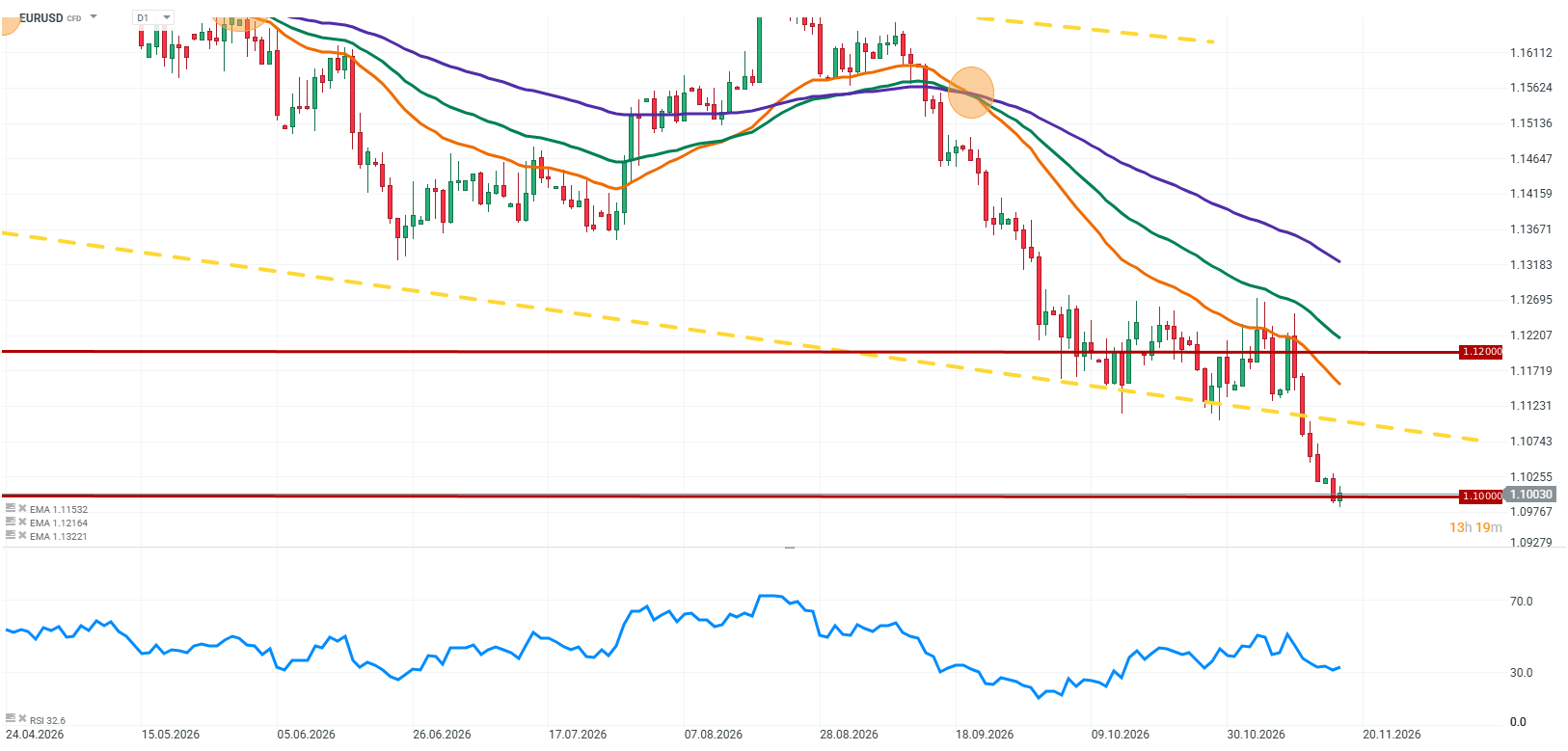
The EURUSD exchange rate has fallen to around 1.1000, reaching its lowest level since the beginning of 2026. This level highlights the strength the US dollar has gained in recent days. Investors are increasingly pricing in the possibility of an interest rate hike by the Federal Reserve in December. The probability of such a move is currently estimated at around 90%.
Today's US retail sales data could have a significant impact on the dollar's performance. The report will show whether American consumers are maintaining strong spending levels despite restrictive financial conditions. Stronger figures could further reinforce expectations of a Fed rate hike, while a weaker reading could prompt markets to reassess their current forecasts.
Source: XTB Reserach
Factors currently shaping EURUSD
Markets are almost certain of a December Fed rate hike
Expectations surrounding Federal Reserve monetary policy are currently among the most important factors influencing EURUSD. Markets are pricing in around a 90% probability of an interest rate hike at the December meeting. This is a very high level, although there is still some time before the decision. Further economic releases and comments from Fed officials could therefore change investors' current expectations.
Such strong expectations of tighter monetary policy are supporting the dollar. Higher interest rates increase the appeal of US assets, while the prospect of further increases may encourage investors to maintain their exposure to the USD. This creates a more challenging environment for the euro, particularly as the European currency currently lacks sufficiently strong catalysts to reverse the trend.
It is worth remembering, however, that market pricing does not mean the Fed's decision is already settled. Further data on inflation, employment and economic activity will be released before the December meeting. If these figures begin to point to a more pronounced slowdown in the US economy, current expectations could quickly decline.
Retail sales to test the resilience of US consumers
Today's US retail sales figures will provide an important test of the health of American consumers. According to market forecasts, sales increased by 0.2% month on month in October, following a 0.8% rise in September. Retail sales excluding automobiles are expected to increase by 0.4%.
The lower forecast for the headline figure suggests that consumer spending may be losing momentum. However, the reading alone would not necessarily signal a deterioration in the economic outlook. What matters is how the figures compare with expectations and whether any slowdown is also visible in sales excluding motor vehicles.
If retail sales come in significantly above forecasts, investors may conclude that the US economy is continuing to withstand high borrowing costs. Such a result would strengthen the case for further Fed tightening and could trigger another wave of dollar appreciation. Weaker figures, on the other hand, could reduce pressure for a December rate hike, giving the euro room to recover.
Hammack sees room for further Fed tightening
Recent comments from Federal Reserve officials are also influencing market expectations. Beth Hammack noted that the US economy can handle more restrictive financial conditions. At the same time, she stressed that inflation remains a concern and that the extent of any further Fed action is still unclear.
Her comments suggest that some policymakers continue to see room to maintain restrictive monetary policy or even tighten it further. This is an important signal for currency markets, as it reinforces expectations that US interest rates could remain high.
Kevin Warsh's recent speech took a different direction. He spoke about artificial intelligence without directly addressing monetary policy. His remarks therefore offered investors no new clues about the Fed's next decision. In the coming days, greater attention is likely to focus on economic data and comments from central bank officials addressing inflation and the outlook for interest rates.
The dollar benefits from weaker market sentiment
The dollar's strength is not driven solely by expectations surrounding Fed policy. The US currency is also benefiting from increased investor caution and demand for assets perceived as safer. During periods of market uncertainty, the dollar often gains ground, as it remains one of the main safe-haven currencies for global investors.
Concerns about technology stock valuations and the possibility of weaker sentiment across equity markets are providing additional support for the dollar. If investors continue to reduce their exposure to riskier assets, pressure on the euro could persist. In such conditions, even positive data from the eurozone may not be enough to trigger a significant EURUSD recovery.
The euro struggles to find reasons to recover
The 1.1000 level could now play an important role in the pair's short-term technical outlook. If EURUSD manages to hold above this threshold, downward pressure could begin to ease. Further attempts at a recovery will depend primarily on US economic data and any changes in expectations ahead of the December Fed meeting.
A short-term correction cannot be ruled out. After such a pronounced decline in the euro, some investors may decide to take profits on positions betting against the currency. However, a more sustained reversal would require a stronger catalyst, such as weaker US economic data or a decline in the market-implied probability of a December rate hike.
EURUSD awaits today's US data
Today's retail sales report could determine whether the dollar maintains its recent advantage. A stronger-than-expected result would likely reinforce the view that the US economy remains resilient despite high interest rates. In that case, markets could place even greater emphasis on the possibility of a December Fed rate hike, increasing the risk of further declines in EURUSD.
A weaker reading could give the dollar some breathing room. If the data point to a clear slowdown in consumer spending, investors may begin to question the currently high probability of a rate hike. This could create room for a euro recovery, although one disappointing indicator may not be enough to bring about a lasting trend reversal.
Key takeaways
EURUSD has fallen to around 1.1000, reaching its lowest level since the beginning of the year.
Markets are already pricing in around a 90% probability of a Fed rate hike in December. Today's US retail sales figures could nevertheless change these expectations.
Beth Hammack's comments suggest that some Fed officials remain open to further monetary tightening. Kevin Warsh, meanwhile, did not address interest rates during his speech on artificial intelligence.
As long as US data support expectations of higher interest rates and market sentiment remains favourable to the dollar, EURUSD could stay under pressure. Today's retail sales report will provide another important test of this trend.



Economic Calendar: Nvidia in focus as markets await key US Data


Morning Wrap: The Tech frenzy is cooling, and Wall Street is bleeding. All eyes on Nvidia.



Daily Summary: Tech Stock Selloff Weighs on Markets, Fed Outlines AI Scenarios


US OPEN: Tech selloff continues ahead of Nvidia earnings and Anthropic’s debut
The content of this report has been created by XTB S.A., with its registered office in Warsaw, at Prosta 67, 00-838 Warsaw, Poland, (KRS number 0000217580) and supervised by Polish Supervision Authority ( No. DDM-M-4021-57-1/2005). This material is a marketing communication within the meaning of Art. 24 (3) of Directive 2014/65/EU of the European Parliament and of the Council of 15 May 2014 on markets in financial instruments and amending Directive 2002/92/EC and Directive 2011/61/EU (MiFID II). Marketing communication is not an investment recommendation or information recommending or suggesting an investment strategy within the meaning of Regulation (EU) No 596/2014 of the European Parliament and of the Council of 16 April 2014 on market abuse (market abuse regulation) and repealing Directive 2003/6/EC of the European Parliament and of the Council and Commission Directives 2003/124/EC, 2003/125/EC and 2004/72/EC and Commission Delegated Regulation (EU) 2016/958 of 9 March 2016 supplementing Regulation (EU) No 596/2014 of the European Parliament and of the Council with regard to regulatory technical standards for the technical arrangements for objective presentation of investment recommendations or other information recommending or suggesting an investment strategy and for disclosure of particular interests or indications of conflicts of interest or any other advice, including in the area of investment advisory, within the meaning of the Trading in Financial Instruments Act of 29 July 2005 (i.e. Journal of Laws 2019, item 875, as amended). The marketing communication is prepared with the highest diligence, objectivity, presents the facts known to the author on the date of preparation and is devoid of any evaluation elements. The marketing communication is prepared without considering the client’s needs, his individual financial situation and does not present any investment strategy in any way. The marketing communication does not constitute an offer of sale, offering, subscription, invitation to purchase, advertisement or promotion of any financial instruments. XTB S.A. is not liable for any client’s actions or omissions, in particular for the acquisition or disposal of financial instruments, undertaken on the basis of the information contained in this marketing communication. In the event that the marketing communication contains any information about any results regarding the financial instruments indicated therein, these do not constitute any guarantee or forecast regarding the future results.