



After a wave of strong gains in the first half of August, the Japanese Nikkei 225 index recorded a sharp drop of over 2% today. The index contract is currently at 67400, deepening its declines along with falling contracts on US indices. If the current downward momentum continues at the end of the Asian session, it could be the deepest one-day correction since late July. Investor optimism hit a wall, and risk aversion prevailed in markets across the Asia-Pacific region. Behind such a sharp deterioration in sentiment in Japan is a combination of several key factors: from escalating geopolitical tensions, through rising bond yields, to yesterday's disappointing economic data.
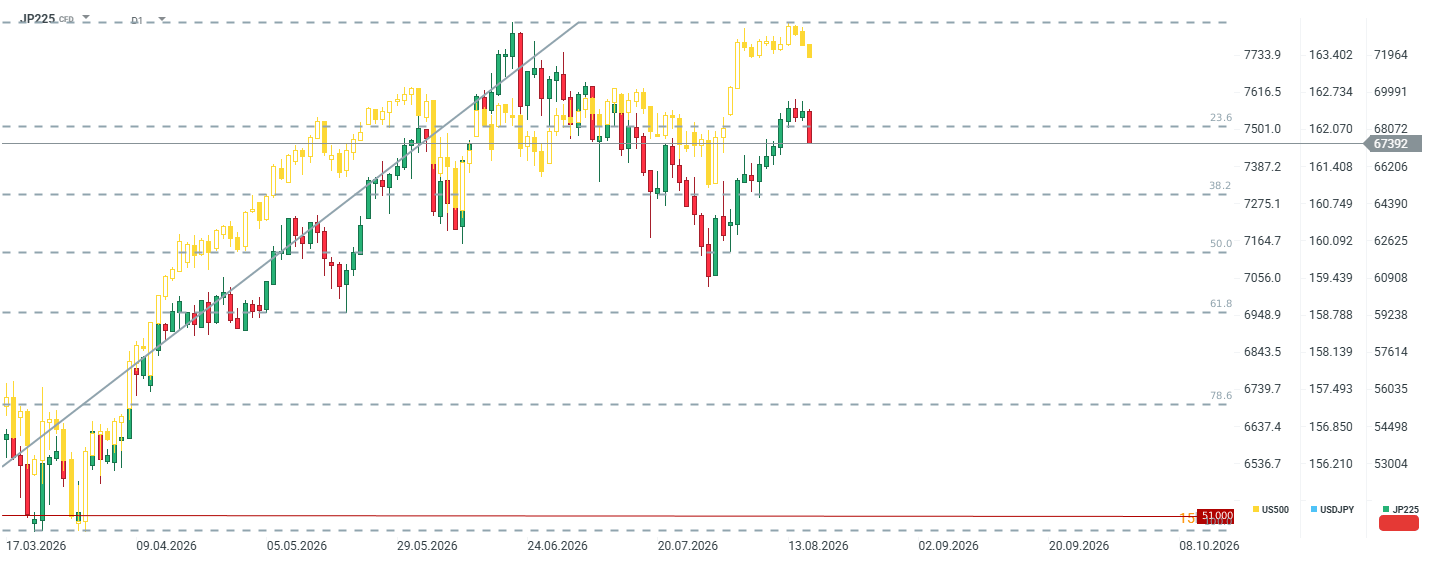 JP225 could potentially be breaking out of its current short-term uptrend. Source: xStation5
Reasons for the decline in Japanese stock prices
1. Jump in oil prices and the specter of escalation in the Middle East
Geopolitics became the trigger for the sell-off. US President Donald Trump categorically ruled out extending the temporary ceasefire with Iran, and his harsh rhetoric (including threats against Oman) raised concerns about the security of commodity supplies. The market reaction was immediate: the price of Brent oil broke the level of 91 USD per barrel, and American WTI rose above 84 USD. For Japan, an economy almost entirely dependent on energy imports, this is terrible news. A sharp rise in oil prices means higher costs for companies and hits margins, which naturally prompts investors to sell stocks on the Tokyo floor.
2. Japanese bond yields at levels from 1996
Another massive burden on the stock market is the debt market. Yields on 10-year Japanese Government Bonds (JGBs) shot up to around 2.95%, the highest reading since September 1996. Rising interest rates on safe government bonds make them an increasingly interesting alternative to the risky stock market. In an environment of rising yields, valuations of tech firms, from which capital is flowing toward "safe havens," particularly suffer.
3. A weak yen compounds the pain (rising USDJPY)
In the currency market, we are observing a weakening of the Japanese currency. The USDJPY exchange rate is rising and approaching the 159.7 level. Usually, a weak yen was welcomed on the Tokyo stock exchange with enthusiasm because it supported the competitiveness of Japanese export giants. However, in the current situation, this phenomenon is a double-edged sword. With the Brent oil price exceeding 91 USD, the depreciating yen drastically raises the costs of imported energy, directly hitting the domestic economy and consumers' wallets.
4. Weak GDP and waiting for Friday's inflation
Local macroeconomic fundamentals also do not provide reasons for optimism. Yesterday's data on Japan's GDP turned out to be rather weak (annualized growth for Q2 at 1.1% vs. expected 2.1% and previous 1.9%), which dampened the enthusiasm for buying stocks and raised concerns about the country's economic growth pace. Moreover, investors are taking a wait-and-see attitude before Friday's key inflation reading in Japan. This data could decide the next steps in the central bank's monetary policy, especially in the context of the aforementioned "imported inflation" and escaping yields. Although an interest rate hike itself is generally negative for the stock market, raising the cost of money now could lead to the end of the yen's weakness.
5. What to expect next?
Today's plunge on the Nikkei 225 is a classic example of a flight from risk in the face of accumulating problems. After a successful first half of August, the market was susceptible to a correction, and the trigger turned out to be geopolitics and oil, which exposed the weaknesses of the Japanese economy: dependence on raw material imports and pressure related to the most expensive financing cost (JGB yields) in nearly three decades. Increased volatility may persist on the Tokyo stock exchange until Friday's inflation data.
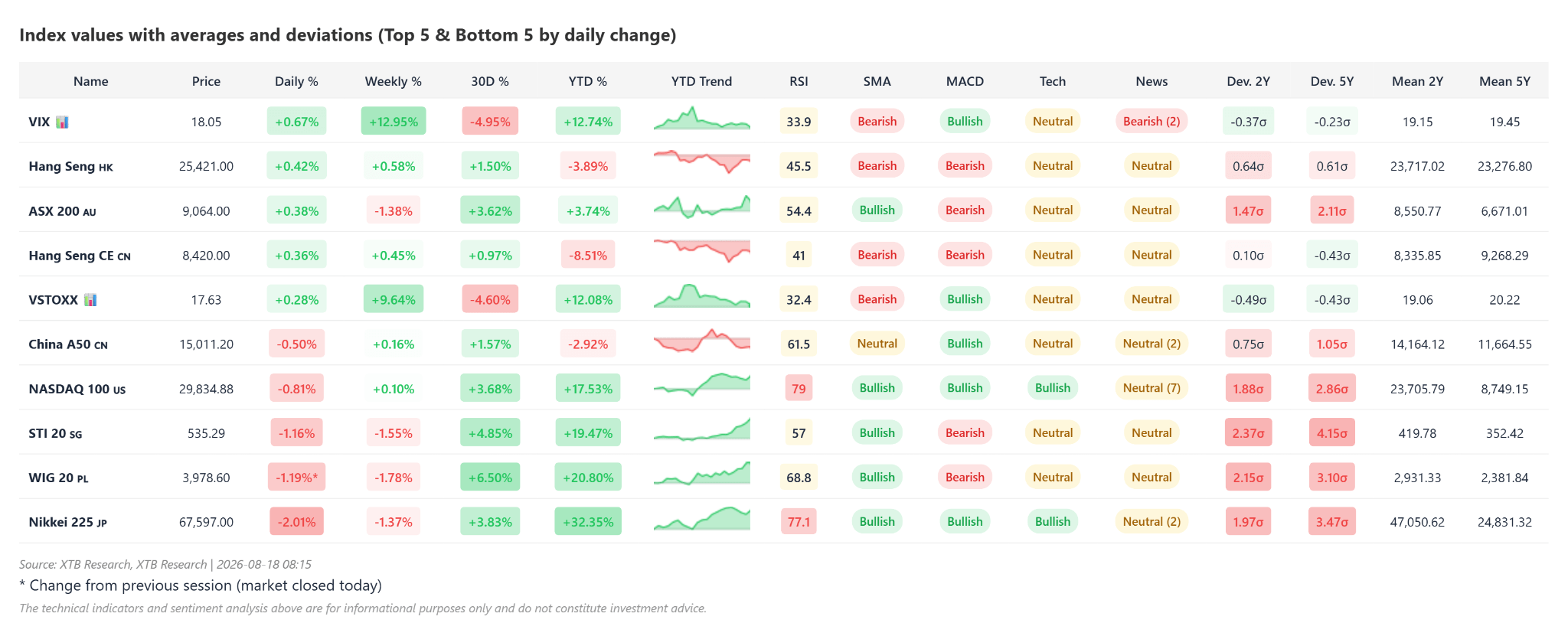 The Nikkei 225 contract is the worst-performing index-based instrument today. Although technically the index still looks positive in the medium term, it simultaneously remains quite heavily overbought relative to the 2 and 5-year averages. The RSI indicator is in the overbought zone. Source: XTB



Daily Summary: Friday offers no relief; the US100 drops 2%🚨


Three Markets to Watch Next Week (October 16, 2026)


Market wrap: European indices rebound 🔼 Defence stocks on the rise


Chart of the Day: NATGAS - Are there chances for a seasonal rebound amid warm weather?
The content of this report has been created by XTB S.A., with its registered office in Warsaw, at Prosta 67, 00-838 Warsaw, Poland, (KRS number 0000217580) and supervised by Polish Supervision Authority ( No. DDM-M-4021-57-1/2005). This material is a marketing communication within the meaning of Art. 24 (3) of Directive 2014/65/EU of the European Parliament and of the Council of 15 May 2014 on markets in financial instruments and amending Directive 2002/92/EC and Directive 2011/61/EU (MiFID II). Marketing communication is not an investment recommendation or information recommending or suggesting an investment strategy within the meaning of Regulation (EU) No 596/2014 of the European Parliament and of the Council of 16 April 2014 on market abuse (market abuse regulation) and repealing Directive 2003/6/EC of the European Parliament and of the Council and Commission Directives 2003/124/EC, 2003/125/EC and 2004/72/EC and Commission Delegated Regulation (EU) 2016/958 of 9 March 2016 supplementing Regulation (EU) No 596/2014 of the European Parliament and of the Council with regard to regulatory technical standards for the technical arrangements for objective presentation of investment recommendations or other information recommending or suggesting an investment strategy and for disclosure of particular interests or indications of conflicts of interest or any other advice, including in the area of investment advisory, within the meaning of the Trading in Financial Instruments Act of 29 July 2005 (i.e. Journal of Laws 2019, item 875, as amended). The marketing communication is prepared with the highest diligence, objectivity, presents the facts known to the author on the date of preparation and is devoid of any evaluation elements. The marketing communication is prepared without considering the client’s needs, his individual financial situation and does not present any investment strategy in any way. The marketing communication does not constitute an offer of sale, offering, subscription, invitation to purchase, advertisement or promotion of any financial instruments. XTB S.A. is not liable for any client’s actions or omissions, in particular for the acquisition or disposal of financial instruments, undertaken on the basis of the information contained in this marketing communication. In the event that the marketing communication contains any information about any results regarding the financial instruments indicated therein, these do not constitute any guarantee or forecast regarding the future results.