



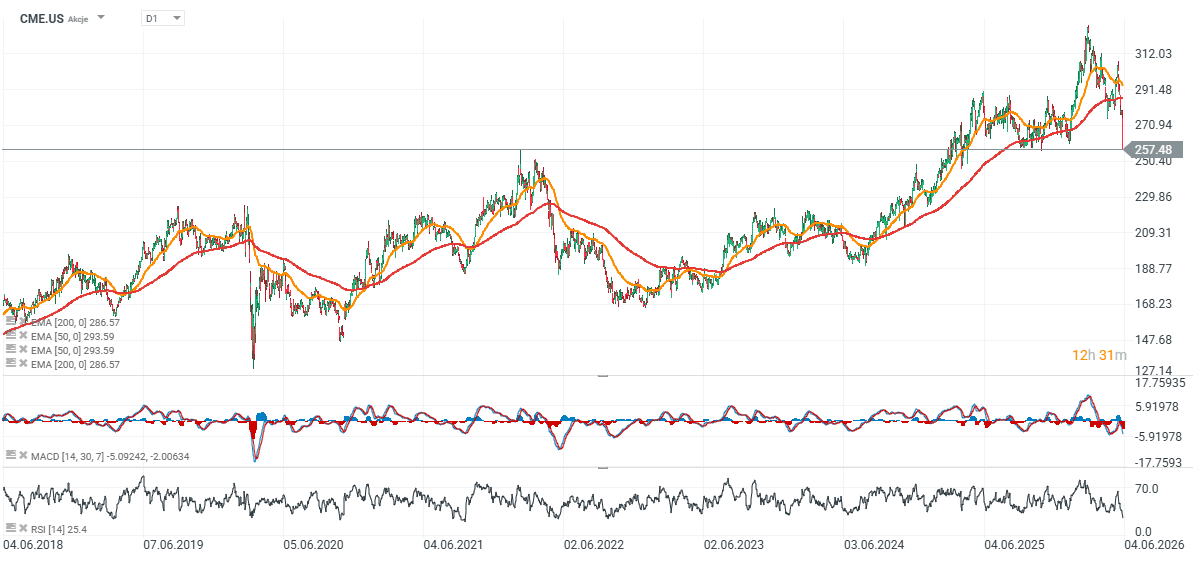
Shares of CME Group (CME.US), the operator of the Chicago-based derivatives exchange, have already fallen more than 20% from their record highs near $330 per share. While CME is rarely mentioned among the most popular market sentiment indicators, history suggests its stock has occasionally provided an early warning signal ahead of periods of increased volatility in global equity markets.
This was the case during the winter of 2018/2019, in early 2020 before the pandemic-driven market crash, and again at the beginning of 2022 when investors started preparing for the Federal Reserve's aggressive rate-hiking cycle. Interestingly, a similar pattern may be emerging today: CME shares have retreated by roughly 22% from their highs despite the absence of any major negative company-specific developments.
Key Takeaways
- CME Group operates the world's largest derivatives marketplace, making it one of the most important hubs for global risk management.
- The company's stock often reacts to changing expectations regarding liquidity, interest rates, and institutional activity before those shifts become visible in broader equity indices.
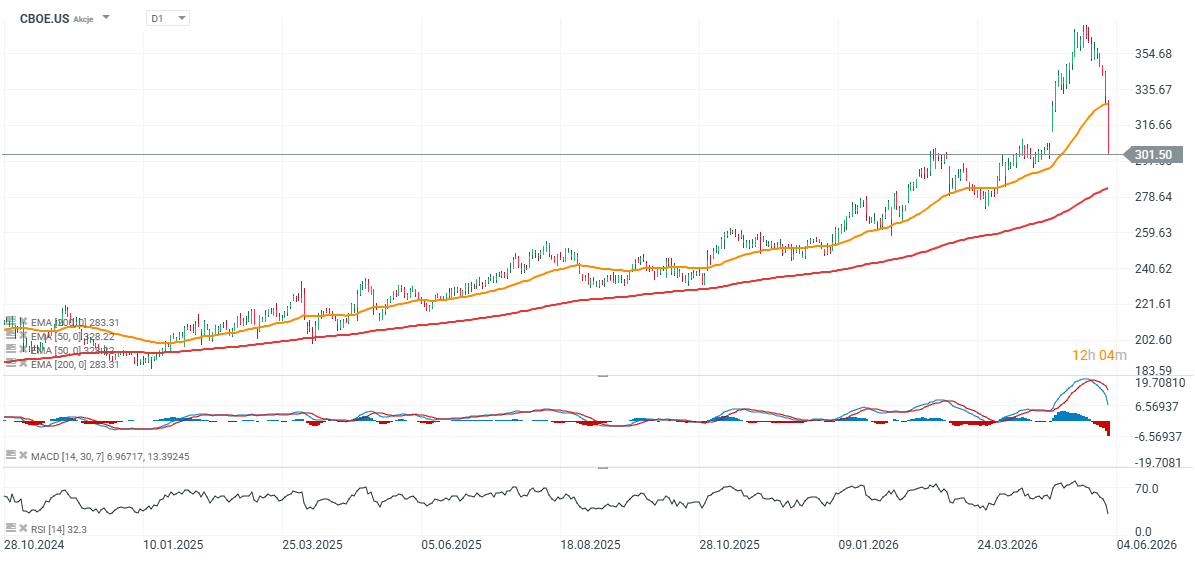
- CME's weakness is not an isolated case. Shares of Intercontinental Exchange (ICE.US) and Cboe Global Markets (CBOE.US) — best known for the VIX volatility index, often referred to as the "fear gauge" — have also come under pressure, with Cboe shares falling nearly 20% over the past two weeks.
What Does CME Group Actually Do?
CME Group is the world's largest derivatives exchange operator. The company owns and manages major marketplaces including CME, CBOT, NYMEX, and COMEX, where traders and institutions buy and sell futures and options linked to interest rates, equity indices, currencies, energy commodities, precious metals, and agricultural products.
As a result, CME sits at the center of the global risk-management ecosystem. When investors seek protection against uncertainty related to inflation, interest rates, recession risks, or geopolitical events, they often use instruments traded on CME's exchanges.
Why Can CME Shares Signal Shifts in Market Sentiment?
CME's business model differs from that of most publicly traded companies. Its revenues are closely linked to trading activity and transaction volumes. In periods of uncertainty, demand for hedging instruments such as futures and options typically increases.
However, CME shares do not always rise alongside market volatility. Investors often attempt to price in future market conditions before they become visible in economic data or corporate earnings. When CME shares start weakening despite a strong stock market backdrop, it may indicate that investors expect tighter financial conditions, lower liquidity, slower economic growth, or a decline in risk appetite.
What Happened in 2019, 2020, and 2022?
At the turn of 2018 and 2019, CME shares began to underperform before broader market sentiment visibly deteriorated. A similar pattern emerged in early 2020 as investors gradually started recognizing the economic risks associated with the spread of COVID-19.
An even more striking example occurred in early 2022. At that time, markets rapidly shifted expectations regarding Federal Reserve policy. Investors moved from a narrative of continued monetary support to one focused on aggressive inflation-fighting measures. The result was one of the sharpest selloffs in technology stocks since the Global Financial Crisis.
Why Could CME Benefit from Fed Uncertainty?
Uncertainty surrounding interest rates is one of the most important drivers of derivatives market activity. Every shift in expectations regarding Federal Reserve policy tends to increase demand for interest-rate futures, Treasury contracts, equity-index derivatives, and other hedging instruments.
In an environment characterized by constantly changing expectations, investors typically hedge more actively and trade derivatives more frequently. For CME, this often translates into higher trading volumes and stronger fee-based revenue generation.
That said, CME shares are not simply a direct bet on rising volatility. The stock remains sensitive to broader financial conditions and investor expectations regarding future economic activity and monetary policy.
Why Might CME React Before the Broader Market?
Investors buying and selling CME shares are often attempting to anticipate changes in trading volumes, hedging demand, and financial liquidity. If markets begin to expect:
- fewer Fed rate cuts,
- higher bond yields,
- slower economic growth,
- or weaker risk appetite,
then CME shares may start declining before those concerns become fully reflected in major equity indices.
This dynamic helps explain why the pattern appeared before both the 2020 and 2022 market downturns. In each case, the key driver was a shift in expectations rather than a deterioration in current economic conditions.
Moreover, CME is often viewed as a "thermometer" of institutional market activity. Its primary clients include:
- investment banks,
- hedge funds,
- asset managers,
- and risk-management institutions.
When these sophisticated market participants begin reducing activity or adjusting hedging strategies, CME shares may reflect that shift faster than the S&P 500 or Nasdaq 100.
CME.US Chart (D1)
CME shares have fallen roughly 15% below their 200-day exponential moving average (EMA200, red line), entering correction territory despite record highs in the broader equity market, including the S&P 500 and Nasdaq 100. Historically, this type of divergence has been relatively rare, particularly given the company's strong first-quarter financial results.
Source: xStation5
CBOE.US Chart (D1)
Source: xStation5
Eryk Szmyd, Financial Markets Analyst, XTB



Daily Summary: A Shallow Rebound Ahead of Earnings Season


Lumentum: Demand for AI infrastructure exceeds capacity



US OPEN: Trump de-escalates, OpenAI supports Wall Street sentiment


Morning Wrap: OpenAI Revenue Concerns Weigh on Wall Street
The content of this report has been created by XTB S.A., with its registered office in Warsaw, at Prosta 67, 00-838 Warsaw, Poland, (KRS number 0000217580) and supervised by Polish Supervision Authority ( No. DDM-M-4021-57-1/2005). This material is a marketing communication within the meaning of Art. 24 (3) of Directive 2014/65/EU of the European Parliament and of the Council of 15 May 2014 on markets in financial instruments and amending Directive 2002/92/EC and Directive 2011/61/EU (MiFID II). Marketing communication is not an investment recommendation or information recommending or suggesting an investment strategy within the meaning of Regulation (EU) No 596/2014 of the European Parliament and of the Council of 16 April 2014 on market abuse (market abuse regulation) and repealing Directive 2003/6/EC of the European Parliament and of the Council and Commission Directives 2003/124/EC, 2003/125/EC and 2004/72/EC and Commission Delegated Regulation (EU) 2016/958 of 9 March 2016 supplementing Regulation (EU) No 596/2014 of the European Parliament and of the Council with regard to regulatory technical standards for the technical arrangements for objective presentation of investment recommendations or other information recommending or suggesting an investment strategy and for disclosure of particular interests or indications of conflicts of interest or any other advice, including in the area of investment advisory, within the meaning of the Trading in Financial Instruments Act of 29 July 2005 (i.e. Journal of Laws 2019, item 875, as amended). The marketing communication is prepared with the highest diligence, objectivity, presents the facts known to the author on the date of preparation and is devoid of any evaluation elements. The marketing communication is prepared without considering the client’s needs, his individual financial situation and does not present any investment strategy in any way. The marketing communication does not constitute an offer of sale, offering, subscription, invitation to purchase, advertisement or promotion of any financial instruments. XTB S.A. is not liable for any client’s actions or omissions, in particular for the acquisition or disposal of financial instruments, undertaken on the basis of the information contained in this marketing communication. In the event that the marketing communication contains any information about any results regarding the financial instruments indicated therein, these do not constitute any guarantee or forecast regarding the future results.