



Cocoa futures (COCOA) on the ICE exchange in the US plunged more than 7% today. Fears of a growing supply surplus in the 2025/26 season and widespread liquidation of long positions are driving a sharp price decline. The market has quickly flipped the narrative that dominated 2024 and 2025: significantly improved production prospects (largely thanks to better weather in West Africa, including Côte d’Ivoire and Ghana), rising output in South America, and—above all—weak demand from manufacturers are pushing prices lower. After falling by nearly 50% in 2025, the reversal of the previous uptrend has accelerated at the start of 2026.
What’s driving the cocoa market right now?
Estimated cocoa stockpiles reached 1.1 million tons at the end of the 2024/25 season, 4.2% higher than a year earlier, according to the International Cocoa Organization (ICCO), based on its annual survey. That figure is below the organization’s statistically derived estimate of 1.3 million tons. The result suggests the gap between supply and demand was smaller than the projected 49,000 tons, but inventories still increased meaningfully year-on-year.
Weak processing data signals soft demand
-
Europe: -8.3% y/y (worst Q4 in 12 years)
-
Asia: -4.8% y/y
-
North America: +0.3% y/y (essentially flat)
Will chocolate prices fall?
Earlier cocoa price spikes translated into higher retail chocolate prices, so consumers have been buying less or trading down to cheaper options. For this season, forecasts point to a surplus of 175,000–250,000 tons (or more) thanks to improved growing conditions in West Africa and a recovery in South American production.
- In Côte d’Ivoire, rising inventories and port congestion have been weighing on the physical market, and the government has purchased 123,000 tons of unsold cocoa to stabilize the situation. Farmers have also called for the resignation of the head of the regulator (CCC), alleging bottlenecks in the supply chain.
- There have been no major new weather threats in West Africa, and conditions are expected to improve further.
- Chocolate producers remain in a tricky spot: lower cocoa prices could help margins, but some costs are still “locked in” via forward contracts signed during the price spike. At the same time, consumers are unwilling to keep paying elevated prices.
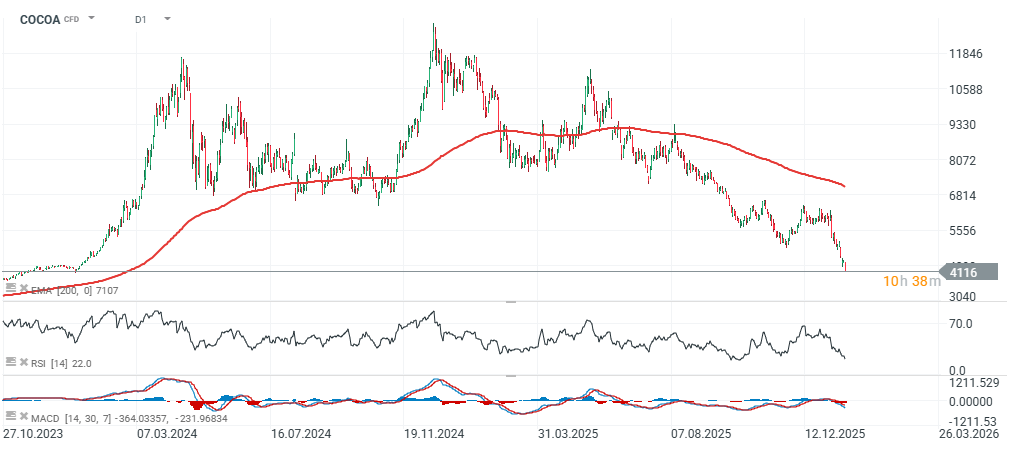
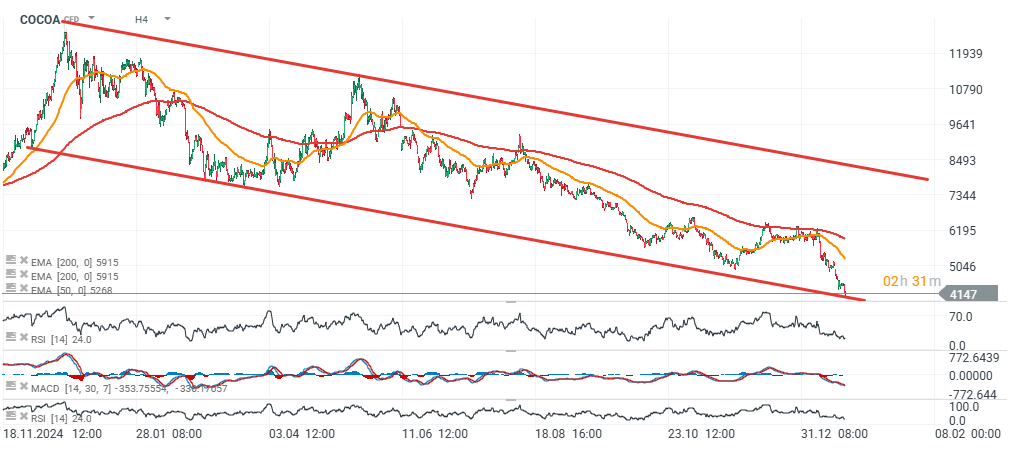
- Technically, the trend remains clearly bearish, and rising volumes suggest the selloff is broad and forceful. Without a demand rebound or a sudden weather shift, cocoa is likely to remain under fundamental pressure.
- Manufacturers are still grinding expensive beans purchased near the market peak in recent years, which is why many have raised prices, shrunk product sizes, or swapped cocoa butter for cheaper vegetable fats to protect profitability. Will chocolate get cheaper? That looks quite likely—if favorable production conditions persist.
Prices will need to adjust to demand to stimulate consumption again while still keeping processing economically viable. It arguably makes sense for producers to secure supply at meaningfully lower prices and cut retail prices to lift volumes and grindings. Shares of companies such as Hershey, Mondelez, and Barry Callebaut have been trying to stabilize and rebound as the market starts to see a chance of limiting “demand destruction” thanks to lower cocoa prices.
COCOA chart (D1, H4)
Price is testing the lower boundary of a descending price channel today and is trading at a clear discount versus the EMA200 and EMA50 moving averages. RSI points to oversold conditions, and futures are heading for a move of more than 20%—the biggest weekly drop in over 18 months. The drawdown from the highs is now over 65%.
Source: xStation5
Source: xStation5



Daily Summary: Friday offers no relief; the US100 drops 2%🚨


Three Markets to Watch Next Week (October 16, 2026)


Market wrap: European indices rebound 🔼 Defence stocks on the rise

🔼 EURUSD continues to rebound
The content of this report has been created by XTB S.A., with its registered office in Warsaw, at Prosta 67, 00-838 Warsaw, Poland, (KRS number 0000217580) and supervised by Polish Supervision Authority ( No. DDM-M-4021-57-1/2005). This material is a marketing communication within the meaning of Art. 24 (3) of Directive 2014/65/EU of the European Parliament and of the Council of 15 May 2014 on markets in financial instruments and amending Directive 2002/92/EC and Directive 2011/61/EU (MiFID II). Marketing communication is not an investment recommendation or information recommending or suggesting an investment strategy within the meaning of Regulation (EU) No 596/2014 of the European Parliament and of the Council of 16 April 2014 on market abuse (market abuse regulation) and repealing Directive 2003/6/EC of the European Parliament and of the Council and Commission Directives 2003/124/EC, 2003/125/EC and 2004/72/EC and Commission Delegated Regulation (EU) 2016/958 of 9 March 2016 supplementing Regulation (EU) No 596/2014 of the European Parliament and of the Council with regard to regulatory technical standards for the technical arrangements for objective presentation of investment recommendations or other information recommending or suggesting an investment strategy and for disclosure of particular interests or indications of conflicts of interest or any other advice, including in the area of investment advisory, within the meaning of the Trading in Financial Instruments Act of 29 July 2005 (i.e. Journal of Laws 2019, item 875, as amended). The marketing communication is prepared with the highest diligence, objectivity, presents the facts known to the author on the date of preparation and is devoid of any evaluation elements. The marketing communication is prepared without considering the client’s needs, his individual financial situation and does not present any investment strategy in any way. The marketing communication does not constitute an offer of sale, offering, subscription, invitation to purchase, advertisement or promotion of any financial instruments. XTB S.A. is not liable for any client’s actions or omissions, in particular for the acquisition or disposal of financial instruments, undertaken on the basis of the information contained in this marketing communication. In the event that the marketing communication contains any information about any results regarding the financial instruments indicated therein, these do not constitute any guarantee or forecast regarding the future results.