

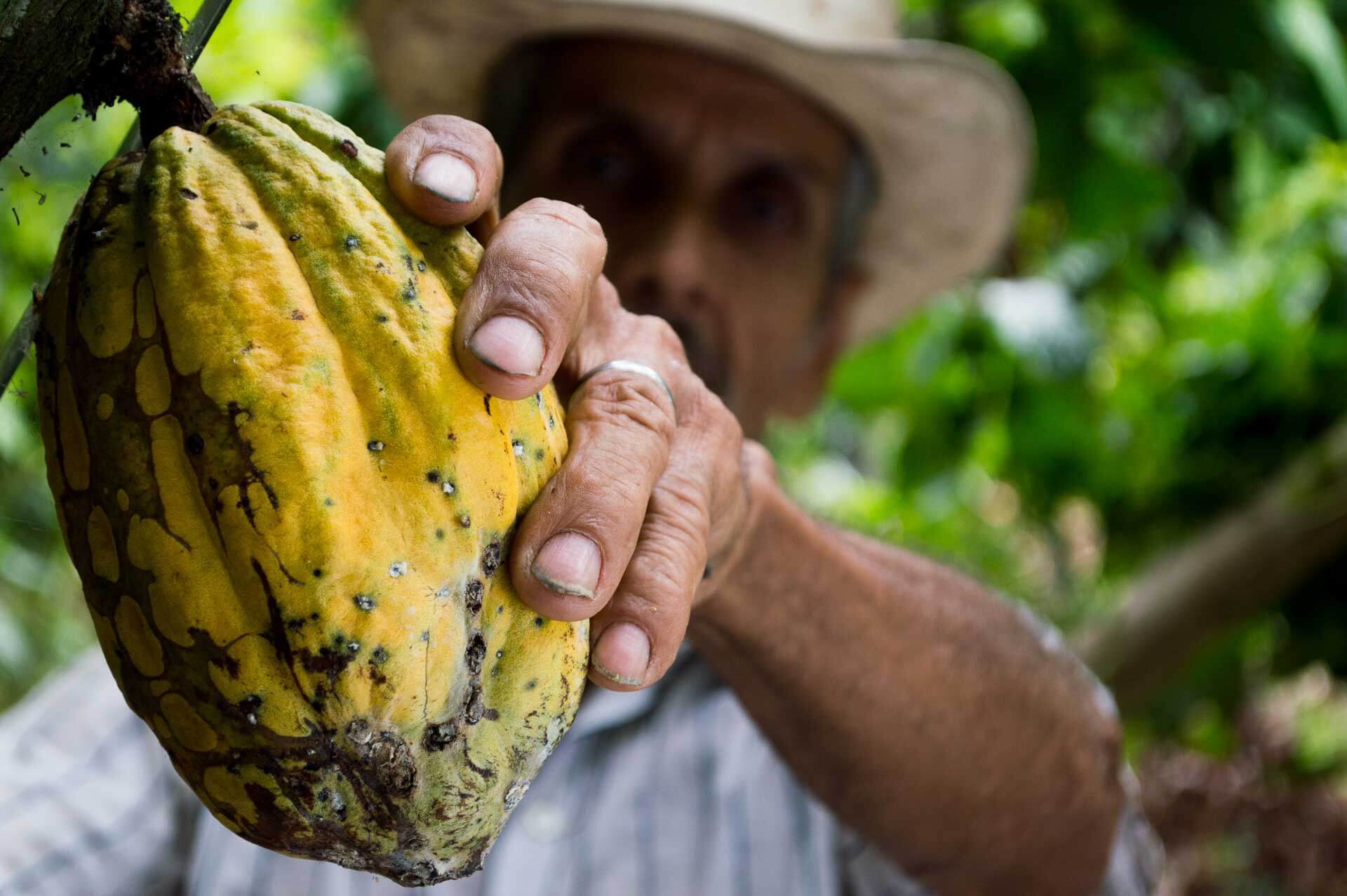

The cocoa market remains strongly supported by concerns over weather conditions in West Africa, but the fundamental picture is far from uniformly bullish, with ICE cocoa futures (COCOA) down more than 4% today. Industry giant Mondelez has pointed out that relatively healthy cocoa inventories provide a buffer that could soften the impact of a modest supply deficit. Since June, cocoa futures have surged by around 80%, driven mainly by expectations of a much smaller global surplus and risks linked to this year’s strong El Niño. However, Mondelez’s latest comments have helped cool the rally.
A cocoa market deficit is far from certain despite El Niño
The main cocoa harvest season in Ivory Coast began this week, with production in the world’s largest producer expected to decline, potentially leading to a smaller global surplus. BMI analysts expect the global cocoa surplus to fall from 442,000 tonnes in the 2025/26 season to 82,000 tonnes in 2026/27. According to BMI, such a sharp contraction should create a higher fundamental floor for cocoa prices and limit the scope for deeper declines.
The key source of uncertainty remains West Africa, as Ivory Coast and Ghana together account for around half of global production. This means that any weather-related disruption in the region can have a disproportionately large impact on prices.
Still, the actual impact of El Niño on harvests is not yet clear and has not yet become visible in hard production data. Mondelez itself stressed that, at this stage, the market is largely trading the risk of such a scenario rather than confirmed evidence of production losses. Hedgepoint expects the global cocoa surplus in 2026/27 to fall to around 111,000 tonnes, showing that not every forecast is aligned with BMI’s estimate. Both projections, however, point to a much tighter market balance, but still not an outright deficit.
The deterioration in the balance is expected to reflect both an approximately 2% decline in production and roughly 2.5% growth in cocoa grindings. This matters because the market is approaching a point where even a relatively small additional deterioration in supply could quickly eliminate the remaining surplus.
South America helps stabilize cocoa prices vulnerable to African production risks
One stabilizing factor is rising production in South America. Ecuador and Brazil in particular are becoming increasingly important as alternative sources of supply, gradually reducing the market’s dependence on West Africa. Ecuador is emerging as the most important challenger to traditional producers and aims to become the world’s second-largest cocoa producer within the next two years. If this expansion continues, it could structurally reduce the risk premium associated with the geographic concentration of global supply.
On the demand side, the picture is also less bullish than chocolate sales alone might suggest. In recent years, manufacturers have reduced cocoa content and adjusted product sizes, meaning that stronger snack demand does not necessarily translate one-for-one into higher demand for cocoa beans.
The key takeaway for the market is that the recent rally has a solid fundamental basis in a tighter supply-demand balance and elevated weather risks, but healthy inventories, rising South American production and lower cocoa intensity in food manufacturing could limit the scale of further upside.
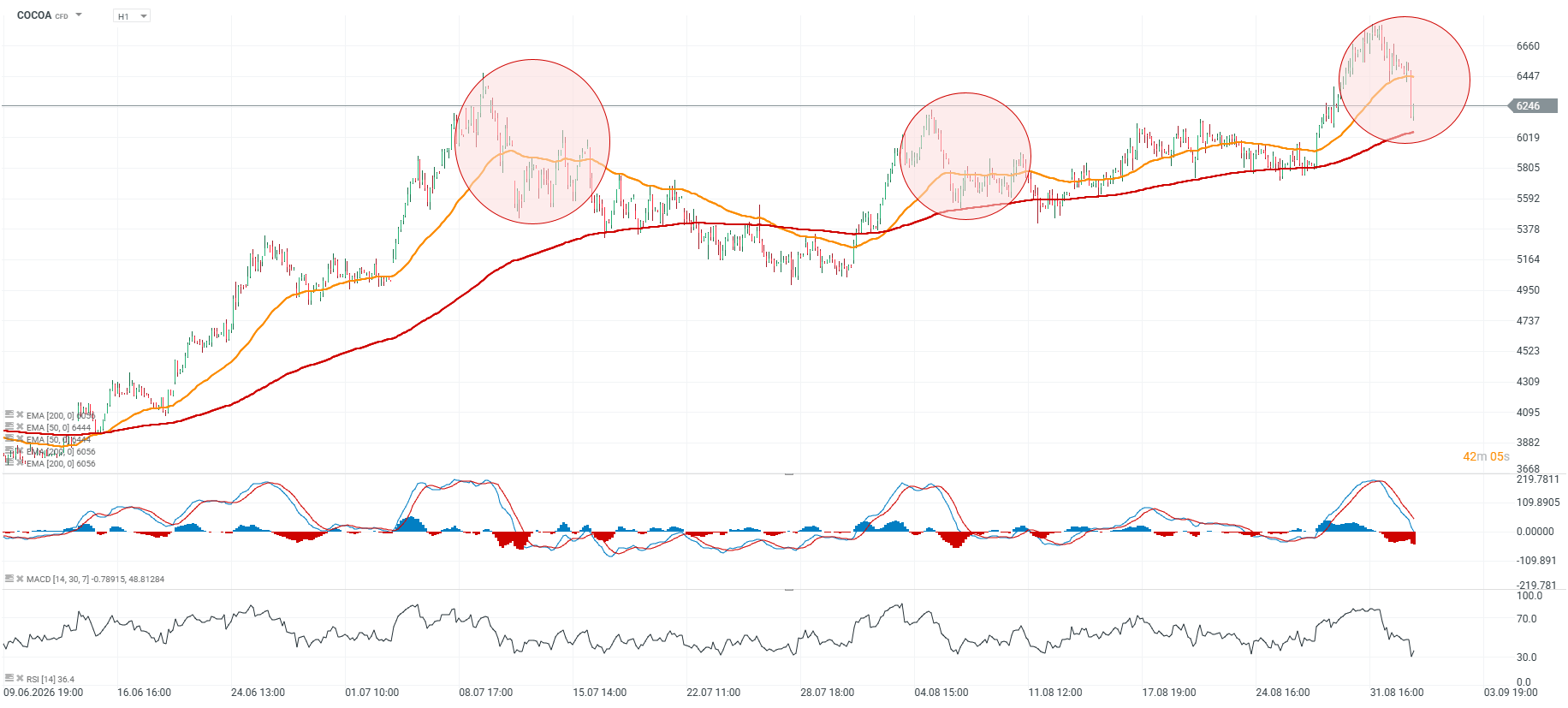
COCOA chart (H1 interval)
Since the beginning of June, we have already seen two downward impulses similar in magnitude to the current move, both of which pushed RSI close to 30. A comparable setup is developing now. If El Niño begins to materially affect actual production in Africa this year, a rebound toward $7,000 per tonne and above may become possible. However, if the impact remains limited, cocoa could just as easily consolidate within the $5,500–$6,200 per tonne range for a prolonged period.
Source: xStation5


Chart of the Day 📈 EURUSD attempts to rebound ahead of US inflation data (14.10.2026)



Daily Summary: Earnings Season Kicks Off on Wall Street Amid Mixed Sentiment



Market Wrap: European Stocks Rise as Banks Beat Earnings Expectations


🚩 US100 loses 0.7%
The content of this report has been created by XTB S.A., with its registered office in Warsaw, at Prosta 67, 00-838 Warsaw, Poland, (KRS number 0000217580) and supervised by Polish Supervision Authority ( No. DDM-M-4021-57-1/2005). This material is a marketing communication within the meaning of Art. 24 (3) of Directive 2014/65/EU of the European Parliament and of the Council of 15 May 2014 on markets in financial instruments and amending Directive 2002/92/EC and Directive 2011/61/EU (MiFID II). Marketing communication is not an investment recommendation or information recommending or suggesting an investment strategy within the meaning of Regulation (EU) No 596/2014 of the European Parliament and of the Council of 16 April 2014 on market abuse (market abuse regulation) and repealing Directive 2003/6/EC of the European Parliament and of the Council and Commission Directives 2003/124/EC, 2003/125/EC and 2004/72/EC and Commission Delegated Regulation (EU) 2016/958 of 9 March 2016 supplementing Regulation (EU) No 596/2014 of the European Parliament and of the Council with regard to regulatory technical standards for the technical arrangements for objective presentation of investment recommendations or other information recommending or suggesting an investment strategy and for disclosure of particular interests or indications of conflicts of interest or any other advice, including in the area of investment advisory, within the meaning of the Trading in Financial Instruments Act of 29 July 2005 (i.e. Journal of Laws 2019, item 875, as amended). The marketing communication is prepared with the highest diligence, objectivity, presents the facts known to the author on the date of preparation and is devoid of any evaluation elements. The marketing communication is prepared without considering the client’s needs, his individual financial situation and does not present any investment strategy in any way. The marketing communication does not constitute an offer of sale, offering, subscription, invitation to purchase, advertisement or promotion of any financial instruments. XTB S.A. is not liable for any client’s actions or omissions, in particular for the acquisition or disposal of financial instruments, undertaken on the basis of the information contained in this marketing communication. In the event that the marketing communication contains any information about any results regarding the financial instruments indicated therein, these do not constitute any guarantee or forecast regarding the future results.