



While global cocoa prices have retreated significantly from their 2024 record peaks, the chocolate industry remains mired in difficulty. Global demand shows signs of structural weakness, and processors are struggling to maintain profitability while working through historically expensive inventories.
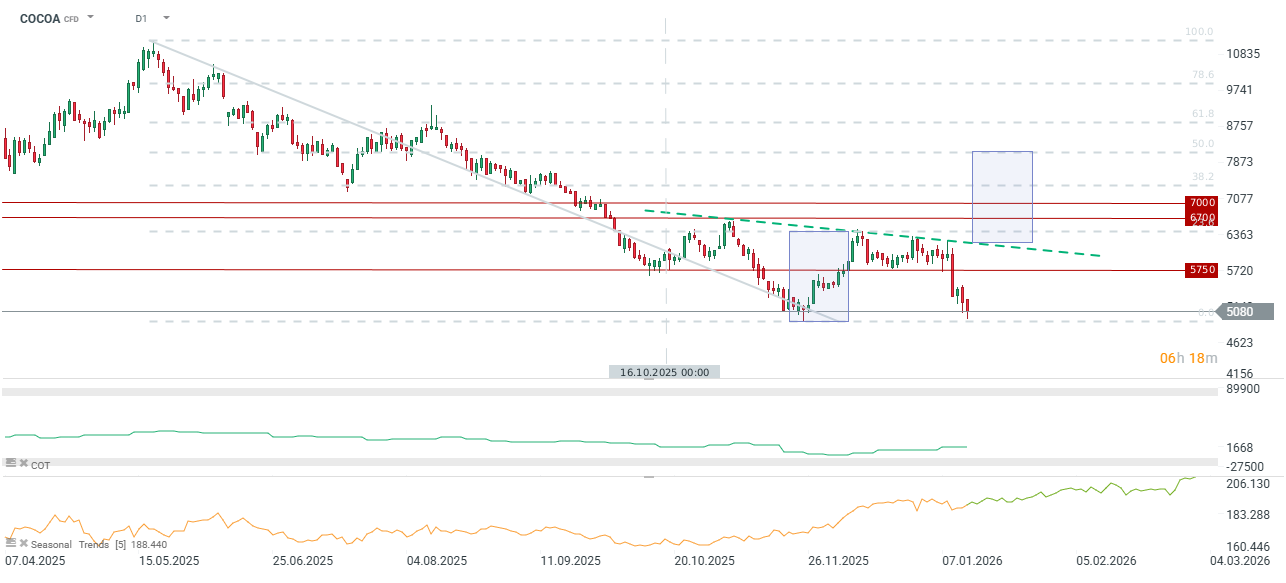
A Sharp Price Correction Since hitting all-time highs in December 2024, cocoa futures have lost more than half of their value. Recent volatility has intensified, partly due to the rebalancing of commodity indexes. Although a short-term influx of capital into the futures market was expected, funds likely spread their exposure over a longer period. Today, prices are down over 3%, briefly dipping below the $5,000 per ton mark—the lowest level since late November. Despite this significant sell-off, the commodity remains expensive by historical standards, with prices still substantially higher than those seen four to five years ago.
Demand Destruction Hits Processing The primary headwind for a price recovery is so-called "demand destruction". Last year’s record prices forced consumers to rein in chocolate purchases and prompted manufacturers to reformulate recipes, opting for cheaper substitutes and increased fillers, such as nuts.
These effects are evident in cocoa grinding data—a key proxy for demand:
- Europe: Fourth-quarter 2025 grindings are estimated to have fallen roughly 3% year-on-year
- Asia: The region is expected to see the steepest decline, estimated at approximately 12%.
- North America: The only region projected to see a slight increase (+1.2%), primarily due to the addition of two new processing plants.
European data will be released on the morning of January 15, followed by U.S. figures later that afternoon (CET). Asian data is due on Friday, January 16. Given the downbeat expectations, markets appear to be pricing in the weakness ahead of the official releases. Experts note that European processing margins fell below break-even as early as August and hit record lows in December, forcing firms to curb investment and production rates.
Crisis at the Source: Ivory Coast The price slump in New York and London has triggered a crisis for the world’s top producer, Ivory Coast. Local exporters are caught in a pincer move between state-mandated farmgate prices and tumbling international benchmarks.
The current situation is critical:
- The farmgate price stands at 2,800 CFA francs per kilogram (approx. $4.97).
- With market prices hovering around $5,000 per ton, exporter margins have effectively vanished, leading to liquidity issues and port congestion.
Traders are appealing to the government for subsidies or tax relief to sustain purchases from farmers. However, the industry regulator (CCC) has categorically rejected proposals to lower the farmgate price.
When Will Relief Reach Retail Shelves? Despite the collapse in raw material costs, consumers should not expect immediate price cuts for confectionery. Most beans processed in Q4 2025 were purchased before the sharp price decline. Market observers predict that retail price relief will only manifest in the second half of 2026. Until then, thin margins and underutilized capacity will continue to weigh on the global cocoa market. Furthermore, it is widely believed that the ultra-low prices seen during the pandemic era are unlikely to return.
Technical Outlook Prices have dropped toward the $5,000 level, effectively invalidating a potential inverse Head and Shoulders (oRGR) formation. However, if the price holds above November lows, a double-bottom formation could emerge, with a neckline near $6,300. It remains possible that weak grinding data could act as a contrarian catalyst, similar to the price action seen in October, when the market saw a temporary upward correction within a long-term bearish trend.



Daily Summary: Oil at five-month highs, indices under pressure (23.10.2026)


US Open: Further declines on Wall Street, Brent above 111 USD, AI correction continues (14.10.2026)


Chart of the Day: Is USDJPY running out of road? Inflation forces the BoJ to act, but the Fed could spoil the Yen’s rally



Macro Calendar: Preliminary PMI Readings and Earnings Ahead
The content of this report has been created by XTB S.A., with its registered office in Warsaw, at Prosta 67, 00-838 Warsaw, Poland, (KRS number 0000217580) and supervised by Polish Supervision Authority ( No. DDM-M-4021-57-1/2005). This material is a marketing communication within the meaning of Art. 24 (3) of Directive 2014/65/EU of the European Parliament and of the Council of 15 May 2014 on markets in financial instruments and amending Directive 2002/92/EC and Directive 2011/61/EU (MiFID II). Marketing communication is not an investment recommendation or information recommending or suggesting an investment strategy within the meaning of Regulation (EU) No 596/2014 of the European Parliament and of the Council of 16 April 2014 on market abuse (market abuse regulation) and repealing Directive 2003/6/EC of the European Parliament and of the Council and Commission Directives 2003/124/EC, 2003/125/EC and 2004/72/EC and Commission Delegated Regulation (EU) 2016/958 of 9 March 2016 supplementing Regulation (EU) No 596/2014 of the European Parliament and of the Council with regard to regulatory technical standards for the technical arrangements for objective presentation of investment recommendations or other information recommending or suggesting an investment strategy and for disclosure of particular interests or indications of conflicts of interest or any other advice, including in the area of investment advisory, within the meaning of the Trading in Financial Instruments Act of 29 July 2005 (i.e. Journal of Laws 2019, item 875, as amended). The marketing communication is prepared with the highest diligence, objectivity, presents the facts known to the author on the date of preparation and is devoid of any evaluation elements. The marketing communication is prepared without considering the client’s needs, his individual financial situation and does not present any investment strategy in any way. The marketing communication does not constitute an offer of sale, offering, subscription, invitation to purchase, advertisement or promotion of any financial instruments. XTB S.A. is not liable for any client’s actions or omissions, in particular for the acquisition or disposal of financial instruments, undertaken on the basis of the information contained in this marketing communication. In the event that the marketing communication contains any information about any results regarding the financial instruments indicated therein, these do not constitute any guarantee or forecast regarding the future results.