


- US October NFP report releases today at 14:30 CET as the final major data before the December FOMC meeting.
- Consensus expects 70 000 non-farm payrolls and an unchanged unemployment rate of 4.2%.
- Strong NFP data can revive December rate hike pricing and strengthen the US dollar.

- US October NFP report releases today at 14:30 CET as the final major data before the December FOMC meeting.
- Consensus expects 70 000 non-farm payrolls and an unchanged unemployment rate of 4.2%.
- Strong NFP data can revive December rate hike pricing and strengthen the US dollar.
Today, as standard at 14:30 CET, we will learn the October US labour market report. This is the last major release before the December FOMC meeting. Although it is of huge significance from the perspective of the US economy, markets are still living with the results of Tuesday's US mid-term elections. Following the elections, the AI sector fell sharply, and the VIX fear index jumped by around 18% in a week. In such an environment, the data could decide whether the Fed returns to rate hikes or takes into account tightening financial conditions.
Expectations:
- Non-farm Payrolls (NFP): consensus +70k vs +29k in September. Bloomberg Economics forecasts +63k, with a forecast range of 30–100k.
- Private sector: approx. +75k, with a further drop in public sector employment (approx. −12k).
- The ADP report showed an increase of 86k, which was above market expectations.
- Unemployment rate: 4.2%, unchanged.
- Average hourly earnings: +0.3% m/m (previously +0.1%), +2.9% y/y (previously 3.0%).
- Breakdown: job gains mainly in education and healthcare (approx. +43k), as well as in manufacturing and construction. Declines in retail and transport, and in sectors most exposed to AI, namely finance, information and professional services.
- Revisions: remain a significant risk. In the previous report, data for July and August were revised down by a total of 60k.
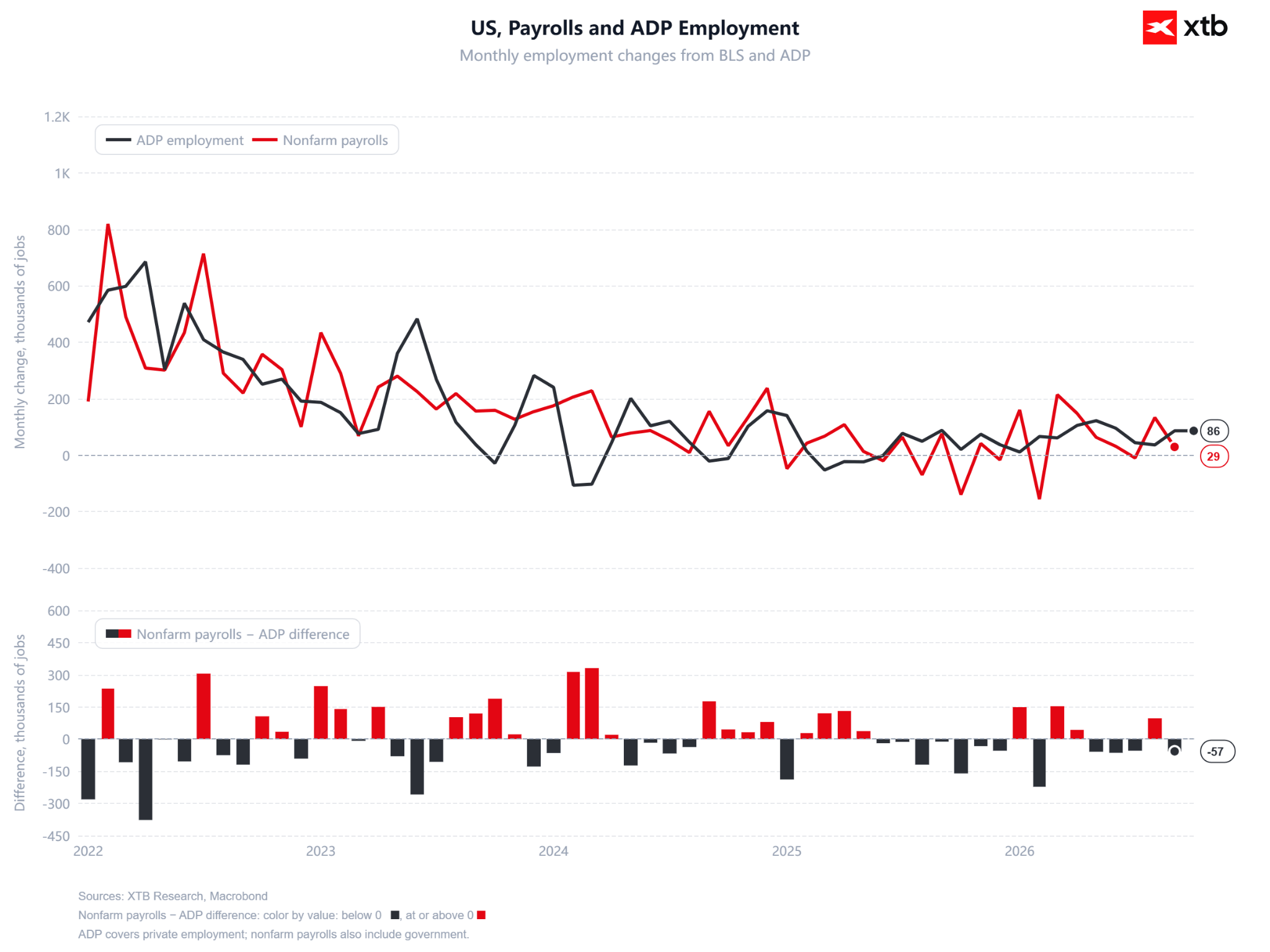
What could work in favour of today's report? The October data collection period was longer than September's, and the weather was exceptionally mild, which could have led to increased employment and artificially boosted the figure. The threshold at which unemployment remains unchanged is currently estimated at only around 50k jobs per month, so even if the result misses market consensus slightly, the labour market picture will remain strong, which could be key from the Fed's perspective.
What is the market pricing in?
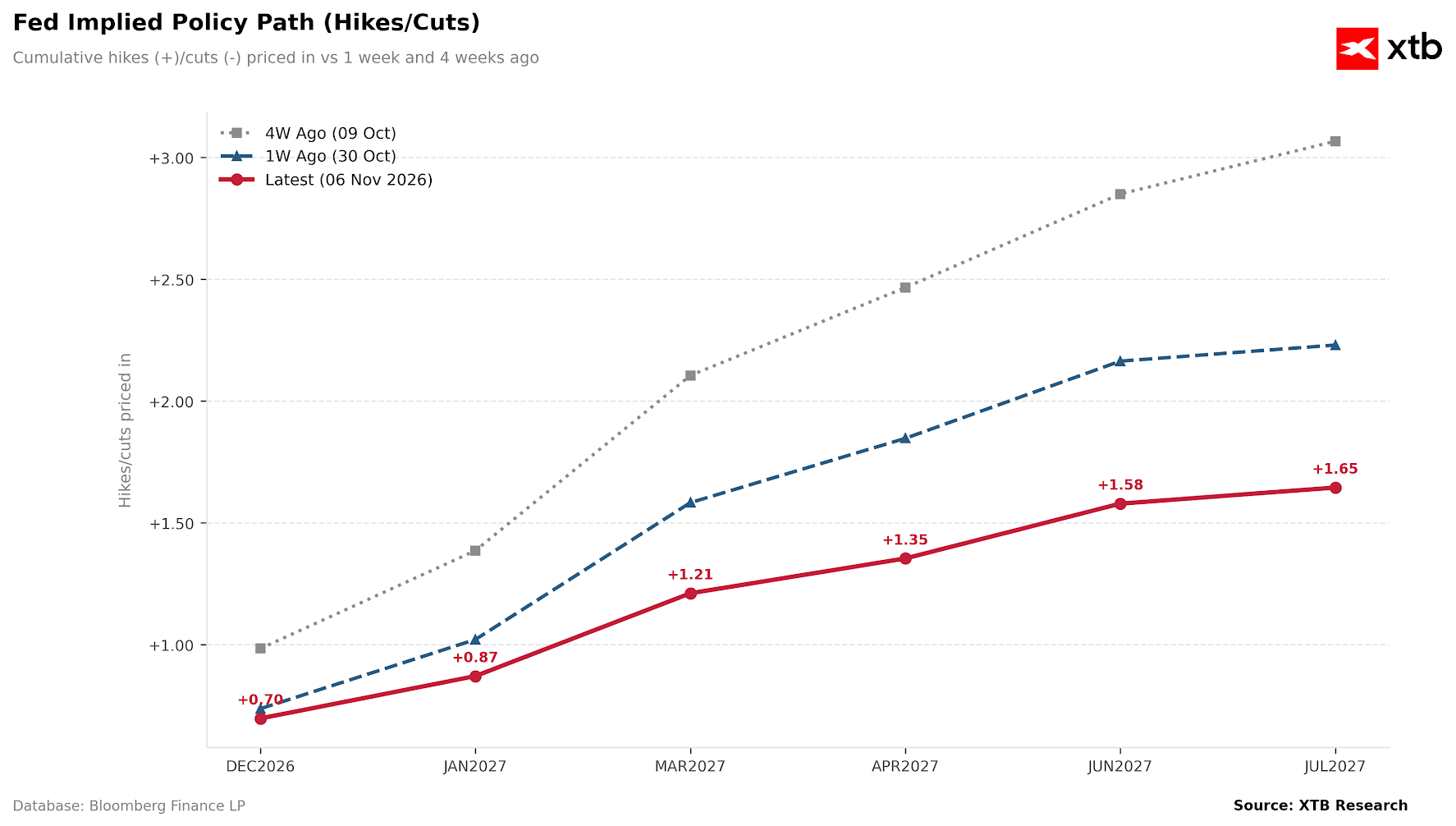
The market has clearly pulled back from slightly higher Fed rate hike expectations. For December, it is pricing in around 0.7 of a hike, or roughly a 70% chance of a 25 bps move, compared to almost a full hike priced in a month ago. Through July 2027, it prices in a total of approx. 1.65 hikes, whereas on 9 October it was over 3. On the hawkish side remains John Williams of the New York Fed, who stresses that inflation is still too high.
Scenarios:
- Strong reading (above 100k, unemployment at 4.1% or lower): In this case, the market would return to pricing in a full hike in December, which could lead to a pullback in TNOTE (rising yields), which in turn could trigger another, even small, wave of dollar strengthening.
- Reading around consensus (60–80k): neutral for market pricing. The market will focus on wages and revisions.
- Weak reading (below 30k or unemployment rising to 4.3%): would argue for a pause in December. Given current sentiment, however, it does not necessarily have to weaken the dollar, as weak data could heighten growth concerns and sustain demand for cash.
EURUSD: dollar gains despite falling yields
An unusual setup is visible in the currency market. US bond yields are falling sharply, and 10-year Treasury note futures (TNOTE) have been rising dynamically since September. Under normal conditions, lower yields would weaken the dollar, but demand for liquidity is currently dominating. Stock market sell-offs and inflows into money market funds mean investors currently prefer to hold cash in dollars. In addition, the euro is weighed down by weak European data: retail sales in the euro area fell by 0.7% m/m in September, a clearly negative surprise.
From a technical standpoint, EURUSD has been moving in a downward channel since February 2026. The latest rebound attempt stalled at the 1.1250 resistance, and the pair pulled back towards 1.1176, below the 25-period simple moving average (1.1191). The rate is now testing the lower boundary of the channel. The key immediate support is the 50% retracement of the last major upward wave near 1.1128. A break below this level would open the way towards the 1.0980–1.1080 zone, a broad support area around 1.10. On the upside, resistance at 1.1250 remains key. Only a move back above this level, followed by the 50-period SMA (approx. 1.1293), would challenge the downtrend.
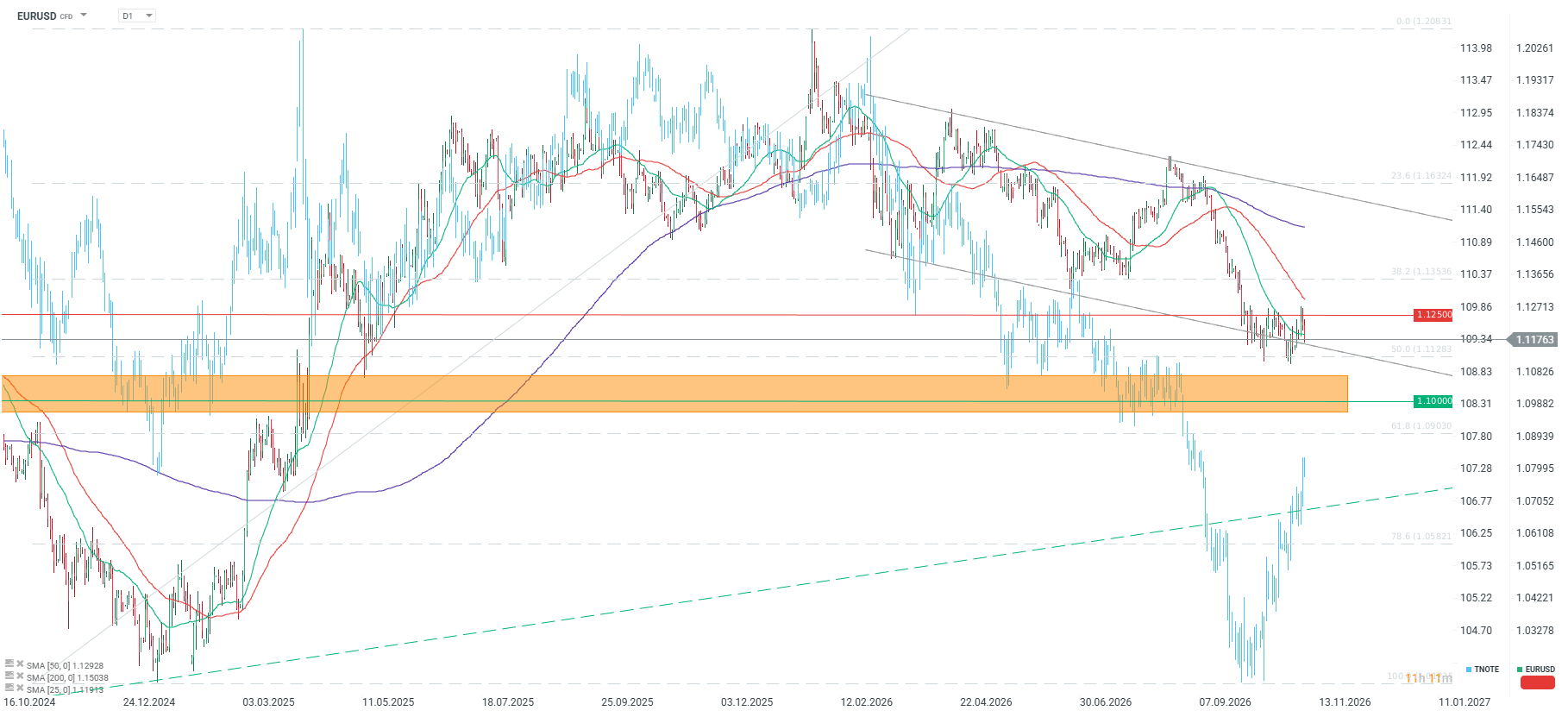
A strong NFP report that revives pricing for a December rate hike could quickly push the pair down towards 1.1130. Conversely, a weak reading combined with a stabilization in stock markets would give the euro a chance to return towards 1.1250.



Norges Bank keeps rates unchanged, but leaves the door open to rate hikes. Is this really the end of the NOK strengthening, though?


Daily Summary: Blue Wave in Congress Triggers Market Euphoria, Oil Plunges

🛢️Oil suffers sharpest fall since April (-9%)

BREAKING: US oil inventories fall less than expected, but prices drop due to elections and hopes for a US-Iran deal
The content of this report has been created by XTB S.A., with its registered office in Warsaw, at Prosta 67, 00-838 Warsaw, Poland, (KRS number 0000217580) and supervised by Polish Supervision Authority ( No. DDM-M-4021-57-1/2005). This material is a marketing communication within the meaning of Art. 24 (3) of Directive 2014/65/EU of the European Parliament and of the Council of 15 May 2014 on markets in financial instruments and amending Directive 2002/92/EC and Directive 2011/61/EU (MiFID II). Marketing communication is not an investment recommendation or information recommending or suggesting an investment strategy within the meaning of Regulation (EU) No 596/2014 of the European Parliament and of the Council of 16 April 2014 on market abuse (market abuse regulation) and repealing Directive 2003/6/EC of the European Parliament and of the Council and Commission Directives 2003/124/EC, 2003/125/EC and 2004/72/EC and Commission Delegated Regulation (EU) 2016/958 of 9 March 2016 supplementing Regulation (EU) No 596/2014 of the European Parliament and of the Council with regard to regulatory technical standards for the technical arrangements for objective presentation of investment recommendations or other information recommending or suggesting an investment strategy and for disclosure of particular interests or indications of conflicts of interest or any other advice, including in the area of investment advisory, within the meaning of the Trading in Financial Instruments Act of 29 July 2005 (i.e. Journal of Laws 2019, item 875, as amended). The marketing communication is prepared with the highest diligence, objectivity, presents the facts known to the author on the date of preparation and is devoid of any evaluation elements. The marketing communication is prepared without considering the client’s needs, his individual financial situation and does not present any investment strategy in any way. The marketing communication does not constitute an offer of sale, offering, subscription, invitation to purchase, advertisement or promotion of any financial instruments. XTB S.A. is not liable for any client’s actions or omissions, in particular for the acquisition or disposal of financial instruments, undertaken on the basis of the information contained in this marketing communication. In the event that the marketing communication contains any information about any results regarding the financial instruments indicated therein, these do not constitute any guarantee or forecast regarding the future results.