



Gold prices have staged a strong rebound, climbing to their highest level since early July as a weaker U.S. dollar and declining Treasury yields boosted demand for the precious metal. Investors are increasingly focused on the Federal Reserve's policy outlook while also monitoring geopolitical developments in the Middle East, which continue to shape inflation expectations and overall market risk sentiment. At this stage, gold is being driven primarily by changes in real interest rates and expectations for Fed policy, with geopolitical headlines playing a secondary role. Following the latest Fed meeting, markets scaled back some of their expectations for additional rate hikes this year, while signs of gradual diplomatic de-escalation between the United States and Iran have provided further short-term support for bullion.
Weaker dollar and lower bond yields once again support gold
The primary catalyst behind the latest rally has been the combination of a softer U.S. dollar and lower yields on 10-year U.S. Treasury bonds. Historically, this environment has been highly supportive for gold, as falling yields reduce the opportunity cost of holding a non-interest-bearing asset while a weaker dollar makes gold more attractive for investors using other currencies.
Additional support came from growing optimism over improving diplomatic relations between the United States and Iran. Expectations that geopolitical tensions may ease have reduced concerns about renewed inflationary pressures stemming from energy markets. As a result, Treasury yields have declined, creating a more favorable backdrop for higher gold prices.
From a macroeconomic perspective, investors are no longer focused solely on geopolitical developments themselves, but rather on how they influence inflation, monetary policy expectations and the valuation of U.S. government debt. These three factors have remained the dominant drivers of gold prices for months and continue to dictate the direction of the market.
U.S. labor market data and the Fed remain the key catalysts
The next major test for gold will come from U.S. labor market releases, particularly the ADP employment report and, more importantly, Friday's Non-Farm Payrolls (NFP) data. Any signs that the labor market is cooling could further reduce expectations for additional Fed tightening, typically supporting gold through another decline in Treasury yields.
At the same time, many economists continue to believe that the Federal Reserve may still need to maintain a restrictive monetary policy in order to return inflation to its 2% target. Under such a scenario, real interest rates could move higher again, limiting the upside potential for gold and potentially triggering a correction below the key psychological levels currently watched by investors.
Other precious metals are also showing renewed strength. Silver continues its strong upward momentum, while platinum and palladium have climbed to their highest levels since June, suggesting that improving sentiment extends well beyond gold alone. Investors appear to be rebuilding exposure to tangible assets as part of portfolio diversification amid persistent monetary and geopolitical uncertainty.
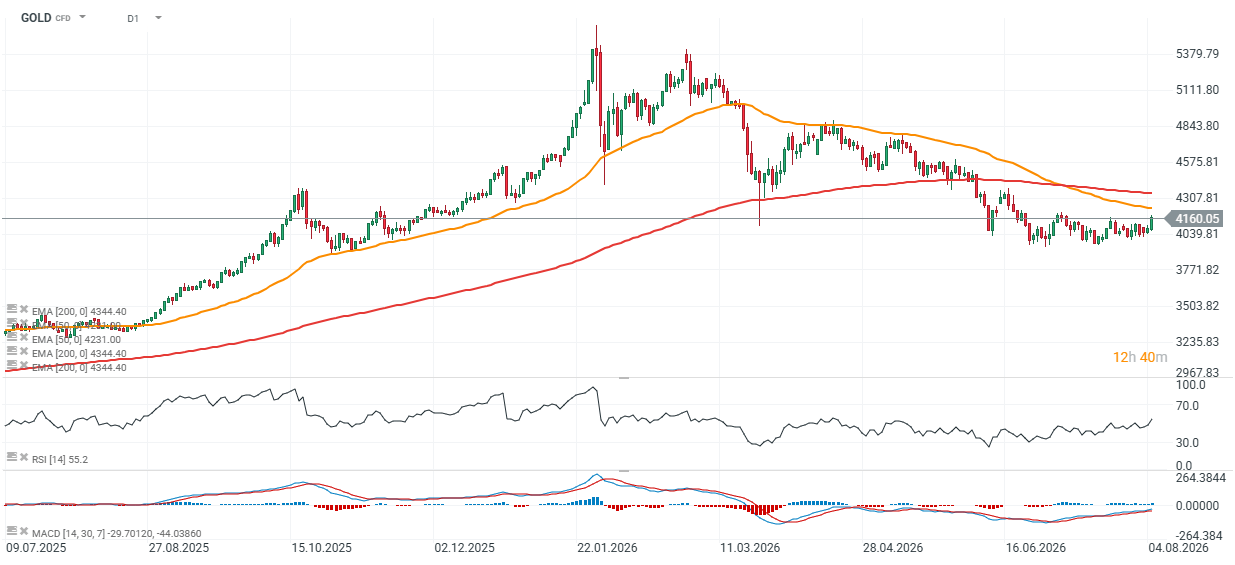
GOLD chart (D1 timeframe)
Gold is approaching a test of its 50-day exponential moving average (EMA50, orange line) near $4,230 per ounce. A sustained move above this level would signal an improvement in short-term momentum and mark the first breakout above the EMA50 since March. During the spring, this moving average repeatedly acted as a ceiling for previous recovery attempts, making it an important technical resistance level. On the downside, the $4,000–4,050 per ounce area remains the key support zone, where buyers have consistently re-entered the market in recent months.
Source: xStation5



Three Markets to Watch Next Week (09.10.2026)



Daily Summary: A Shallow Rebound Ahead of Earnings Season


Strong rise in natural gas prices 📈🚨



US OPEN: Trump de-escalates, OpenAI supports Wall Street sentiment
The content of this report has been created by XTB S.A., with its registered office in Warsaw, at Prosta 67, 00-838 Warsaw, Poland, (KRS number 0000217580) and supervised by Polish Supervision Authority ( No. DDM-M-4021-57-1/2005). This material is a marketing communication within the meaning of Art. 24 (3) of Directive 2014/65/EU of the European Parliament and of the Council of 15 May 2014 on markets in financial instruments and amending Directive 2002/92/EC and Directive 2011/61/EU (MiFID II). Marketing communication is not an investment recommendation or information recommending or suggesting an investment strategy within the meaning of Regulation (EU) No 596/2014 of the European Parliament and of the Council of 16 April 2014 on market abuse (market abuse regulation) and repealing Directive 2003/6/EC of the European Parliament and of the Council and Commission Directives 2003/124/EC, 2003/125/EC and 2004/72/EC and Commission Delegated Regulation (EU) 2016/958 of 9 March 2016 supplementing Regulation (EU) No 596/2014 of the European Parliament and of the Council with regard to regulatory technical standards for the technical arrangements for objective presentation of investment recommendations or other information recommending or suggesting an investment strategy and for disclosure of particular interests or indications of conflicts of interest or any other advice, including in the area of investment advisory, within the meaning of the Trading in Financial Instruments Act of 29 July 2005 (i.e. Journal of Laws 2019, item 875, as amended). The marketing communication is prepared with the highest diligence, objectivity, presents the facts known to the author on the date of preparation and is devoid of any evaluation elements. The marketing communication is prepared without considering the client’s needs, his individual financial situation and does not present any investment strategy in any way. The marketing communication does not constitute an offer of sale, offering, subscription, invitation to purchase, advertisement or promotion of any financial instruments. XTB S.A. is not liable for any client’s actions or omissions, in particular for the acquisition or disposal of financial instruments, undertaken on the basis of the information contained in this marketing communication. In the event that the marketing communication contains any information about any results regarding the financial instruments indicated therein, these do not constitute any guarantee or forecast regarding the future results.