


We are facing one of the most intriguing and uncertain Federal Reserve meetings. Markets are pricing in a roughly 36% chance of an interest rate hike at today's meeting, however, the situation within the Committee and the macroeconomic and political backdrop mean that today's decision and the accompanying press conference could trigger significant moves in financial markets. Of course, in line with market consensus, the Fed will keep interest rates unchanged, but the tone of the conference itself could significantly impact the dollar, yields, and consequently, gold and US indices. What can we expect from today's event?
Key points to consider
- The pricing of today's move in terms of size is low, as it stands at just over 1/3, but at the same time it remains relatively high, which is linked to a lack of proper communication from American bankers, primarily Kevin Warsh.
- Kevin Warsh avoids declarations, limits communication, and is waiting for autumn data revisions and reports from his working groups, which we will likely see only at the end of this year, when the market is 100% certain of a hike (or even nearly 2).
- The monetary policy transmission mechanism and the political calendar (midterms) suggest that a hike may take place at a later time.
- The biggest "black swan" remains the return of commodity inflation. Oil was trading for a moment at 100 USD per barrel, and fuel prices in the US were above 4 USD per gallon. Despite the recent drop in inflation to 3.5%, price pressure may return to the US economy.
Market pricing vs. analyst consensus
Analyzing the expected interest rate curve, based on futures contracts, one can see a clear rise in hawkish expectations over the last month. While four weeks ago the market assigned negligible probability to any move in July, currently, mainly due to the rise in oil prices, the probability of a hike has risen to 36%. The long-term path looks even more interesting. For September 2026, markets are fully pricing in at least one hike (+1.05), for December they are approaching two (+1.74), and in April 2027 they are pricing in more than two full hikes (+2.18). This testifies to the market's growing fears of an outbreak of a "second wave" of inflation.
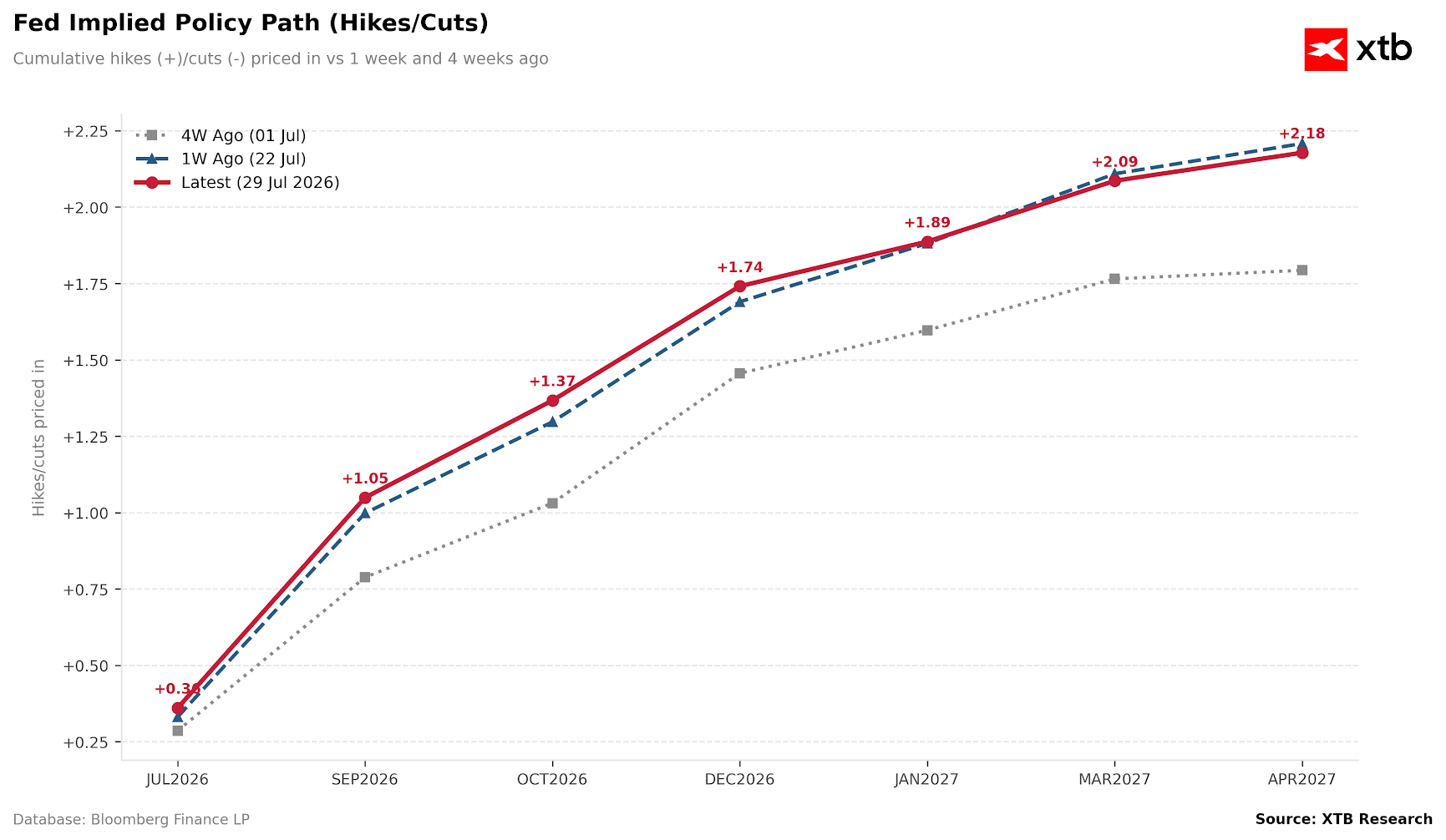 Expected curve for upcoming Fed meetings. Source: Bloomberg Finance LP, XTB
From an economic consensus perspective, the Fed should decide to maintain the status quo. On the other hand, with over 100 votes in the Bloomberg consensus, two indicate an interest rate hike. Within the FOMC itself, we might encounter two strong hawkish votes, mainly from members who are not permanent voters on the Committee (e.g., Beth Hammack (Cleveland) and Lorie Logan (Dallas)). Although the dot-chart presented by the Fed indicated the possibility of a hike this year, at the same time half of the FOMC members see rates remaining unchanged or even cuts. On the other hand, Warsh himself indicates that the dot-chart tool is a bad idea for presenting monetary policy actions.
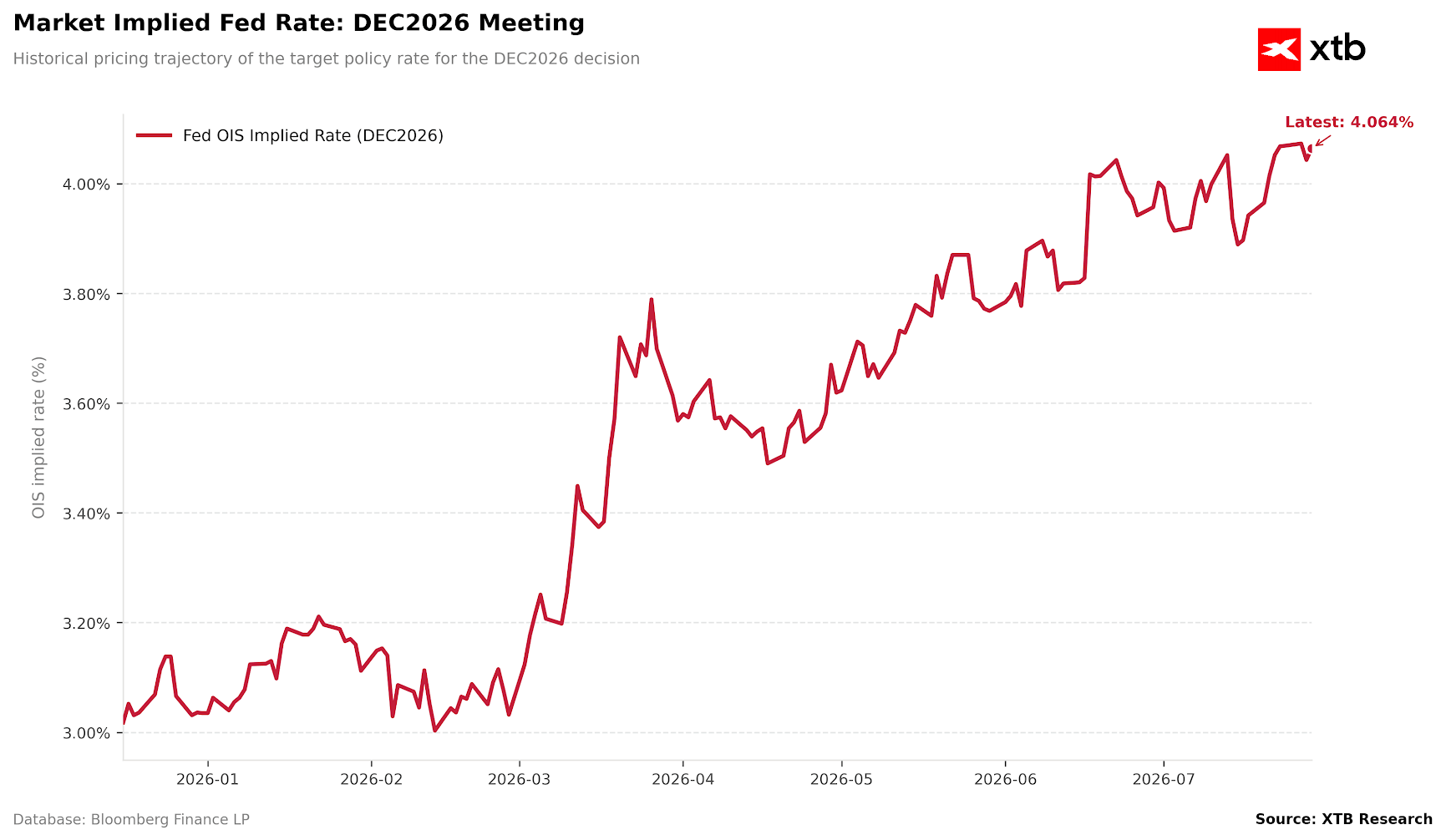 Pricing for the Fed rate at the end of this year. Source: Bloomberg Finance LP, XTB
2. The Warsh Riddle: hawkish rhetoric, dovish actions
The biggest unknown of today's meeting is the attitude of the new Fed Chair, Kevin Warsh. Since taking office, Warsh has significantly reduced communication with the market, assuming that press conferences only make sense when the central bank has significant decisions or systemic changes to convey. Warsh himself claims that he talks a lot about the need for a "real fight against inflation," however, in practice, his actions are very restrained. This raises concerns among some investors that the Fed is simply "doing nothing."
Warsh has adopted a methodical, almost corporate approach. He has appointed five special working groups to investigate the nature of current inflation dynamics, whose final reports are expected only at the end of the year. Additionally, the new Fed chief is clearly waiting for the great annual revision of core PCE inflation data, scheduled for September. Speaking before Congress, he argued that, for example, demand impulses resulting from the artificial intelligence (AI) boom drive price growth in the initial phase, but in the medium and long term, productivity growth generated by AI is expected to be disinflationary.
One should also consider the very fact of today's press conference. Although some see this as a sign of an unexpected hike (as a final show of strength and establishing credibility in the fight against inflation), it is much more likely that Warsh will present a new framework for institutional Fed communication, revise the format of market uncertainty communications, or share preliminary guidelines from the working groups. It is worth remembering that this will be Warsh's second conference, and if he has nothing to convey, it might be significantly shorter than the last time.
3. Political Stalemate: Midterm elections and monetary policy transmission.
It is difficult to write about Federal Reserve decisions in an election year, ignoring the political context. Regardless of the officially declared apolitical nature of the Fed, before the upcoming US Congressional elections in November (midterm elections), the central bank is extremely cautious about generating shocks to the economy. Fed research clearly indicates that the real economy needs up to half a year to feel the full effect of higher interest rates, and their change is felt in the short term mainly through financial markets and loans. Consequently, the impact on inflation itself is heavily delayed.
What does this mean in practice for the July meeting? A potential hike today would start to really choke the economy and hit the labor market exactly at the turn of October and November – that is, at the hottest moment of the election campaign. At the same time, by that moment, inflation would likely not have drastically decreased as a result of this move. Risking a "hard landing" right before the ballot box is a scenario that no Fed chair, even the most hawkish, wants on their record without absolute necessity.
4. Oil is still dealing the cards
Ignoring all the aspects being considered, ultimately almost everything will depend on crude oil, which remains the main engine of inflation. The recent very strong rise in crude oil prices to levels around 100 USD per barrel and fuel prices reaching 4 USD per gallon at US gas stations is an alarm signal for central bankers.
Fuel in the US, priced above 4 USD, acts as a consumption tax imposed on citizens, while simultaneously immediately translating into logistics and production costs in almost every sector of the economy. A supply shock of this type can destroy within a few weeks the downward inflation trend, including core inflation, that has been painstakingly built over recent quarters.
Although Kevin Warsh repeats that monetary policy should not react to one-off supply spikes, history shows that the long-term stay of oil around one hundred dollars immediately spills over into core inflation measures. If the oil shock lasts until autumn, the arguments about waiting for "final working group reports" will cease to be credible to the market. If the markets are right (looking at the pricing of more than 2 hikes by April 2027), then the July suspension of action will be just the calm before the storm, and aggressive tightening will begin from September or November. On the other hand, if the situation in the Middle East is quickly brought under control, and gas and grain prices fall due to El Nino, there is a chance that inflation will be transitory (although Powell indicated something similar during the initial phase of inflation growth after 2021).
5. Conclusions
All signs point to the fact that today the Fed will leave rates unchanged, accepting the fact that the short-term benefits for the credibility of the "hawkish" Warsh are smaller than the risk of unnecessarily freezing a still unstable labor market (and the risk of hitting the election period). Investors' eyes will be turned to the tone of today's conference. If Warsh continues to evolve towards a "sage who studies the market" instead of an activist, and oil stays above 90-100 USD, strong concerns about a central bank policy error may appear in the market, which in the long run will weigh on the rise in bond yields and the strengthening of the dollar.
6. How gold might react
Gold is clearly losing before today's decision, although the EURUSD pair remains stable below the 1.14 level. The main motive for the drop in gold prices today is the rebound in crude oil prices following the escalation of the situation in the Middle East. Gold remains at the point of key support, which without a clear change of words from Warsh should be maintained. It is hard to expect a dovish tone from Warsh, who has not yet done anything to get rid of inflation. If, however, he communicates that the Fed is ready to raise rates or at least limit the balance sheet, then a situation might arise where gold falls below 4000 USD. If the market starts to price in more than two hikes by the middle of next year, gold could fall even to the 3700-3800 range.
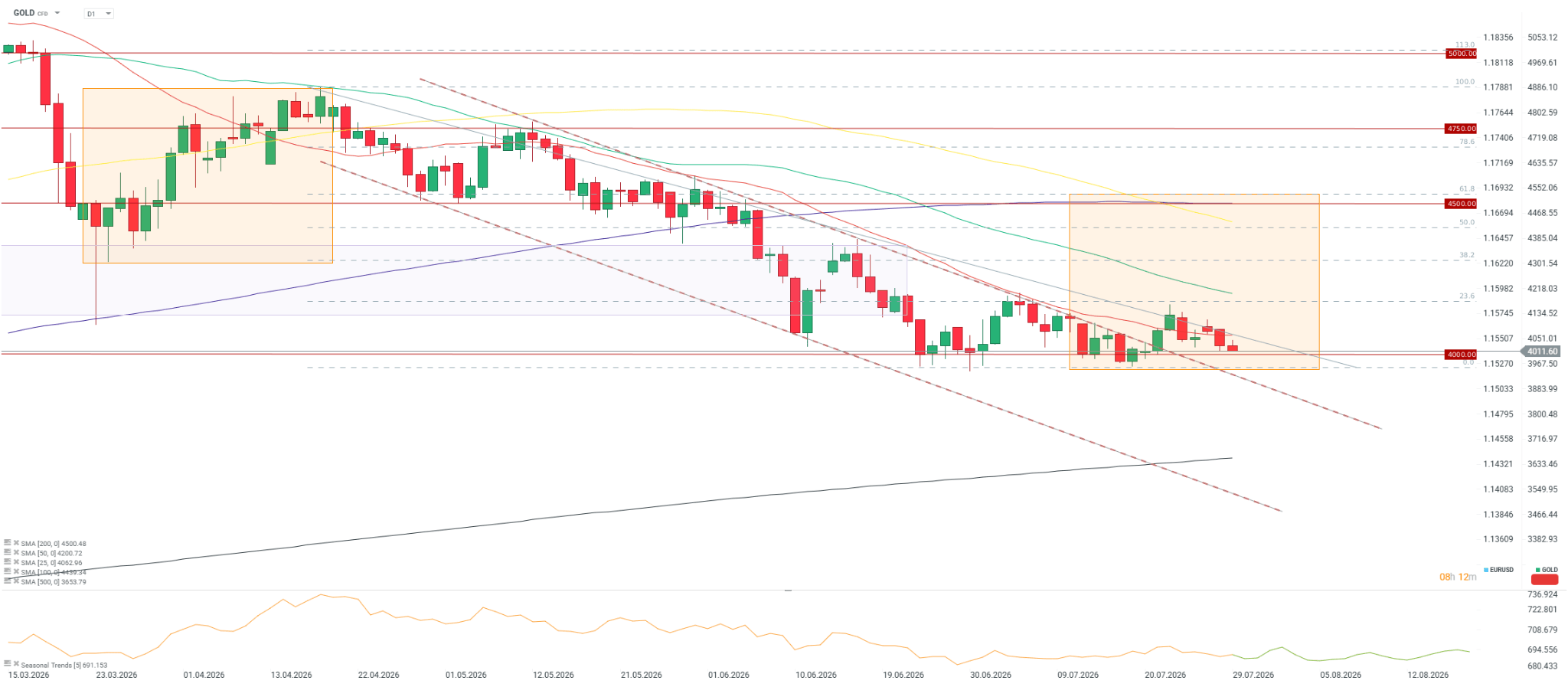 Gold remains above 4000 USD, but at the same time below the 25-session average. Source: xStation5
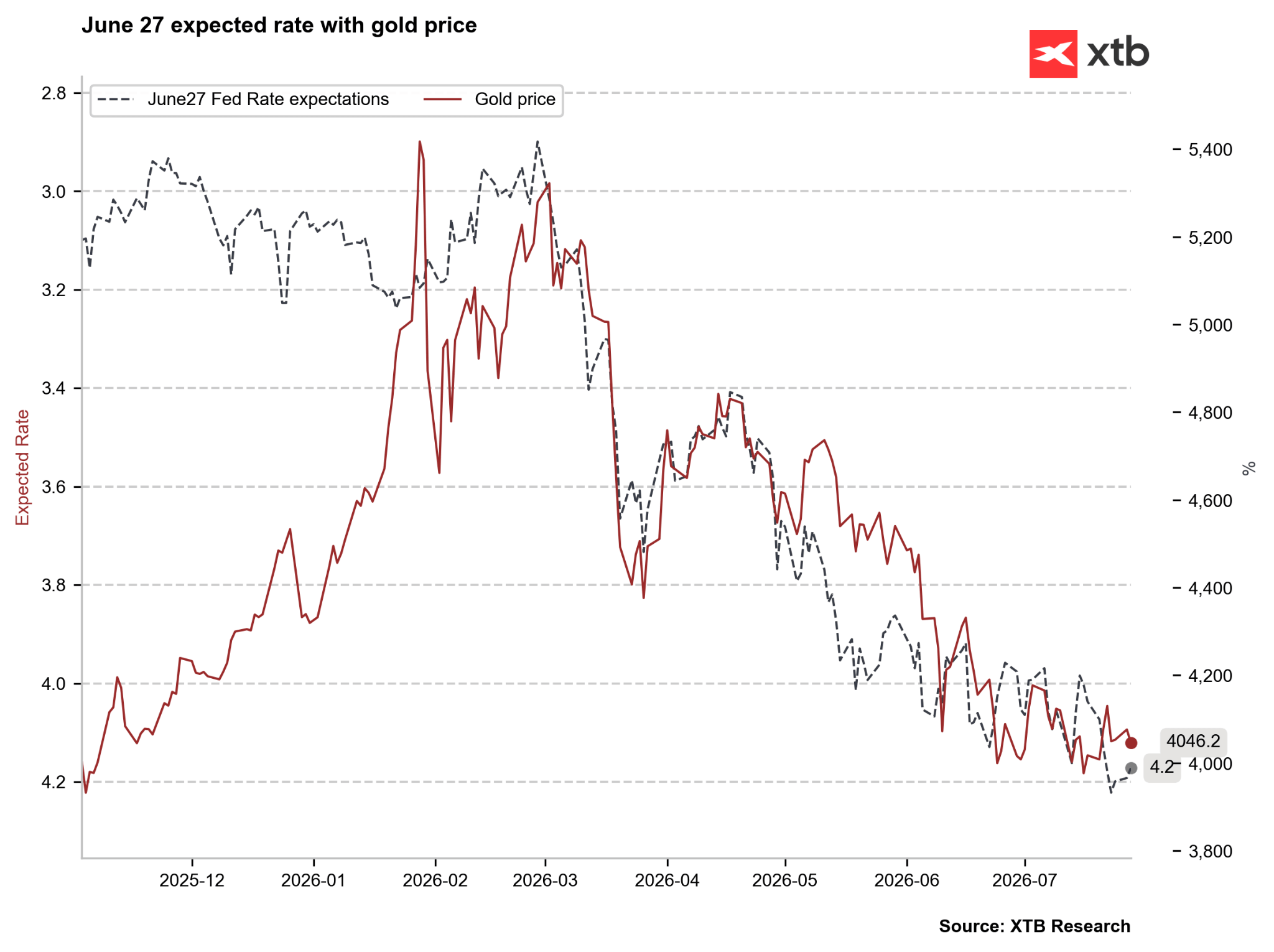 Gold is currently well-valued relative to the expected interest rate, which is why potential changes in expectations could have huge significance for the perspectives of gold in the short term. Source: Bloomberg Finance LP, XTB


BREAKING: France slows down, Germany holds on. Euro falls below 1.12



Daily Summary: Valuations Under Pressure, Capital Moves Away From Technology

Market Wrap: "Decent" results are not enough – tech stocks fall further; oil highest since May (22.10.2026)


Daily Summary: SpaceX and the tech sector drive Wall Street, oil retreats sharply below $97
The content of this report has been created by XTB S.A., with its registered office in Warsaw, at Prosta 67, 00-838 Warsaw, Poland, (KRS number 0000217580) and supervised by Polish Supervision Authority ( No. DDM-M-4021-57-1/2005). This material is a marketing communication within the meaning of Art. 24 (3) of Directive 2014/65/EU of the European Parliament and of the Council of 15 May 2014 on markets in financial instruments and amending Directive 2002/92/EC and Directive 2011/61/EU (MiFID II). Marketing communication is not an investment recommendation or information recommending or suggesting an investment strategy within the meaning of Regulation (EU) No 596/2014 of the European Parliament and of the Council of 16 April 2014 on market abuse (market abuse regulation) and repealing Directive 2003/6/EC of the European Parliament and of the Council and Commission Directives 2003/124/EC, 2003/125/EC and 2004/72/EC and Commission Delegated Regulation (EU) 2016/958 of 9 March 2016 supplementing Regulation (EU) No 596/2014 of the European Parliament and of the Council with regard to regulatory technical standards for the technical arrangements for objective presentation of investment recommendations or other information recommending or suggesting an investment strategy and for disclosure of particular interests or indications of conflicts of interest or any other advice, including in the area of investment advisory, within the meaning of the Trading in Financial Instruments Act of 29 July 2005 (i.e. Journal of Laws 2019, item 875, as amended). The marketing communication is prepared with the highest diligence, objectivity, presents the facts known to the author on the date of preparation and is devoid of any evaluation elements. The marketing communication is prepared without considering the client’s needs, his individual financial situation and does not present any investment strategy in any way. The marketing communication does not constitute an offer of sale, offering, subscription, invitation to purchase, advertisement or promotion of any financial instruments. XTB S.A. is not liable for any client’s actions or omissions, in particular for the acquisition or disposal of financial instruments, undertaken on the basis of the information contained in this marketing communication. In the event that the marketing communication contains any information about any results regarding the financial instruments indicated therein, these do not constitute any guarantee or forecast regarding the future results.