



In times of market turbulence, it is natural for investors to seek safe assets where they can hold their capital until trends and sentiment calm down and become clear.
Recently, investors have felt a shortage of safe assets. The unstable U.S. policy shakes confidence in the dollar and American bonds. Precious metals have experienced rare volatility, and Bitcoin has lost over 30% of its value in just the last two months.
Some point to the superiority of investing in real estate during times of economic and market unrest. This view is often lacking fundamental justification, but it is not the biggest problem. Market inertia, capital requirements, and freezing significant sums are not for everyone.
However, what if there is a way to invest in real estate through the capital market that allows to reap most its benefits without having to worry about most of its risks or downsides? Such possibilities are offered by so-called REITs. However, not all REITs are equal; the key to sucess today is the market segment. Office properties suffer from poor returns and debt due to oversupply. Residential properties, contrary to popular belief, are very susceptible to economic cycles, and widespread speculative bubbles maintained by local laws expose investors to the risk of large corrections.
A segment of the real estate market that is largely free from these problems is the unassuming but extremely lucrative industrial real estate market. The days when companies owned infrastructure and buildings are over. Today, companies need to be agile and adaptable; they cannot be permanently tied to a piece of land. Hence, the increasingly well-developed market of industrial REITs.
The advantages of such instruments and this sector are:
- Significantly higher occupancy rates. Industrial REITs are much more efficient in organizing tenants.
- Smaller price fluctuations; industrial properties are more specialized and of better quality.
- Greater opportunities for rent increases; large economic entities are in a better position than consumers whose wages do not keep up with price increases.
- Less sensitivity to regulations; lack of social pressure and significant distance from densely populated areas reduce pressure on the government to regulate the industry.
- Contracts are usually signed for many years in advance, creating a stable cash flow.
Who are the market leaders, what are the prospects for such entities, and what is their business model?
One of the most promising choices in this segment is STAG Industrial.
- The company boasts an occupancy rate of over 95%.
- The customer retention rate is as high as 75%.
- The lease increase rate is over 20%.
- Unprecedented diversification; the largest client (Amazon) accounts for only 2.8% of revenues.
- Revenue growth year-over-year of 9%.
- 14 years of dividend growth, with a coverage ratio of 60%.
- Recent debt upgrade by Moody’s.
- The company pays dividends not annually or quarterly but monthly.
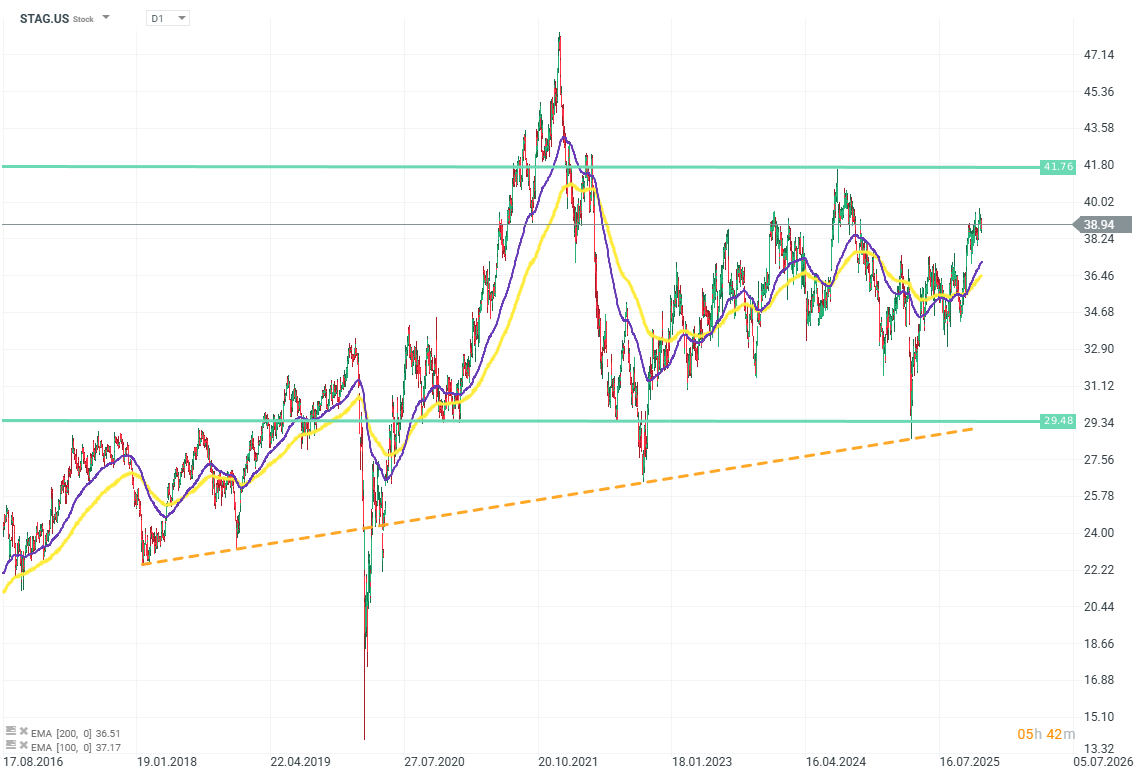
STAG Industrial (STAG.US - D1)
Source: xStation5



Three markets to watch next week (23.10.2026)



Daily Summary: Oil at five-month highs, indices under pressure (23.10.2026)

US Open: Further declines on Wall Street, Brent above 111 USD, AI correction continues (14.10.2026)

Chart of the Day: Is USDJPY running out of road? Inflation forces the BoJ to act, but the Fed could spoil the Yen’s rally
The content of this report has been created by XTB S.A., with its registered office in Warsaw, at Prosta 67, 00-838 Warsaw, Poland, (KRS number 0000217580) and supervised by Polish Supervision Authority ( No. DDM-M-4021-57-1/2005). This material is a marketing communication within the meaning of Art. 24 (3) of Directive 2014/65/EU of the European Parliament and of the Council of 15 May 2014 on markets in financial instruments and amending Directive 2002/92/EC and Directive 2011/61/EU (MiFID II). Marketing communication is not an investment recommendation or information recommending or suggesting an investment strategy within the meaning of Regulation (EU) No 596/2014 of the European Parliament and of the Council of 16 April 2014 on market abuse (market abuse regulation) and repealing Directive 2003/6/EC of the European Parliament and of the Council and Commission Directives 2003/124/EC, 2003/125/EC and 2004/72/EC and Commission Delegated Regulation (EU) 2016/958 of 9 March 2016 supplementing Regulation (EU) No 596/2014 of the European Parliament and of the Council with regard to regulatory technical standards for the technical arrangements for objective presentation of investment recommendations or other information recommending or suggesting an investment strategy and for disclosure of particular interests or indications of conflicts of interest or any other advice, including in the area of investment advisory, within the meaning of the Trading in Financial Instruments Act of 29 July 2005 (i.e. Journal of Laws 2019, item 875, as amended). The marketing communication is prepared with the highest diligence, objectivity, presents the facts known to the author on the date of preparation and is devoid of any evaluation elements. The marketing communication is prepared without considering the client’s needs, his individual financial situation and does not present any investment strategy in any way. The marketing communication does not constitute an offer of sale, offering, subscription, invitation to purchase, advertisement or promotion of any financial instruments. XTB S.A. is not liable for any client’s actions or omissions, in particular for the acquisition or disposal of financial instruments, undertaken on the basis of the information contained in this marketing communication. In the event that the marketing communication contains any information about any results regarding the financial instruments indicated therein, these do not constitute any guarantee or forecast regarding the future results.