



In recent weeks, a clear deterioration in the condition of technology companies has been visible, with the exception of semiconductor manufacturers. Returns on the latter’s stocks since March this year have been in triple digits, while all hyperscale companies have lost, from a few to several dozen percent of their market value, over the last month alone.
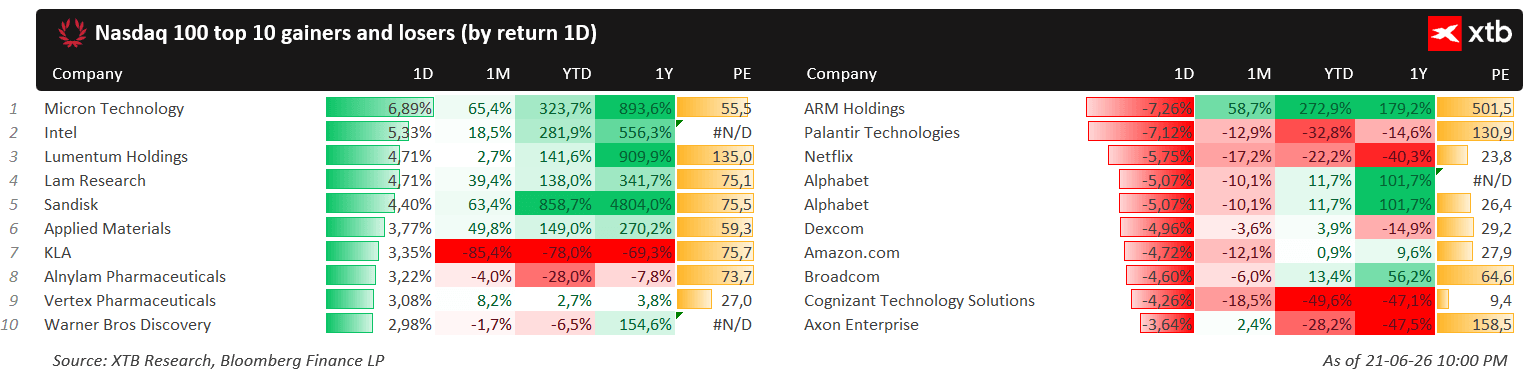
Shouldn’t the moves of these entities be linked in the context of investment in AI?
Problems with monetization
Massive AI investments by U.S. technology sector leaders require a strong justification in the form of monetization. It must be real in order to keep indices near their highs. It is precisely this wavering belief in monetization that is putting pressure on markets. How?
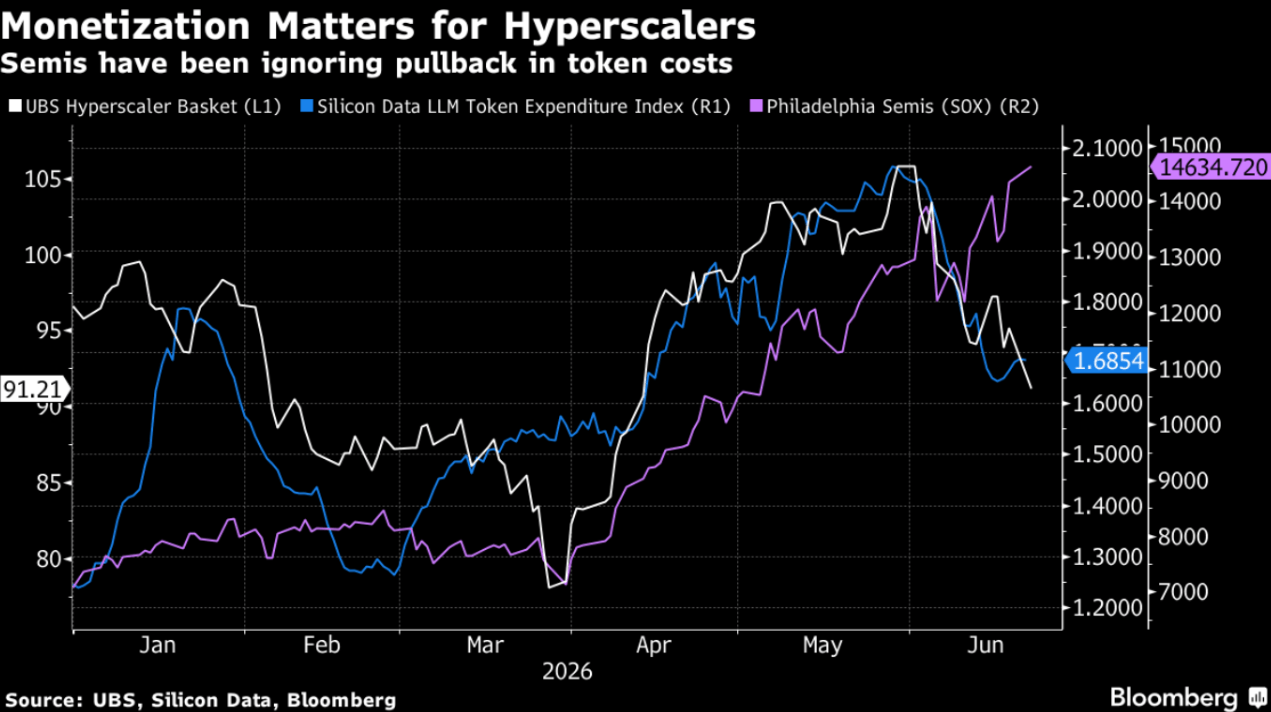
Until the next financial results are published, most of the market is forced to speculate; however, specialized data aggregators already exist today that indicate where and to what extent monetization is failing. One of them is the Silicon Data LLM Spending Index.
Source: Bloomberg Finance Lp.
As you can see, in recent months this chart has shown a very high correlation with hyperscale companies’ valuations. This index is one of the indirect gauges and leading signals regarding AI spending. Recently it has fallen sharply, dragging the technology sector down with it. At the same time, semiconductor companies are doing well, because they earn money from delivering hardware, not from AI itself.
In the AI industry, a “two-speed” segmentation can currently be observed—“low” and “high” or “frontier” intelligence. Analyzing trends in the prices and capabilities of LLM models, it can be seen that while “high-end” AI capabilities (e.g., Fable, Mythos, ChatGPT 5.5, etc.) are impressive, their prices are equally high. “Low-end” models, meanwhile, are experiencing deliberate price hyperdeflation. As a result, companies are increasingly limiting the use of “high-end” AI in favor of “low-end” AI, which is sufficient for most applications.
Precedent and forecasts
Switching to cheaper models and optimization are not new phenomena, this is visible in the chart attached earlier. Sharp rises and falls could already be observed in the first quarter of this year, which corresponded with sell-offs in hyperscale companies.
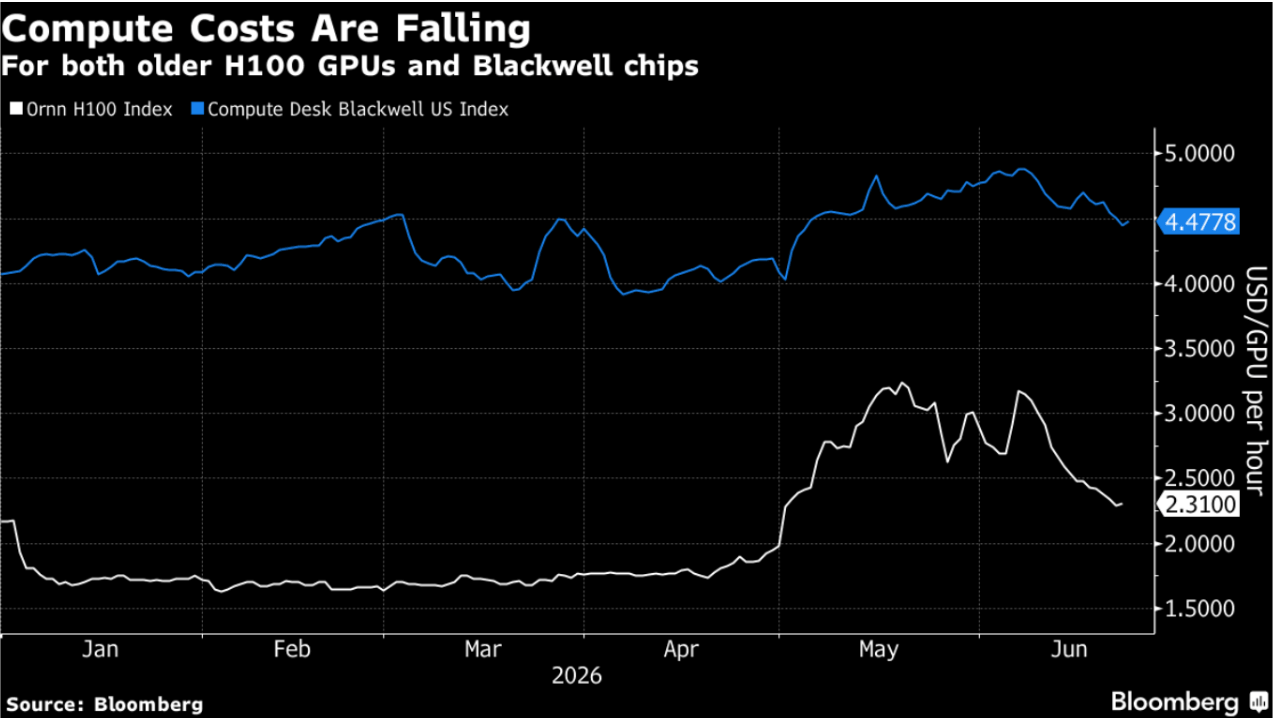
One characteristic feature of supply and demand is that, in the absence of external variables (such as logistics), as the price approaches zero, demand grows toward infinity. AI tokens are an ideal example of a good that, in practical terms, comes closest to such theoretical considerations.
Source: Bloomberg Finance Lp.
If the price drops, as the next generation of “Blackwell” processors is supposed to enable (SemiAnalysis analysts speak of cost reductions of around 99%), one can expect that business will, over time, adapt to the new realities. AI-based solutions will move higher up the value-creation chain, improve margins, and over time allow for further waves of spending on tokens. However, this process will take time—time many investors do not have. The lag of valuations relative to the AI spending index itself is also visible on the chart.
Concerns about AI monetization may persist, and room for further declines still exists. However, the current sell-off episode is more of a speed bump for the AI bull market than a wall. A real verification of the thesis supporting investments in AI will likely take place at the end of this year or at the beginning of the next. Key in this process will be the IPO prospectuses of Anthropic and OpenAI, which may reach investors within a few weeks.
MSF.US (D1)
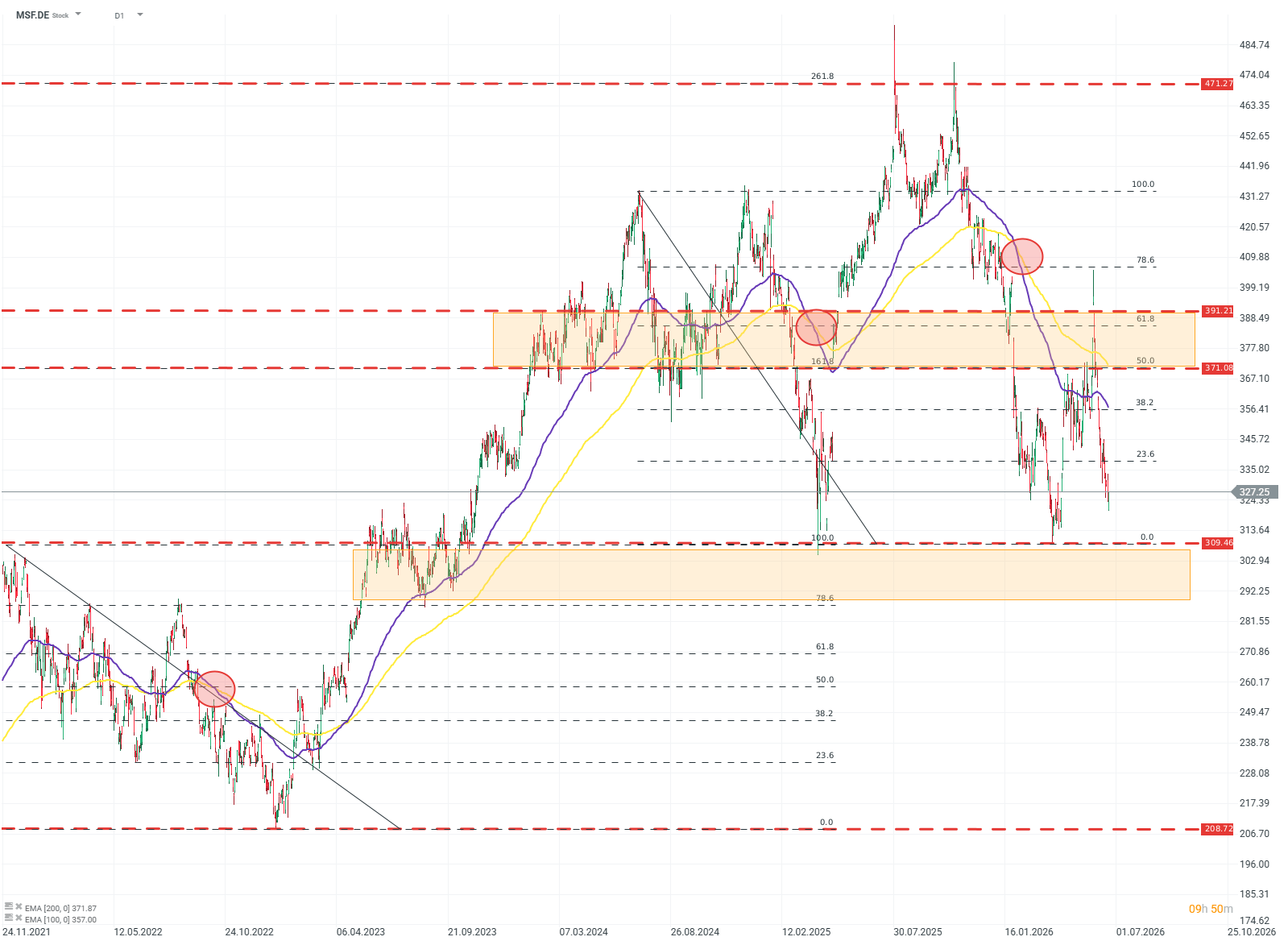
Microsoft shares are now only about 5% away from an extremely important resistance level around $300. These are levels tested during the declines at the beginning of 2025 and 2026. Looking at the history of price behavior, one can note the “death cross,” which is a strong bearish signal. In Microsoft’s case, however, it appeared near the end of the decline wave rather than signaling a deeper drop. Given the relative strength of resistance around $300, one can expect this to be the case again this time.
Source: xStation5
Kamil Szczepański
Financial Market Analyst at XTB


Marvell: Memory-market problems and opportunities


⛩️Chart of the Day: JP225, Nikkei Plays Its Own Tune (01.10.2026)



Morning Wrap: Tech Rally in Asia Following Micron Results and Weakening Yen Despite Hawkish BoJ


Record after record: Micron smashes Q4 results, server overload crashes website, stock surges post-market
The content of this report has been created by XTB S.A., with its registered office in Warsaw, at Prosta 67, 00-838 Warsaw, Poland, (KRS number 0000217580) and supervised by Polish Supervision Authority ( No. DDM-M-4021-57-1/2005). This material is a marketing communication within the meaning of Art. 24 (3) of Directive 2014/65/EU of the European Parliament and of the Council of 15 May 2014 on markets in financial instruments and amending Directive 2002/92/EC and Directive 2011/61/EU (MiFID II). Marketing communication is not an investment recommendation or information recommending or suggesting an investment strategy within the meaning of Regulation (EU) No 596/2014 of the European Parliament and of the Council of 16 April 2014 on market abuse (market abuse regulation) and repealing Directive 2003/6/EC of the European Parliament and of the Council and Commission Directives 2003/124/EC, 2003/125/EC and 2004/72/EC and Commission Delegated Regulation (EU) 2016/958 of 9 March 2016 supplementing Regulation (EU) No 596/2014 of the European Parliament and of the Council with regard to regulatory technical standards for the technical arrangements for objective presentation of investment recommendations or other information recommending or suggesting an investment strategy and for disclosure of particular interests or indications of conflicts of interest or any other advice, including in the area of investment advisory, within the meaning of the Trading in Financial Instruments Act of 29 July 2005 (i.e. Journal of Laws 2019, item 875, as amended). The marketing communication is prepared with the highest diligence, objectivity, presents the facts known to the author on the date of preparation and is devoid of any evaluation elements. The marketing communication is prepared without considering the client’s needs, his individual financial situation and does not present any investment strategy in any way. The marketing communication does not constitute an offer of sale, offering, subscription, invitation to purchase, advertisement or promotion of any financial instruments. XTB S.A. is not liable for any client’s actions or omissions, in particular for the acquisition or disposal of financial instruments, undertaken on the basis of the information contained in this marketing communication. In the event that the marketing communication contains any information about any results regarding the financial instruments indicated therein, these do not constitute any guarantee or forecast regarding the future results.