


European indices are extending their rebound after last week’s sell-off, with capital flowing primarily back into technology and companies linked to AI infrastructure. The DAX, CAC 40 and FTSE 100 are advancing after a strong session in Asia and an earlier rebound on Wall Street, although the current move still looks more like a powerful relief rally after panic selling than a full trend reversal. Sentiment is also being supported by a sharp decline in oil prices, which is easing inflationary pressure and improving the backdrop for risk assets. Investors currently appear more willing to buy equipment suppliers, semiconductor companies and infrastructure providers than the hyperscalers funding record CAPEX. The next major test for the rebound will be U.S. CPI data, which could determine whether lower yields and improving risk appetite prove sustainable. Fed’s Waller signaled that a rate hike of as much as 50 bp could be needed after the December meeting if October CPI data come in materially above expectations. For market momentum, the key event will therefore be the U.S. inflation release scheduled for 14:30 CET and the subsequent reaction in equities and bond yields.
-
Europe opened Tuesday’s session firmly higher: the FTSE 100 was up around 0.7%, the CAC 40 gained 1.2%, and the DAX advanced 1.1%. The move is part of a broader global rebound following last week’s sell-off and is being supported by renewed demand for beaten-down technology shares.
-
In Asia, the strongest gains came from markets with the highest exposure to semiconductors and AI. The Kospi rose 4.5%, the Nikkei gained 2.9%, and the Taiex advanced 2.5%, supported by strong moves in SK hynix, Samsung, Kioxia and Tokyo Electron; additionally, TSMC reported a 59.7% year-over-year increase in October revenue.
-
The technology sector has clearly regained some investor confidence, although not all segments are being treated equally. A growing share of investors appear to prefer chipmakers, optical networking companies and data-center infrastructure suppliers, while questions are increasingly being raised about the returns hyperscalers will generate on their massive investment programs.
-
Nvidia remains in focus despite reports of an investigation involving CEO Jensen Huang. The shares were up around 1% in pre-market trading, suggesting that investors are currently separating the personal and regulatory risks surrounding the investigation from Nvidia’s fundamental position within the AI supply chain.
-
Falling oil prices are providing additional support to sentiment: Brent has declined toward $90 per barrel, while WTI has fallen to around $84.7. Both benchmarks are down roughly 20% in November as investors increasingly price in the possibility of de-escalation in the U.S.-Iran conflict and a reduction in the geopolitical risk premium.
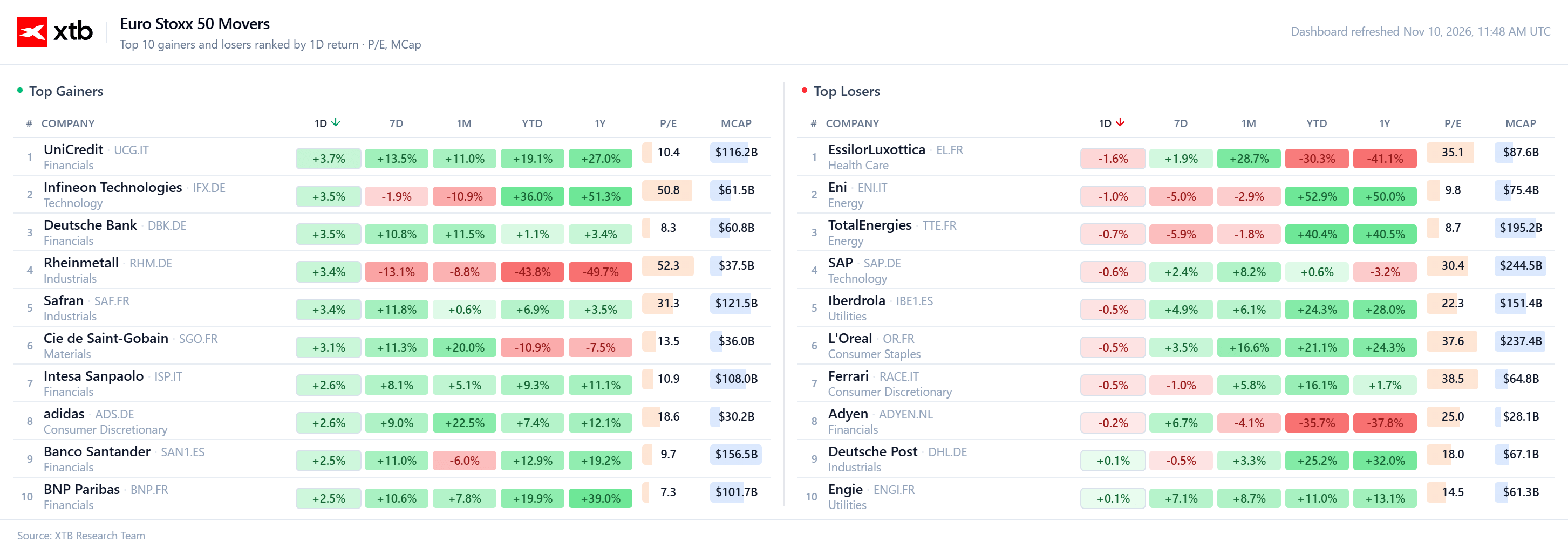
Euro Stoxx 50: session leaders and laggards
The table confirms that today’s gains have a distinctly sector-driven character: UniCredit is up 3.7%, while Infineon, Deutsche Bank, Rheinmetall and Safran are gaining around 3.4–3.5%. Particularly interesting is the divergence between short-term momentum and the longer-term trend, as Rheinmetall remains roughly 44% lower YTD and close to 50% lower year over year despite today’s rebound. On the downside, the greatest pressure is visible in EssilorLuxottica, Eni and TotalEnergies, although the latter two remain very strong over a 12-month horizon, suggesting that today’s weakness is more corrective than structural. SAP is also slightly lower, but still trades at a forward P/E of around 30, leaving limited room for disappointment when sentiment toward technology weakens. Overall, the market picture points to a rotation out of defensive and energy leaders of recent months and into banks, selected industrials and parts of the technology sector, rather than a broad capitulation in risk assets.
Source: XTB Research
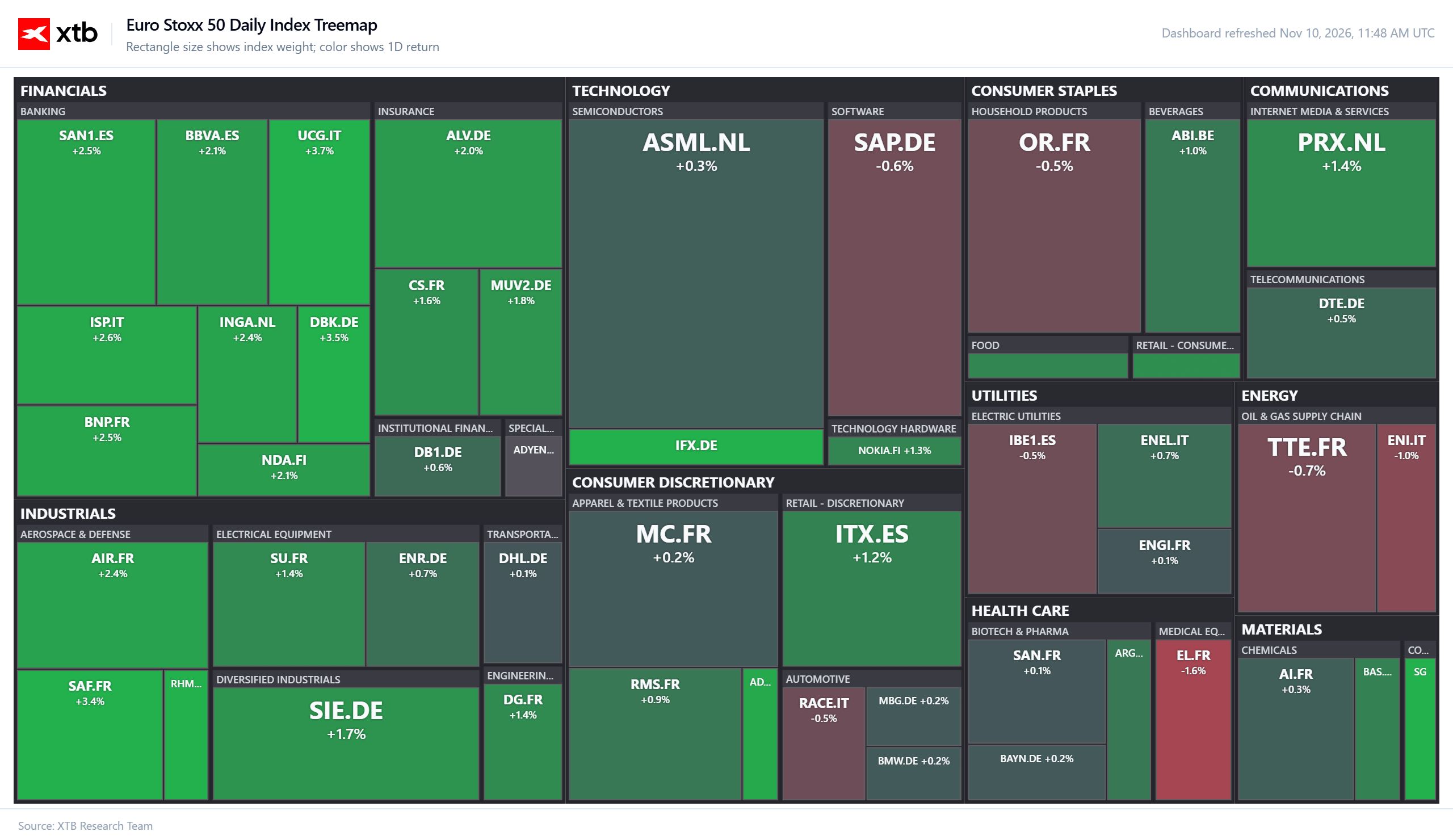
Euro Stoxx 50: market map
The European session has so far been clearly positive, with market strength concentrated primarily in financials and selected industrials. Banks are among the strongest performers, with UniCredit, Deutsche Bank, Intesa Sanpaolo, Santander and BNP Paribas all trading higher, suggesting that investors are favoring sectors sensitive to yields and the economic outlook. Industrial stocks are also performing well, particularly Rheinmetall, Safran and Airbus, while technology is more mixed: Infineon is higher, but SAP remains under pressure. Energy and parts of the defensive complex are among the weaker areas, which fits well with today’s decline in oil prices and the rotation toward more cyclical assets. Market breadth nevertheless remains relatively healthy, distinguishing the current session from a rebound driven solely by a handful of the index’s largest constituents.
 Source: XTB Research
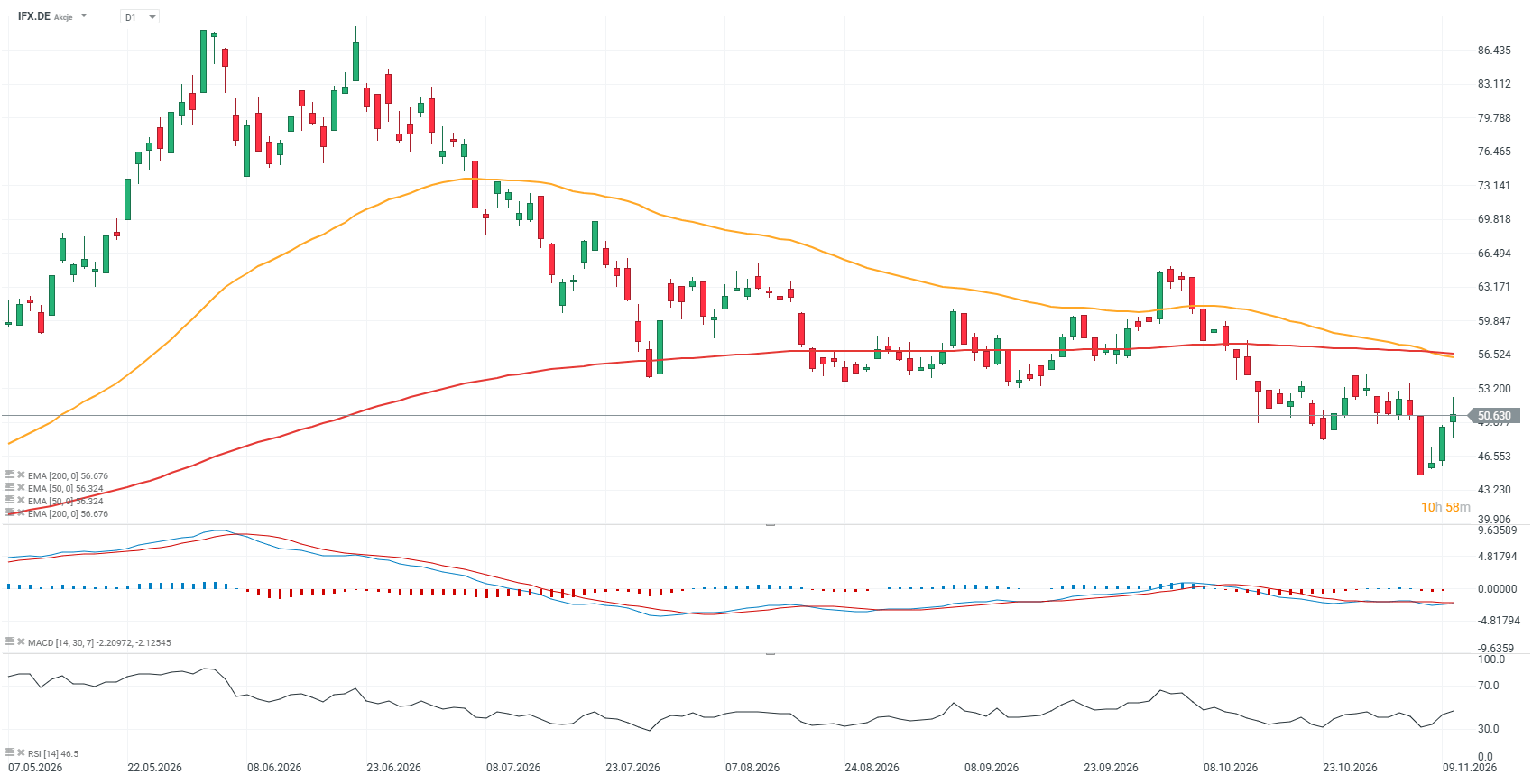
Infineon accelerates on AI demand and improving margins
Infineon closed fiscal 2026 with a clear acceleration in growth, record fourth-quarter revenue and a significantly stronger outlook for 2027. The German semiconductor manufacturer remains one of Europe’s most direct beneficiaries of rising investment in AI data centers, power infrastructure and automotive electronics, with especially strong demand for power semiconductors. Full-year revenue rose 12% to €16.35 billion, while net income from continuing operations increased significantly to €1.97 billion. Momentum was strongest toward the end of the year, with fourth-quarter revenue reaching a record €4.71 billion, up 19% year over year and 13% quarter over quarter. Profitability also improved, with adjusted gross margin rising to 45.1% and the segment result margin reaching 23.8%. The market reacted very positively, with the shares rising around 9% after the earnings release following a gain of more than 6% the previous day.
-
Fourth-quarter revenue reached a record €4.706 billion, rising 13% quarter over quarter and 19% year over year, while full-year revenue increased 12% to €16.353 billion.
-
Net income from continuing operations rose to €1.97 billion, confirming that stronger sales are increasingly translating into bottom-line growth.
-
Adjusted gross margin increased to 45.1% in Q4 from 42.8% in the previous quarter.
-
Segment result margin reached 23.8%, indicating a clear improvement in operating leverage.
-
AI power revenue reached €1.7 billion and more than doubled compared with the previous year.
-
Management expects fiscal 2027 revenue of around €20 billion, implying growth of more than 20%.
-
The dividend is set to increase by €0.03 to €0.38 per share.
-
Infineon also said it does not intend to scale back investment related to data centers, supporting the improvement in sentiment across the technology sector.
The quality of the results was stronger than the revenue growth alone would suggest. Infineon pointed to higher volumes, a more favorable product mix, better pricing and lower idle-capacity costs, all of which directly supported margins and profit growth. Inventory conditions also improved significantly, with days inventory outstanding falling to 136 days from 165 days in the previous quarter, reducing the risk of excess inventory and signaling better turnover.
Strategically, Infineon’s exposure to power management remains the most important growth driver. AI data centers require enormous amounts of power and increasingly advanced systems for power conversion and distribution, directly increasing demand for power semiconductors. At the same time, recovering automotive demand and investment in energy infrastructure mean that Infineon’s growth is not dependent on a single segment of the AI market. It is precisely this combination of stronger demand, improving margins and rising profits that makes the company’s approximately €20 billion revenue outlook for 2027 look more fundamentally grounded than a simple cyclical rebound in the semiconductor market.
 Source: xStation5
Charts EU50, DE40, GOLD (interval D1)
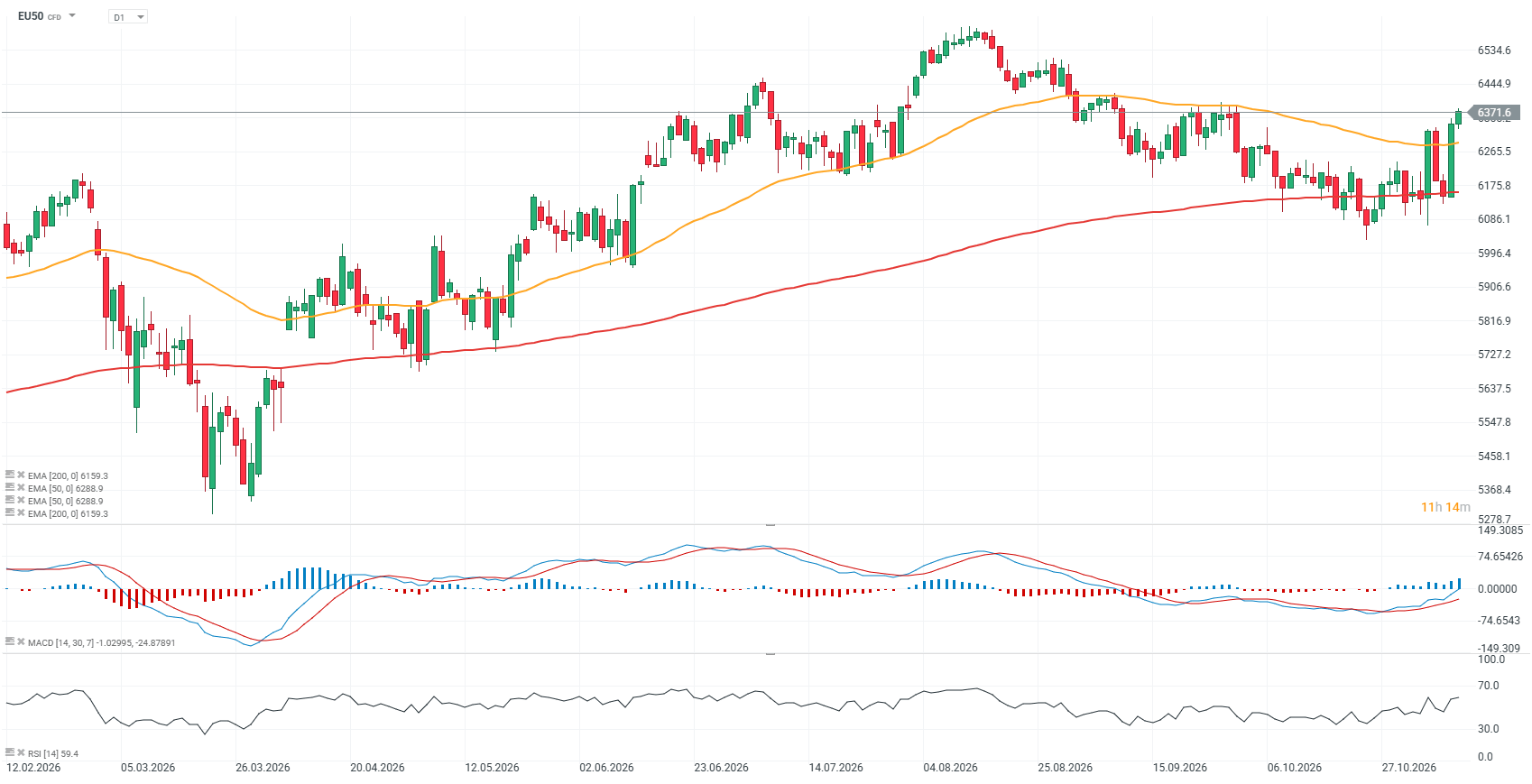
Source: xStation5
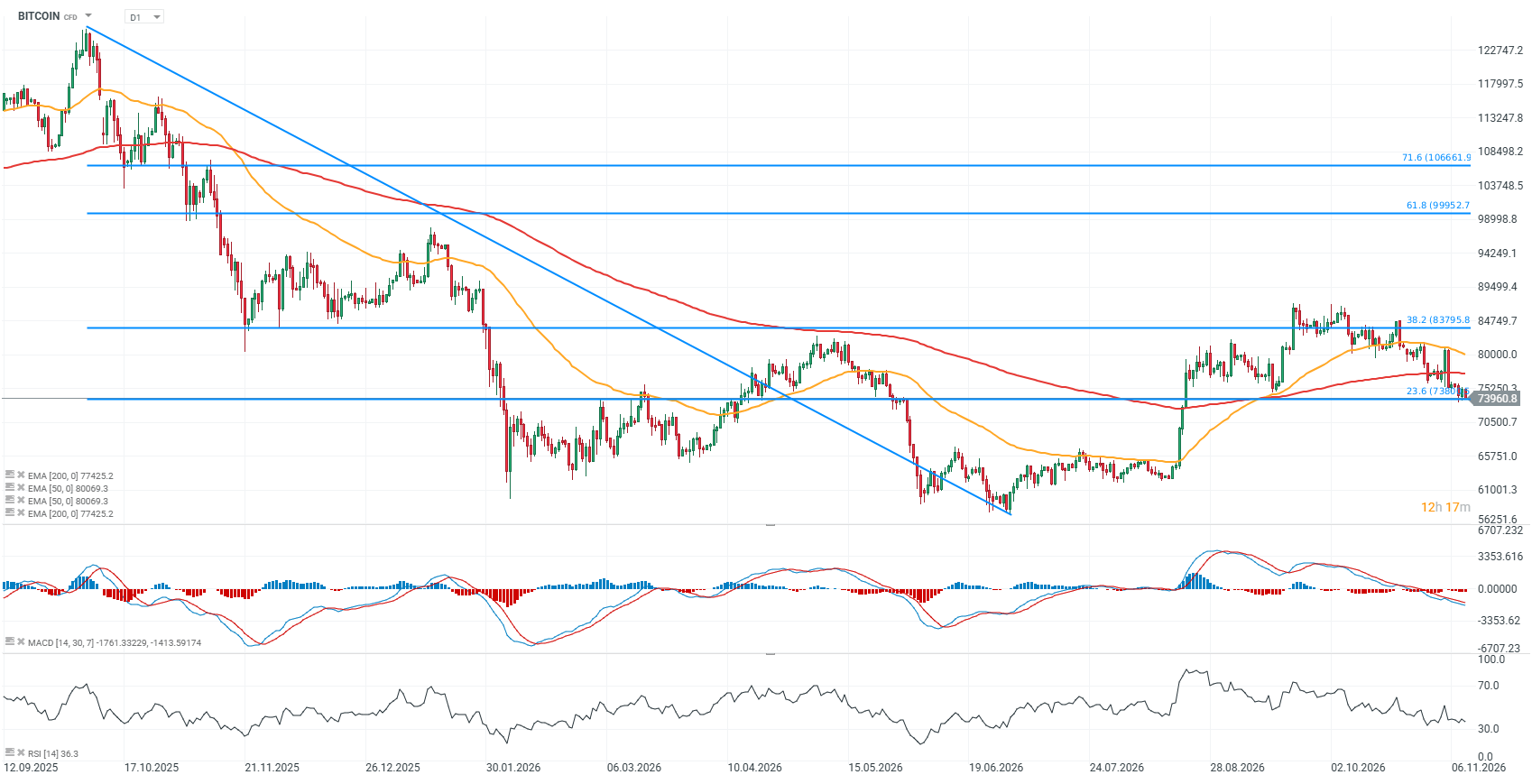
Source: xStation5
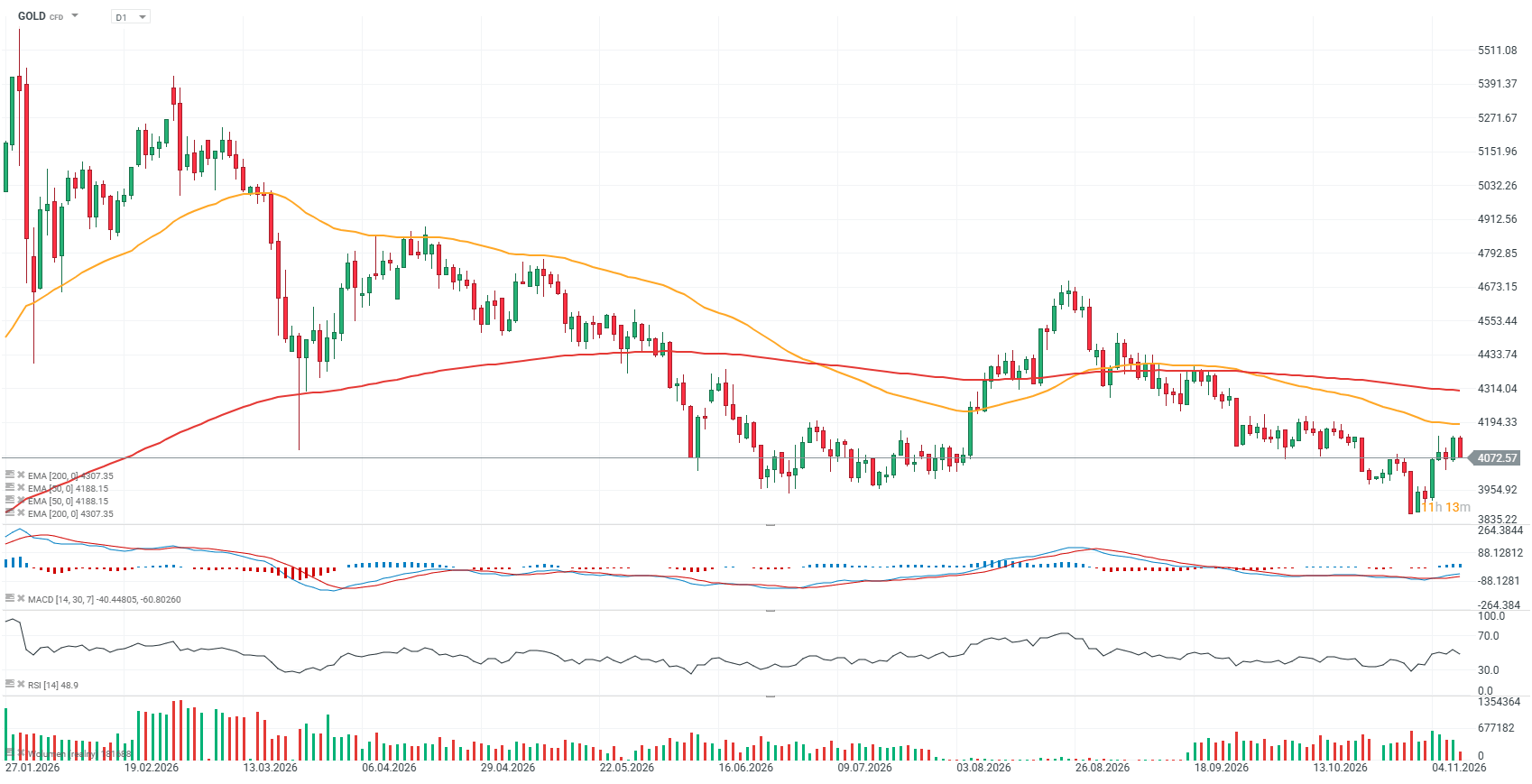
Source: xStation5


Waller’s hawkish Fed remarks drive USDIDX rebound 🗽 Is a 50 bp U.S. rate hike possible?

What’s Next for the S&P 500? 🔼 U.S. Earnings Season Recap

📊Economic Calendar - Key US CPI Report in the Shadow of Geopolitical Tensions (10.11.2026)



📈Morning Wrap: Tech Bounce and Oil Price Collapse Following Signals of De-escalation Around Iran
The content of this report has been created by XTB S.A., with its registered office in Warsaw, at Prosta 67, 00-838 Warsaw, Poland, (KRS number 0000217580) and supervised by Polish Supervision Authority ( No. DDM-M-4021-57-1/2005). This material is a marketing communication within the meaning of Art. 24 (3) of Directive 2014/65/EU of the European Parliament and of the Council of 15 May 2014 on markets in financial instruments and amending Directive 2002/92/EC and Directive 2011/61/EU (MiFID II). Marketing communication is not an investment recommendation or information recommending or suggesting an investment strategy within the meaning of Regulation (EU) No 596/2014 of the European Parliament and of the Council of 16 April 2014 on market abuse (market abuse regulation) and repealing Directive 2003/6/EC of the European Parliament and of the Council and Commission Directives 2003/124/EC, 2003/125/EC and 2004/72/EC and Commission Delegated Regulation (EU) 2016/958 of 9 March 2016 supplementing Regulation (EU) No 596/2014 of the European Parliament and of the Council with regard to regulatory technical standards for the technical arrangements for objective presentation of investment recommendations or other information recommending or suggesting an investment strategy and for disclosure of particular interests or indications of conflicts of interest or any other advice, including in the area of investment advisory, within the meaning of the Trading in Financial Instruments Act of 29 July 2005 (i.e. Journal of Laws 2019, item 875, as amended). The marketing communication is prepared with the highest diligence, objectivity, presents the facts known to the author on the date of preparation and is devoid of any evaluation elements. The marketing communication is prepared without considering the client’s needs, his individual financial situation and does not present any investment strategy in any way. The marketing communication does not constitute an offer of sale, offering, subscription, invitation to purchase, advertisement or promotion of any financial instruments. XTB S.A. is not liable for any client’s actions or omissions, in particular for the acquisition or disposal of financial instruments, undertaken on the basis of the information contained in this marketing communication. In the event that the marketing communication contains any information about any results regarding the financial instruments indicated therein, these do not constitute any guarantee or forecast regarding the future results.