


Meta is heading into its third-quarter earnings release at a time when investors are scrutinizing the financial returns of the artificial intelligence boom more closely than ever. Mark Zuckerberg has a strong case for defending his strategy. The advertising business remains a powerful revenue-generating machine, while AI helps improve ad targeting, increase user engagement, and develop new products. At the same time, investment in computing infrastructure is growing so rapidly that it is becoming increasingly difficult to distinguish the long-term opportunity from the costs already weighing on cash flow.
This time, additional attention is focused on Muse, a new AI assistant that is rapidly gaining users and offers Meta a chance to move beyond its traditional business model. Its popularity is an encouraging sign, but it should not yet be equated with financial success. Revenue from the new service, its impact on Meta's app ecosystem, and its monetization potential will likely become much clearer over the coming quarters. For now, the market will primarily be looking for signs that Muse can become more than just a popular product, while also assessing whether Meta's existing business continues to grow fast enough to support Zuckerberg's costly ambitions.
Key Market Expectations
-
Third-quarter revenue: Approximately $63.3 billion, representing year-over-year growth of nearly 24%.
-
Group operating income: Approximately $16.9 billion.
-
Family of Apps: Approximately $62.8 billion in revenue, primarily from advertising across Facebook, Instagram, and the group's other apps.
-
Earnings per share (EPS): $6.74.
-
Reality Labs: An expected quarterly operating loss of approximately $5.7 billion.
-
Capital expenditures: Consensus estimates for full-year 2026 have risen to approximately $139.7 billion, nearly double the 2025 figure.
-
Muse: Approximately 10.9 million downloads since its September launch and an estimated 2.5 million daily active users in mid-October. These are early indicators of product adoption, not measures of profitability.
Advertising Remains the Main Growth Driver
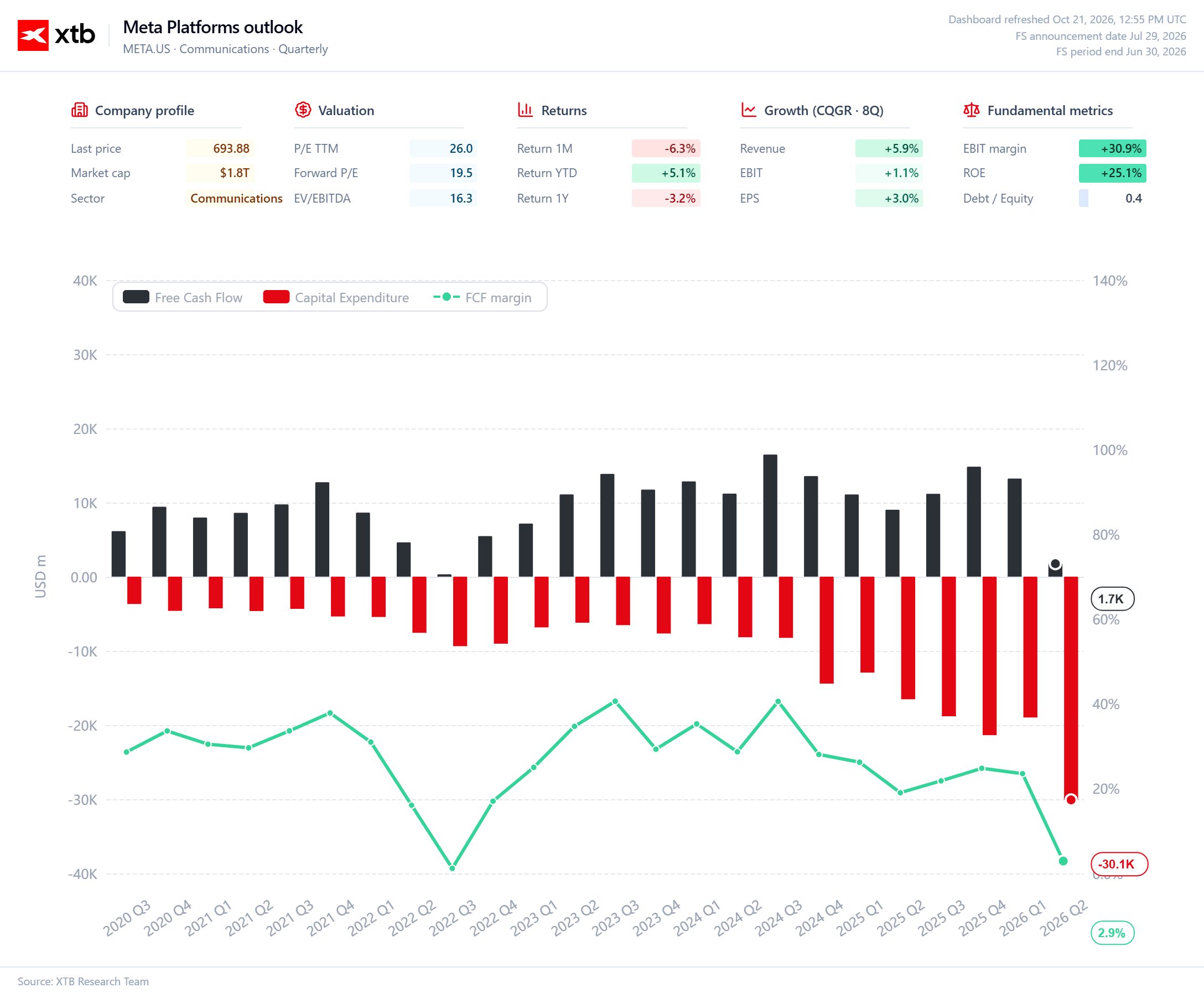
Meta's core business remains its greatest strength. With quarterly revenue expected to reach $63.3 billion, virtually all sales are projected to come from the Family of Apps segment. The scale of Facebook and Instagram gives the company access to an enormous user base and substantial advertiser budgets. AI can further improve campaign performance, enhance content recommendations, and increase the value of advertising without requiring Meta to build an entirely new revenue stream.
Source: XTB Research
Advertising is currently where the economic rationale for AI investment is easiest to identify. If algorithms become better at predicting user behavior and improving campaign results, Meta can increase revenue and the efficiency of its existing business. AI does not need to become a standalone product worth tens of billions of dollars overnight to deliver tangible benefits.
The earnings report will show whether this mechanism continues to work effectively. Revenue growth will be important, but so will management's commentary on the next quarter and 2027. At Meta's current scale, sustaining strong growth requires the company to make effective use of its data, users' attention, and advertising budgets.
Muse Opens a New Path, but Revenue Still Lies Ahead
Muse's rapid rise in popularity shows that Meta can leverage its existing ecosystem to introduce new AI products. In the future, the assistant could create an additional channel for engaging with users and businesses while opening up new monetization opportunities. However, it remains unclear how effectively the company will convert initial interest into regular usage and revenue. Downloads are a starting point, not a measure of financial success.
In the coming quarters, user retention, usage frequency, and the monetization model will become increasingly important. Running an AI assistant generates computing costs, so a large user base does not automatically translate into high margins. Meta will need to find a way to generate revenue without undermining the product's appeal. Potential links to advertising and business services are promising, but the path from AI conversations to incremental revenue has yet to be proven.
AI Spending Is Rising Faster Than Confidence in Returns
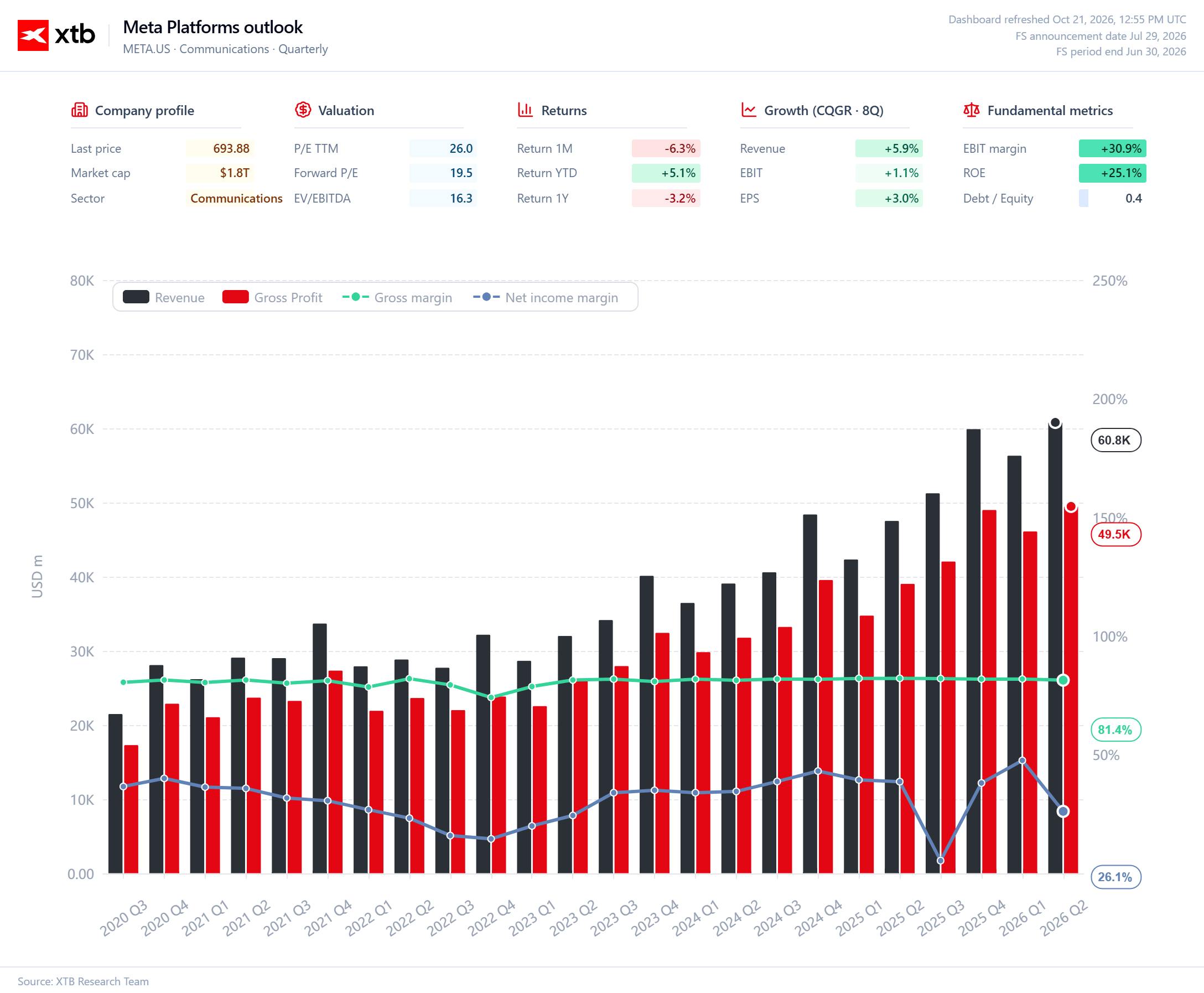
The biggest financial burden comes from the infrastructure required to execute Zuckerberg's strategy. Consensus estimates for Meta's 2026 capital expenditures have reached approximately $140 billion, nearly double the previous year's level. This represents an enormous commitment of capital to servers, data centers, and the hardware needed to train and run increasingly sophisticated models.
Source: XTB Research
This infrastructure supports not only new products but also advertising systems and content recommendations. Meta must nevertheless convince the market that it is building assets capable of generating benefits for years to come, rather than simply keeping pace with competitors in the technology race.
High capital expenditures can be justified if they help establish a lasting competitive advantage and increase future cash flows. Concerns arise when costs grow faster than revenue and the payoff remains years away. In that scenario, an increasing share of cash is directed toward investment rather than being used to boost free cash flow or returned to shareholders.
That is why updated investment plans will be crucial. Further spending increases could be well received if management presents a convincing outlook for improved productivity and revenue growth. Without such a rationale, a larger budget could intensify concerns about future profitability.
Reality Labs Continues to Weigh on Results
In addition to AI spending, Meta must contend with losses at Reality Labs, the segment developing technologies including virtual and augmented reality. The projected operating loss for the third quarter is approximately $5.7 billion, while the full-year figure could reach $20.7 billion. This is another capital-intensive business whose commercial potential remains difficult to assess based on current results.
Reality Labs and AI are distinct initiatives, but from an investor's perspective, both raise the same question: how effectively is Meta allocating its capital? The company is developing new platforms and technological infrastructure while continuing to support a segment that generates substantial losses. Its strong advertising business gives it the financial capacity to pursue several expensive projects simultaneously, but it does not relieve management of the responsibility to demonstrate progress and present a credible path toward better results.
The Market Will Focus on the Cost of Future Growth
Meta has an advantage that many companies developing AI lack: an enormous user base, an extensive advertising infrastructure, and experience monetizing digital products. This gives it an opportunity to turn new technologies into products that can operate at massive scale. However, it does not guarantee that spending will translate into a proportional increase in shareholder value.
The third-quarter results will primarily reveal whether Meta's advertising core is maintaining its momentum and how management views the outlook for the coming quarters. Muse will remain an important part of the story, although its financial significance will be easier to assess only when more data becomes available.
Ultimately, the success of Zuckerberg's strategy will not be determined by how much Meta spends on AI or how quickly its new products gain popularity. What matters is how much additional profit and cash those investments generate. With annual capital expenditures approaching $140 billion, revenue growth alone is no longer enough. Meta must demonstrate that it can develop AI faster than the cost of the technology increases, while maintaining the high profitability of its core business.
If these investments fail to translate into meaningful growth in earnings and free cash flow, even impressive sales figures may prove insufficient to convince investors.
Source: XTB Research



US OPEN: Preparations for Tesla's mega-merger with SpaceX. Diplomatic stalemate with Iran cools Wall Street's enthusiasm

Tesla Preview: Will Robotaxis Save Earnings?


Supermicro Raises Forecast by $4 Billion as AI Server Demand Once Again Surprises the Market


SpaceX Results: Can Starlink Carry the AI Revolution?
The content of this report has been created by XTB S.A., with its registered office in Warsaw, at Prosta 67, 00-838 Warsaw, Poland, (KRS number 0000217580) and supervised by Polish Supervision Authority ( No. DDM-M-4021-57-1/2005). This material is a marketing communication within the meaning of Art. 24 (3) of Directive 2014/65/EU of the European Parliament and of the Council of 15 May 2014 on markets in financial instruments and amending Directive 2002/92/EC and Directive 2011/61/EU (MiFID II). Marketing communication is not an investment recommendation or information recommending or suggesting an investment strategy within the meaning of Regulation (EU) No 596/2014 of the European Parliament and of the Council of 16 April 2014 on market abuse (market abuse regulation) and repealing Directive 2003/6/EC of the European Parliament and of the Council and Commission Directives 2003/124/EC, 2003/125/EC and 2004/72/EC and Commission Delegated Regulation (EU) 2016/958 of 9 March 2016 supplementing Regulation (EU) No 596/2014 of the European Parliament and of the Council with regard to regulatory technical standards for the technical arrangements for objective presentation of investment recommendations or other information recommending or suggesting an investment strategy and for disclosure of particular interests or indications of conflicts of interest or any other advice, including in the area of investment advisory, within the meaning of the Trading in Financial Instruments Act of 29 July 2005 (i.e. Journal of Laws 2019, item 875, as amended). The marketing communication is prepared with the highest diligence, objectivity, presents the facts known to the author on the date of preparation and is devoid of any evaluation elements. The marketing communication is prepared without considering the client’s needs, his individual financial situation and does not present any investment strategy in any way. The marketing communication does not constitute an offer of sale, offering, subscription, invitation to purchase, advertisement or promotion of any financial instruments. XTB S.A. is not liable for any client’s actions or omissions, in particular for the acquisition or disposal of financial instruments, undertaken on the basis of the information contained in this marketing communication. In the event that the marketing communication contains any information about any results regarding the financial instruments indicated therein, these do not constitute any guarantee or forecast regarding the future results.