


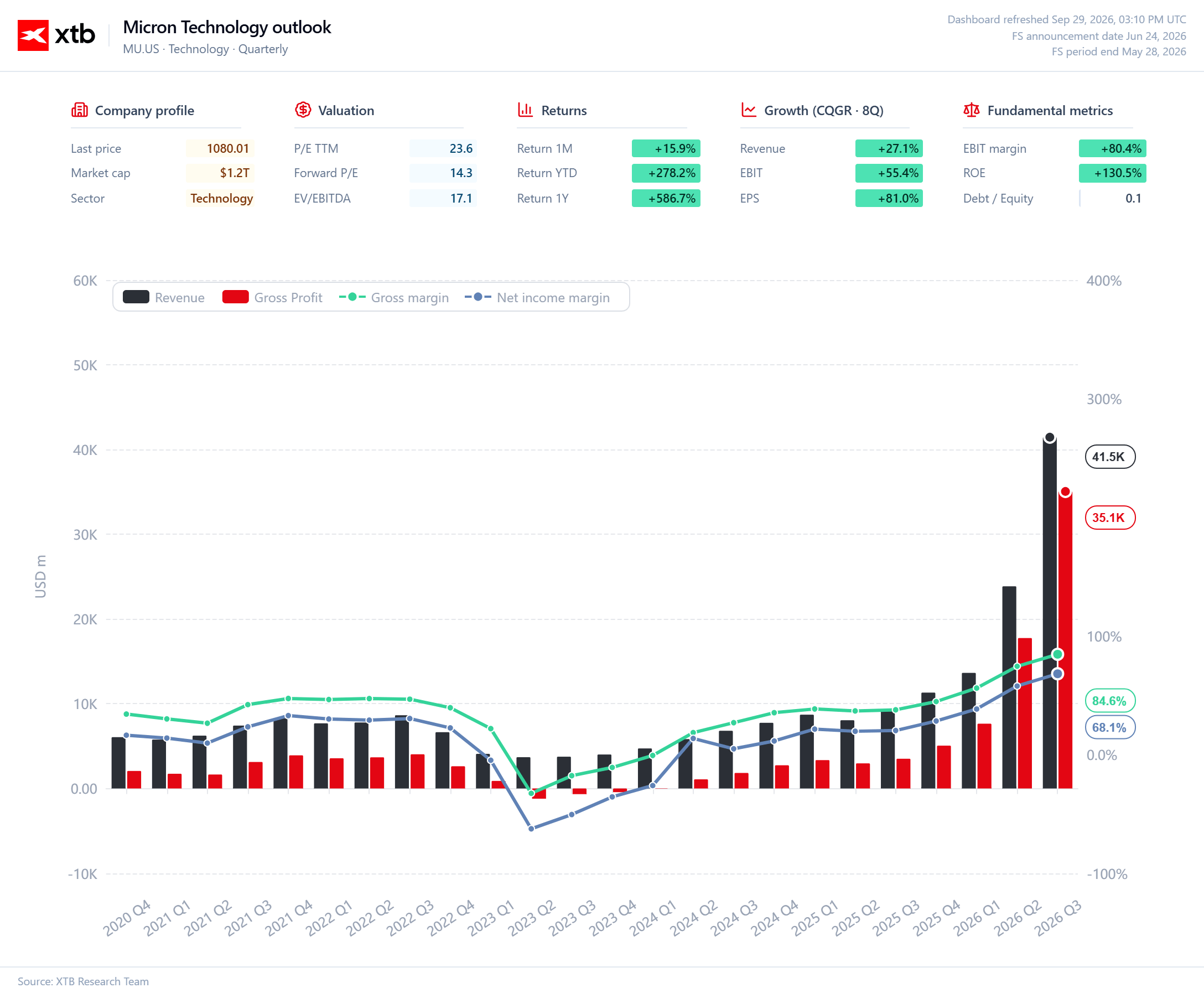
Micron is coming off one of the strongest periods in its history, but Wednesday’s earnings report will primarily be a test of what comes next. The scale of the current growth is already impressive. In the previous quarter, the company generated $41.46 billion in revenue, up 346% year over year, while its non-GAAP gross margin reached 85%. At the same time, HBM4 has already entered the high-volume shipment phase for a key customer.
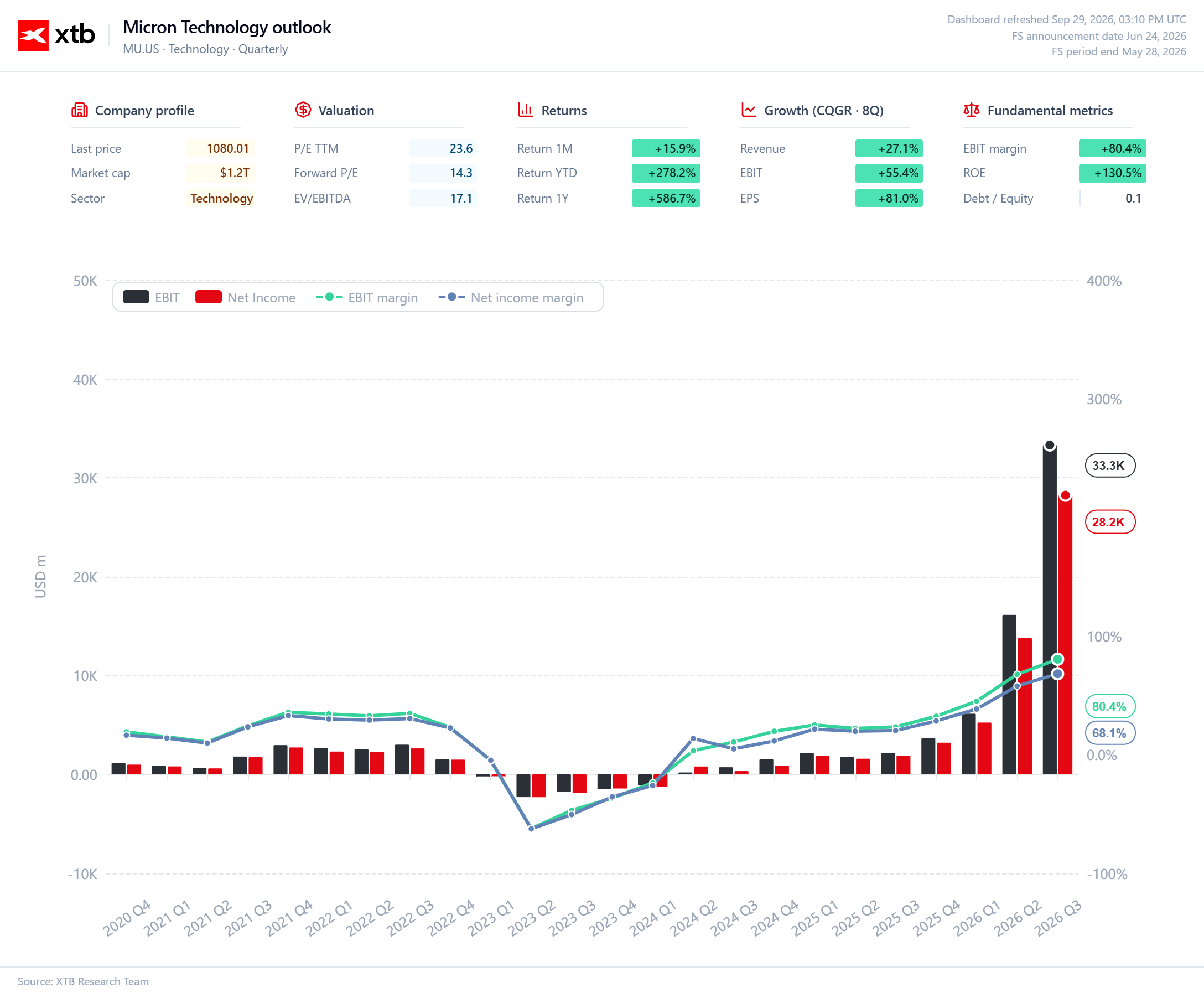
The market therefore does not need another confirmation that Micron is benefiting from the artificial intelligence boom. That is already reflected in expectations. Far more important will be how long the shortage of advanced memory continues and whether demand related to data-center expansion will continue to outpace the industry’s ability to increase supply. The consensus currently calls for approximately $51.25 billion in revenue and $31.60 in earnings per share.
Key market expectations:
-
Revenue: approximately $51.25 billion
-
Earnings per share: approximately $31.60
-
Previous quarter: $41.46 billion in revenue
-
Previous company guidance: $50 billion in revenue, plus or minus $1 billion
-
Projected gross margin: approximately 86%
-
Previous EPS guidance: approximately $31
-
HBM4: high-volume shipments are already underway
Record Numbers Are No Longer Enough
With results growing at this pace, simply beating forecasts may no longer carry as much weight as it once did. Micron previously guided for $50 billion in fourth-quarter revenue, a gross margin of approximately 86%, and earnings per share of around $31. If the company delivers results in line with those assumptions, investors will likely shift their focus quickly to the coming quarters. For Micron, the key issue is no longer the size of a single record, but the durability of the current cycle.
HBM – The Most Important Piece of the Puzzle
HBM remains a critical part of the entire story. The development of the most advanced AI chips requires increasing amounts of high-bandwidth memory, while the ability to expand production is limited. Micron has already begun high-volume HBM4 shipments to a major customer, while samples are also being delivered to additional customers. The pace at which new customers are qualified and shipments ramp up will be among the most important factors the market will be watching.
The question is no longer simply how much Micron will sell in the coming quarter. More important is how quickly the company will be able to increase production as demand for HBM continues to grow. Successive generations of memory are expected to play an increasingly important role, while the development of HBM4E could open the door to another phase of growth in 2027.
The Memory Shortage May Matter More Than Demand Itself
Supply is particularly important in this story. Demand from data centers and AI infrastructure is growing extremely quickly, but expanding memory production capacity requires enormous investment and years of preparation. As a result, the current shortage could persist much longer than in a typical memory-market cycle.
Micron has already signed 16 strategic agreements with customers, 14 of which call for approximately $100 billion in minimum cumulative revenue over the life of the contracts. Such agreements provide greater visibility into future demand and indicate that the biggest challenge may not be finding customers, but ensuring that enough memory is available to meet their needs.
Margins – Can the Record Be Sustained?
A gross margin of 85% demonstrated just how dramatically the economics of Micron’s business have changed. Until recently, such a high level would have been difficult to imagine for a memory manufacturer whose results had historically been heavily dependent on the pricing cycle. Now the company itself is projecting approximately 86% for the following quarter.
The question is whether this represents the beginning of a new normal or simply the result of exceptionally favorable market conditions. If the memory shortage persists for several more quarters, Micron could continue to benefit from high prices and extremely strong margins. If supply begins to grow faster than demand, however, current profitability levels could prove difficult to sustain.
AI Is Changing the Economics of Micron’s Business
Artificial intelligence is changing the nature of the memory market. In previous cycles, demand was much more broadly distributed across smartphones, PCs, consumer electronics and data centers. Today, the expansion of AI infrastructure is driving demand for much more advanced and more expensive memory solutions.
For Micron, this creates an opportunity to move into a significantly higher-value segment of the market. HBM is no longer just another product in the company’s portfolio, but one of the key components of the infrastructure required to build AI systems. That is why the current cycle could look very different from previous periods of rapidly rising memory prices.
2027 Will Be the Key Year
The results for the current quarter will obviously matter, but increasingly more attention will be focused on 2027. By then, it should be much clearer whether the current demand for HBM and other advanced memory products is structural or whether the market will begin returning to a more typical balance between supply and demand.
For investors, the key factors will therefore include new contracts, the pace of production expansion, next-generation HBM products and planned capital expenditures. Micron needs to increase capacity in order to capitalize on demand, while at the same time avoiding a situation in which future supply shifts the balance of the market too quickly.
Micron as One of the Biggest Beneficiaries of AI
Micron is in an unusual position today. On the one hand, it is already benefiting from the enormous increase in spending on AI infrastructure. On the other, its future results will depend on whether the current memory shortage lasts long enough. Record revenue and margins show that the company is at the center of this cycle, but that also means the bar for future earnings reports is getting higher.
The market is no longer asking whether Micron is making money from AI. That has already been confirmed. Now it wants to know how long this boom will last, how quickly demand for HBM will grow, and whether the company will be able to turn the current memory shortage into years of sustained revenue and earnings growth.
That is why the most important number in the earnings report may not even be $51.25 billion in revenue. Far more interesting will be the answer to the question of how much memory Micron will be able to sell in 2027 and beyond.
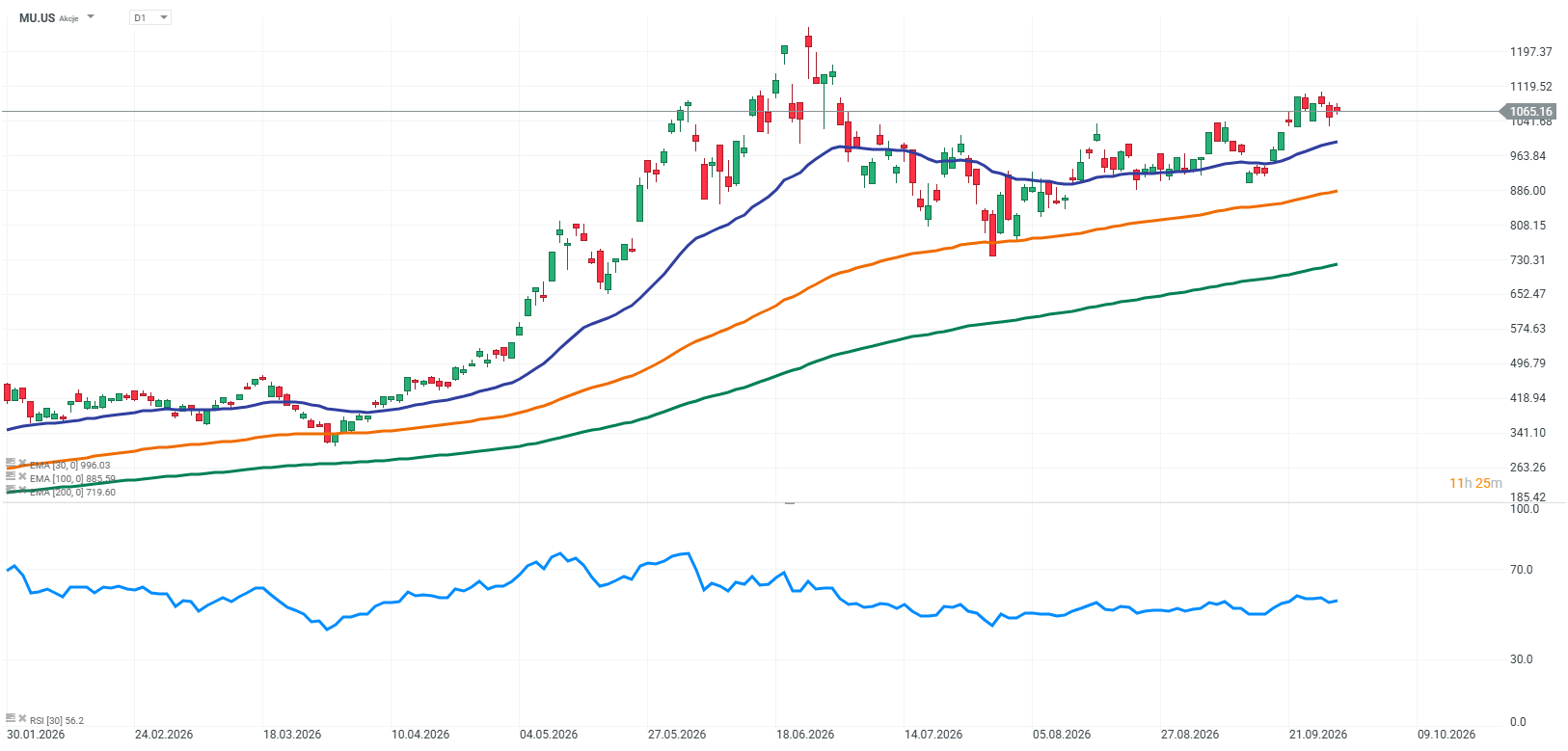
Source: XTB Reserach


Meta Preview: Billions in AI spending, but when will the investments start paying off?


Tesla Preview: Will Robotaxis Save Earnings?

Supermicro Raises Forecast by $4 Billion as AI Server Demand Once Again Surprises the Market


SpaceX Results: Can Starlink Carry the AI Revolution?
The content of this report has been created by XTB S.A., with its registered office in Warsaw, at Prosta 67, 00-838 Warsaw, Poland, (KRS number 0000217580) and supervised by Polish Supervision Authority ( No. DDM-M-4021-57-1/2005). This material is a marketing communication within the meaning of Art. 24 (3) of Directive 2014/65/EU of the European Parliament and of the Council of 15 May 2014 on markets in financial instruments and amending Directive 2002/92/EC and Directive 2011/61/EU (MiFID II). Marketing communication is not an investment recommendation or information recommending or suggesting an investment strategy within the meaning of Regulation (EU) No 596/2014 of the European Parliament and of the Council of 16 April 2014 on market abuse (market abuse regulation) and repealing Directive 2003/6/EC of the European Parliament and of the Council and Commission Directives 2003/124/EC, 2003/125/EC and 2004/72/EC and Commission Delegated Regulation (EU) 2016/958 of 9 March 2016 supplementing Regulation (EU) No 596/2014 of the European Parliament and of the Council with regard to regulatory technical standards for the technical arrangements for objective presentation of investment recommendations or other information recommending or suggesting an investment strategy and for disclosure of particular interests or indications of conflicts of interest or any other advice, including in the area of investment advisory, within the meaning of the Trading in Financial Instruments Act of 29 July 2005 (i.e. Journal of Laws 2019, item 875, as amended). The marketing communication is prepared with the highest diligence, objectivity, presents the facts known to the author on the date of preparation and is devoid of any evaluation elements. The marketing communication is prepared without considering the client’s needs, his individual financial situation and does not present any investment strategy in any way. The marketing communication does not constitute an offer of sale, offering, subscription, invitation to purchase, advertisement or promotion of any financial instruments. XTB S.A. is not liable for any client’s actions or omissions, in particular for the acquisition or disposal of financial instruments, undertaken on the basis of the information contained in this marketing communication. In the event that the marketing communication contains any information about any results regarding the financial instruments indicated therein, these do not constitute any guarantee or forecast regarding the future results.