


- Microsoft revenue rose 19 percent year-on-year to 92.28 billion USD.
- Azure cloud revenue grew 48 percent year-on-year to reach 33.17 billion USD.
- Capital expenditures doubled to 39.37 billion USD, reducing free cash flow.

- Microsoft revenue rose 19 percent year-on-year to 92.28 billion USD.
- Azure cloud revenue grew 48 percent year-on-year to reach 33.17 billion USD.
- Capital expenditures doubled to 39.37 billion USD, reducing free cash flow.
Microsoft delivered a solid quarter, materially ahead of expectations. The positive surprises were concentrated in the Cloud segment, which is currently at the center of shareholders’ and the market’s attention. In after hours trading, the company’s shares are up about 3 to 4 percent.
- Revenue rose 19 percent year on year to USD 92.28 billion, versus expectations of around USD 91 billion.
- Operating profit increased 21 percent year on year to USD 4.92 billion.
- On an adjusted EPS basis, profit rose 18 percent to USD 4.89, versus an expected approximately USD 4.72.
- At the same time, the operating margin improved from about 48.9 percent to 49.8 percent.
- Azure performed best, accelerating growth to 48 percent year on year and reaching USD 33.17 billion.
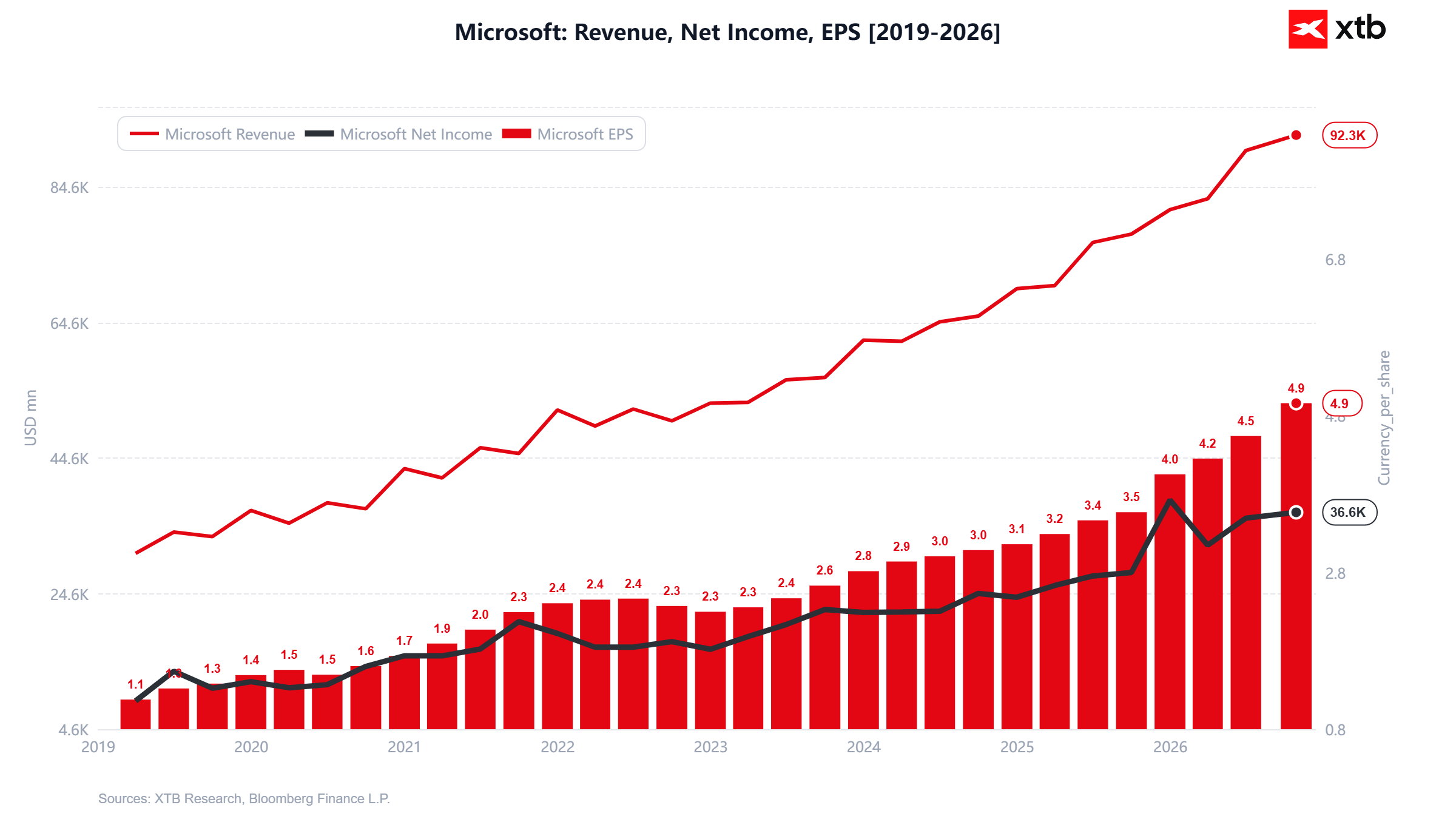
Azure is the strongest argument for the market’s positive reaction. Management had previously guided for growth of around 45 percent at constant currency.
- On the negative side are capital expenditures and cash spending. CAPEX increased 103 percent year on year to USD 39.37 billion.
- This is reflected in a decline in FCF to USD 18.63 billion. That represents a drop in FCF coverage of net income to 51 percent, compared with 92 percent a year ago.
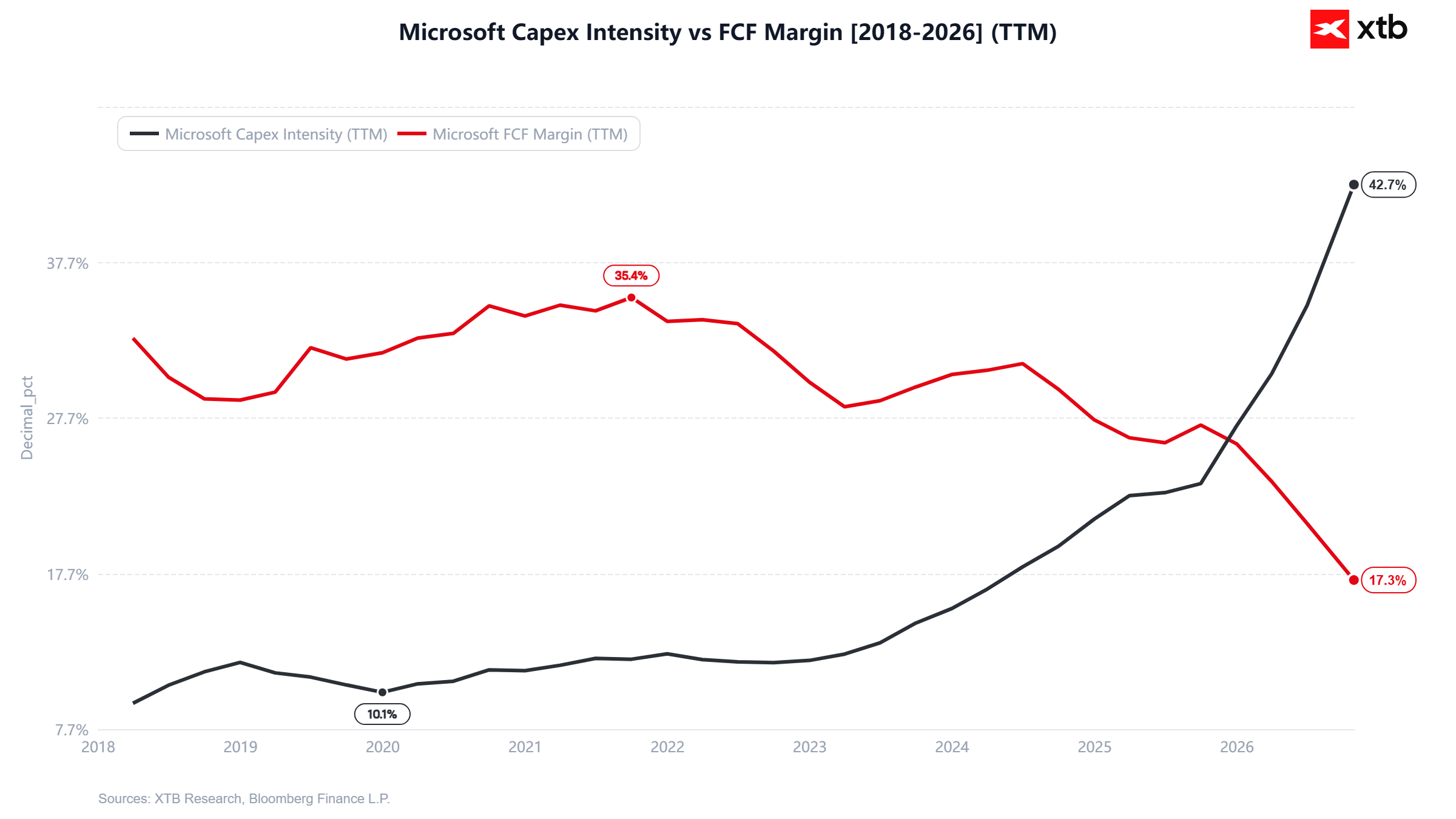
Crucially in the context of investment, Microsoft changed its accounting policy and announced an extension of the estimated useful life of data centers and buildings from 15 to 25 years.
This means that part of future agreements shifts from finance leases to operating leases, reducing reported CAPEX without a corresponding reduction in investment. The company cited this as the reason for revising its 2026 spending outlook to around USD 175 billion.
This information did not reach the market in a vacuum. A few days before the earnings call, the company offered a voluntary buyout to 60,000 employees, roughly one quarter of its global workforce. This signals to the market that Microsoft is actively managing margins to offset rising capital expenditures.
The most important questions remain unanswered. The company is expanding, improving efficiency, and the Azure segment is delivering unprecedented profit growth. At the same time, the scale of investment means that the value remaining for shareholders is clearly falling.
The final takeaway from the release is that, for now, the market is satisfied with Cloud growth running above already optimistic expectations.
Questions about a genuine return of value to shareholders may quiet down until the next earnings call, this time covering the full calendar year.



Daily Summary: Oracle drives the market higher, dollar weakens following Fed meeting (28.10.2026)



📊Hyperscaler Results: Alphabet and Microsoft. Will results justify giant investments?



Market Wrap: Renewed confidence in AI drives stock market recovery (27.10.2026)



📈Daily Summary: Falling Oil Prices and Anthropic Prospectus Drive Markets
The content of this report has been created by XTB S.A., with its registered office in Warsaw, at Prosta 67, 00-838 Warsaw, Poland, (KRS number 0000217580) and supervised by Polish Supervision Authority ( No. DDM-M-4021-57-1/2005). This material is a marketing communication within the meaning of Art. 24 (3) of Directive 2014/65/EU of the European Parliament and of the Council of 15 May 2014 on markets in financial instruments and amending Directive 2002/92/EC and Directive 2011/61/EU (MiFID II). Marketing communication is not an investment recommendation or information recommending or suggesting an investment strategy within the meaning of Regulation (EU) No 596/2014 of the European Parliament and of the Council of 16 April 2014 on market abuse (market abuse regulation) and repealing Directive 2003/6/EC of the European Parliament and of the Council and Commission Directives 2003/124/EC, 2003/125/EC and 2004/72/EC and Commission Delegated Regulation (EU) 2016/958 of 9 March 2016 supplementing Regulation (EU) No 596/2014 of the European Parliament and of the Council with regard to regulatory technical standards for the technical arrangements for objective presentation of investment recommendations or other information recommending or suggesting an investment strategy and for disclosure of particular interests or indications of conflicts of interest or any other advice, including in the area of investment advisory, within the meaning of the Trading in Financial Instruments Act of 29 July 2005 (i.e. Journal of Laws 2019, item 875, as amended). The marketing communication is prepared with the highest diligence, objectivity, presents the facts known to the author on the date of preparation and is devoid of any evaluation elements. The marketing communication is prepared without considering the client’s needs, his individual financial situation and does not present any investment strategy in any way. The marketing communication does not constitute an offer of sale, offering, subscription, invitation to purchase, advertisement or promotion of any financial instruments. XTB S.A. is not liable for any client’s actions or omissions, in particular for the acquisition or disposal of financial instruments, undertaken on the basis of the information contained in this marketing communication. In the event that the marketing communication contains any information about any results regarding the financial instruments indicated therein, these do not constitute any guarantee or forecast regarding the future results.