


- US100 loses 0.7% despite stronger sentiments on US500 and US30
- SanDisk and Western Digital were down almost 10% and 14%, respectively, in premarket trading.
- Before the today US market open semiconductor stocks lags broader market sentiments again

- US100 loses 0.7% despite stronger sentiments on US500 and US30
- SanDisk and Western Digital were down almost 10% and 14%, respectively, in premarket trading.
- Before the today US market open semiconductor stocks lags broader market sentiments again
Weakness in US technology stocks contrasts today with the relatively stronger performance of S&P 500 and Dow Jones futures. Nasdaq 100 futures (US100) are down 0.7%, pointing to a rotation of capital away from the market’s highest-growth segments. The main source of risk aversion is renewed concern about the valuations of companies benefiting from the AI boom.
- The market is not questioning the continued growth in spending on artificial intelligence infrastructure. Instead, investors are increasingly demanding that exceptionally high expectations be matched by equally strong financial results.
- SanDisk and Western Digital were down almost 10% and 14%, respectively, in premarket trading. Their results failed to meet elevated market expectations, showing that even companies with direct exposure to rising demand for memory products and data centers can face a sharp negative reaction to relatively small disappointments.
- The pressure extends across the semiconductor supply chain. Following earlier declines in AMD, the Philadelphia Semiconductor Index was down 1.4%, while negative sentiment spread across the broader memory sector. This suggests that investors view the issue as sector-wide rather than limited to a few individual earnings reports.
Nasdaq at risk again?
The main risk for the Nasdaq is a compression in valuation multiples. After a strong start to August, some technology companies were trading with little room for error. In such an environment, solid results may not be sufficient—earnings and guidance may need to exceed consensus estimates by a significant margin. Falling oil prices and bond yields are supportive of the Nasdaq over the medium term. A potential reopening of the Strait of Hormuz would reduce the risk of an energy-driven inflationary shock, easing pressure for further interest-rate increases. Lower yields also raise the theoretical present value of technology companies’ future cash flows.
However, the positive effect of geopolitical developments may be limited because some of the favorable news has already been priced in. The market is assuming progress in negotiations concerning the Strait of Hormuz, meaning that a lack of a concrete agreement or a renewed escalation could quickly reverse the decline in oil prices and bond yields. The most important macroeconomic event remains Friday’s US nonfarm payrolls report. A weaker—but not recessionary—reading could support the Nasdaq by lowering bond yields. Conversely, stronger-than-expected data could revive concerns that the Federal Reserve will maintain a restrictive monetary policy.
Earnings reports from Airbnb and Warner Bros. Discovery will provide another test of conditions among Nasdaq-listed companies. Investors will assess not only quarterly results but, more importantly, guidance, revenue growth, margins and management commentary on consumer demand. Following the declines in SanDisk and Western Digital, Seagate shares are down 3.6%, Micron is losing 3.7% and SK Hynix ADRs are falling 6.2%. Intel, AMD and Marvell are also down by approximately 1–1.5%. The market reaction suggests that investors are not questioning demand for AI infrastructure itself, but rather whether the current pace of price and margin growth can be sustained across the memory and data-storage industry.
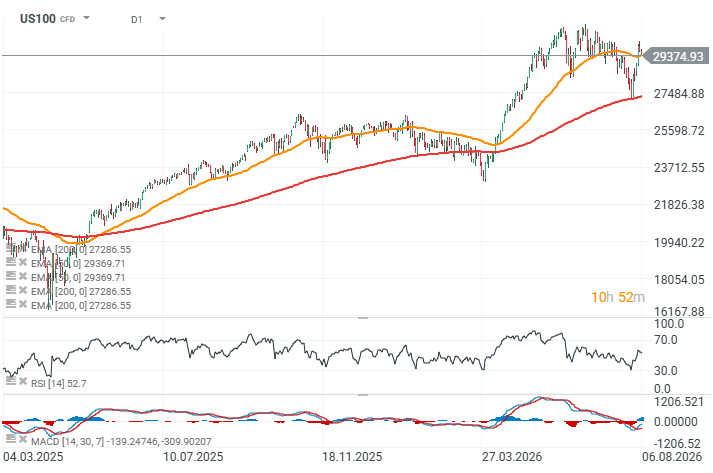
US100 Chart—Daily Time Frame
Nasdaq 100 futures, represented by US100, are down more than 0.7% today and are testing the 50-day exponential moving average on the daily chart.
Source: xStation5
SanDisk Delivers Strong Results, but the Market Expected More
SanDisk reported results above consensus estimates and forecast further revenue growth driven by demand from AI data centers. Fiscal fourth-quarter revenue reached $8.97 billion, compared with analysts’ expectations of $8.39 billion, while adjusted earnings per share came in at $39.25 versus the consensus estimate of $34.45. Data-center revenue more than doubled from the previous quarter to $2.98 billion and was over 400% higher in the full 2026 fiscal year than a year earlier.
The company’s guidance also indicates that demand is expected to remain strong. SanDisk forecasts revenue of between $10.30 billion and $10.80 billion for the first quarter of the new fiscal year. The midpoint of that range, $10.55 billion, is above the LSEG consensus estimate of $10.47 billion. Adjusted earnings per share are expected to range from $44 to $46, compared with analysts’ expectations of $43.12.
Despite exceeding forecasts, SanDisk shares were down approximately 9.2% in premarket trading, falling to $1,226.04. Western Digital experienced a similar reaction, with its shares declining by almost 15% to $440, even though the company also issued revenue guidance above the LSEG consensus. This indicates that, for some of the largest beneficiaries of the AI boom, simply beating analysts’ forecasts is no longer sufficient. Results must also exceed elevated market expectations that may not be fully reflected in published consensus estimates.
The scale of the earlier rally raised the bar further. SanDisk’s share price increased more than fivefold in 2026, while Western Digital shares more than tripled. By comparison, the Philadelphia Semiconductor Index gained approximately 70% over the same period, while the S&P 500 rose 12.8%. These gains indicate that investors had already priced in not only sustained demand but also continued growth in memory prices, margins and profitability. Past share-price performance describes previous market behavior and does not determine future results.
SanDisk is seeking to reduce uncertainty by shifting from quarterly orders to multi-year customer agreements. The company has eight agreements with six customers, with a combined minimum value of $93.9 billion and a median term of four years. In the fiscal year ending in July 2027, approximately half of its production is expected to be sold under these contracts. In the following fiscal year, that proportion is projected to rise to two-thirds.
Since April, SanDisk has signed five additional agreements, including three with new customers and two extensions of existing contracts. Multi-year agreements improve revenue visibility and reduce the company’s exposure to short-term fluctuations in memory prices. However, they do not eliminate the risk that growth may begin to normalize, particularly if current margins are close to a cyclical peak.
RBC Capital Markets highlighted this issue. According to its analysts, long-term contracts improve visibility into SanDisk’s business, but investor caution may persist because margins could be approaching a peak while growth in memory prices slows. As a result, future earnings reports are likely to be assessed not only in terms of sales growth but also on the stability of profitability and the pace at which the multi-year agreements are executed.
Another indication of management’s confidence is the approval of a $14 billion share-repurchase program. This increases SanDisk’s total remaining buyback authorization to $15.5 billion. Repurchases could support earnings per share, but they do not change the company’s main challenge: the market expects the rapid expansion of AI infrastructure to produce financial results that grow at a pace consistent with the earlier increase in its share valuation.
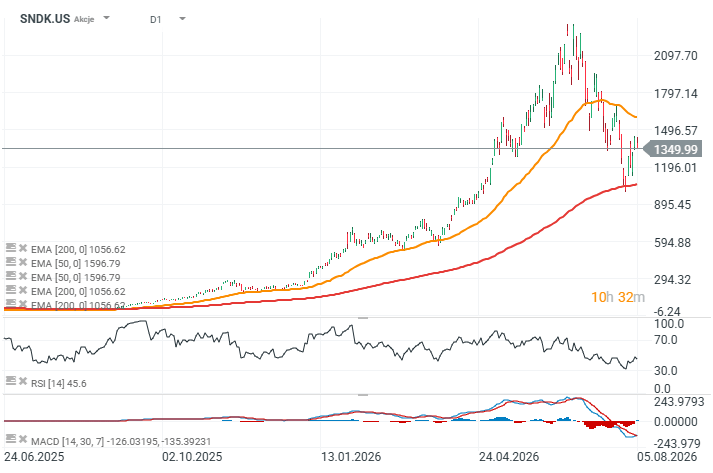
SanDisk Chart—Daily Time Frame
SanDisk shares may open near $1,200 today, bringing the price close to the 200-day exponential moving average shown by the red line. This indicator is commonly viewed as a broad technical dividing line between an uptrend and a downtrend.
Source: xStation5



Daily Summary: Wall Street Rises Ahead of Tomorrow's Fed Meeting💡



The US100 gets back on track and gains 1%📈



Market Wrap: Renewed confidence in AI drives stock market recovery (27.10.2026)



Gold Falls Below $4,000
The content of this report has been created by XTB S.A., with its registered office in Warsaw, at Prosta 67, 00-838 Warsaw, Poland, (KRS number 0000217580) and supervised by Polish Supervision Authority ( No. DDM-M-4021-57-1/2005). This material is a marketing communication within the meaning of Art. 24 (3) of Directive 2014/65/EU of the European Parliament and of the Council of 15 May 2014 on markets in financial instruments and amending Directive 2002/92/EC and Directive 2011/61/EU (MiFID II). Marketing communication is not an investment recommendation or information recommending or suggesting an investment strategy within the meaning of Regulation (EU) No 596/2014 of the European Parliament and of the Council of 16 April 2014 on market abuse (market abuse regulation) and repealing Directive 2003/6/EC of the European Parliament and of the Council and Commission Directives 2003/124/EC, 2003/125/EC and 2004/72/EC and Commission Delegated Regulation (EU) 2016/958 of 9 March 2016 supplementing Regulation (EU) No 596/2014 of the European Parliament and of the Council with regard to regulatory technical standards for the technical arrangements for objective presentation of investment recommendations or other information recommending or suggesting an investment strategy and for disclosure of particular interests or indications of conflicts of interest or any other advice, including in the area of investment advisory, within the meaning of the Trading in Financial Instruments Act of 29 July 2005 (i.e. Journal of Laws 2019, item 875, as amended). The marketing communication is prepared with the highest diligence, objectivity, presents the facts known to the author on the date of preparation and is devoid of any evaluation elements. The marketing communication is prepared without considering the client’s needs, his individual financial situation and does not present any investment strategy in any way. The marketing communication does not constitute an offer of sale, offering, subscription, invitation to purchase, advertisement or promotion of any financial instruments. XTB S.A. is not liable for any client’s actions or omissions, in particular for the acquisition or disposal of financial instruments, undertaken on the basis of the information contained in this marketing communication. In the event that the marketing communication contains any information about any results regarding the financial instruments indicated therein, these do not constitute any guarantee or forecast regarding the future results.