



Brent crude oil futures (OIL) are rising for the third consecutive session, gaining approximately 1% today to $91 per barrel. Brent also advanced on Wednesday, with the rebound gaining momentum following reports of attacks on Saudi oil infrastructure and tanker explosions in the Strait of Hormuz. The market, which until recently had been focused on the prospect of an oil supply surplus in 2027, is once again pricing in the risk of disruptions to crude shipments from the Persian Gulf.
-
The Strait of Hormuz is once again becoming a major source of risk for global energy markets. Iran's Islamic Revolutionary Guard Corps (IRGC) reported that two tankers exploded after striking naval mines near the Omani port of Khasab. One of the vessels was reportedly carrying more than 2 million barrels of crude oil. The Iranian claims have not been independently verified, but even the threat to shipping could increase transportation and insurance costs.
-
The reported attack on Ras Tanura is raising concerns about the security of Saudi Arabia's oil exports. Yemen's Houthis claim to have targeted the country's largest refinery, part of a complex that also includes a strategically important crude export terminal. Even without confirmed, prolonged production losses, potential disruptions in the area could increase the geopolitical risk premium embedded in Brent prices.
-
The recovery in Middle Eastern oil exports could face another setback. According to Morgan Stanley estimates, crude exports from the region, including shipments using routes that bypass the Strait of Hormuz, reached approximately 15.3 million barrels per day last week. The market must now assess whether the latest incidents represent temporary shipping disruptions or the beginning of another period of constrained physical supply.
-
The November 29 OPEC+ decision could significantly influence oil prices in December. According to Reuters, the group is considering maintaining its current production targets through at least the first quarter of 2027. Keeping output targets unchanged could limit the risk of additional supply, although the market impact will also depend on actual production levels among member countries and developments in the Middle East.
-
US inventory data do not indicate a sharp deterioration in the oil market's supply-demand balance. According to the EIA, commercial crude inventories increased by 1.1 million barrels to 418.9 million barrels last week, compared with expectations for a 1.5 million barrel build. Inventories nevertheless remain approximately 3% below their five-year average, suggesting that the US crude oil inventory buffer remains relatively limited.
-
According to Al-Hadath, the United States is working to arrange a meeting between Donald Trump and Israeli politician Gadi Eisenkot. The talks would reportedly focus on Iran and understandings with Israeli Prime Minister Benjamin Netanyahu. Meanwhile, a spokesperson for Iran's armed forces denied that Tehran had conducted any military or offensive operations in the region. According to the Tasnim news agency, Iran also rejected claims by the Kuwaiti military that it had attacked a critical infrastructure facility.
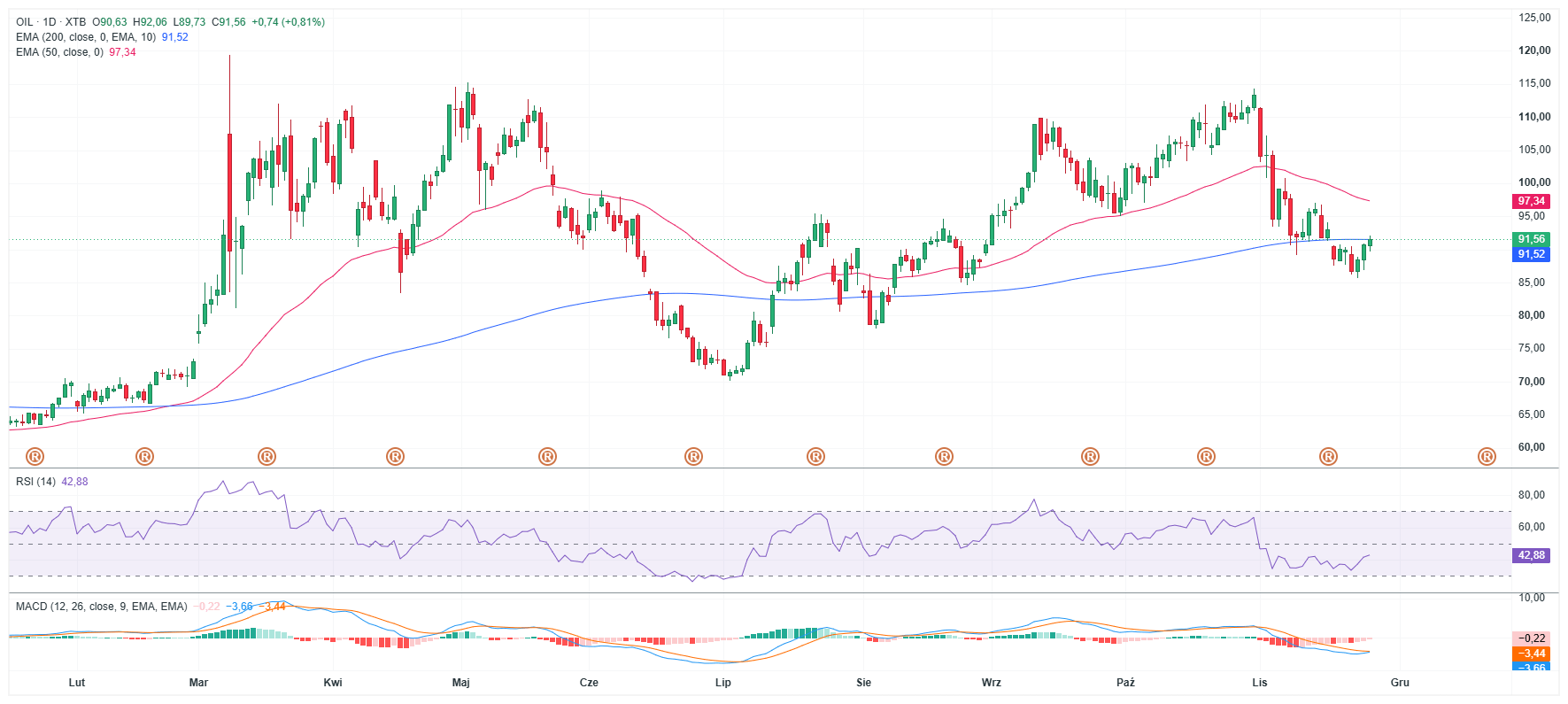
OIL chart (daily timeframe)
From a technical perspective, the $98 to $100 per barrel area remains a key resistance zone for Brent crude oil futures, where the 200-day exponential moving average (EMA200), previous price reactions and the psychologically important $100 level converge. A sustained breakout above this area could increase the risk of another sharp upward move, particularly if reports confirm prolonged disruptions to Middle Eastern oil exports. Conversely, the prospect of a supply surplus in 2027, elevated interest rates and a stronger US dollar could limit further gains. Key support is currently located around $86 per barrel.
 Source: XTB
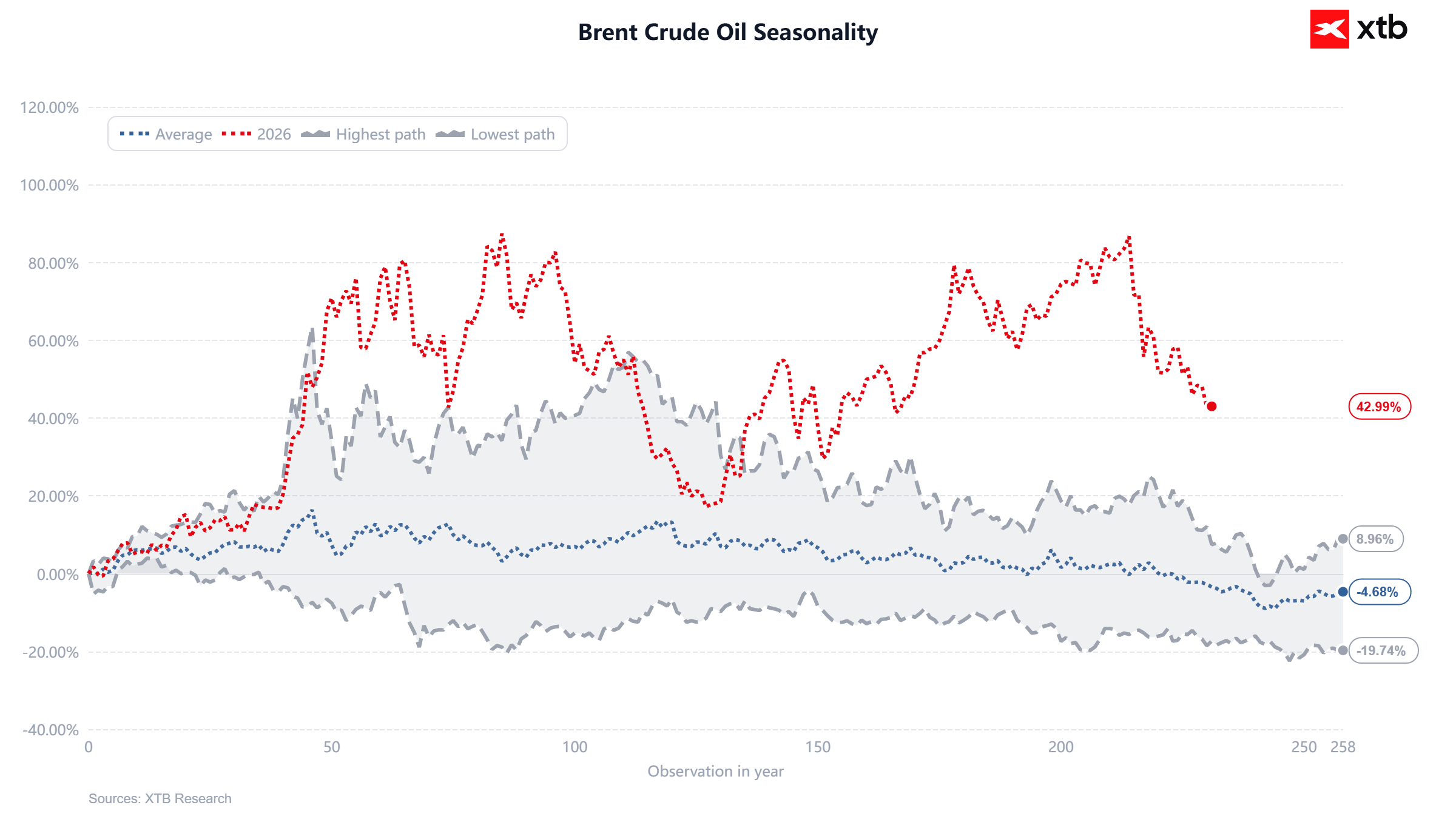
Seasonality analysis of Brent crude oil futures shows that 2026 has deviated significantly from historical patterns, primarily due to the sharp price increases driven by geopolitical tensions and supply disruptions in the Middle East. Despite the subsequent correction, Brent futures have gained approximately 43% this year, compared with a historical average return close to zero over the corresponding period. Notably, prices have repeatedly exceeded the historical upper seasonal range in 2026, highlighting the exceptional scale of this year's market fluctuations. Historical seasonality nevertheless points to a weaker year-end performance, suggesting that Brent's next major move may depend primarily on the extent of Middle Eastern supply disruptions and OPEC+ production decisions for 2027.
Source: XTB


Market Wrap: European Indices Rise 📈



Morning Wrap: Wall Street Under Pressure from AI Fears as the Fed Turns Increasingly Hawkish


Daily Summary: Trump's New Tariffs and AI Sector Slowdown Trigger Wall Street Sell-Off



US crude oil inventories rise less than expected. Market eyes Strait of Hormuz and supply surplus
The content of this report has been created by XTB S.A., with its registered office in Warsaw, at Prosta 67, 00-838 Warsaw, Poland, (KRS number 0000217580) and supervised by Polish Supervision Authority ( No. DDM-M-4021-57-1/2005). This material is a marketing communication within the meaning of Art. 24 (3) of Directive 2014/65/EU of the European Parliament and of the Council of 15 May 2014 on markets in financial instruments and amending Directive 2002/92/EC and Directive 2011/61/EU (MiFID II). Marketing communication is not an investment recommendation or information recommending or suggesting an investment strategy within the meaning of Regulation (EU) No 596/2014 of the European Parliament and of the Council of 16 April 2014 on market abuse (market abuse regulation) and repealing Directive 2003/6/EC of the European Parliament and of the Council and Commission Directives 2003/124/EC, 2003/125/EC and 2004/72/EC and Commission Delegated Regulation (EU) 2016/958 of 9 March 2016 supplementing Regulation (EU) No 596/2014 of the European Parliament and of the Council with regard to regulatory technical standards for the technical arrangements for objective presentation of investment recommendations or other information recommending or suggesting an investment strategy and for disclosure of particular interests or indications of conflicts of interest or any other advice, including in the area of investment advisory, within the meaning of the Trading in Financial Instruments Act of 29 July 2005 (i.e. Journal of Laws 2019, item 875, as amended). The marketing communication is prepared with the highest diligence, objectivity, presents the facts known to the author on the date of preparation and is devoid of any evaluation elements. The marketing communication is prepared without considering the client’s needs, his individual financial situation and does not present any investment strategy in any way. The marketing communication does not constitute an offer of sale, offering, subscription, invitation to purchase, advertisement or promotion of any financial instruments. XTB S.A. is not liable for any client’s actions or omissions, in particular for the acquisition or disposal of financial instruments, undertaken on the basis of the information contained in this marketing communication. In the event that the marketing communication contains any information about any results regarding the financial instruments indicated therein, these do not constitute any guarantee or forecast regarding the future results.