



Oracle is the smallest of the publicly listed companies commonly classified as “hyperscalers.” Even though Oracle is the smallest player in the segment, management clearly has no intention of accepting smaller “AI” investments, which is reflected in the valuation.
ORACLE stock chart (D1)
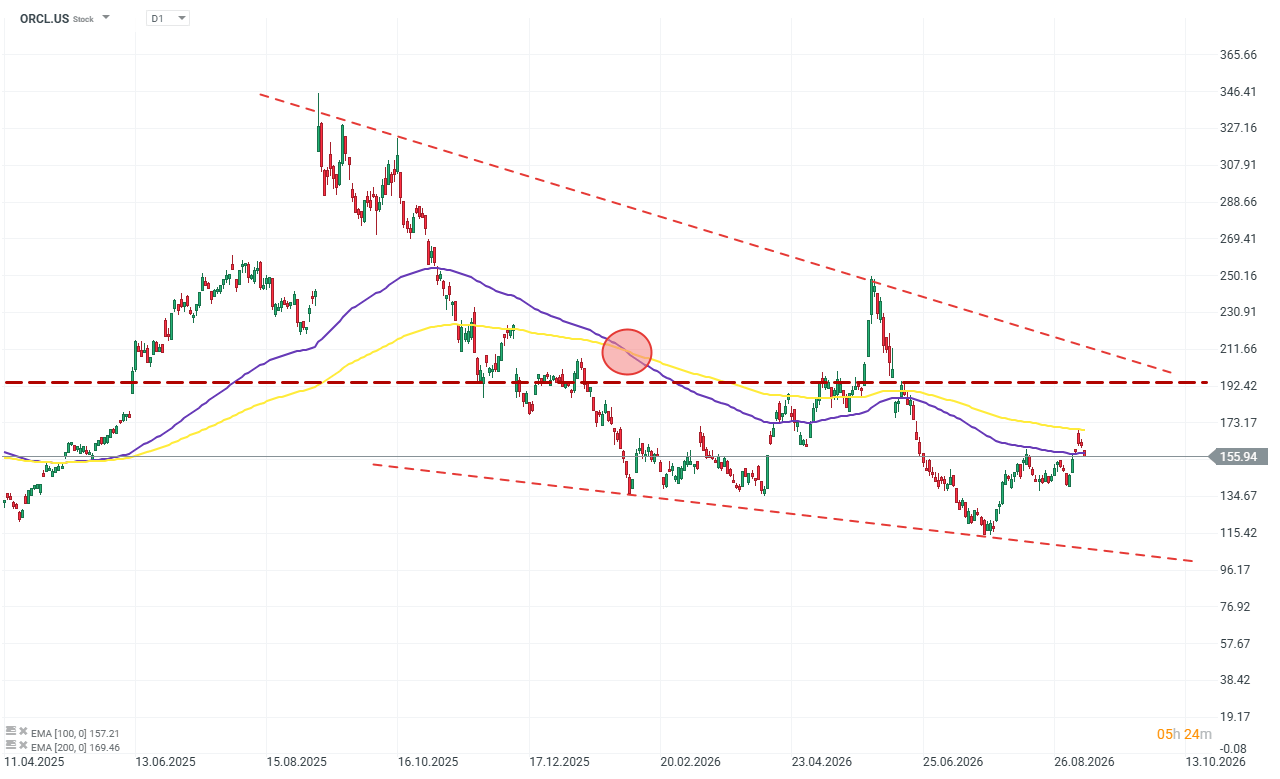
Since the start of the year, at the low of the correction, the sell-off reached as much as about 54%. After the rally that began in July (around 40%), the valuation is still about 36% below the peak. Source: xStation5
Second-quarter results, while a positive surprise on revenue and profits, triggered another sell-off due to further expansion in investment spending and debt. Do the previous results and the market’s reaction help us better prepare for the upcoming earnings call?
Consensus
Analysts’ consensus, in the context of the broader sector and the company’s situation, can be summed up as: “It’s bad, but it can always get worse.” This matters because the company’s financial position is currently questionable despite phenomenal revenue growth.
The median of available forecasts shows:
- Expected revenue of about USD 19.05 billion: a slight quarter-on-quarter decline, but still up 28% year over year.
- Non-GAAP EPS of about USD 1.75: again a quarter-on-quarter decline, but up about 18% year over year.
This means the analyst and market consensus appears to be largely aligned with management’s guidance. However, for AI and hyperscale companies, dry, surface-level financials often have little value. For Oracle, the key items will be: cloud revenue, receivables, guidance, debt, and CAPEX.
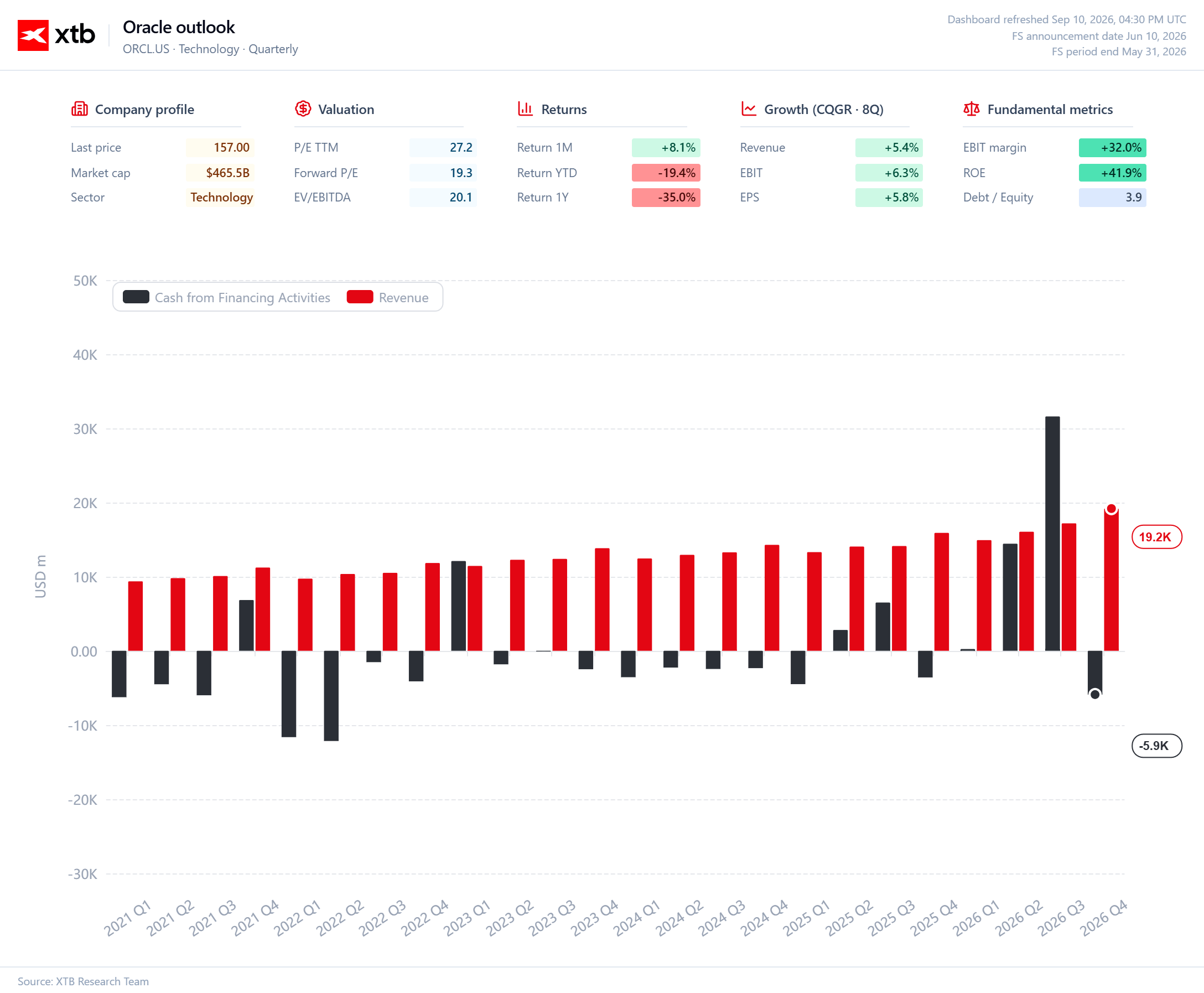
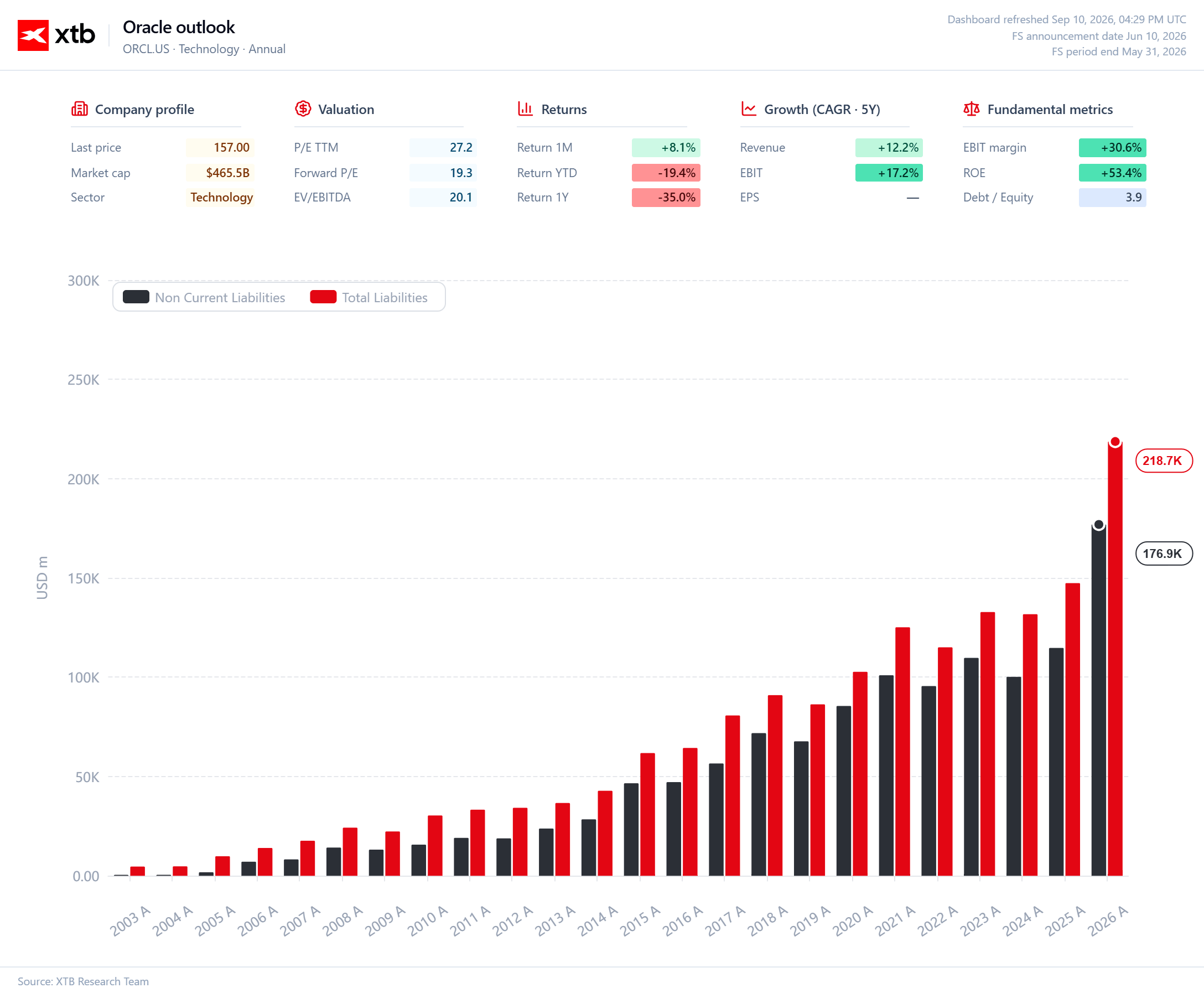
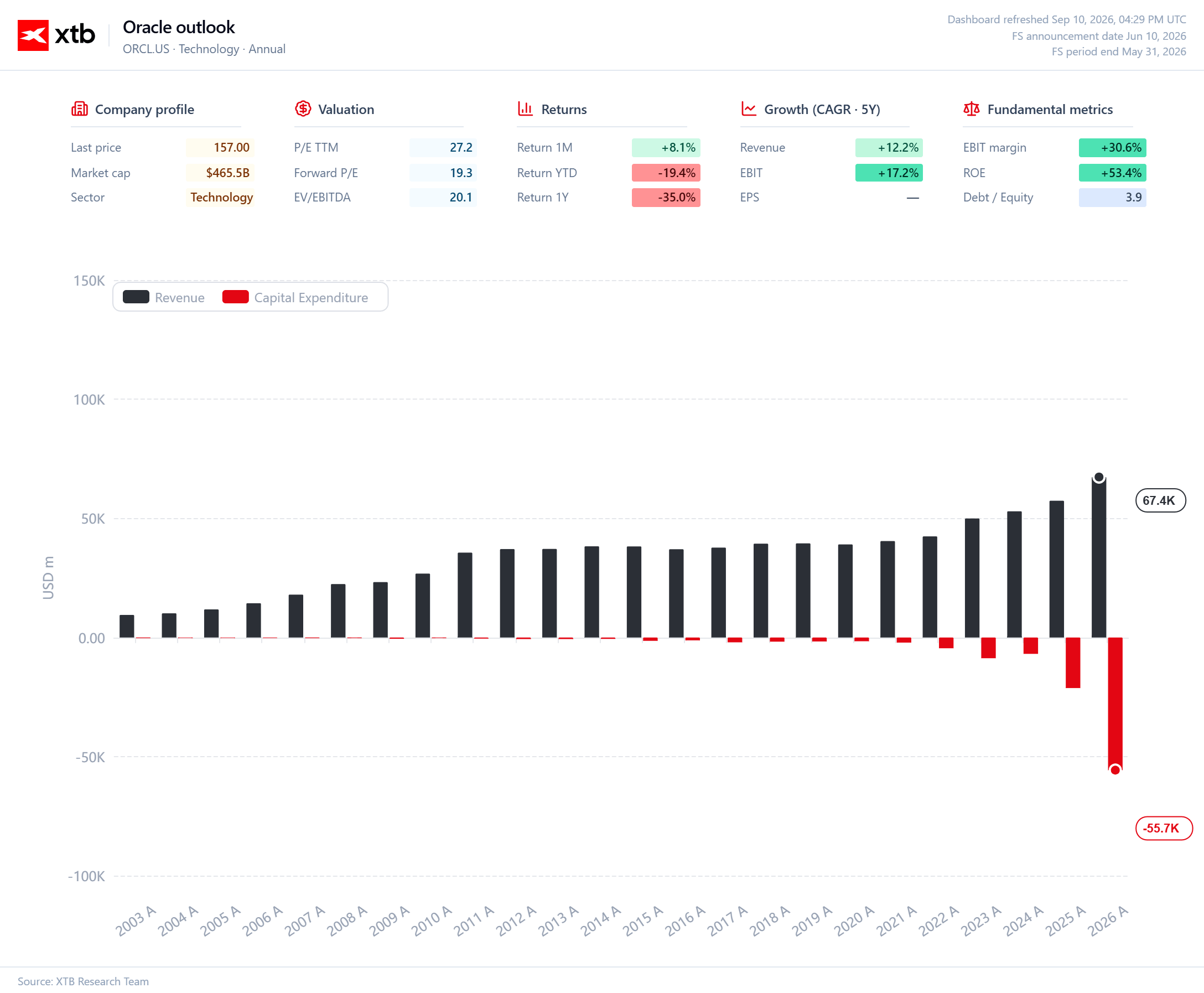
- Cloud revenue (for Oracle this is IaaS plus SaaS) needs to reach at least about 60% year-over-year growth to even partially calm investor concerns and justify the massive investments.
- The order backlog will likely come in within the USD 630 to 650 billion range. Similar figures are already priced in. Much more important will be information on delivery timelines, contract durability, and customers’ ability to pay.
What to look for?
A make-or-break issue for the upcoming earnings call could be the status of contracted infrastructure and/or the debt situation.
- In Abilene, Texas, Oracle is involved in building a data center with power consumption of about 1.2 gigawatts. This is one of the company’s most important investments, and any new positive or negative updates could affect shareholder sentiment.
- Additionally, Oracle already operates a number of smaller or older data centers which, if the company’s forecasts and AI expectations are to be met, should show a meaningful increase in profitability and utilization rates. If that is indeed the case, management will likely mention it in the earnings presentation. If they do not, it may suggest infrastructure occupancy is not as strong as the market hopes.
- The “elephant in the room” remains debt. Oracle is one of the few companies in the technology sector that has managed to take on debt to a degree that could threaten solvency if AI investments turn out to be a failure. This is not a hypothesis, but a clear signal from the CDS market. In this context, the market will be sensitive to further “above-plan” increases in investment spending, rising interest costs on debt, and the quality of currently secured financing.
- The options market going into the pre-earnings session implies post-release volatility of about 10%, which means that both disappointment and a positive surprise will likely lead to a significant move in the stock’s valuation.



US Open: Further declines on Wall Street, Brent above 111 USD, AI correction continues (14.10.2026)


Market Wrap: "Decent" results are not enough – tech stocks fall further; oil highest since May (22.10.2026)


Tesla was supposed to burn $5 billion, but posted a positive result. Will Tesla still be a car company in a year?

Record-breaking Meta, though with a cash loss. Investors (for now) are buying Zuckerberg's plan anyway
The content of this report has been created by XTB S.A., with its registered office in Warsaw, at Prosta 67, 00-838 Warsaw, Poland, (KRS number 0000217580) and supervised by Polish Supervision Authority ( No. DDM-M-4021-57-1/2005). This material is a marketing communication within the meaning of Art. 24 (3) of Directive 2014/65/EU of the European Parliament and of the Council of 15 May 2014 on markets in financial instruments and amending Directive 2002/92/EC and Directive 2011/61/EU (MiFID II). Marketing communication is not an investment recommendation or information recommending or suggesting an investment strategy within the meaning of Regulation (EU) No 596/2014 of the European Parliament and of the Council of 16 April 2014 on market abuse (market abuse regulation) and repealing Directive 2003/6/EC of the European Parliament and of the Council and Commission Directives 2003/124/EC, 2003/125/EC and 2004/72/EC and Commission Delegated Regulation (EU) 2016/958 of 9 March 2016 supplementing Regulation (EU) No 596/2014 of the European Parliament and of the Council with regard to regulatory technical standards for the technical arrangements for objective presentation of investment recommendations or other information recommending or suggesting an investment strategy and for disclosure of particular interests or indications of conflicts of interest or any other advice, including in the area of investment advisory, within the meaning of the Trading in Financial Instruments Act of 29 July 2005 (i.e. Journal of Laws 2019, item 875, as amended). The marketing communication is prepared with the highest diligence, objectivity, presents the facts known to the author on the date of preparation and is devoid of any evaluation elements. The marketing communication is prepared without considering the client’s needs, his individual financial situation and does not present any investment strategy in any way. The marketing communication does not constitute an offer of sale, offering, subscription, invitation to purchase, advertisement or promotion of any financial instruments. XTB S.A. is not liable for any client’s actions or omissions, in particular for the acquisition or disposal of financial instruments, undertaken on the basis of the information contained in this marketing communication. In the event that the marketing communication contains any information about any results regarding the financial instruments indicated therein, these do not constitute any guarantee or forecast regarding the future results.