



POET is a Canadian company that has been trying, with mixed results, to establish itself in the photonics industry, which has recently been gaining importance in the investment “race for AI”.
As of today, POET has a market capitalization of around USD 1.3 billion, revenue of about USD 1.7 million, and a net loss of as much as USD 75 million.
In most cases, companies like POET would remain on the fringes of the market, mentioned mainly in the context of an assumed impending restructuring mechanism. However, a set of fairly unique circumstances has pushed the company into the basket of so called “meme stocks”, which can often act as a cushion that softens the fall from price level down to the company’s fundamentals.
Quo vadis
Like many similar companies, POET entered the public market in 2020, quickly multiplied its valuation, and then, after 2022 arrived, lost most of its value in response to the re pricing of the cost of capital.
Most investors who recognize the company’s name likely heard about it in April or May 2026, when rumors of a deal with Marvell sent the company’s valuation up by several hundred percent.
The rumors turned out to be true, but a Marvell subsidiary terminated the agreement because the CEO failed to comply with the confidentiality terms of the agreement between the companies. This is an especially interesting phenomenon because the CEO’s response that constituted the breach of confidentiality was a response to a report by short seller fund WolfPack Research.
POET price chart (D1)
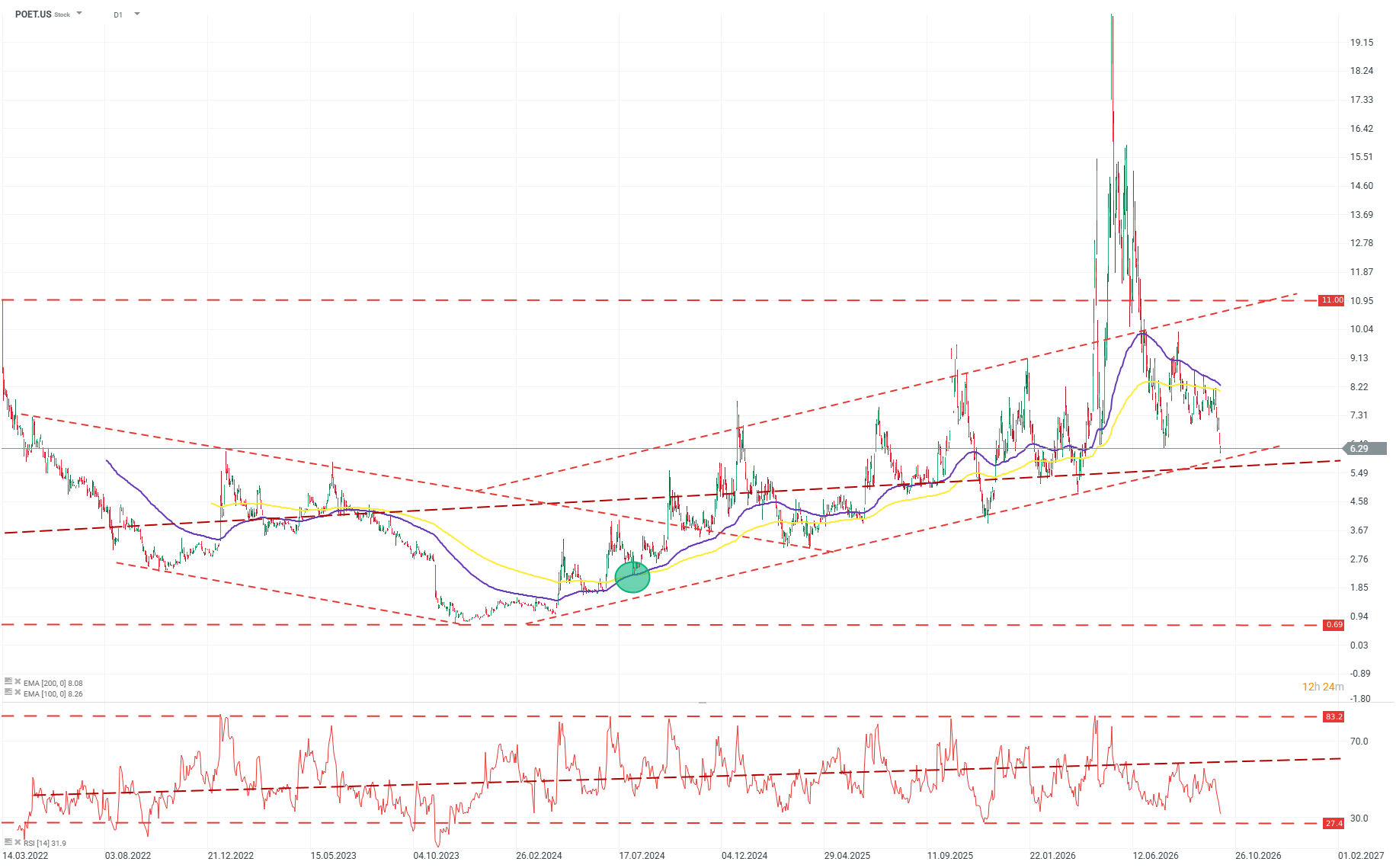
Several months have passed since the “drop” from around USD 17 per share to current levels between USD 9 and USD 6, and the market has had time to cool off and often to forget about the company. In a month, the company will publish its financial results for the next quarter, which may provoke a return of some interest in the stock. Source: xStation5
Expectations are not particularly high, but they may still prove challenging for the company. The market expects year over year revenue growth from USD 0.5 million to USD 0.7 million and a reduction in losses to around -0.05 EPS.
POET as a company is in an interesting position which, despite the rather grim situation on the chart and in the financial data, is not hopeless. From the current valuation level, the balance of opportunity versus risk is starting to look favorable.
WolfPack Research accused the company of having no real product platforms, pointing for example to the fact that the company repeatedly changed its area of specialization to whatever, in the author’s view, was currently “popular” among investors. However, this thesis looks more like a series of cognitive errors stacked on top of each other than a high quality analysis.
The company has a functioning “Optical Interposer” platform, an ecosystem of optical relays and switches ultimately intended for AI data centers. When analyzing the company through the lens of its products, the company’s outlook becomes much more optimistic than current figures suggest.
The system sold by POET is compact and features extensive customization of deployment, making it a highly versatile and attractive solution in many more or less niche applications.
More important than the product itself, however, may be the market in which the company operates. While competition in the market is formidable, including Broadcom, Lumentum, Marvell, and Coherent, it must be stated clearly, as Lumentum recently confirmed, that demand for photonics solutions currently exceeds supply by approximately an order of magnitude.
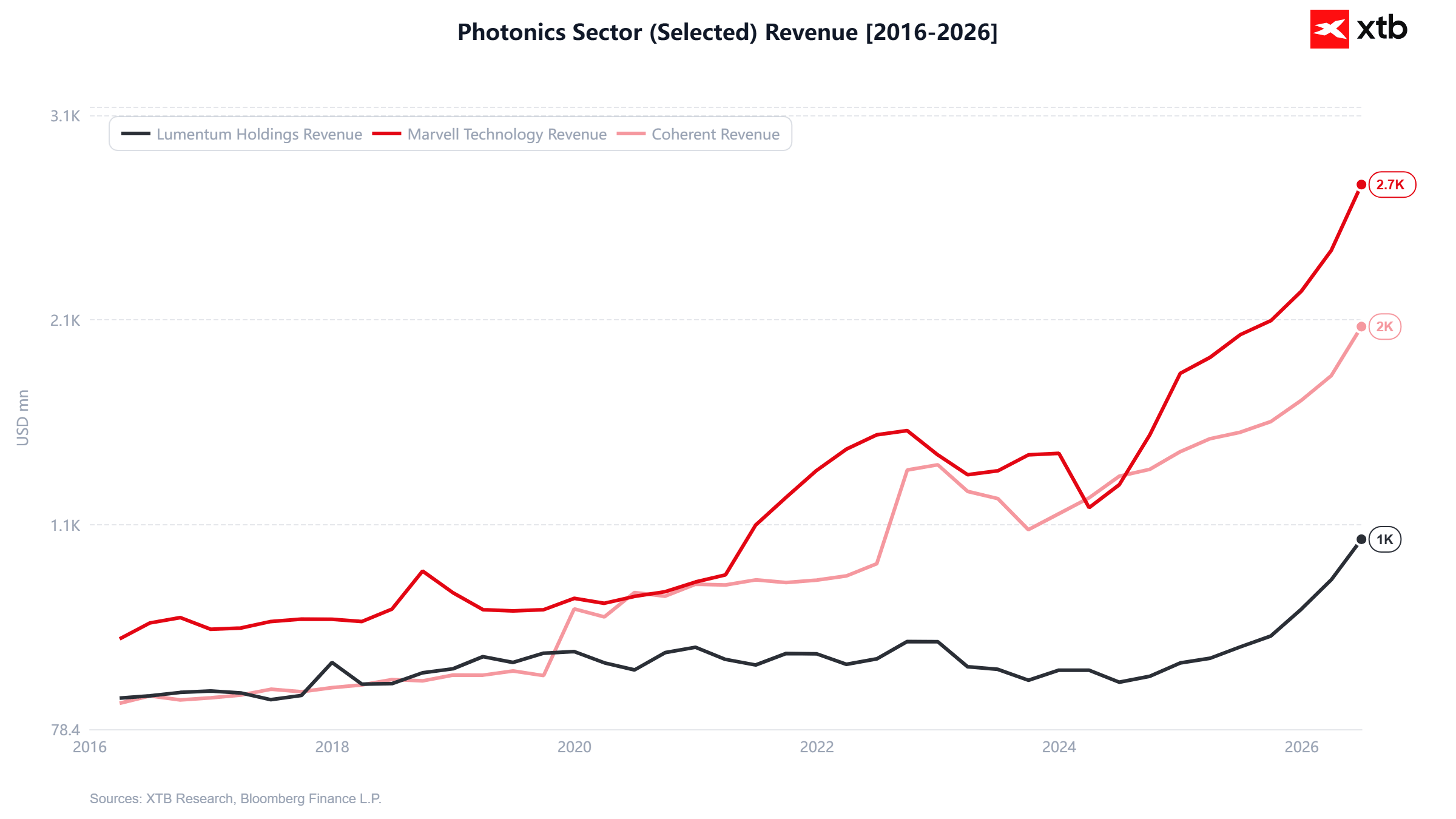
POET effectively operates in a market and an industry where the customer needs everything and needs it “yesterday”. If POET manages to diversify its customer base, win the sector’s trust, and optimize its production yield, then management’s target of around USD 300 million in revenue in 2028 would not look particularly distant. Based on a discounted cash flow model, such a scenario would justify not only today’s valuation but also a very significant increase in the share price.
What to watch
For every opportunity at POET, there is currently at least one threat. Key items to watch in the coming quarters will be:
- Sales: How the company is doing in acquiring customers, retaining and expanding existing relationships, and managing its backlog.
- Yield: Achieving the right production yield for advanced components is the company’s economic make or break. This is the company’s biggest technical challenge and must be addressed for the product to move beyond the late prototype phase.
- Financing: The company has generated losses consistently for nearly its entire existence. This is not particularly surprising for tech small caps, but for the investment thesis to play out, it is crucial to monitor the company’s capital reserves. The risk is huge but of low probability. The June balance sheet shows strong financial buffers and resources for continued development. It is management’s job to keep it that way.



US Open: Earnings season kicks off on a high note (13.10.2026)


🖥️Chart of the Day - US100: Is the KOSPI crash a foretaste of Nasdaq's troubles?



Morning Wrap: Tech Crash in Asia and Hawkish Central Banks in the Shadow of an Oil Shock (13.10.2026)


Morning Wrap: Oil cheaper despite attacks on Saudi Arabia, markets await CPI (12.10.2026)
The content of this report has been created by XTB S.A., with its registered office in Warsaw, at Prosta 67, 00-838 Warsaw, Poland, (KRS number 0000217580) and supervised by Polish Supervision Authority ( No. DDM-M-4021-57-1/2005). This material is a marketing communication within the meaning of Art. 24 (3) of Directive 2014/65/EU of the European Parliament and of the Council of 15 May 2014 on markets in financial instruments and amending Directive 2002/92/EC and Directive 2011/61/EU (MiFID II). Marketing communication is not an investment recommendation or information recommending or suggesting an investment strategy within the meaning of Regulation (EU) No 596/2014 of the European Parliament and of the Council of 16 April 2014 on market abuse (market abuse regulation) and repealing Directive 2003/6/EC of the European Parliament and of the Council and Commission Directives 2003/124/EC, 2003/125/EC and 2004/72/EC and Commission Delegated Regulation (EU) 2016/958 of 9 March 2016 supplementing Regulation (EU) No 596/2014 of the European Parliament and of the Council with regard to regulatory technical standards for the technical arrangements for objective presentation of investment recommendations or other information recommending or suggesting an investment strategy and for disclosure of particular interests or indications of conflicts of interest or any other advice, including in the area of investment advisory, within the meaning of the Trading in Financial Instruments Act of 29 July 2005 (i.e. Journal of Laws 2019, item 875, as amended). The marketing communication is prepared with the highest diligence, objectivity, presents the facts known to the author on the date of preparation and is devoid of any evaluation elements. The marketing communication is prepared without considering the client’s needs, his individual financial situation and does not present any investment strategy in any way. The marketing communication does not constitute an offer of sale, offering, subscription, invitation to purchase, advertisement or promotion of any financial instruments. XTB S.A. is not liable for any client’s actions or omissions, in particular for the acquisition or disposal of financial instruments, undertaken on the basis of the information contained in this marketing communication. In the event that the marketing communication contains any information about any results regarding the financial instruments indicated therein, these do not constitute any guarantee or forecast regarding the future results.